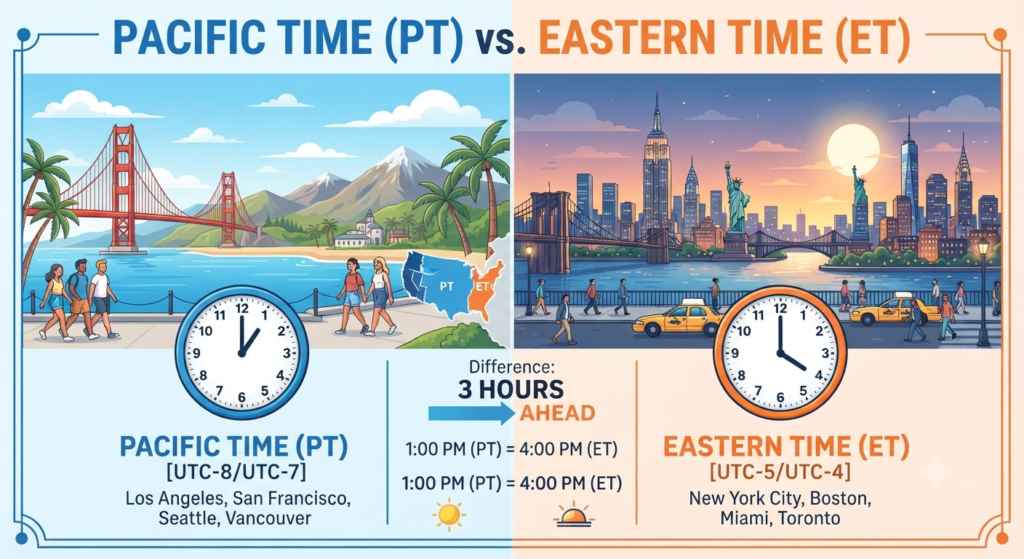
The main difference between Pacific Time vs. Eastern Time is that Pacific Time (PT) is 3 hours behind Eastern Time (ET). For example, when it is 12:00 PM (noon) in Eastern Time, it is 9:00 AM in Pacific Time. These two time zones are among the most widely used in the United States and Canada for business, travel, broadcasting, and online meetings.
Understanding Pacific Time vs. Eastern Time is essential for scheduling conference calls, virtual meetings, flights, television broadcasts, financial market activities, and remote work. Since millions of people live and work across these time zones, knowing the time difference helps prevent scheduling conflicts and improves communication.
Pacific Time vs. Eastern Time Comparison Table
The table below highlights the major differences between Pacific Time vs. Eastern Time.
| Feature | Pacific Time (PT) | Eastern Time (ET) |
|---|---|---|
| UTC Offset (Standard Time) | UTC−8 | UTC−5 |
| UTC Offset (Daylight Saving Time) | UTC−7 (PDT) | UTC−4 (EDT) |
| Time Difference | 3 hours behind ET | 3 hours ahead of PT |
| Standard Time Name | Pacific Standard Time (PST) | Eastern Standard Time (EST) |
| Daylight Saving Name | Pacific Daylight Time (PDT) | Eastern Daylight Time (EDT) |
| Major U.S. States | California, Washington, Oregon, Nevada (most), Alaska (some areas use AKT instead) | New York, Florida, Georgia, Pennsylvania, Ohio, Massachusetts |
| Major Cities | Los Angeles, San Francisco, Seattle, San Diego, Las Vegas | New York City, Washington, D.C., Boston, Miami, Atlanta |
| Population Covered | About 55 million | More than 145 million |
| Business Importance | Technology and entertainment industries | Finance, government, media, and commerce |
| Financial Markets | Opens later than ET | Home of the New York Stock Exchange and Nasdaq |
| Television Scheduling | Broadcasts often delayed by 3 hours | Primary broadcast schedule |
| International Communication | Better overlap with Asia-Pacific | Better overlap with Europe |
What Is Pacific Time?
Pacific Time (PT) is the time zone used along the western coast of the United States and Canada. During the winter months, it follows Pacific Standard Time (PST), which is UTC−8. During Daylight Saving Time, it changes to Pacific Daylight Time (PDT), which is UTC−7.
Pacific Time is widely used in technology, entertainment, gaming, software development, and international trade with Asia. Many globally recognized companies headquartered on the West Coast, especially in California and Washington, operate using Pacific Time.
Characteristics of Pacific Time
- Uses PST during winter
- Uses PDT during Daylight Saving Time
- UTC−8 in standard time
- UTC−7 in daylight saving time
- Three hours behind Eastern Time
- Covers the U.S. West Coast
- Used by major technology companies
- Common in the entertainment industry
- Better overlap with Asian business hours
- Observes Daylight Saving Time in most regions
What Is Eastern Time?
Eastern Time (ET) is the time zone observed across much of the eastern United States, eastern Canada, and parts of the Caribbean. During the winter, it follows Eastern Standard Time (EST), which is UTC−5. During Daylight Saving Time, it becomes Eastern Daylight Time (EDT), which is UTC−4.
Eastern Time is the most influential U.S. time zone because it includes the country’s largest financial centers, federal government offices, major television networks, and many corporate headquarters.
Characteristics of Eastern Time
- Uses EST during winter
- Uses EDT during Daylight Saving Time
- UTC−5 in standard time
- UTC−4 during daylight saving time
- Three hours ahead of Pacific Time
- Covers the U.S. East Coast
- Includes major financial markets
- Used by federal government agencies
- Home to major television networks
- Observes Daylight Saving Time in most regions
Pacific Time vs. Eastern Time: Key Differences
1. UTC Offset
The primary difference between Pacific Time vs. Eastern Time is their offset from Coordinated Universal Time (UTC).
Pacific Time (PT)
- UTC−8 during Pacific Standard Time (PST)
- UTC−7 during Pacific Daylight Time (PDT)
Eastern Time (ET)
- UTC−5 during Eastern Standard Time (EST)
- UTC−4 during Eastern Daylight Time (EDT)
Eastern Time is always 3 hours ahead of Pacific Time.
2. Time Difference
The most noticeable distinction is the time gap between the two zones.
Pacific Time
- Three hours behind Eastern Time
- Morning begins later compared to ET
Eastern Time
- Three hours ahead of Pacific Time
- Business activities start earlier
Example:
| Eastern Time (ET) | Pacific Time (PT) |
|---|---|
| 6:00 AM | 3:00 AM |
| 9:00 AM | 6:00 AM |
| 12:00 PM | 9:00 AM |
| 3:00 PM | 12:00 PM |
| 6:00 PM | 3:00 PM |
| 9:00 PM | 6:00 PM |
3. Geographic Coverage
Another major difference between Pacific Time vs. Eastern Time is the regions they cover.
Pacific Time is used in:
- California
- Washington
- Oregon (most areas)
- Nevada (most areas)
- Parts of British Columbia (Canada)
Eastern Time is used in:
- New York
- Florida (most areas)
- Georgia
- Pennsylvania
- Ohio
- Virginia
- Massachusetts
- Ontario and Quebec (Canada)
Eastern Time covers a much larger population than Pacific Time.
4. Major Cities
Each time zone includes several globally important cities.
Pacific Time
- Los Angeles
- San Francisco
- Seattle
- San Diego
- Las Vegas
Eastern Time
- New York City
- Washington, D.C.
- Boston
- Philadelphia
- Miami
- Atlanta
These cities play major roles in finance, technology, entertainment, and government.
5. Business Importance
Both time zones are economically significant but dominate different industries.
Pacific Time
- Technology
- Software development
- Entertainment
- Film production
- Gaming
- Aerospace
Eastern Time
- Banking
- Stock markets
- Government
- Healthcare
- National media
- Corporate headquarters
Eastern Time is generally considered the primary U.S. business time zone because many national companies operate according to ET.
6. Financial Markets
Financial activity differs considerably between the two time zones.
Pacific Time
- Financial markets open three hours earlier locally.
- Stock traders often begin work before sunrise.
Eastern Time
- Home to the New York Stock Exchange (NYSE).
- Home to the Nasdaq Stock Market.
- Standard time zone for U.S. financial trading.
Most financial news and market schedules are announced using Eastern Time.
7. Television and Media Scheduling
Television programming is handled differently across these time zones.
Pacific Time
- Many national broadcasts are delayed by approximately three hours.
- Prime-time programming typically airs at local evening hours.
Eastern Time
- Most national television broadcasts follow the Eastern schedule.
- Live sporting events are generally scheduled based on ET.
Many broadcasters advertise programs using both ET and PT.
8. International Communication
The two time zones overlap differently with other regions of the world.
Pacific Time
- Better overlap with:
- Australia
- New Zealand
- Japan
- South Korea
- Singapore
Eastern Time
- Better overlap with:
- United Kingdom
- Germany
- France
- Spain
- Italy
- Brazil
This difference influences international business meetings and customer support schedules.
9. Daylight Saving Time
Both Pacific Time and Eastern Time observe Daylight Saving Time (DST) in most regions.
During DST:
Pacific Time
- Changes from PST (UTC−8) to PDT (UTC−7)
Eastern Time
- Changes from EST (UTC−5) to EDT (UTC−4)
Although the UTC offsets change, the 3-hour difference remains the same between Pacific Time and Eastern Time.
10. Population Served
The number of people using each time zone differs significantly.
Pacific Time
- Covers approximately 55 million people in the United States and Canada.
Eastern Time
- Covers more than 145 million people, making it the most populated U.S. time zone.
This larger population contributes to Eastern Time’s greater influence on business and media.
11. Typical Working Hours
Working schedules are similar locally but occur three hours apart.
Pacific Time
- Standard workday: 9:00 AM–5:00 PM PT
Eastern Time
- Standard workday: 9:00 AM–5:00 PM ET
A meeting scheduled for 2:00 PM ET takes place at 11:00 AM PT, making time conversion essential for remote teams.
12. Best Uses
Each time zone offers advantages depending on the activity.
Pacific Time is ideal for:
- Technology companies
- Entertainment industry
- Gaming businesses
- Asia-Pacific communication
- West Coast operations
Eastern Time is ideal for:
- Financial markets
- Government agencies
- National television broadcasts
- Corporate headquarters
- Business with Europe
Choosing the appropriate time zone depends on geographic location, business operations, and international communication needs.
Similarities Between Pacific Time and Eastern Time
Although Pacific Time vs. Eastern Time differ by three hours, they share many common characteristics. Both are official time zones in North America and are widely used for business, travel, communication, and daily life.
Some major similarities include:
- Both are official North American time zones.
- Both are used in the United States and Canada.
- Both observe Daylight Saving Time in most regions.
- Both switch between Standard Time and Daylight Saving Time.
- Both are based on Coordinated Universal Time (UTC).
- Both are recognized internationally for scheduling.
- Both are commonly used in business and commerce.
- Both are important for transportation schedules.
- Both are used for television and online broadcasts.
- Both support global communication and remote work.
Advantages of Pacific Time
Pacific Time offers several benefits, particularly for technology companies and businesses operating with Asia-Pacific countries.
Major advantages include:
- Better overlap with Asian markets.
- Home to Silicon Valley and major tech companies.
- Strong entertainment industry presence.
- Convenient for West Coast businesses.
- Later business hours for East Coast collaboration.
- Ideal for software and gaming industries.
- Supports international trade across the Pacific.
- Popular among remote workers on the West Coast.
- Includes major ports for global shipping.
- Widely used by leading technology firms.
Advantages of Eastern Time
Eastern Time is the most influential time zone in the United States because it serves the country’s financial and governmental centers.
Major advantages include:
- Home to major financial markets.
- Includes New York City and Washington, D.C.
- Better overlap with European business hours.
- Preferred time zone for national television broadcasts.
- Covers the largest U.S. population.
- Supports major banking institutions.
- Ideal for government operations.
- Hosts many corporate headquarters.
- Standard reference for U.S. business schedules.
- Widely used for national and international events.
Which Time Zone Is Better—Pacific Time or Eastern Time?
Neither Pacific Time nor Eastern Time is universally better because each serves different geographic regions and industries.
Pacific Time is ideal for technology companies, entertainment businesses, software development, gaming, and organizations that frequently communicate with Asia-Pacific countries. Its schedule aligns well with businesses on the U.S. West Coast and across the Pacific.
Eastern Time is preferred for finance, government, national media, healthcare, and international business with Europe. Since many U.S. companies, federal agencies, and financial markets operate on Eastern Time, it is often considered the country’s primary business time zone.
In summary:
- Choose Pacific Time for technology, entertainment, and Asia-Pacific collaboration.
- Choose Eastern Time for finance, government, national broadcasting, and European business communication.
The better choice depends entirely on your location, industry, and communication needs.
Conclusion
The comparison of Pacific Time vs. Eastern Time shows that the two time zones differ mainly in their UTC offset, geographic coverage, and business focus. Pacific Time is three hours behind Eastern Time and is widely used along the U.S. West Coast, while Eastern Time serves much of the eastern United States and Canada, including major financial and government centers.
Understanding Pacific Time vs. Eastern Time is essential for scheduling meetings, coordinating travel, conducting business, and communicating across regions. Knowing the three-hour difference helps individuals and organizations avoid scheduling errors and improve productivity in today’s globally connected world.
Frequently Asked Questions (FAQs)
The main difference between Pacific Time vs. Eastern Time is that Pacific Time is three hours behind Eastern Time.
Pacific Time is always 3 hours behind Eastern Time.
Example:
9:00 AM PT = 12:00 PM ET
5:00 PM PT = 8:00 PM ET
Pacific Time is used in most or all of:
California
Washington
Oregon (most areas)
Nevada (most areas)
It is also observed in parts of western Canada.
Eastern Time is observed in many eastern U.S. states, including:
New York
Florida (most areas)
Georgia
Pennsylvania
Ohio
Virginia
Massachusetts
It is also used in parts of eastern Canada.
Yes. Most regions in both time zones observe Daylight Saving Time (DST), changing from:
PST to PDT in the Pacific Time Zone
EST to EDT in the Eastern Time Zone
Read Next: