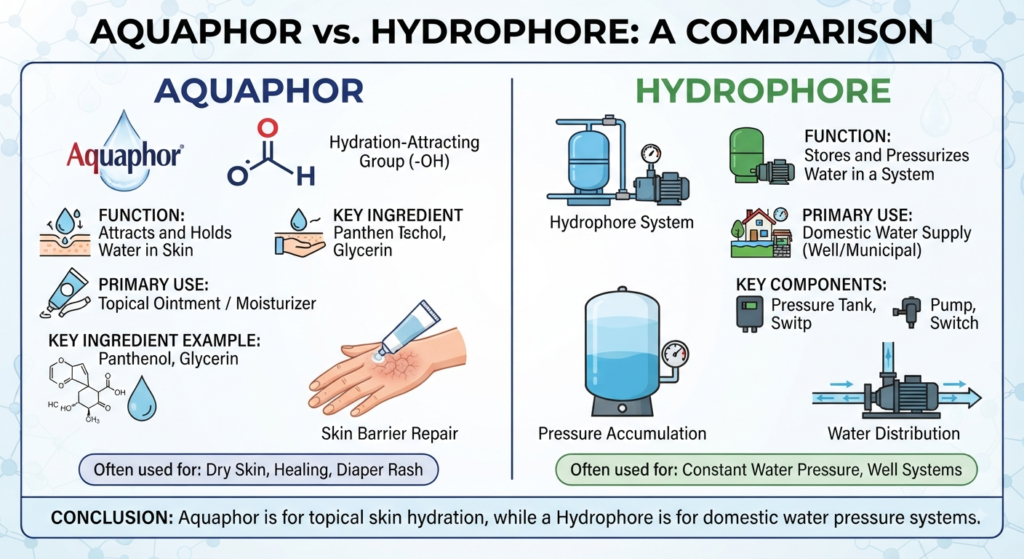
The main difference between Aquaphor vs. Hydrophore is that Aquaphor is a petroleum-based skin-care ointment used to moisturize and protect dry or irritated skin, whereas a hydrophore is a hydro-pneumatic water-pressure system used to maintain relatively constant pressure in a water-supply network. Although their names sound similar, they are completely different in purpose, composition, application, and field of use.
Understanding Aquaphor vs. Hydrophore is important because the two terms belong to entirely different fields. Aquaphor is associated with skin care and topical protection, while a hydrophore is associated with plumbing, water distribution, pumps, and pressure regulation. Knowing this distinction prevents confusion when interpreting technical, commercial, or everyday terminology.
Aquaphor vs. Hydrophore Comparison Table
The table below highlights the major differences between Aquaphor vs. Hydrophore.
| Feature | Aquaphor | Hydrophore |
|---|---|---|
| Definition | A topical skin-protective ointment | A hydro-pneumatic water-pressure system |
| Field | Skin care and personal care | Plumbing and water supply |
| Primary Purpose | Protects skin and reduces moisture loss | Maintains water pressure in a distribution system |
| Form | Semi-solid ointment | Mechanical system containing a pressure vessel and associated equipment |
| Main Components | Petrolatum-based formulation with other skin-conditioning ingredients | Pressure tank, water, compressed air or gas space, pump, and controls |
| Application | Applied directly to the skin | Installed in a water-supply system |
| Function | Forms an occlusive barrier over the skin | Stores pressurized water and helps regulate pressure |
| Typical Location | Home, medical, and personal-care settings | Buildings, wells, pumping systems, and water networks |
| Maintenance | Replace or reapply as required | Requires inspection and maintenance of pumps, tank, valves, and controls |
| Related Field | Dermatology and skin care | Hydraulic engineering and plumbing |
What Is Aquaphor?
Aquaphor is a petroleum-based skin-protective ointment designed to help protect dry, chapped, or irritated skin. Its occlusive properties help reduce moisture loss by forming a protective layer over the skin.
Aquaphor is commonly used on areas that become particularly dry, such as the lips, hands, elbows, knees, and heels. It can also be used as a protective barrier for minor skin irritation and other situations where maintaining skin moisture is desirable.
The term Aquaphor is also a brand name, so formulations can vary depending on the specific product. However, the classic healing ointment is primarily known for its petrolatum-based protective action.
Characteristics of Aquaphor
- Used as a topical skin-protective product.
- Primarily associated with moisturizing and barrier protection.
- Contains petrolatum in its classic ointment formulation.
- Has a thick, semi-solid consistency.
- Helps reduce moisture loss from the skin.
- Useful for dry and chapped areas.
- Can be applied directly to the skin.
- Commonly used on lips, hands, feet, and other dry areas.
- Generally forms an occlusive layer over the skin.
- Belongs to the personal-care and skin-care category.
Common Uses of Aquaphor
- Protecting dry skin
- Moisturizing chapped areas
- Protecting lips
- Reducing moisture loss
- Softening rough skin
- Protecting irritated skin
- Supporting the skin barrier
- Protecting areas exposed to dryness or friction
What Is a Hydrophore?
A hydrophore is a hydro-pneumatic water-pressure system used to supply water at a relatively consistent pressure. It is commonly used in buildings, water-supply installations, well systems, and other applications where a pump alone may not provide stable pressure.
A typical hydrophore system includes a pressure vessel, water, a compressed-air or gas space, a pump, pressure controls, valves, and associated piping. The pressure vessel stores water under pressure and helps reduce the frequency with which the pump needs to start and stop.
When water is consumed, the pressure in the system falls. Depending on the system design and pressure settings, the pump starts and restores the pressure. The hydrophore therefore helps provide a more stable and reliable water supply.
Characteristics of a Hydrophore
- Used in water-supply systems.
- Maintains relatively stable water pressure.
- Uses a pressure vessel to store pressurized water.
- Works together with a pump.
- Contains pressure-control equipment.
- Can reduce frequent pump cycling.
- Used in buildings and water distribution systems.
- Suitable for applications requiring pressurized water.
- Requires mechanical and hydraulic installation.
- Needs periodic inspection and maintenance.
Common Applications of Hydrophore Systems
- Residential buildings
- Apartment complexes
- Commercial buildings
- Industrial facilities
- Hotels
- Hospitals
- Water-supply installations
- Well-water systems
- Irrigation systems
- High-rise buildings
Aquaphor vs. Hydrophore: Key Differences
1. Meaning and Definition
The most fundamental difference between Aquaphor vs. Hydrophore is their meaning.
Aquaphor refers to a skin-care product, particularly a protective ointment designed to help maintain skin moisture and protect dry or irritated skin.
A hydrophore, in contrast, refers to a water-pressure system that uses a pressure vessel and pumping equipment to provide pressurized water.
Therefore, Aquaphor belongs to skin care, while a hydrophore belongs to water engineering and plumbing.
2. Purpose
The purposes of the two are completely different.
Aquaphor is intended to protect the skin and reduce moisture loss. Its occlusive nature helps keep moisture within the outer layers of the skin.
A hydrophore is designed to maintain an adequate and relatively stable water pressure in a water-supply system. It helps ensure that water can reach outlets at the required pressure.
Thus, Aquaphor protects skin, whereas a hydrophore manages water pressure.
3. Composition and Components
Another major difference between Aquaphor vs. Hydrophore is their physical composition.
Aquaphor is a formulated topical ointment containing petrolatum and, depending on the product, additional ingredients intended to condition or protect the skin.
A hydrophore is not a chemical formulation. It is a mechanical and hydraulic system consisting of components such as a pressure vessel, pump, pressure switch or controller, valves, piping, and pressure connections.
Consequently, Aquaphor is a material applied to a surface, while a hydrophore is an engineered system.
4. Physical Form
Aquaphor and hydrophore also differ significantly in physical form.
Aquaphor is generally a thick, semi-solid ointment that can be spread over the skin.
A hydrophore is a physical installation made up of mechanical equipment and a pressure vessel. The system contains water under pressure and may contain a compressed-air or gas cushion depending on its design.
This makes their physical characteristics fundamentally different.
5. Method of Use
Aquaphor is used by applying the ointment directly to the skin. The product is spread over the desired area to form a protective layer.
A hydrophore is used by connecting it to a water-supply or pumping system. Water enters the pressure vessel and is delivered through connected piping when demand occurs.
Therefore, Aquaphor is manually applied, whereas a hydrophore operates as part of an engineered water system.
6. Function
The functions of Aquaphor and a hydrophore are entirely different.
Aquaphor primarily functions as an occlusive skin protectant. By forming a barrier over the skin, it helps reduce water loss and protects the surface from excessive dryness.
A hydrophore functions as a pressure-management and water-storage component. Its pressure vessel stores water under pressure and can help reduce pump cycling while maintaining water availability between pump operations.
Thus, one performs a skin-barrier function, while the other performs a hydraulic function.
7. Installation
Aquaphor does not require installation. It is simply opened and applied to the skin according to the product’s intended use.
A hydrophore requires proper installation as part of a water-supply system. The pressure vessel, pump, piping, valves, and control equipment must be correctly connected and adjusted.
Improper installation of a hydrophore can result in inadequate water pressure, excessive pump cycling, leakage, or other system problems.
8. Maintenance
The maintenance requirements of Aquaphor vs. Hydrophore are also very different.
Aquaphor generally requires no mechanical maintenance. Once the product is used, it may simply need to be reapplied when necessary and stored according to its product instructions.
A hydrophore requires periodic inspection and maintenance. Depending on the system, this can include checking pressure settings, the pressure vessel, pump, valves, connections, and associated controls.
Therefore, Aquaphor requires product-use management, while a hydrophore requires mechanical and hydraulic maintenance.
9. Applications
Aquaphor is primarily used in skin-care and personal-care applications. It is commonly associated with dry skin, chapped lips, rough areas, and skin-barrier protection.
Hydrophores are used in water-supply and pressure-boosting applications. They are especially useful where a building or facility needs reliable water pressure.
Their applications therefore belong to completely different industries.
10. Importance of Correct Terminology
The similarity between the words Aquaphor and Hydrophore can create confusion, particularly because both names contain terms associated with water or moisture.
However, their meanings should not be confused.
Aquaphor is a commercial skin-care product, whereas hydrophore is a technical term used for a hydro-pneumatic water-pressure arrangement.
Recognizing the context in which the word is used is therefore essential.
Similarities Between Aquaphor and Hydrophore
Although Aquaphor and hydrophore are completely different in function, they share a few general characteristics.
Some similarities between Aquaphor and hydrophore include:
- Both are associated with the management or protection of moisture or water in different contexts.
- Both are designed for a specific practical purpose.
- Both can be used in everyday applications.
- Both are available in systems or products designed to improve a particular function.
- Both require appropriate use for their intended purpose.
- Both can be found in residential settings.
- Both have specialized terminology associated with them.
- Both should be used according to the manufacturer’s or system requirements.
- Both can provide useful benefits when used correctly.
- Neither should be confused with the other despite their similar-sounding names.
Benefits of Aquaphor
Aquaphor provides several useful properties for skin protection and moisture management. Its occlusive nature makes it particularly useful when the objective is to reduce water loss from the skin.
Some major benefits of Aquaphor include:
- Helps reduce moisture loss.
- Forms a protective layer over the skin.
- Useful for dry and chapped skin.
- Helps protect rough skin.
- Can be used on several external skin areas.
- Useful for lip protection.
- Helps maintain the skin barrier.
- Has a thick protective texture.
- Convenient for targeted application.
- Useful as part of a skin-care routine.
Benefits of a Hydrophore System
A hydrophore system provides several benefits in water-supply installations. By combining a pressure vessel with pumping and control equipment, it can improve the reliability and efficiency of pressurized water delivery.
Some major benefits of a hydrophore system include:
- Helps maintain relatively consistent water pressure.
- Provides pressurized water storage.
- Can reduce frequent pump starting and stopping.
- Helps improve water-supply reliability.
- Useful in buildings with varying water demand.
- Can support water distribution to higher levels.
- Useful in well-water systems.
- Can improve the performance of pressure-dependent outlets.
- Suitable for residential and industrial applications.
- Can reduce unnecessary pump cycling when properly sized and controlled.
Which Is Better—Aquaphor or Hydrophore?
Neither Aquaphor nor a hydrophore is universally better because they are not alternative products serving the same purpose. The appropriate choice depends entirely on what you are trying to accomplish.
Aquaphor is the appropriate choice when the requirement involves skin protection, reducing moisture loss, or caring for dry and chapped skin.
A hydrophore is appropriate when the requirement involves maintaining water pressure, storing pressurized water, or improving water distribution in a building or facility.
In summary:
- Choose Aquaphor when you need a topical skin-protective ointment.
- Choose a hydrophore when you need a water-pressure and storage system.
- Do not treat them as competing alternatives because they belong to completely different fields.
The correct choice therefore depends on the application rather than on which product is inherently superior.
Conclusion
The comparison of Aquaphor vs. Hydrophore reveals that these two terms describe completely different things. Aquaphor is a petroleum-based topical ointment used primarily to protect the skin and reduce moisture loss, while a hydrophore is a hydro-pneumatic system used to store pressurized water and maintain relatively stable pressure in water-supply installations.
The two differ in meaning, purpose, composition, physical form, function, installation, maintenance, and applications. Aquaphor is associated with skin care and personal care, whereas hydrophore systems are associated with plumbing, pumping, and hydraulic engineering.
Understanding Aquaphor vs. Hydrophore is therefore useful for avoiding terminology confusion. Although their names sound somewhat similar, they have entirely different functions and should be selected according to the specific application.
Frequently Asked Questions (FAQs)
The primary difference between Aquaphor vs. Hydrophore is their purpose. Aquaphor is a topical skin-protective ointment, while a hydrophore is a hydro-pneumatic system used to maintain water pressure.
No. Aquaphor is a skin-care product. It is applied externally to the skin and is not related to plumbing or water-pressure systems.
A hydrophore is used to provide and maintain pressurized water in a water-supply system. It commonly consists of a pressure vessel, pump, controls, valves, and associated piping.
A hydrophore system commonly includes a pressure tank or pressure vessel, but the complete system can also include a pump, controls, valves, and piping. Therefore, the terms should not always be treated as exactly synonymous.
No. Despite their similar-sounding names, Aquaphor and hydrophore are not related products or technologies. Aquaphor belongs to skin care, while a hydrophore belongs to water-supply and hydraulic systems.
Reference:
1. “Hydrophor Topical: Uses, Side Effects, Interactions, Pictures, Warnings & Dosing.” Webmd.Com.
Read Next:
- Paralysis vs. Paresthesia: Differences, Symptoms, Causes, and Treatment
- Difference Between Junctional and Idioventricular Rhythm
- Difference Between Cyst and Oocyst
- Difference Between Pyelonephritis and Glomerulonephritis
- Difference Between Chemotaxis and Diapedesis
- Difference Between Apheresis and Dialysis
- Difference Between Etiology and Pathophysiology
- Terramycin vs. Tobramycin