The main difference between Discipline vs. Profession is that a discipline is a field of knowledge, study, or specialized learning, whereas a profession is an occupation that involves applying specialized knowledge and skills to perform work or provide services. A discipline establishes the academic or intellectual foundation of a field, while a profession focuses on the practical application of that knowledge in a career or occupational setting.
Understanding Discipline vs. Profession is important in education, career planning, professional development, and academic studies because the two terms are related but do not have the same meaning. A discipline can provide the knowledge and principles needed for a profession, while a profession applies that knowledge through practical work, professional standards, training, and responsibility.
Discipline vs. Profession Comparison Table
The table below highlights the major differences between Discipline vs. Profession.
| Feature | Discipline | Profession |
|---|---|---|
| Definition | A field or branch of knowledge or study | An occupation requiring specialized knowledge and skills |
| Main Focus | Learning, research, knowledge, and theory | Practical application of knowledge and professional services |
| Purpose | Develop and organize knowledge | Apply expertise to perform specialized work |
| Education | May be studied academically or independently | Usually requires specific education and training |
| Practical Application | May involve research and theoretical study | Directly involves professional practice |
| Certification | May or may not require certification | Often requires qualifications, certification, or licensing |
| Code of Ethics | May have academic or disciplinary standards | Commonly has professional ethical standards |
| Regulation | May be unregulated | May be regulated by professional or government bodies |
| Career Connection | Can form the foundation for multiple careers | Usually represents a specific career or occupational path |
| Examples | Physics, chemistry, history, mathematics | Medicine, law, engineering, teaching |
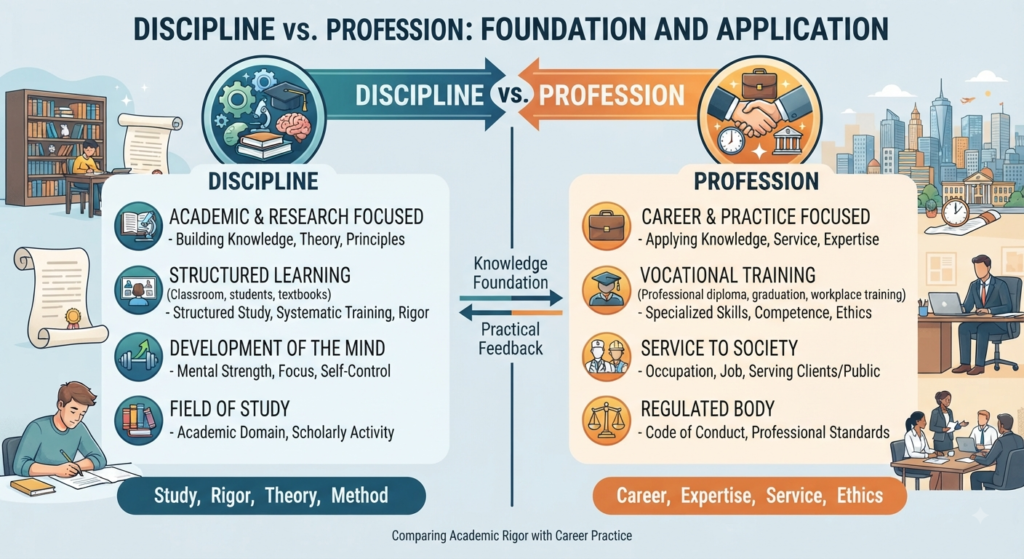
What Is a Discipline?
A discipline is a structured field of knowledge or study that focuses on a particular subject, area of inquiry, or body of principles. It usually has its own concepts, theories, methods, research practices, and terminology.
For example, physics is a discipline concerned with matter, energy, motion, forces, and their interactions. Similarly, chemistry is a discipline concerned with substances, their properties, structures, and reactions.
A discipline does not necessarily represent a specific occupation. Instead, it provides knowledge that can be used in research, education, industry, public service, or different professions.
Characteristics of a Discipline
Some important characteristics of a discipline include:
- Represents a specific field of knowledge.
- Has defined concepts and principles.
- May involve systematic study and research.
- Develops theories and methods.
- Can be studied in academic institutions.
- May contain several specialized subfields.
- Encourages knowledge development and discovery.
- Provides a foundation for further education.
- Can support multiple career paths.
- May overlap with other disciplines.
Examples of Disciplines
Examples of academic or knowledge-based disciplines include:
- Physics
- Chemistry
- Biology
- Mathematics
- History
- Economics
- Sociology
- Psychology
- Computer science
- Political science
These disciplines can provide the theoretical and technical foundation for different occupations and professional careers.
What Is a Profession?
A profession is an occupation or career that requires specialized knowledge, education, training, skills, and professional competence. Professionals use their expertise to perform specialized tasks or provide services to individuals, organizations, or society.
For example, medicine is a profession in which trained professionals use medical knowledge and clinical skills to diagnose, treat, and manage health conditions. Engineering is another profession in which specialized technical knowledge is applied to design, develop, operate, and maintain systems and structures.
Many professions also involve ethical responsibilities, professional standards, continuing education, and accountability.
Characteristics of a Profession
Important characteristics of a profession include:
- Requires specialized knowledge and skills.
- Usually involves formal education or training.
- Has practical applications.
- May require certification or licensing.
- Often follows professional standards.
- Commonly has a code of ethics.
- Requires professional competence.
- May involve continuing education.
- Provides specialized services or expertise.
- Can offer a defined career path.
Examples of Professions
Examples of professions include:
- Engineer
- Doctor
- Lawyer
- Accountant
- Teacher
- Architect
- Pharmacist
- Nurse
- Chartered accountant
- Surveyor
The requirements for entering and practicing these professions vary according to the field and jurisdiction.
Discipline vs. Profession: Key Differences
1. Meaning
The primary difference between Discipline vs. Profession is their meaning.
A discipline refers to a field of knowledge or study. It provides concepts, theories, principles, and methods for understanding a particular subject.
A profession refers to an occupation in which specialized knowledge and skills are applied in practical work.
Therefore, discipline is primarily knowledge-oriented, while profession is primarily occupation-oriented.
2. Main Purpose
The purpose of a discipline is generally to develop, organize, study, and expand knowledge.
For example, physics seeks to understand physical phenomena and develop explanations based on scientific principles.
A profession, in contrast, focuses on applying specialized knowledge to practical situations.
An engineer, for example, applies knowledge of mathematics, physics, materials, and engineering principles to solve practical problems.
3. Theory and Practice
Another important difference between Discipline vs. Profession is the relationship between theory and practice.
A discipline may emphasize theoretical understanding, research, analysis, and knowledge development.
A profession generally emphasizes applying knowledge and skills to real-world situations.
However, the distinction is not absolute. Many disciplines contain extensive practical work, while modern professions depend heavily on theoretical knowledge.
4. Education and Training
A discipline can be studied as part of academic education without necessarily preparing someone for one particular occupation.
A profession usually requires specialized education and practical training related to the occupational role.
For example, a student can study mathematics as a discipline and later work in education, research, finance, data analysis, computing, or other fields.
Professional training, however, is generally more closely connected to the requirements of a particular occupation.
5. Certification and Licensing
Disciplines do not always require professional certification or a license simply to be studied.
Professions may require formal qualifications, certification, registration, or licensing, particularly when professional practice affects public safety, health, finances, or legal rights.
For example, some engineering, medical, legal, and accounting roles have specific professional requirements depending on the country and type of practice.
6. Code of Ethics
A discipline may have academic standards, research principles, or scholarly conventions.
A profession often has a formal code of ethics governing professional conduct.
Professional ethics can address issues such as responsibility, confidentiality, competence, conflicts of interest, integrity, and protection of clients or the public.
Therefore, ethical accountability is often a particularly important feature of professional practice.
7. Career Orientation
A discipline does not necessarily correspond to one specific career.
For example, economics can lead to careers in research, teaching, banking, finance, consulting, government, and business.
A profession, however, is directly associated with an occupational role, such as medicine, law, engineering, architecture, or accounting.
Thus, one discipline can support several different professions and careers.
8. Regulation
Many disciplines are not directly regulated as occupations.
Professions may be subject to professional regulations, institutional requirements, licensing rules, or government oversight.
The level of regulation varies significantly between professions and countries.
Regulation is particularly common where professional errors could create significant risks to individuals or society.
9. Scope
A discipline may have a broad intellectual scope and can contain numerous specialized branches.
For example, biology includes areas such as microbiology, zoology, botany, genetics, and ecology.
A profession usually has a defined occupational scope, although professionals may specialize within that profession.
For example, engineering includes several professional areas such as electrical, mechanical, civil, chemical, and instrumentation engineering.
10. Relationship to Society
Disciplines contribute to society primarily through knowledge creation, research, education, and intellectual development.
Professions contribute through the practical application of knowledge and the delivery of specialized services.
For example, scientific disciplines contribute to the development of new knowledge, while professionals use scientific and technical knowledge to design products, provide services, solve problems, and support society.
Relationship Between Discipline and Profession
The relationship between a discipline and a profession can be understood as a connection between knowledge and application.
A discipline provides the theories, principles, concepts, and methods that can form the foundation for professional practice.
A profession then applies relevant knowledge to real-world situations.
For example:
Engineering discipline → Engineering knowledge → Professional training → Engineering practice
Similarly:
Medicine as a field of knowledge → Medical education → Clinical training → Medical profession
However, not every discipline leads directly to one profession, and not every profession is based on a single discipline. Many modern professions draw knowledge from multiple disciplines.
For example, environmental professionals may use knowledge from biology, chemistry, geology, economics, law, and engineering.
Similarities Between Discipline and Profession
Although Discipline vs. Profession describes two different concepts, they have several important similarities.
Some major similarities include:
- Both involve specialized knowledge.
- Both require learning and development.
- Both can involve formal education.
- Both may have specialized terminology.
- Both can contain areas of specialization.
- Both contribute to individual development.
- Both contribute to societal development.
- Both can involve research and innovation.
- Both require competence in their respective areas.
- A discipline can provide the foundation for a profession.
The strongest connection is that professional practice often depends on knowledge developed within one or more disciplines.
Discipline vs. Profession in Education and Career Planning
Understanding the distinction between a discipline and a profession can be especially useful for students choosing an academic or career path.
A student may first select a discipline based on academic interest and then determine which professions or careers can be pursued using that knowledge.
For example:
Physics can lead to careers in teaching, research, engineering-related fields, data analysis, and technology.
Computer science can lead to careers in software development, cybersecurity, data science, artificial intelligence, systems administration, and research.
This demonstrates that studying a discipline does not necessarily limit a person to one profession.
Which Is More Important—Discipline or Profession?
Neither discipline nor profession is universally more important because they serve different purposes.
A discipline provides the knowledge and intellectual foundation needed to understand a subject. A profession applies relevant knowledge and skills to practical work and often involves professional responsibility and ethical standards.
In summary:
- Choose a discipline when referring to a field of knowledge, academic study, or research.
- Choose a profession when referring to a specialized occupation or career.
- A discipline can provide the knowledge foundation for a profession.
- A profession provides the practical application of specialized knowledge.
Therefore, discipline and profession should generally be viewed as complementary rather than competing concepts.
Conclusion
The comparison of Discipline vs. Profession shows that the two terms are closely related but have different meanings. A discipline is primarily a structured field of knowledge, study, or research, whereas a profession is an occupation that applies specialized knowledge and skills in practical situations.
Disciplines provide theories, principles, methods, and knowledge that can support professional practice. Professions, in turn, apply this knowledge through specialized work, training, ethical standards, and professional responsibilities.
Understanding Discipline vs. Profession is useful in education and career planning because one discipline can support several different professions, while a profession may draw knowledge from multiple disciplines. Recognizing this relationship makes it easier to distinguish academic fields from occupational roles and to understand how knowledge is transformed into professional practice.
Frequently Asked Questions (FAQs)
The primary difference between Discipline vs. Profession is that a discipline is a field of knowledge or study, whereas a profession is a specialized occupation that applies knowledge and skills in practical work.
No. A discipline and a profession are not the same. A discipline represents a field of knowledge, while a profession represents an occupation requiring specialized expertise and practical application.
Yes. A single discipline can provide the foundation for several different careers. For example, mathematics can support careers in teaching, research, finance, data analysis, and computing.
Not necessarily. Many professions use knowledge from multiple disciplines. For example, environmental professionals may combine knowledge from biology, chemistry, engineering, economics, and law.
Understanding Discipline vs. Profession helps students and professionals distinguish between a field of academic knowledge and an occupational career. It can also make education and career planning easier by showing how academic disciplines can provide foundations for different professions.
Reference:
1. “Academic Discipline.” Wikipedia, Wikimedia Foundation.
2. “Profession” Wikipedia, Wikimedia Foundation.
3. “Outline of Academic Disciplines” Wikipedia, Wikimedia Foundation.
4. “What is a Profession.” New Mexico State University.
Read Next: