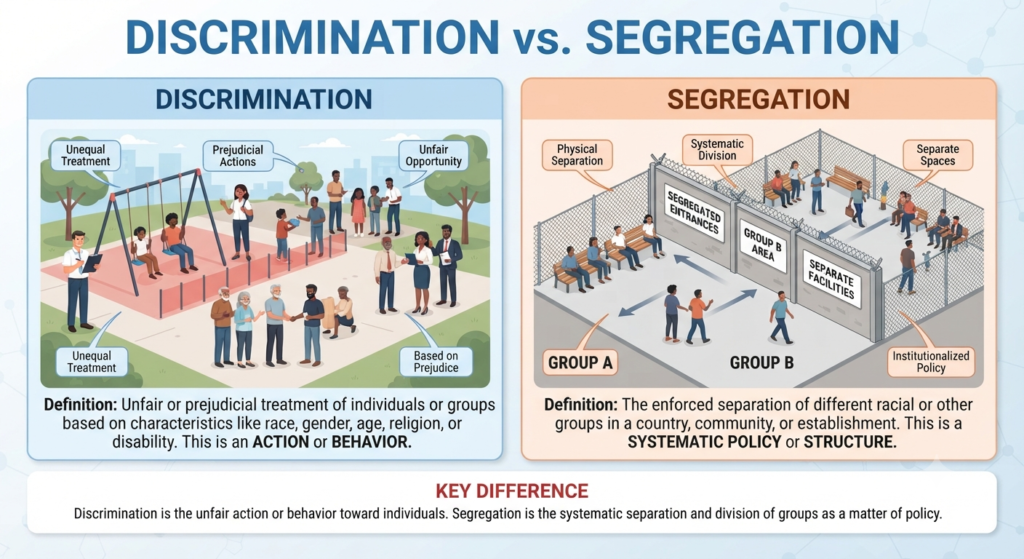
The main difference between Discrimination vs. Segregation is that discrimination refers to the unfair or unequal treatment of individuals or groups based on characteristics such as race, gender, religion, ethnicity, age, or disability, whereas segregation refers to the physical or institutional separation of people into different groups based on those characteristics. In simple terms, discrimination is about unequal treatment, while segregation is about forced or systematic separation.
Although discrimination and segregation are closely related and often occur together, they are not the same. Discrimination can exist without physical separation, such as denying someone a job because of their religion or gender. Segregation, on the other hand, separates people in schools, neighborhoods, workplaces, transportation, or public facilities, often reinforcing discrimination and social inequality. Understanding the difference between Understanding difference between Discrimination and Segregation helps explain how prejudice and unequal treatment affect individuals, communities, and society.
Discrimination vs. Segregation Comparison Table
The table below highlights the major differences between Discrimination and Segregation.
| Feature | Discrimination | Segregation |
|---|---|---|
| Definition | Unfair treatment of individuals or groups | Separation of individuals or groups based on specific characteristics |
| Main Purpose | Unequal treatment or denial of opportunities | Physical or institutional separation |
| Basis | Race, religion, gender, age, disability, ethnicity, nationality, etc. | Mostly race, ethnicity, religion, or social class |
| Nature | Behavioral or institutional | Physical, legal, social, or institutional |
| Effect | Limits rights and opportunities | Creates separate communities or facilities |
| Can Occur Without Separation? | Yes | Usually involves separation |
| Legal Status | Illegal in many countries | Generally prohibited when based on protected characteristics |
| Areas Affected | Employment, education, housing, healthcare, public services | Schools, neighborhoods, transportation, workplaces, public facilities |
| Main Consequence | Inequality and social injustice | Social division and unequal access to resources |
| Examples | Hiring bias, unequal pay, racial profiling | Segregated schools, separate public facilities, divided neighborhoods |
What Is Discrimination?
Discrimination is the unfair or prejudicial treatment of a person or group because of characteristics such as race, color, religion, gender, age, disability, nationality, sexual orientation, or ethnicity. Instead of judging individuals based on their abilities or qualifications, discrimination treats them differently because they belong to a particular group.
Discrimination may occur in many areas of everyday life, including employment, education, healthcare, housing, public services, and social interactions. It can be intentional, such as refusing to hire someone because of their religion, or unintentional, resulting from unconscious bias or institutional practices.
Discrimination can be committed by individuals, organizations, or governments and often leads to unequal opportunities, social exclusion, economic disadvantages, and violations of fundamental human rights.
Characteristics of Discrimination
Discrimination has several defining characteristics that distinguish it from other forms of unfair treatment.
- Involves unequal or unfair treatment.
- Based on personal characteristics or group identity.
- May be direct or indirect.
- Can occur intentionally or unintentionally.
- Exists in social, educational, legal, and workplace settings.
- Denies equal opportunities or rights.
- May be practiced by individuals, organizations, or institutions.
- Often results in emotional, social, and economic harm.
Features of Discrimination
Discrimination affects both individuals and society in multiple ways.
- Restricts equal access to employment and education.
- Limits career advancement and economic opportunities.
- Creates social inequality and injustice.
- Encourages prejudice and stereotypes.
- Reduces diversity and inclusion.
- May violate national laws and international human rights.
- Can negatively affect mental health and self-esteem.
- Weakens social harmony and equal participation.
Common Examples of Discrimination
Discrimination occurs in many different situations across society.
- Refusing employment because of race or religion.
- Paying employees differently for the same work based on gender.
- Denying housing because of ethnicity.
- Age discrimination during recruitment.
- Disability discrimination in workplaces.
- Religious discrimination in educational institutions.
- Racial profiling by law enforcement.
- Denying services because of nationality or cultural background.
What Is Segregation?
Segregation is the practice of separating people into different groups based on characteristics such as race, ethnicity, religion, caste, nationality, or socioeconomic status. This separation may be enforced by laws, institutional policies, or long-standing social customs.
Historically, segregation has been used to separate communities in schools, neighborhoods, transportation systems, workplaces, hospitals, and public facilities. Such separation often creates unequal access to education, employment, healthcare, and other essential services.
Although legal segregation has been abolished in many countries, forms of residential, educational, and social segregation may still exist due to economic, cultural, or institutional factors.
Characteristics of Segregation
Segregation has several unique characteristics that distinguish it from discrimination.
- Involves physical or institutional separation.
- Divides people based on group identity.
- May be legally enforced or socially practiced.
- Often results in unequal access to resources.
- Can affect education, housing, transportation, and employment.
- Reinforces social and economic inequality.
- May persist through historical or institutional practices.
- Creates barriers between communities.
Features of Segregation
Segregation produces long-term social and economic consequences.
- Separates communities into distinct groups.
- Limits interaction between different populations.
- Contributes to unequal educational opportunities.
- Creates disparities in healthcare and employment.
- Reinforces stereotypes and prejudice.
- Increases social isolation.
- Can lead to economic inequality.
- Undermines social unity and inclusion.
Common Examples of Segregation
Segregation has appeared in various forms throughout history and continues to exist in some societies.
- Separate schools for different racial groups.
- Residential neighborhoods divided by race or income.
- Separate seating or facilities based on race (historically).
- Religious segregation in certain communities.
- Gender-segregated educational institutions.
- Workplace segregation by occupation or job role.
- Social segregation based on caste or ethnicity.
- Institutional separation in prisons or detention facilities.
Discrimination vs. Segregation: Detailed Comparison
Although Discrimination vs. Segregation are closely related concepts that contribute to inequality, they differ significantly in their definition, purpose, methods, legal implications, and social impact. The following comparison explains these differences in detail.
1. Definition
The most fundamental difference between Discrimination vs. Segregation lies in their meaning.
Discrimination is the unfair or unequal treatment of individuals or groups because of characteristics such as race, religion, gender, ethnicity, disability, or age.
Segregation is the separation of individuals or groups into different spaces, institutions, or communities based on similar characteristics, often resulting in unequal access to resources and opportunities.
2. Nature
Discrimination primarily concerns how people are treated.
Segregation primarily concerns where and how people are separated.
A person may experience discrimination without being physically separated, whereas segregation usually involves some form of physical, institutional, or social separation.
3. Purpose
Discrimination often arises from prejudice, stereotypes, bias, or unequal decision-making.
Segregation creates or maintains separate environments for different groups, sometimes through laws, institutional policies, or social customs.
While discrimination affects treatment, segregation affects access and interaction.
4. Forms
Discrimination appears in numerous forms, including:
- Racial discrimination
- Gender discrimination
- Religious discrimination
- Disability discrimination
- Age discrimination
- Nationality-based discrimination
Segregation may occur in different forms, such as:
- Residential segregation
- Educational segregation
- Workplace segregation
- Religious segregation
- Racial segregation
- Socioeconomic segregation
5. Areas of Occurrence
Discrimination can occur almost anywhere people interact.
Common areas include:
- Employment
- Education
- Healthcare
- Housing
- Banking
- Public services
- Sports
- Government services
Segregation most commonly occurs in:
- Schools
- Residential neighborhoods
- Public transportation
- Hospitals
- Religious institutions
- Workplaces
- Correctional facilities
6. Legal Status
In many countries, discrimination based on protected characteristics is prohibited by law.
Employers, educational institutions, landlords, and public authorities are generally prohibited from treating people unfairly because of race, gender, disability, religion, or similar protected characteristics.
Similarly, legally enforced segregation has been abolished in many parts of the world because it violates equality and human rights principles. However, some forms of social or economic segregation may continue to exist due to historical, cultural, or economic factors.
7. Impact on Society
Discrimination affects individuals by limiting opportunities and creating unequal treatment.
Its consequences include:
- Reduced employment opportunities
- Unequal education
- Income inequality
- Psychological stress
- Social exclusion
- Reduced quality of life
Segregation has broader structural effects because it separates communities and limits interaction between different groups.
Its consequences include:
- Unequal public services
- Educational disparities
- Economic inequality
- Reduced cultural exchange
- Social division
- Long-term community isolation
8. Causes
Discrimination is commonly caused by:
- Prejudice
- Stereotypes
- Personal bias
- Cultural beliefs
- Institutional inequality
- Lack of awareness
Segregation often develops because of:
- Discriminatory laws
- Historical policies
- Economic inequality
- Political decisions
- Social traditions
- Residential patterns
9. Relationship Between the Two
Although they are different concepts, discrimination and segregation are often interconnected.
Discrimination frequently leads to segregation by denying certain groups equal opportunities or access to housing, education, or employment. Likewise, segregation can reinforce discrimination by limiting interaction between communities and maintaining stereotypes.
In many historical examples, segregation was a direct result of discriminatory policies.
10. Human Rights Perspective
Modern human rights principles recognize both discrimination and segregation as barriers to equality.
International organizations and many national governments promote:
- Equal treatment
- Equal educational opportunities
- Equal employment rights
- Freedom from discrimination
- Inclusive communities
- Protection of minority rights
These efforts aim to eliminate both discriminatory practices and unjust segregation.
11. Overall Distinction
The overall distinction between Discrimination vs. Segregation is straightforward.
Discrimination primarily involves unequal treatment, preventing individuals from enjoying equal rights, opportunities, and services.
Segregation primarily involves separation, dividing people into different environments, institutions, or communities, often resulting in unequal access to resources and reinforcing social inequality.
Similarities Between Discrimination and Segregation
Although Discrimination vs. Segregation have important differences, they also share several common characteristics.
- Both involve unequal treatment or unequal social conditions.
- Both may be based on race, ethnicity, religion, gender, disability, or other characteristics.
- Both can violate fundamental human rights.
- Both contribute to social and economic inequality.
- Both reduce equal access to opportunities and resources.
- Both can occur through individual actions or institutional practices.
- Both negatively affect social inclusion and diversity.
- Both may have lasting psychological and economic effects.
- Both have been addressed through laws, policies, and civil rights movements.
- Both hinder equality, fairness, and social cohesion.
Common Misconceptions About Discrimination and Segregation
Although Discrimination and Segregation are closely related, they are frequently misunderstood. Here are some common myths and the correct facts.
Myth: Discrimination and segregation mean exactly the same thing.
Fact: Discrimination refers to unfair treatment, whereas segregation refers to the separation of people into different groups or environments.
Myth: Segregation always requires discriminatory laws.
Fact: While historical segregation was often enforced by law, modern segregation may also result from economic conditions, social practices, or institutional patterns.
Myth: Discrimination only occurs because of race.
Fact: Discrimination may also occur based on gender, religion, age, disability, ethnicity, nationality, sexual orientation, or other protected characteristics.
Myth: Segregation exists only in schools.
Fact: Segregation can occur in housing, workplaces, transportation, healthcare, neighborhoods, and other public or private settings.
Myth: Eliminating discriminatory laws completely removes discrimination.
Fact: Even after legal reforms, discrimination may continue through unconscious bias, institutional practices, or social attitudes.
Myth: Both concepts affect only the targeted individuals.
Fact: Discrimination and segregation affect entire communities by increasing inequality, reducing social cohesion, and limiting economic and educational opportunities.
Conclusion
Understanding the difference between Discrimination vs. Segregation is essential for recognizing how inequality develops within societies. Although both concepts are interconnected, they differ in their meaning, methods, and effects.
Discrimination involves treating individuals or groups unfairly because of personal characteristics such as race, gender, religion, age, or disability. It limits equal opportunities and can occur in employment, education, healthcare, housing, and many other areas of daily life.
Segregation, in contrast, involves separating people into different communities, institutions, or public spaces based on similar characteristics. This separation often reinforces inequality by limiting access to resources, education, employment, and social interaction.
Recognizing these differences helps promote fairness, inclusion, equal opportunity, and respect for human rights. By addressing both discrimination and segregation, societies can work toward greater equality, diversity, and social harmony.
Frequently Asked Questions (FAQs)
Discrimination is the unfair treatment of individuals or groups, whereas segregation is the physical or institutional separation of people based on characteristics such as race, ethnicity, religion, or gender.
Yes. A person may experience discrimination in hiring, education, or healthcare without being physically separated from others.
Legally enforced segregation based on protected characteristics is prohibited in many countries. However, some forms of residential or socioeconomic segregation may still exist due to economic or social factors.
Examples include unequal pay, racial profiling, religious bias, disability discrimination, age discrimination, and unfair hiring practices.
Examples include segregated schools (historically), residential segregation, separate public facilities, and divided neighborhoods based on race or socioeconomic status.
Read Next: