The main difference between Generalist vs. Specialist is the breadth and depth of knowledge and skills they develop. A generalist has knowledge across several fields and can handle a wide variety of tasks, whereas a specialist focuses on one particular field and develops deep expertise in that area. Thus, generalists are typically associated with versatility and adaptability, while specialists are associated with advanced knowledge and focused expertise.
Understanding Generalist vs. Specialist is important in education, career planning, management, business, and professional development because it helps individuals determine whether they should build broad capabilities, develop deep expertise, or combine both approaches to achieve their career goals.
Generalist vs. Specialist Comparison Table
The table below highlights the major differences between Generalist vs. Specialist.
| Feature | Generalist | Specialist |
|---|---|---|
| Definition | A person with knowledge and skills across several areas. | A person with deep expertise in one specific area. |
| Knowledge | Broad knowledge across multiple subjects. | In-depth knowledge of a particular subject. |
| Skills | Develops diverse and transferable skills. | Develops highly specialized skills. |
| Focus | Focuses on breadth. | Focuses on depth. |
| Expertise | Has functional knowledge across different areas. | Has advanced expertise in a specific field. |
| Flexibility | Usually highly adaptable to different tasks. | Usually most effective within the area of specialization. |
| Career Path | Can move across different roles and fields. | Usually follows a more focused career path. |
| Problem-Solving | Connects ideas from different disciplines. | Uses detailed knowledge to solve specialized problems. |
| Learning Approach | Explores multiple subjects. | Concentrates extensively on one subject. |
| Work Environment | Often suited to varied and changing responsibilities. | Often suited to technical and specialized responsibilities. |
| Main Strength | Versatility and adaptability. | Depth of knowledge and expertise. |
| Potential Limitation | May lack advanced expertise in one area. | May have limited knowledge outside the specialization. |
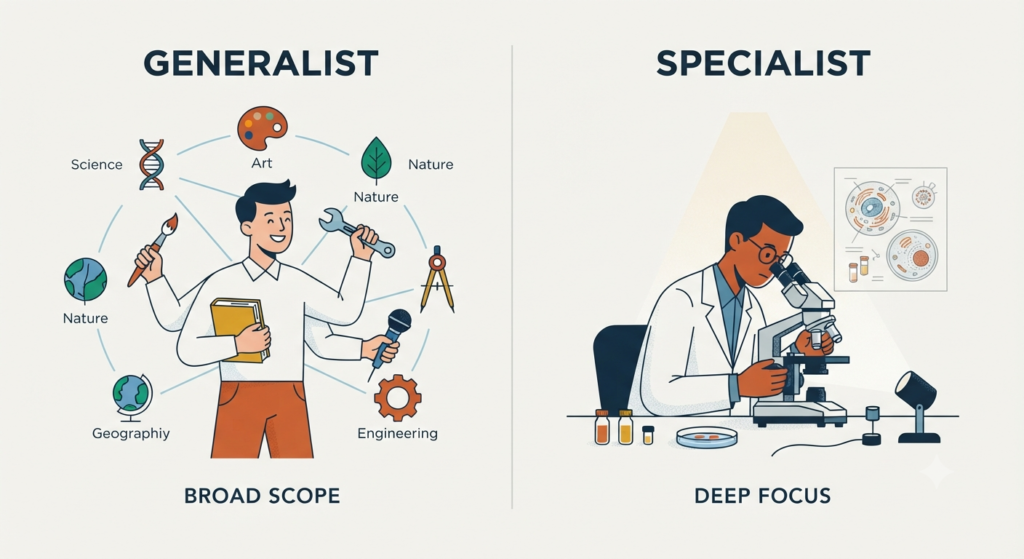
What Is a Generalist?
A generalist is a person who develops knowledge and skills across multiple subjects, disciplines, or professional areas. Instead of concentrating exclusively on one field, a generalist learns about several areas and can apply their knowledge to different types of tasks.
For example, a business professional may understand marketing, finance, operations, human resources, sales, and project management. The person may not have expert-level knowledge of every area but can understand how these functions work together.
Generalists are particularly valuable in situations that require flexibility, coordination, communication, and an understanding of the bigger picture.
Characteristics of a Generalist
Some common characteristics of generalists include:
- Has knowledge of multiple subjects.
- Develops a wide range of skills.
- Can adapt to different responsibilities.
- Is comfortable learning new topics.
- Can work across different departments.
- Often has strong communication skills.
- Can connect ideas from different fields.
- Can understand the broader context of a problem.
- May pursue several types of career opportunities.
- Often performs well in changing work environments.
Examples of Generalists
Examples of generalists include:
- A project manager who understands engineering, finance, procurement, and operations.
- A business manager with knowledge of marketing, sales, finance, and human resources.
- An entrepreneur who understands product development, marketing, finance, and customer service.
- An engineer with working knowledge of electrical, mechanical, instrumentation, and energy systems.
- An IT professional who understands programming, databases, networking, and cloud computing.
What Is a Specialist?
A specialist is a person who focuses on one particular subject, profession, technical area, or discipline and develops deep expertise in that field.
For example, an electrical engineer who concentrates on power system protection may develop extensive knowledge of protection relays, fault analysis, relay coordination, circuit breakers, and protection schemes.
Specialists invest considerable time in improving their knowledge and skills within their chosen area. Their expertise allows them to handle complex problems that require detailed technical understanding.
Characteristics of a Specialist
Common characteristics of specialists include:
- Focuses on one specific area.
- Develops deep technical knowledge.
- Builds advanced skills within a particular field.
- Spends significant time developing expertise.
- Can solve complex domain-specific problems.
- Often follows a focused career path.
- May become an authority in a particular subject.
- Continuously updates knowledge within the specialization.
- Often works on technically demanding tasks.
- May have strong professional credibility in the chosen field.
Examples of Specialists
Examples of specialists include:
- A cardiologist specializing in heart-related conditions.
- A structural engineer specializing in building structures.
- An electrical engineer specializing in relay protection.
- A cybersecurity professional specializing in network security.
- A tax accountant specializing in corporate taxation.
- A software engineer specializing in artificial intelligence.
Generalist vs. Specialist: Key Differences
1. Breadth of Knowledge
The most important difference between Generalist vs. Specialist is the breadth of knowledge.
A generalist develops knowledge across several subjects and can understand different areas of a problem.
A specialist concentrates on a particular subject and develops much deeper knowledge within that field.
Therefore:
Generalist → Broad knowledge
Specialist → Deep knowledge
2. Depth of Expertise
The depth of expertise also differs between generalists and specialists.
Generalists generally understand the fundamentals of several areas but may not possess advanced knowledge in each one.
Specialists spend more time concentrating on one area, allowing them to develop detailed expertise and handle complex problems within that domain.
Thus, specialists generally have greater depth, while generalists generally have greater breadth.
3. Skill Set
Generalists usually develop a diverse collection of transferable skills.
These may include communication, management, problem-solving, leadership, organization, business knowledge, and basic technical knowledge in several areas.
Specialists develop a narrower but more advanced collection of skills that are directly related to their field.
For example, a generalist engineer may understand motors, transformers, switchgear, protection, instrumentation, and energy management, while a protection specialist may have advanced expertise specifically in relay coordination and power-system protection.
4. Career Flexibility
Career flexibility is another major difference.
Generalists can often move between different functions because their skills are transferable across several roles.
Specialists usually have more focused career paths because their expertise is closely associated with one particular field.
However, specialization can also create strong career opportunities when a particular technical skill is highly demanded.
5. Adaptability
Generalists are often comfortable with changing responsibilities because they are accustomed to learning and working across different areas.
Specialists can also adapt effectively, particularly when changes occur within their area of expertise. However, moving into an entirely unrelated field may require additional education or training.
Therefore, generalists often have an advantage when flexibility across disciplines is required.
6. Problem-Solving Approach
Generalists and specialists may approach problems from different perspectives.
A generalist tends to look at the wider situation and connect information from several fields.
A specialist usually examines the technical or professional details of a problem using deep knowledge of a particular discipline.
For example, a generalist project manager may identify that a project delay involves procurement, engineering, finance, and manpower issues. A specialist engineer may then investigate the specific technical problem causing the delay.
Both approaches can be valuable.
7. Learning Approach
Generalists typically enjoy exploring different subjects and acquiring knowledge from multiple areas.
Specialists usually spend more time studying and practicing one particular field.
A generalist may learn the basics of ten different subjects, while a specialist may spend years mastering one discipline.
Therefore:
Generalist learning → Wider range
Specialist learning → Greater depth
8. Job Opportunities
Generalists may have access to a broader range of roles because their skills can be transferred between different functions.
They may work in:
- Management
- Consulting
- Project management
- Operations
- Business development
- Entrepreneurship
- Administration
Specialists generally pursue roles directly related to their expertise, such as:
- Engineering specialist
- Medical specialist
- Cybersecurity specialist
- Legal specialist
- Research scientist
- Technical consultant
The number and quality of opportunities depend heavily on industry demand and the individual’s experience.
9. Professional Expertise
Specialists are generally recognized for their authority in a specific subject.
A company may consult a specialist when it encounters a highly technical problem requiring advanced knowledge.
Generalists, on the other hand, are often valued for their ability to understand different perspectives and coordinate specialists.
Thus, specialists provide depth, while generalists often provide integration.
10. Role in Organizations
Generalists and specialists can perform complementary roles within an organization.
A generalist may coordinate several departments and understand how different functions contribute to an overall business objective.
A specialist may provide the technical knowledge needed to complete a particular task or solve a complex problem.
For example:
Generalist → Coordinates the project
Specialist → Solves the specialized technical problem
This combination can make organizations more effective.
Similarities Between Generalists and Specialists
Although Generalist vs. Specialist represents two different approaches to professional development, they also share several similarities.
Some major similarities include:
- Both require continuous learning.
- Both can develop valuable professional expertise.
- Both can build successful careers.
- Both need communication skills.
- Both require problem-solving abilities.
- Both can contribute significantly to organizations.
- Both can become leaders.
- Both can work collaboratively with other professionals.
- Both can adapt to changes within their field.
- Both benefit from practical experience.
The primary difference is not whether they learn or develop skills, but where they concentrate their learning and expertise.
Factors to Consider When Choosing Between a Generalist and Specialist
Several factors can help determine whether a generalist or specialist approach is more suitable.
1. Career Goals
If your goal is to work across multiple functions or eventually move into broad management, generalist skills may be useful.
If your goal is to become an expert in a particular technical or professional field, specialization may be more appropriate.
2. Personal Interests
People who enjoy exploring different subjects may naturally prefer the generalist approach.
People who enjoy studying one subject deeply may prefer specialization.
3. Industry Requirements
Some industries strongly depend on specialists. Medicine, scientific research, engineering, cybersecurity, and advanced technology often require deep technical expertise.
Other roles, particularly management and business leadership, may benefit from broader knowledge.
4. Career Stage
Career stage can also influence the decision.
Early in a career, exploring different areas can help a person discover their strengths and interests.
Later, developing deeper expertise in a selected area may provide greater professional differentiation.
5. Future Career Flexibility
If you want to keep your career options broad, developing generalist skills can be useful.
If you want to establish yourself as an authority in a particular area, specialization may be more suitable.
Generalist vs. Specialist: T-Shaped Professional
The choice between a generalist and specialist does not always have to be absolute.
Many professionals develop what is commonly described as a T-shaped skill set.
The horizontal part of the “T” represents broad knowledge across different subjects, while the vertical part represents deep expertise in one specific area.
For example, an electrical professional may have broad knowledge of:
- Transformers
- Motors
- Switchgear
- Instrumentation
- Energy management
- Automation
- Maintenance
At the same time, the professional may have deep expertise in one area such as electrical protection.
This combination allows a person to understand the broader system while maintaining specialized knowledge.
Which Is Better—Generalist or Specialist?
Neither a generalist nor a specialist is universally better. The appropriate approach depends on the person’s career goals, interests, industry, and professional responsibilities.
A generalist may be more suitable when the work requires:
- Flexibility
- Broad knowledge
- Leadership
- Coordination
- Cross-functional communication
- Project management
- Problem-solving across multiple areas
A specialist may be more suitable when the work requires:
- Deep technical expertise
- Advanced problem-solving
- Research
- Detailed analysis
- Professional specialization
- Complex technical decision-making
A combination of both can be particularly useful for professionals who want to become technical leaders or managers.
In summary:
Choose a generalist approach when you value breadth, flexibility, and variety.
When you value depth, expertise, and mastery of a particular field, choose a specialist approach
Choose a T-shaped approach when you want broad knowledge combined with deep expertise in one area.
Conclusion
The comparison of Generalist vs. Specialist demonstrates two different approaches to developing professional knowledge and skills. A generalist develops broad knowledge across multiple areas and is often valued for adaptability, versatility, and the ability to connect ideas from different disciplines. A specialist concentrates on one particular area and develops deep expertise that can be used to solve complex problems.
Both approaches have advantages and limitations. Generalists may have greater career flexibility and a broader perspective, while specialists may have greater technical depth and professional authority within their field.
The best approach depends on individual career goals, personal interests, industry requirements, and professional responsibilities. In many cases, combining broad knowledge with deep expertise through a T-shaped skill set can provide the advantages of both approaches.
Understanding Generalist vs. Specialist can therefore help students, professionals, managers, and career planners make better decisions about learning, skill development, and career direction.
Frequently Asked Questions (FAQs)
The main difference between Generalist vs. Specialist is the breadth and depth of knowledge. A generalist has broad knowledge across several areas, while a specialist develops deep expertise in one particular area.
No. Neither is universally better. Generalists are useful when flexibility and broad knowledge are needed, while specialists are valuable when deep technical or professional expertise is required.
Yes. A person can develop broad knowledge across multiple areas while maintaining deep expertise in one field. This approach is often called a T-shaped professional.
Generalists may have a broader range of possible roles, while specialists may have strong opportunities in specific fields where advanced expertise is in demand. Career opportunities depend on the industry, skills, experience, and market demand.
Yes. A person can develop broad knowledge across multiple areas while maintaining deep expertise in one field. This approach is often called a T-shaped professional.
Read Next: