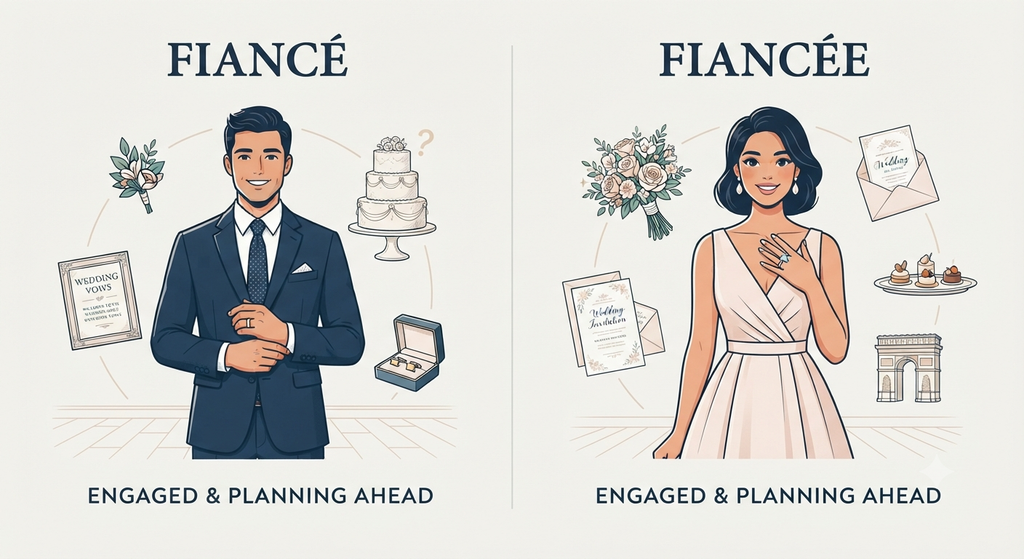
The main difference between Fiance vs. Fiancee is the gender of the person who is engaged to be married. A fiancé is a man who is engaged to be married, whereas a fiancée is a woman who is engaged to be married. Both words describe a person who has formally agreed to marry another person but has not yet married them.
Understanding Fiance vs. Fiancee is important because the two words have almost identical pronunciation and spelling, but they are traditionally distinguished by gender. The terms come from French and are commonly used in English to describe an engaged man or woman.
Fiance vs. Fiancee Comparison Table
The table below highlights the major differences between Fiance vs. Fiancee.
| Feature | Fiancé | Fiancée |
|---|---|---|
| Definition | A man who is engaged to be married. | A woman who is engaged to be married. |
| Gender | Male | Female |
| Relationship Status | Engaged | Engaged |
| Marital Status | Not yet married | Not yet married |
| Origin | French | French |
| French Spelling | Fiancé | Fiancée |
| Meaning | Engaged man | Engaged woman |
| Plural Form | Fiancés | Fiancées |
| Use in English | Refers to a male partner who is engaged | Refers to a female partner who is engaged |
| Pronunciation | Commonly pronounced fee-ahn-SAY | Commonly pronounced fee-ahn-SAY |
| Opposite Gender Term | Fiancée | Fiancé |
| Main Distinction | Male engagement partner | Female engagement partner |
What Is a Fiancé?
A fiancé is a man who is engaged to be married. The word describes a male person who has agreed to marry someone in the future but is not yet married to that person.
For example, if a man proposes to his partner and they become formally engaged, he can be described as her fiancé.
The word fiancé comes from French and traditionally uses the masculine form. The acute accent over the final é is part of the original French spelling, although the word is sometimes written as “fiance” in informal English.
A fiancé remains a fiancé until the marriage takes place or the engagement ends.
Characteristics of a Fiancé
Some common characteristics of a fiancé include:
- Refers to a man.
- Is engaged to be married.
- Has not yet married his partner.
- Has a future marriage commitment.
- Is the male counterpart of a fiancée.
- Can be used in formal and informal English.
- Comes from the French word related to engagement.
- Traditionally includes an accent mark: fiancé.
- Changes to husband after marriage.
- Refers specifically to the male member of an engaged couple.
Examples of Fiancé
Examples of using fiancé include:
- “My fiancé and I are planning our wedding.”
- “She introduced her fiancé to her family.”
- “Her fiancé proposed to her last year.”
- “My fiancé will attend the ceremony with me.”
- “He is excited to marry his fiancée.”
In each example, fiancé refers to a man who is engaged to be married.
What Is a Fiancée?
A fiancée is a woman who is engaged to be married. The word describes a female person who has agreed to marry someone in the future but has not yet married that person.
For example, if a woman accepts a marriage proposal and becomes engaged, she can be described as the man’s fiancée.
The word fiancée is the traditional feminine form of the French term. It is spelled with two e’s at the end and traditionally has an acute accent on the final é.
A fiancée remains a fiancée until the marriage takes place or the engagement ends.
Characteristics of a Fiancée
Common characteristics of a fiancée include:
- Refers to a woman.
- Is engaged to be married.
- Has not yet married her partner.
- Has a future marriage commitment.
- Is the female counterpart of a fiancé.
- Can be used in formal and informal English.
- Comes from the French language.
- Traditionally includes an accent mark: fiancée.
- Changes to wife after marriage.
- Refers specifically to the female member of an engaged couple.
Examples of Fiancée
Examples of using fiancée include:
- “My fiancée and I are planning our wedding.”
- “He introduced his fiancée to his friends.”
- “His fiancée accepted the proposal.”
- “My fiancée will choose the wedding flowers.”
- “He is excited to marry his fiancée.”
In each example, fiancée refers to a woman who is engaged to be married.
Fiance vs. Fiancee: Key Differences
1. Gender
The most important difference between Fiance vs. Fiancee is gender.
Fiancé traditionally refers to a man who is engaged to be married.
Fiancée traditionally refers to a woman who is engaged to be married.
Therefore:
Fiancé → Male
Fiancée → Female
2. Meaning
Both words describe a person who is engaged to be married.
The basic meaning is therefore the same: an engaged marriage partner.
The difference is that fiancé is traditionally masculine, while fiancée is traditionally feminine.
For example:
A man engaged to be married → fiancé
A woman engaged to be married → fiancée
3. Spelling
The spelling is another important difference.
Fiancé ends with é:
F-I-A-N-C-É
Fiancée ends with ée:
F-I-A-N-C-É-E
The extra e traditionally indicates the feminine form in French.
4. Pronunciation
In common English pronunciation, fiancé and fiancée are generally pronounced almost identically.
Both are commonly pronounced approximately as:
fee-ahn-SAY
Therefore, pronunciation usually does not help distinguish between the two words.
The spelling and context are more useful for determining whether the word refers to a man or woman.
5. French Origin
Both fiancé and fiancée come from French.
The French distinction between masculine and feminine forms is reflected in English usage.
Fiancé is the masculine form.
Fiancée is the feminine form.
English has adopted both forms, particularly in contexts involving relationships and marriage.
6. Relationship Status
Both a fiancé and a fiancée are engaged.
Neither term normally means that the person is already married.
For example:
Before engagement → Partner/Boyfriend/Girlfriend
After engagement → Fiancé/Fiancée
After marriage → Husband/Wife or spouse
Therefore, fiancé and fiancée specifically describe the engagement stage of a relationship.
7. Use After Marriage
The words fiancé and fiancée generally describe a relationship before marriage.
After the couple gets married, the appropriate relationship terms change.
A male fiancé becomes a husband after marriage.
A female fiancée becomes a wife after marriage.
Thus:
Fiancé → Husband after marriage
Fiancée → Wife after marriage
8. Accent Marks
The traditional spellings include accent marks.
The masculine form is:
fiancé
The feminine form is:
fiancée
However, English-language writing sometimes omits the accents and uses fiance and fiancee. The accented forms are closer to the original French spellings and are generally preferred in careful writing.
9. Context
Context can often clarify which word is being used.
For example:
“She went to dinner with her fiancé.”
The word fiancé indicates that her engaged partner is a man.
Similarly:
“He went to dinner with his fiancée.”
The word fiancée indicates that his engaged partner is a woman.
The surrounding sentence can therefore help readers understand the relationship.
Similarities Between Fiancé and Fiancée
Although Fiancé vs. Fiancée involves an important gender distinction, the two words have several similarities.
Some major similarities include:
- Both refer to people who are engaged.
- Both describe a future marriage partner.
- Both are associated with marriage.
- Both originate from French.
- Both are commonly used in English.
- Both describe a relationship before marriage.
- Both can be used in formal and informal communication.
- Both generally refer to someone who has accepted or made a marriage commitment.
- Both can be used when discussing wedding planning.
- Both change to marital relationship terms after marriage.
Fiance vs. Fiancee: Gender Difference
The easiest way to understand Fiance vs. Fiancee is to remember that the final e traditionally identifies the feminine form.
Fiancé = Engaged man
Fiancée = Engaged woman
For example:
“Sarah’s fiancé is planning the proposal celebration.”
Here, fiancé refers to Sarah’s male partner.
“John’s fiancée is choosing the wedding venue.”
Here, fiancée refers to John’s female partner.
This distinction comes from the traditional masculine and feminine forms of French.
Fiance vs. Fiancee: Spelling Difference
The spelling difference is small but important.
The masculine form of Finace has one final é:
Fiancé
The feminine form of Fiancée has an additional e before the final accented letter:
Fiancée
A useful visual comparison is:
Fiancé → one final e sound represented by é
Fiancée → additional e before the final é
In English, the accents are sometimes omitted, resulting in fiance and fiancee. However, fiancé and fiancée are the traditional spellings.
Fiance vs. Fiancee: Pronunciation
One reason people sometimes confuse these words is that they are generally pronounced the same way in English.
Both are commonly pronounced approximately:
fee-ahn-SAY
Therefore, the difference is primarily visible in writing rather than audible in everyday English speech.
When speaking, context usually makes the intended meaning clear.
When writing, using the correct spelling helps communicate whether the engaged person is male or female.
Which Word Should You Use—Fiancé or Fiancée?
The correct word depends on the gender of the person being described.
Use fiancé when referring to a man who is engaged to be married.
Use fiancée when referring to a woman who is engaged to be married.
For example:
Correct: “My fiancé proposed to me.”
This means the engaged partner is a man.
Correct: “My fiancée proposed to me.”
This means the engaged partner is a woman.
In modern English, some writers may use fiancé as a gender-neutral term, while others retain the traditional distinction between fiancé and fiancée. If you want to follow the traditional usage, use fiancé for a man and fiancée for a woman.
In summary:
Choose fiancé when referring to an engaged man.
Choose fiancée when referring to an engaged woman.
Use the traditional accented forms when you want to follow standard French-derived spelling.
Conclusion
The comparison of Fiance vs. Fiancee shows that both words describe a person who is engaged to be married, but they traditionally differ according to gender. Fiancé refers to a man who is engaged, whereas fiancée refers to a woman who is engaged.
The main differences are found in their gender, spelling, and traditional French grammatical forms. Fiancé has one final accented é, while fiancée has an additional e before the final é. Both words are generally pronounced in the same way in English.
Understanding Fiance vs. Fiancee makes it easier to use these relationship terms correctly in conversations, wedding invitations, personal writing, and other forms of communication. The simplest rule to remember is: fiancé means an engaged man, while fiancée means an engaged woman.
Frequently Asked Questions (FAQs)
The primary difference between Fiance vs. Fiancee is gender. Fiancé traditionally refers to a man who is engaged to be married, while fiancée traditionally refers to a woman who is engaged to be married.
A fiancé traditionally refers to a man who is engaged to be married.
A fiancée traditionally refers to a woman who is engaged to be married
In common English usage, fiancé and fiancée are generally pronounced the same way, approximately “fee-ahn-SAY.”
Fiancé is the traditional masculine spelling, while fiancée is the traditional feminine spelling. The feminine form contains an additional e before the final accented é.
Read Next: