The main difference between Femur vs Humerus is their location and function in the human body. The femur is the long bone of the thigh and connects the hip to the knee, whereas the humerus is the long bone of the upper arm and connects the shoulder to the elbow. The femur is longer, larger, and generally stronger than the humerus because it supports much of the body’s weight during standing and walking.
Understanding Femur vs Humerus is important in anatomy, physiology, biology, medicine, and health sciences because both are major long bones with similar basic structures but different anatomical features and functions. The femur is primarily adapted for weight-bearing and locomotion, while the humerus provides support and movement for the upper limb.
Although both bones contain a shaft, two ends, compact bone, spongy bone, marrow, periosteum, and articular cartilage, their shapes, joints, proportions, and mechanical roles are different.
Femur vs. Humerus Comparison Table
The table below highlights the major differences between Femur vs Humerus.
| Feature | Femur | Humerus |
| Definition | Long bone of the thigh | Long bone of the upper arm |
| Location | Lower limb | Upper limb |
| Position | Between the hip and knee | Between the shoulder and elbow |
| Number in the Body | Two | Two |
| Bone Type | Long bone | Long bone |
| Relative Size | Larger | Smaller |
| Length | Generally the longest bone in the body | Shorter than the femur |
| Overall Strength | Very strong and adapted for weight-bearing | Strong but not primarily weight-bearing |
| Proximal Joint | Hip joint | Shoulder joint |
| Distal Joint | Knee joint | Elbow joint |
| Proximal Articulation | Head articulates with the acetabulum of the pelvis | Head articulates with the glenoid cavity of the scapula |
| Distal Articulation | Articulates mainly with the tibia and patella | Articulates with the radius and ulna |
| Head Shape | Rounded and approximately two-thirds of a sphere | Rounded and approximately hemispherical |
| Neck | Relatively long and distinct | Shorter and less prominent |
| Major Projections | Greater and lesser trochanters | Greater and lesser tubercles |
| Shaft Shape | Long and generally cylindrical | Triangular to cylindrical |
| Distal Features | Medial and lateral condyles | Capitulum, trochlea, epicondyles, and fossae |
| Primary Function | Weight-bearing and locomotion | Movement and support of the upper limb |
| Main Muscular Attachments | Numerous muscles involved in hip and knee movement | Numerous muscles involved in shoulder, elbow, and forearm movement |
| Typical Fracture Concern | Hip and shaft fractures can significantly affect mobility | Upper-arm fractures can affect arm and shoulder function |
| Largest Long Bone | Yes | No |
| Weight Bearing | Major weight-bearing bone | Not normally weight-bearing in standing |
| Associated Limb | Lower limb | Upper limb |
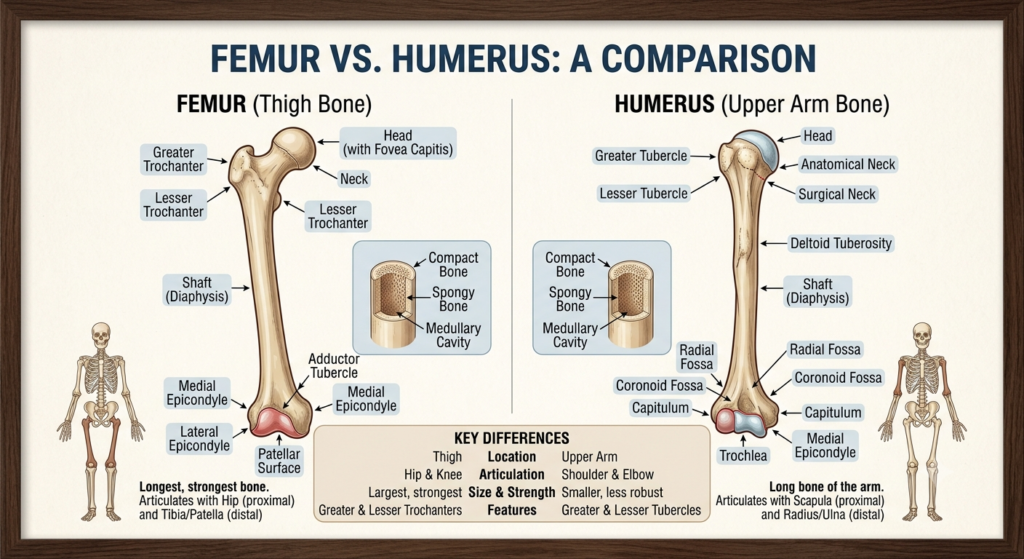
What Is the Femur?
The femur is the long bone located in the thigh. It extends from the hip joint to the knee joint and is the longest and one of the strongest bones in the human body.
The femur is specially adapted to support body weight and transmit forces between the pelvis and lower leg. During activities such as standing, walking, running, and jumping, the femur transfers loads between the hip and knee.
Like other long bones, the femur has a central shaft called the diaphysis and expanded ends called the epiphyses. Its upper end has a rounded head that fits into the acetabulum of the pelvis, forming the hip joint.
The lower end is enlarged and contains the medial and lateral condyles, which participate in forming the knee joint.
Characteristics of the Femur
Important characteristics of the femur include:
- It is located in the thigh.
- It is the longest bone in the human body.
- It is one of the strongest bones in the skeleton.
- It connects the hip and knee.
- It is a major weight-bearing bone.
- Its upper end forms part of the hip joint.
- Its lower end forms part of the knee joint.
- It has a long shaft called the diaphysis.
- Its proximal end contains a rounded head and neck.
- It contains greater and lesser trochanters.
- Its distal end contains medial and lateral condyles.
- It provides attachment sites for numerous muscles and ligaments.
Main Parts of the Femur
The femur can broadly be divided into three regions.
1. Proximal End
The proximal end of the femur is located near the hip. Its major features include:
- Head
- Neck
- Greater trochanter
- Lesser trochanter
- Intertrochanteric line
- Intertrochanteric crest
The head of the femur is rounded and fits into the acetabulum of the pelvis. This arrangement creates the ball-and-socket hip joint.
The neck connects the femoral head to the shaft and helps position the head within the hip joint.
2. Shaft
The shaft, or diaphysis, is the long central portion of the femur.
It is relatively cylindrical in much of its length and contains a medullary cavity. The shaft provides attachment sites for muscles that control the hip and knee.
The posterior surface contains a prominent ridge called the linea aspera, which provides attachment for several muscles.
3. Distal End
The distal end of the femur is enlarged and forms part of the knee joint.
Its major features include:
- Medial condyle
- Lateral condyle
- Medial epicondyle
- Lateral epicondyle
- Intercondylar fossa
- Patellar surface
The femoral condyles articulate primarily with the tibia, while the patellar surface interacts with the patella.
What Is the Humerus?
The humerus is the long bone of the upper arm. It extends from the shoulder to the elbow and connects the upper arm with the forearm.
The proximal end of the humerus forms the shoulder joint with the scapula. The distal end participates in the elbow joint with the radius and ulna.
Although the humerus is a strong long bone, its primary role is not weight-bearing in the upright position. Instead, it provides structural support and acts as a lever for muscles that move the shoulder, elbow, and forearm.
Like the femur, the humerus consists of a shaft and two expanded ends.
Characteristics of the Humerus
Important characteristics of the humerus include:
- It is located in the upper arm.
- It is a long bone.
- It connects the shoulder and elbow.
- It is shorter than the femur.
- Its proximal end forms part of the shoulder joint.
- Its distal end forms part of the elbow joint.
- It has a rounded head.
- It contains greater and lesser tubercles.
- Its shaft provides attachment sites for several muscles.
- The radial nerve passes along the posterior aspect of the shaft.
- Its distal end contains the capitulum and trochlea.
- It helps provide movement and leverage for the upper limb.
Main Parts of the Humerus
The humerus can also be divided into three major regions.
1. Proximal End
The proximal end of the humerus contains the rounded head, which articulates with the glenoid cavity of the scapula.
Important structures include:
- Head
- Anatomical neck
- Greater tubercle
- Lesser tubercle
- Intertubercular sulcus
The greater and lesser tubercles provide attachment sites for muscles and tendons associated with shoulder movement.
2. Shaft
The shaft of the humerus extends from the proximal to the distal end.
Its upper region is more cylindrical, while the middle portion has a more angular or triangular appearance.
An important feature is the deltoid tuberosity, which provides attachment for the deltoid muscle.
Another important feature is the radial groove, which runs along the posterior surface of the shaft and is associated with the radial nerve and accompanying vessels.
3. Distal End
The distal humerus is involved in forming the elbow joint.
Important structures include:
- Capitulum
- Trochlea
- Medial epicondyle
- Lateral epicondyle
- Radial fossa
- Coronoid fossa
- Olecranon fossa
The capitulum articulates with the head of the radius, while the trochlea articulates with the ulna.
Femur vs. Humerus: Key Differences
1. Location
The most basic difference between Femur vs Humerus is their location.
The femur is located in the thigh, forming the skeletal framework of the upper part of the lower limb.
The humerus is located in the upper arm, forming the skeletal framework between the shoulder and elbow.
2. Length
The femur is longer than the humerus.
In an average adult, the femur accounts for a substantial portion of total body height, whereas the humerus is considerably shorter.
This difference reflects their different mechanical roles and positions in the skeleton.
3. Size
The femur is generally larger and more massive than the humerus.
Because the femur must transmit body weight between the pelvis and lower limb, it has a robust structure capable of handling substantial mechanical loads.
The humerus is also strong but is designed primarily for upper-limb movement rather than supporting body weight during standing.
4. Weight-Bearing Function
One of the most important differences between Femur vs Humerus is their role in weight-bearing.
The femur is a major weight-bearing bone. It transfers forces from the pelvis toward the knee and lower leg.
The humerus does not normally bear body weight in the same way when a person is standing upright.
Therefore, the femur is more closely associated with load-bearing and locomotion, while the humerus is primarily associated with movement and leverage of the upper limb.
5. Proximal Joint
The proximal end of each bone forms a different joint.
The head of the femur fits into the acetabulum of the pelvis, forming the hip joint.
The head of the humerus fits into the glenoid cavity of the scapula, forming the shoulder joint.
The hip provides substantial stability for weight-bearing, whereas the shoulder allows a much greater range of upper-limb movement.
6. Shape of the Head
Both bones have rounded heads, but their shapes and proportions differ.
The femoral head is approximately spherical and forms a deep articulation with the acetabulum.
The humeral head is also rounded and forms the ball portion of the shoulder’s ball-and-socket joint.
The shoulder joint, however, has a relatively shallow socket and therefore permits a greater range of movement than the hip.
7. Neck
The femur has a prominent and relatively long neck connecting its head to the shaft.
The humerus also has an anatomical neck, but the proximal arrangement is different, with the head being closely associated with the greater and lesser tubercles.
The femoral neck is particularly important in clinical anatomy because fractures in this region can compromise the blood supply to the femoral head.
8. Major Projections
The proximal femur has two major bony projections called the greater trochanter and lesser trochanter.
The humerus has two major proximal projections called the greater tubercle and lesser tubercle.
These structures provide attachment sites for muscles and tendons.
9. Shaft Structure
The shafts of the two bones differ in shape.
The femoral shaft is generally long and cylindrical, although its cross-sectional shape changes along its length.
The humeral shaft transitions from a more cylindrical proximal region to a more angular or triangular configuration in parts of its middle section.
The humerus also contains the radial groove on its posterior surface.
10. Distal End
The lower ends of the femur and humerus have different structures because they form different joints. The femur has large medial and lateral condyles that help form the knee joint.
The humerus contains the capitulum and trochlea at its lower end. These structures help form the elbow joint with the forearm bones.
11. Associated Bones
The femur interacts with different bones at its two ends.
At the proximal end, it articulates with the pelvis. At the distal end, it articulates mainly with the tibia and also with the patella as part of the knee joint.
The humerus articulates with the scapula at the shoulder and with the radius and ulna at the elbow.
12. Main Function
The femur primarily supports the body and assists in locomotion.
It provides a strong connection between the pelvis and lower leg and helps transmit forces generated during walking, running, jumping, and other movements.
The humerus primarily functions as a lever for movement of the upper limb.
It contributes to movements of the shoulder and elbow and provides attachment sites for muscles controlling the arm and forearm.
13. Muscle Attachments
Both bones have numerous muscle attachment sites.
The femur provides attachment for muscles involved in:
- Hip movement
- Knee movement
- Thigh stabilization
- Locomotion
The humerus provides attachment for muscles involved in:
- Shoulder movement
- Elbow movement
- Forearm movement
- Hand positioning
14. Mechanical Role
The femur is optimized for load transmission and stability.
The humerus is optimized more toward mobility and leverage.
This difference is particularly evident when comparing the hip and shoulder joints. The hip sacrifices some range of motion for stability, while the shoulder permits extensive movement.
Similarities Between Femur and Humerus
Although Femur vs Humerus highlights many differences, the two bones share several important characteristics.
Major similarities include:
- Both are long bones.
- Both occur as paired bones in the human body.
- Both have a shaft called the diaphysis.
- Both have proximal and distal epiphyses.
- Both contain compact and spongy bone.
- Both contain bone marrow.
- Both are covered externally by periosteum except at articular surfaces.
- Both have articular cartilage where they form synovial joints.
- Both provide attachment sites for muscles and ligaments.
- Both contain blood vessels and nerves.
- Both contribute to movement of the limbs.
- Both undergo bone growth, remodeling, and repair.
- Both can be affected by fractures and other bone disorders.
Functions of the Femur and Humerus
Functions of the Femur
The femur performs several important functions:
- Supports body weight.
- Transfers forces between the pelvis and lower leg.
- Helps maintain standing posture.
- Provides leverage for walking and running.
- Participates in hip and knee movement.
- Provides attachment sites for thigh and hip muscles.
- Contributes to overall stability of the lower limb.
- Contains bone marrow involved in blood cell production and fat storage.
Functions of the Humerus
The humerus performs several important functions:
- Provides structural support to the upper arm.
- Connects the shoulder with the elbow.
- Acts as a lever for arm movement.
- Provides attachment sites for shoulder and arm muscles.
- Participates in shoulder and elbow joint movement.
- Helps transmit forces through the upper limb.
- Contributes to movements such as lifting, pushing, pulling, and reaching.
- Contains bone marrow.
Femur vs. Humerus in the Human Skeleton
The femur and humerus occupy corresponding positions in the lower and upper limbs.
The femur is the major bone of the proximal lower limb, while the humerus is the major bone of the proximal upper limb.
A simple comparison is that the pelvis connects to the femur, which continues toward the tibia and fibula, while the scapula connects to the humerus, which continues toward the radius and ulna.
This arrangement demonstrates an important principle of human skeletal anatomy. Both limbs contain a single large proximal bone followed by two bones in the more distal part of the limb.
The femur connects the pelvis to the knee, while the humerus connects the shoulder girdle to the elbow.
Which Is Longer: Femur or Humerus?
The femur is longer than the humerus.
The femur is generally the longest bone in the human body and makes up a significant portion of the length of the lower limb.
The humerus is also a long bone, but it is substantially shorter than the femur.
Which Is Stronger: Femur or Humerus?
The femur is generally considered stronger and more robust than the humerus.
This is closely related to its role in supporting and transmitting body weight. The femur must withstand considerable forces during standing, walking, running, and jumping.
The humerus is also a strong bone, but its structure and function are more closely associated with movement and leverage of the upper limb.
Femur vs. Humerus: Simple Way to Remember
A simple way to remember the difference is that the femur is the thigh bone, while the humerus is the upper-arm bone. The femur connects the hip to the knee, whereas the humerus connects the shoulder to the elbow.
| Femur | Humerus |
|---|---|
| Thigh bone | Upper-arm bone |
| Lower limb | Upper limb |
| Hip to knee | Shoulder to elbow |
| Longer | Shorter |
| Larger | Smaller |
| Major weight-bearing role | Primarily movement |
| Head articulates with acetabulum | Head articulates with glenoid cavity |
| Distal end forms part of knee joint | Distal end forms part of elbow joint |
| Greater and lesser trochanters | Greater and lesser tubercles |
Conclusion
The comparison of Femur vs Humerus shows that both are major long bones of the human skeleton, but they are adapted for different anatomical and mechanical roles. The femur is the long bone of the thigh and is the longest and one of the strongest bones in the body. It connects the hip and knee and plays a major role in weight-bearing, posture, and locomotion.
The humerus, in contrast, is the long bone of the upper arm. It connects the shoulder and elbow and is primarily involved in positioning and moving the upper limb. Its proximal head forms the shoulder joint with the scapula, while its distal end participates in the elbow joint with the radius and ulna.
Both bones share the basic organization of long bones, including a diaphysis, epiphyses, compact bone, spongy bone, marrow, periosteum, and articular cartilage. However, their differences in size, shape, joint structure, muscle attachments, and mechanical function reflect the different demands placed on the upper and lower limbs.
The simplest distinction is that the femur is the large, weight-bearing thigh bone, whereas the humerus is the upper-arm bone responsible mainly for supporting and enabling movement of the arm.
Frequently Asked Questions (FAQs)
The main difference between Femur vs Humerus is their location and function. The femur is the long bone of the thigh and is a major weight-bearing bone, while the humerus is the long bone of the upper arm and is primarily involved in upper-limb movement.
Yes. The femur is considerably longer than the humerus and is the longest bone in the human body.
The femur is generally stronger and more robust than the humerus because it is adapted to support and transmit substantial body weight.
The femur is located in the thigh, between the hip and knee joints.
The humerus is located in the upper arm, between the shoulder and elbow joints.
References:
1. Jones, Oliver. “The Femur.” TeachMe Anatomy, 8 Apr. 2019
2. Jones, Oliver. “The Humerus.” TeachMeAnatomy, 16 June 2019
Read Next: