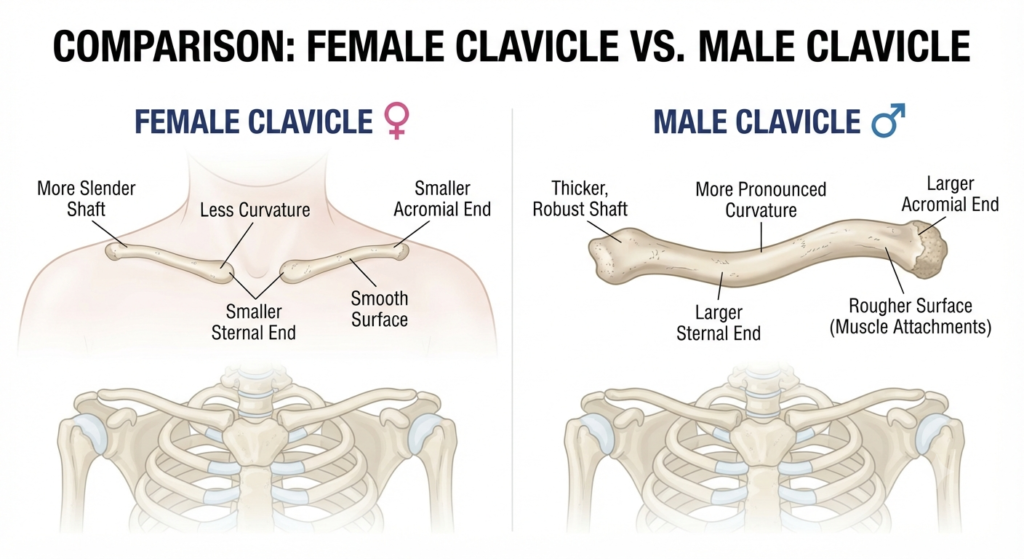
The main difference between Female Clavicle vs. Male Clavicle is that the female clavicle is generally shorter, thinner, lighter, and less curved, whereas the male clavicle is typically longer, thicker, heavier, and more robust. These anatomical differences develop due to hormonal influences and overall skeletal growth patterns. Although both clavicles perform the same function of connecting the upper limb to the trunk, their size, shape, and strength differ enough that the clavicle is often used in forensic anthropology to help estimate biological sex.
Understanding the differences between Female Clavicle vs. Male Clavicle is important for students of anatomy, medical professionals, orthopedic surgeons, radiologists, archaeologists, and forensic scientists because clavicle characteristics provide valuable information about skeletal structure, injury risk, and human identification.
Female Clavicle vs. Male Clavicle Comparison Table
| Feature | Female Clavicle | Male Clavicle |
| Average Length | Shorter | Longer |
| Bone Thickness | Thinner | Thicker |
| Weight | Lighter | Heavier |
| Shape | More slender | More robust |
| Curvature | Less pronounced | More pronounced |
| Diameter | Smaller | Larger |
| Muscle Attachment | Less prominent | More prominent |
| Shoulder Width | Narrower | Broader |
| Bone Density | Slightly lower | Higher |
| Mechanical Strength | Lower | Higher |
| Surface Texture | Smoother | Rougher due to stronger muscle attachments |
| Cross-sectional Area | Smaller | Larger |
| Fracture Resistance | Comparatively lower | Comparatively higher |
| Common Use in Forensics | Sex estimation | Sex estimation |
What Is the Clavicle?
The clavicle, commonly called the collarbone, is an S-shaped long bone located between the breastbone (sternum) and the shoulder blade (scapula). Every person has two clavicles—one on each side of the body.
The clavicle performs several essential functions:
- Connects the upper limb to the axial skeleton
- Maintains shoulder alignment
- Supports arm movement
- Protects underlying nerves and blood vessels
- Serves as an attachment site for muscles and ligaments
- Transmits forces from the arm to the trunk
Although male and female clavicles serve identical functions, their dimensions and morphology differ.
Female Clavicle vs. Male Clavicle: Key Differences
1. Overall Size
One of the most noticeable differences in Female Clavicle vs. Male Clavicle is the overall size.
The female clavicle is generally shorter and more delicate. Since females usually have a smaller skeletal frame, their clavicles are proportionally smaller.
Male clavicles are longer and larger, contributing to the broader shoulder appearance typically seen in men.
Female Clavicle
- Shorter
- Smaller frame
- Less bulky
Male Clavicle
- Longer
- Larger frame
- More massive
2. Bone Thickness
The thickness of the clavicle differs considerably.
Female clavicles have a narrower shaft and thinner cortical bone.
Male clavicles possess thicker bone tissue capable of supporting larger muscle mass and greater mechanical loads.
This difference results from higher testosterone levels during skeletal development.
3. Shape
Shape is another important characteristic.
Female clavicles usually appear:
- Slimmer
- More graceful
- Less rugged
Male clavicles are:
- Broader
- More angular
- More robust
These differences are especially noticeable near the middle shaft.
4. Curvature
The clavicle has a natural S-shaped curve.
In females:
- The curvature is usually gentler.
- The bone appears smoother.
In males:
- The S-shaped curve is more pronounced.
- The shaft appears more twisted and stronger.
This increased curvature provides greater resistance to mechanical stress.
5. Length
Length is one of the most commonly measured parameters in anatomy and forensic science.
Average adult measurements are approximately:
| Sex | Average Clavicle Length |
| Female | 12–14 cm |
| Male | 14–16 cm |
Actual measurements vary according to ethnicity, genetics, nutrition, and overall body size.
6. Weight
The male clavicle generally weighs more because it contains:
- More bone mass
- Greater cortical thickness
- Larger dimensions
Female clavicles are lighter due to their smaller size.
Although the weight difference is relatively small, it becomes significant during skeletal analysis.
7. Muscle Attachment Sites
Several muscles attach to the clavicle, including:
- Deltoid
- Pectoralis major
- Sternocleidomastoid
- Trapezius
- Subclavius
Male clavicles typically have:
- Rougher attachment areas
- More pronounced ridges
- Larger tubercles
Female clavicles generally have smoother attachment surfaces.
8. Shoulder Width
Shoulder width depends partly on clavicle length.
Female clavicles contribute to:
- Narrower shoulders
- Smaller upper body frame
Male clavicles contribute to:
- Broader shoulders
- Greater upper-body width
This difference is one reason shoulder breadth is often used in anthropological studies.
9. Bone Density
Bone density varies due to hormonal influences.
Male clavicles usually have:
- Higher mineral density
- Greater cortical thickness
- Better resistance to heavy loading
Female clavicles generally have slightly lower bone density, particularly after menopause due to reduced estrogen levels.
10. Strength
In terms of mechanical properties, male clavicles are generally stronger.
They can withstand:
- Greater bending forces
- Higher compression loads
- Increased muscular stress
Female clavicles remain sufficiently strong for normal activities but have comparatively lower mechanical strength.
11. Forensic Identification
One of the most practical applications of Female Clavicle vs. Male Clavicle is forensic anthropology.
Experts analyze:
- Length
- Width
- Curvature
- Weight
- Cross-sectional diameter
- Muscle attachment markings
These characteristics help estimate the biological sex of unidentified skeletal remains. However, clavicle analysis is typically combined with pelvic and skull features for greater accuracy.
12. Fracture Characteristics
The clavicle is one of the most frequently fractured bones in the human body.
Common causes include:
- Falls
- Sports injuries
- Bicycle accidents
- Vehicle collisions
Both males and females can experience clavicle fractures. However, differences in bone size and density may influence fracture patterns and healing, though treatment principles are generally similar.
13. Development and Growth
The clavicle is unique because it is one of the first bones to begin ossification during fetal development and one of the last bones to complete growth.
In both sexes:
- Primary ossification starts before birth.
- Secondary ossification at the sternal end completes in early adulthood.
Male clavicles typically continue growing for a slightly longer period, contributing to their greater final size.
14. Clinical Significance
Recognizing the differences between female and male clavicles helps healthcare professionals in several areas:
- Orthopedic surgery
- Fracture fixation
- Implant design
- Shoulder reconstruction
- Radiology interpretation
- Sports medicine
- Forensic investigations
Understanding sex-specific anatomy can improve surgical planning and implant selection.
15. Evolutionary Perspective
Sex-based differences in clavicle structure are considered part of normal human sexual dimorphism.
Broader shoulders in males are associated with:
- Greater upper-body muscle mass
- Increased leverage for lifting and throwing
- Higher mechanical loading
Female clavicles are adapted to the overall proportions of the female skeleton while maintaining the same essential function.
Similarities Between Female and Male Clavicles
Although there are several anatomical differences in Female Clavicle vs. Male Clavicle, both bones share the same basic structure, function, and developmental pattern. These similarities are essential for maintaining normal shoulder movement and upper-limb function.
Some of the major similarities include:
- Both are S-shaped long bones located above the first rib.
- Both connect the sternum (breastbone) to the scapula (shoulder blade).
- Both form part of the pectoral (shoulder) girdle.
- Both support and stabilize the shoulder joint.
- Both help transmit forces from the upper limb to the trunk.
- Both protect important nerves and blood vessels beneath the clavicle.
- Both serve as attachment sites for muscles and ligaments.
- Both participate in shoulder movements such as lifting, pushing, and pulling.
- Both develop through intramembranous and endochondral ossification.
- Both are commonly fractured following falls or direct shoulder injuries.
Despite these similarities, the female clavicle is generally smaller and more slender, while the male clavicle is larger and stronger due to normal skeletal sexual dimorphism.
Functions of the Clavicle
Whether in females or males, the clavicle performs several vital functions that contribute to shoulder stability, arm mobility, and upper-body biomechanics.
1. Connects the Upper Limb to the Skeleton
The clavicle forms the only direct bony connection between the upper limb and the axial skeleton through the sternoclavicular joint.
2. Maintains Shoulder Position
The clavicle acts as a strut that holds the shoulder away from the chest, allowing the arm to move freely without restriction.
3. Supports Arm Movement
It provides stability during various shoulder movements, including:
- Raising the arm
- Reaching overhead
- Throwing
- Pushing
- Pulling
- Rotating the shoulder
4. Protects Neurovascular Structures
The clavicle shields important structures passing beneath it, including:
- Subclavian artery
- Subclavian vein
- Brachial plexus
This protective role helps reduce the risk of injury to these vital structures.
5. Transfers Mechanical Forces
The clavicle transmits forces generated by the upper limb to the trunk during activities such as lifting heavy objects, climbing, and sports.
6. Provides Muscle Attachment
Several major muscles attach to the clavicle, including:
- Deltoid
- Trapezius
- Pectoralis major
- Sternocleidomastoid
- Subclavius
These muscles contribute to shoulder stability, head movement, breathing, and arm function.
7. Assists in Shock Absorption
Because of its curved shape, the clavicle helps absorb and distribute mechanical forces, reducing stress on the shoulder joint.
Clinical Importance of Female Clavicle vs. Male Clavicle
Understanding the anatomical differences between female and male clavicles is valuable in medicine, orthopedics, and forensic science.
Orthopedic Surgery
Surgeons consider clavicle size and shape when selecting:
- Plates
- Screws
- Intramedullary devices
- Shoulder implants
Sex-specific anatomical variations can improve implant fit and surgical outcomes.
Fracture Management
Clavicle fractures account for a significant proportion of shoulder injuries. Bone dimensions and density may influence fracture patterns, fixation techniques, and rehabilitation strategies.
Medical Imaging
Radiologists evaluate clavicle anatomy during:
- X-rays
- CT scans
- MRI examinations
Recognizing normal sex-related differences helps distinguish anatomical variation from pathology.
Forensic Anthropology
The clavicle is frequently used alongside the pelvis and skull to estimate the biological sex of skeletal remains by examining:
- Bone length
- Shaft thickness
- Curvature
- Muscle attachment markings
Sports Medicine
Athletes participating in contact sports, cycling, football, hockey, or skiing commonly sustain clavicle injuries. Knowledge of clavicular anatomy aids in diagnosis, treatment, and recovery planning.
Which Clavicle Is Stronger?
When comparing Female Clavicle vs. Male Clavicle, the male clavicle is generally stronger due to its larger dimensions, greater cortical thickness, and higher bone density. It is better adapted to withstand greater muscular forces and mechanical loads.
However, this does not mean that female clavicles are weak. Female clavicles provide adequate strength and stability for normal daily activities and athletic performance. Bone strength in both sexes is influenced by multiple factors, including age, nutrition, hormones, physical activity, and overall health.
Ultimately, both clavicles are designed to perform the same essential functions, with their structural differences reflecting normal variations in skeletal anatomy.
Conclusion
The comparison of Female Clavicle vs. Male Clavicle shows that while both clavicles share the same fundamental role in supporting the shoulder and connecting the upper limb to the axial skeleton, they differ in several anatomical characteristics. Female clavicles are generally shorter, thinner, lighter, and less curved, whereas male clavicles are longer, thicker, stronger, and have more prominent muscle attachment sites.
These differences result from normal skeletal development and hormonal influences and are valuable in anatomy, orthopedics, sports medicine, radiology, and forensic anthropology. Despite these variations, both female and male clavicles perform the same essential functions of stabilizing the shoulder, facilitating arm movement, protecting vital neurovascular structures, and transmitting forces between the upper limb and the trunk.
Understanding Female Clavicle vs. Male Clavicle helps students, healthcare professionals, and researchers appreciate the importance of sex-specific skeletal anatomy in clinical practice and scientific study.
Frequently Asked Questions (FAQs)
The main difference is that the female clavicle is generally shorter, thinner, and lighter, while the male clavicle is longer, thicker, stronger, and more robust.
Male clavicles develop under the influence of testosterone, which promotes greater bone growth, higher bone density, and stronger muscle attachments.
Yes. In forensic anthropology, clavicle measurements such as length, thickness, curvature, and muscle attachment markings can assist in estimating biological sex, although they are usually evaluated along with other skeletal features.
Both female and male clavicles are susceptible to fractures, especially after falls or sports injuries. Individual risk depends more on trauma, bone health, age, and activity level than on sex alone
No. Both clavicles perform the same functions, including supporting the shoulder, connecting the upper limb to the trunk, protecting underlying nerves and blood vessels, and enabling a wide range of arm movements.
Reference:
1. “4.1 Determining the Gender of the Crew.” Analytical Science: Secrets of the Mary Rose.
2. “Anatomy, Shoulder and Upper Limb, Clavicle” – Statpearls – NCBI Bookshelf.
Read Next: