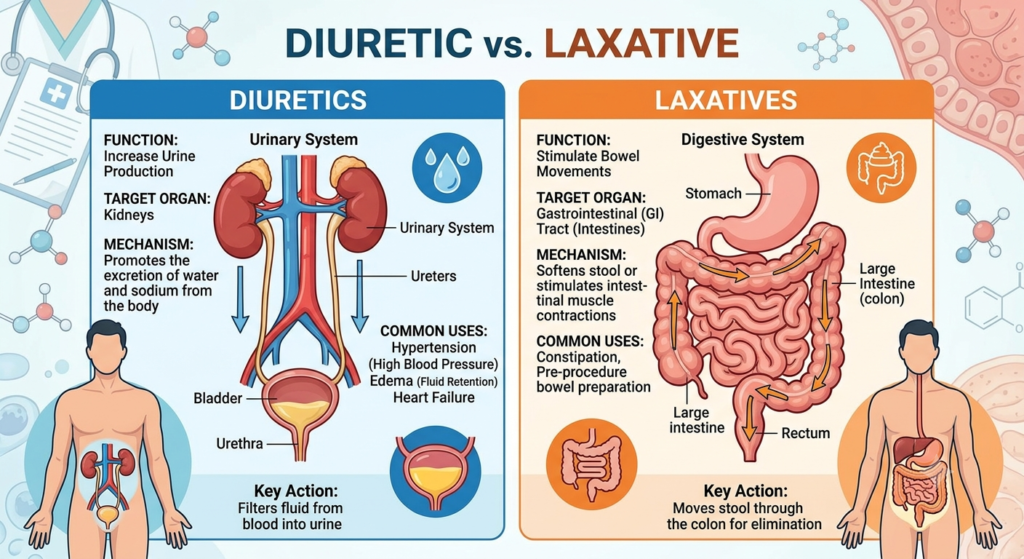
The main difference between Diuretic vs. Laxative is the body system they act on and the type of elimination they promote. Diuretics increase urine production by helping the kidneys remove excess water and electrolytes from the body, while laxatives promote bowel movements and help relieve constipation.
Although both can increase the elimination of substances from the body, they work in very different ways. Diuretics primarily affect the kidneys and urinary system, whereas laxatives primarily affect the digestive system and intestines.
Understanding Diuretic vs. Laxative is important because these medications are used for different medical purposes and should not be considered interchangeable. Diuretics are commonly used for conditions involving fluid retention and high blood pressure, while laxatives are mainly used to manage constipation.
Diuretic vs. Laxative Comparison Table
The following table highlights the major differences between Diuretic vs. Laxative.
| Feature | Diuretic | Laxative |
| Definition | Medication that increases urine production | Medication or substance that promotes bowel movements |
| Primary system affected | Kidneys and urinary system | Digestive system |
| Main purpose | Removes excess fluid and electrolytes | Relieves constipation and facilitates stool passage |
| Primary action | Increases urinary excretion | Increases stool movement, softens stool, or adds water to stool |
| Common uses | High blood pressure, edema, and certain fluid-retention conditions | Constipation and bowel preparation |
| Main route | Oral or, for some medicines, injection | Oral or rectal, depending on the product |
| Common effects | Increased urination and reduced fluid retention | Increased bowel movements and easier stool passage |
| Possible side effects | Dehydration, frequent urination, and electrolyte disturbances | Cramps, diarrhea, bloating, dehydration, and electrolyte disturbances |
| Target of action | Primarily the kidneys | Primarily the intestines |
| Typical outcome | Greater urine output | Easier or more frequent bowel movements |
What Is a Diuretic?
A diuretic is a medication that increases the amount of urine produced by the kidneys. Diuretics are sometimes called water pills because they help the body eliminate excess water and, depending on the medication, sodium and other electrolytes.
They are commonly prescribed when the body retains too much fluid or when lowering blood pressure is needed. Conditions in which diuretics may be used include hypertension, edema, heart failure, and certain kidney or liver-related conditions.
Diuretics work by changing how the kidneys handle sodium and water. When less sodium is reabsorbed into the bloodstream, more water remains in the urine and is subsequently excreted.
Types of Diuretics
There are several major types of diuretics.
Loop Diuretics
Loop diuretics act on the loop of Henle in the kidney and can produce a strong increase in sodium and water excretion.
Furosemide is a commonly known example of a loop diuretic.
Thiazide Diuretics
Thiazide diuretics act on the distal convoluted tubule of the nephron. They increase the excretion of sodium and water and are widely used in the management of hypertension.
Hydrochlorothiazide is an example.
Potassium-Sparing Diuretics
Potassium-sparing diuretics increase sodium and water excretion while reducing potassium loss compared with many other diuretics.
Spironolactone is one example.
The choice of diuretic depends on the medical condition, kidney function, other medications, and the desired effect.
Common Uses of Diuretics
Diuretics may be used to:
- Reduce excess fluid retention
- Treat edema
- Help control high blood pressure
- Manage fluid overload associated with heart failure
- Treat certain kidney-related conditions
- Manage fluid accumulation associated with some liver conditions
The supplied reference similarly identifies hypertension, edema, and certain kidney disorders among the conditions for which diuretics may be used.
Possible Side Effects of Diuretics
Because diuretics increase urine production, they can sometimes cause:
- Frequent urination
- Dehydration
- Low blood pressure
- Electrolyte disturbances
- Changes in sodium or potassium levels
- Dizziness or weakness in some people
The specific side effects depend on the type of diuretic and the individual’s medical condition.
What Is a Laxative?
A laxative is a medication or substance used to promote bowel movements and relieve constipation. Laxatives can work in several ways, including increasing stool bulk, drawing water into the intestine, stimulating intestinal movement, or softening stool.
Constipation may involve hard stools, difficult bowel movements, or bowel movements that occur less frequently than usual. Laxatives can provide temporary relief when dietary and lifestyle measures are not sufficient.
Types of Laxatives
Different types of laxatives work through different mechanisms.
Bulk-Forming Laxatives
Bulk-forming laxatives increase the amount of water and bulk in the stool. This can make stool softer and easier to pass.
Psyllium is a commonly used bulk-forming fiber.
Stimulant Laxatives
Stimulant laxatives increase intestinal activity and encourage bowel movements.
Bisacodyl is an example of a stimulant laxative.
Osmotic Laxatives
Osmotic laxatives draw water into the intestine, which can soften stool and make it easier to pass.
Lactulose is an example.
Stool Softeners
Stool softeners help increase the amount of water mixed with stool, making it easier to pass.
The reference identifies bulk-forming, stimulant, osmotic laxatives, and stool softeners as major categories.
Common Uses of Laxatives
Laxatives are commonly used to:
- Relieve occasional constipation
- Make hard stools easier to pass
- Improve bowel regularity
- Reduce straining during bowel movements
- Prepare the bowel for certain medical procedures when specifically directed
The appropriate type of laxative depends on the cause and duration of constipation and the individual’s circumstances.
Possible Side Effects of Laxatives
Laxatives may cause side effects such as:
- Abdominal cramps
- Bloating
- Gas
- Diarrhea
- Dehydration
- Electrolyte disturbances
Excessive or prolonged use of some laxatives can cause additional problems, so they should be used according to product directions or medical advice.
Diuretic vs. Laxative: Key Differences
1. Body System Affected
The most important difference between Diuretic vs. Laxative is the body system they primarily affect.
Diuretics act mainly on the kidneys, which regulate urine formation and fluid balance.
Laxatives act mainly on the digestive tract, particularly the intestines, where they influence stool consistency or bowel movement.
2. Main Purpose
Diuretics are primarily used to manage excess fluid and conditions such as hypertension or edema.
Laxatives are primarily used to manage constipation and difficulty passing stool.
Their medical purposes are therefore fundamentally different.
3. Route of Elimination
Diuretics promote elimination through the urinary system.
Laxatives promote elimination through the digestive system.
This distinction is one of the easiest ways to understand the difference between the two medications.
4. Effect on the Body
Diuretics increase urine output. This can help reduce the amount of excess fluid in the body.
Laxatives increase or facilitate bowel movements. Depending on the type, they may soften stool, increase stool bulk, draw water into the intestine, or stimulate intestinal activity.
5. Effect on Fluid Balance
Both types of medication can influence fluid balance, but they do so differently.
Diuretics directly increase urinary fluid loss.
Some laxatives increase the amount of water present in the intestinal contents. Excessive laxative use can therefore also contribute to dehydration.
6. Common Medical Applications
Diuretics are frequently associated with conditions involving fluid retention and blood pressure.
Laxatives are primarily associated with constipation and bowel management.
Using one medication in place of the other is inappropriate because they are designed to address different problems.
7. Side Effects
Diuretics may cause increased urination, dehydration, changes in blood pressure, and electrolyte abnormalities.
Laxatives may cause abdominal cramps, bloating, diarrhea, dehydration, and electrolyte abnormalities.
The severity and likelihood of side effects depend on the specific medication, dose, duration, and individual health factors.
8. Treatment Target
The primary treatment target of a diuretic is usually fluid balance.
The primary treatment target of a laxative is usually bowel movement and stool passage.
This difference explains why the two medications have different mechanisms and clinical applications.
9. Onset of Action
The onset of action varies considerably between individual medications.
Some diuretics can begin increasing urine production relatively quickly, while the effect of other types may develop over a longer period.
Likewise, laxatives differ in how quickly they work. Some act within hours, while others may require a longer period to produce a bowel movement.
10. Appropriate Use
Diuretics should generally be used according to medical advice when prescribed for a medical condition.
Laxatives should also be selected and used appropriately, especially when constipation is persistent, severe, or associated with other symptoms.
Neither medication should be used simply for routine weight loss or unnecessary fluid removal.
Similarities Between Diuretics and Laxatives
Although Diuretic vs. Laxative describes two very different types of medication, they share some similarities.
Both:
- Promote elimination of substances from the body.
- Can influence the body’s fluid balance.
- Are available in different forms or types.
- Have different mechanisms of action depending on the specific medication.
- Can cause dehydration when used excessively.
- May affect electrolyte levels.
- Should be used according to appropriate dosage instructions.
- Can be useful when treating specific medical conditions.
- May cause unwanted effects if misused.
- Require consideration of a person’s overall health and other medications.
Diuretic vs. Laxative for Weight Loss
Diuretics and laxatives are sometimes incorrectly used for weight loss.
Neither should be considered a safe or effective method for reducing body fat.
Diuretics primarily remove water through increased urine production, while laxatives primarily affect bowel contents and bowel movements. Any short-term change in body weight from excessive fluid or stool loss does not represent meaningful loss of body fat.
Misuse can also result in dehydration and electrolyte disturbances.
For healthy and sustainable weight management, dietary habits, physical activity, and appropriate medical guidance are much more important than using medications to artificially increase elimination.
Can Diuretics and Laxatives Be Used Together?
In some medical situations, a person may be prescribed both a diuretic and a laxative. However, combining them should not be done without appropriate medical guidance.
Both can contribute to fluid loss, and some laxatives can also affect electrolyte balance. When used together, the risk of dehydration or electrolyte disturbances may increase in certain circumstances.
Anyone taking multiple medications should discuss the combination with a healthcare professional, particularly if they experience dizziness, weakness, severe diarrhea, unusual thirst, or other concerning symptoms.
Which Is Better: Diuretic or Laxative?
There is no universally better option because they treat different problems.
A diuretic is appropriate for certain conditions involving excess fluid or blood pressure when prescribed by a healthcare professional.
A laxative may be appropriate for constipation when a bowel movement needs to be facilitated.
The correct choice depends on the underlying condition rather than a comparison of which medication is generally stronger or more effective.
When Should You Seek Medical Advice?
Constipation that persists, severe abdominal pain, vomiting, blood in the stool, unexplained weight loss, or significant changes in bowel habits may require medical evaluation rather than repeated use of laxatives.
Similarly, excessive swelling, shortness of breath, sudden changes in urine output, severe dizziness, or symptoms of dehydration should be medically assessed.
Medication use should be based on the underlying problem, and persistent symptoms should not simply be masked with repeated doses.
Conclusion
The comparison of Diuretic vs. Laxative highlights two medications that promote different forms of elimination.
Diuretics primarily act on the kidneys to increase urine production and help remove excess fluid from the body. They are commonly used for conditions such as hypertension and fluid retention.
Laxatives, on the other hand, act on the digestive system to promote bowel movements and relieve constipation. Different laxatives work by increasing stool bulk, softening stool, drawing water into the intestine, or stimulating intestinal activity.
Although both can affect fluid balance and may cause dehydration or electrolyte disturbances when misused, they are not interchangeable. The appropriate medication depends on the medical condition being treated and should be used according to professional advice or product directions.
Frequently Asked Questions (FAQs)
The main difference between Diuretic vs. Laxative is their target system. A diuretic increases urine production through its effects on the kidneys, while a laxative promotes bowel movements through its effects on the digestive system.
Both can affect fluid balance, but they do so through different mechanisms. Diuretics increase urinary water loss, while some laxatives increase water in the intestinal contents. Excessive use of either can contribute to dehydration.
No. Laxatives are intended to affect bowel movements and should not be used as a substitute for diuretics. They have different mechanisms and medical purposes.
Diuretics are not constipation medications. They increase urine production and are generally used for conditions involving fluid balance or blood pressure rather than bowel movements.
They may sometimes be used together when medically appropriate, but combining them without guidance can increase the risk of dehydration or electrolyte disturbances. Follow the advice of a healthcare professional when using both.
Reference:
1. “What You Need to Know about Water Pills (Diuretics).” Mayo Clinic, Mayo Foundation for Medical Education and Research
2. Cunha, John P. “Laxative Types for Constipation Relief, Weight Loss & Side Effects.” MedicineNet
Read Next: