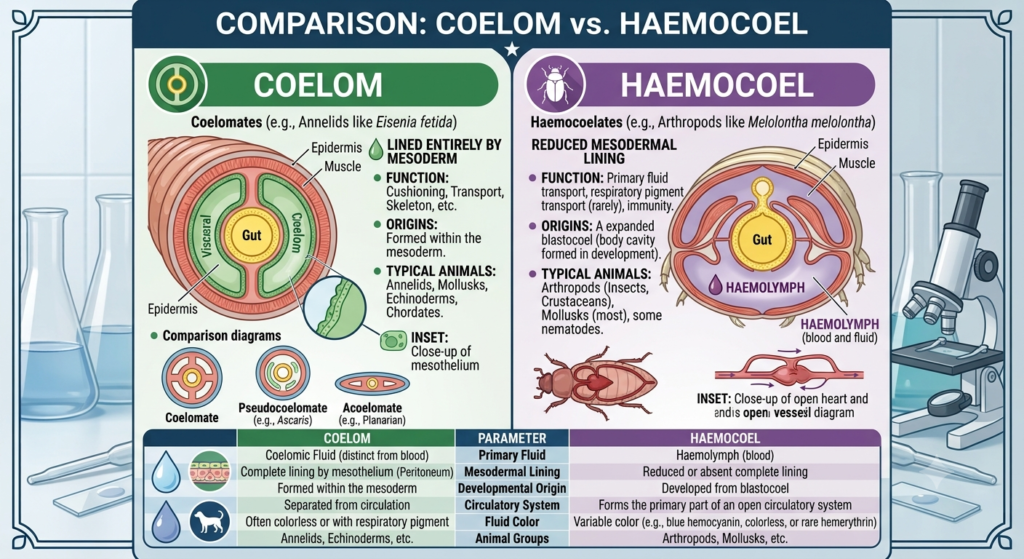
The main difference between Coelom vs. Haemocoel is their structure, origin, and role in the animal body. A coelom is a fluid-filled body cavity that is completely or substantially lined by mesoderm and provides space for internal organs, whereas a haemocoel is a blood- or haemolymph-filled body cavity associated with an open circulatory system, particularly in arthropods and most mollusks. Thus, a coelom primarily provides space, support, and protection for organs, while a haemocoel is closely associated with circulation and the distribution of haemolymph.
Understanding Coelom vs. Haemocoel is important in zoology, biology, anatomy, and evolutionary studies because body-cavity organization differs considerably among animal groups. Although both provide internal space around organs, they are structurally and functionally different.
Coelom vs. Haemocoel Comparison Table
The table below highlights the major differences between Coelom vs. Haemocoel.
| Feature | Coelom | Haemocoel |
| Definition | A body cavity lined by mesoderm and containing coelomic fluid | A major body cavity filled with haemolymph |
| Primary Fluid | Coelomic fluid | Haemolymph |
| Lining | Lined by mesoderm-derived tissue | Not a true mesoderm-lined body cavity |
| Main Role | Provides space, support, protection, and freedom for organ movement | Functions as the principal space through which haemolymph circulates |
| Circulatory Relationship | Separate from the main blood vascular system in animals with closed circulation | Closely associated with an open circulatory system |
| Organ Position | Organs can be suspended within the cavity | Organs are generally bathed directly by haemolymph |
| Animals Commonly Associated | Annelids, echinoderms, and chordates | Arthropods and most mollusks |
| Fluid Movement | Coelomic fluid can circulate within the cavity | Haemolymph circulates through body spaces and sinuses |
| Protection | Can cushion and protect internal organs | Provides little of the specialized cushioning associated with a true coelom |
| Hydrostatic Function | Can act as a hydrostatic skeleton in some animals | Not primarily a hydrostatic skeleton |
| Structural Organization | May be divided into compartments or regions | Generally forms interconnected blood-filled spaces |
| Example | Coelom of an earthworm or vertebrate | Haemocoel of an insect |
What Is a Coelom?
A coelom is a fluid-filled body cavity located between the body wall and the digestive tract. It is lined by mesoderm-derived tissue and is considered a true body cavity.
The coelom provides internal organs with a separate space in which they can develop, move, and function. Because organs are not tightly packed against the body wall, they can often move independently of the surrounding tissues.
Coelomic cavities occur in several major animal groups, including annelids, echinoderms, and chordates. The structure and arrangement of the coelom vary considerably among these groups.
In vertebrates, for example, the embryonic coelom gives rise to important body cavities, including the pericardial, pleural, and peritoneal cavities. These cavities surround and accommodate major organs such as the heart, lungs, and abdominal organs.
The coelomic fluid can also have important physiological functions. Depending on the animal, it may assist with transport of substances, immune responses, waste handling, and reproduction.
Characteristics of Coelom
Important characteristics of a coelom include:
- It is a true body cavity.
- It is lined by mesoderm-derived tissue.
- It occurs between the body wall and digestive tract.
- It contains coelomic fluid.
- It provides space for internal organs.
- It allows organs to move independently of the body wall.
- It can cushion internal organs against mechanical forces.
- It can provide a hydrostatic skeleton in some animals.
- It may be divided into different regions or compartments.
- It plays an important role in the organization of complex body plans.
Examples of Coelom
Examples of animals possessing a coelom include:
- Earthworms and other annelids.
- Echinoderms such as starfish.
- Vertebrates, including mammals, birds, reptiles, amphibians, and fish.
- Other members of the chordate lineage.
The exact structure of the coelom differs among these groups.
What Is a Haemocoel?
A haemocoel is the principal internal body space associated with an open circulatory system. It is filled with haemolymph, a circulating fluid that performs many functions analogous to blood and tissue fluid.
The haemocoel is particularly characteristic of arthropods, such as insects, spiders, and crustaceans, and is also found in most mollusks.
Unlike a true coelom, the haemocoel is not simply a mesoderm-lined cavity containing a separate body fluid. Instead, it is formed largely by the spaces or sinuses of the open circulatory system. Haemolymph is pumped from the heart into these spaces, where it comes into direct contact with many organs and tissues before returning to the circulatory system.
In an insect, for example, the heart pumps haemolymph into the haemocoel. The haemolymph flows around internal organs and eventually returns toward the heart through openings and associated pathways.
The haemocoel therefore has an important role in the transport of nutrients, hormones, immune components, and metabolic wastes.
Characteristics of Haemocoel
Important characteristics of a haemocoel include:
- It is associated with an open circulatory system.
- It contains haemolymph.
- It is especially characteristic of arthropods.
- It is also present in most mollusks.
- Haemolymph directly bathes many internal organs.
- It provides space for circulation around tissues.
- It helps transport nutrients and chemical signals.
- It participates in waste transport.
- It is involved in immune defense.
- It is not equivalent to a true mesoderm-lined coelom.
Examples of Haemocoel
Examples include the haemocoel of:
- Insects such as cockroaches and grasshoppers.
- Arachnids such as spiders.
- Crustaceans such as crabs and prawns.
- Most mollusks, including many snails and bivalves.
Coelom vs. Haemocoel: Key Differences
1. Basic Structure
The most fundamental difference between Coelom vs. Haemocoel is their structural organization.
A coelom is a true body cavity lined by mesoderm-derived tissue.
A haemocoel is a blood- or haemolymph-filled body space associated with an open circulatory system.
Therefore:
Coelom → True body cavity
Haemocoel → Haemolymph-filled circulatory space
2. Type of Fluid
The fluids present in the two cavities are different.
A coelom contains coelomic fluid, which can perform several functions depending on the animal.
A haemocoel contains haemolymph, the circulating fluid of an open circulatory system.
Haemolymph transports substances such as nutrients, hormones, and waste products around the body.
Thus:
Coelom → Coelomic fluid
Haemocoel → Haemolymph
3. Mesodermal Lining
A major anatomical distinction concerns the lining of the cavity.
The coelom is defined as a cavity associated with a mesodermal lining. This lining forms the boundary between the cavity and surrounding tissues.
The haemocoel, in contrast, is not a true mesoderm-lined body cavity in the same sense. It largely consists of spaces through which haemolymph circulates.
This difference is particularly important when classifying animal body plans.
4. Relationship With Circulation
Coelom and haemocoel have different relationships with the circulatory system.
In many coelomate animals, the coelom is structurally separate from the main blood vascular system. An animal may have a closed circulatory system in which blood remains within vessels while coelomic fluid occupies the coelomic cavity.
In animals with a haemocoel, the cavity is closely integrated with the open circulatory system. Haemolymph leaves vessels and enters body sinuses, bathing internal organs.
Therefore:
Coelom → Usually separate from the main circulatory fluid
Haemocoel → Forms the major space of an open circulatory system
5. Relationship With Internal Organs
The two cavities also differ in how internal organs interact with the surrounding fluid.
In a coelom, organs may be suspended within the cavity by mesenteries or related tissues. The fluid-filled space gives organs room to move while maintaining their general position.
In a haemocoel, internal organs are generally surrounded or bathed directly by haemolymph.
Consequently, the coelom provides a distinct compartment around organs, whereas the haemocoel serves as a major circulatory space.
6. Protective Function
A coelom can provide mechanical protection by surrounding organs with fluid. The fluid-filled cavity can act as a cushion and reduce the effects of external mechanical forces.
A haemocoel does not primarily function as a protective fluid-filled cavity. Its main significance is related to circulation and the distribution of haemolymph.
Thus, protection and organ accommodation are more prominent functions of the coelom.
7. Hydrostatic Skeleton
The coelom can perform a hydrostatic function in some animals.
For example, in earthworms, the fluid-filled coelom works with the body-wall muscles to provide hydrostatic support. Changes in pressure within the coelomic compartments contribute to body movement.
The haemocoel is not generally regarded as the primary hydrostatic skeleton of arthropods.
Therefore:
Coelom → Can provide hydrostatic support
Haemocoel → Primarily associated with circulation
8. Animals in Which They Occur
The groups of animals associated with these structures are another important difference.
Coeloms are found in animals such as:
- Annelids.
- Echinoderms.
- Chordates.
Haemocoels are especially characteristic of:
- Arthropods.
- Most mollusks.
This distinction is useful when studying animal classification and body-plan evolution.
9. Role in Transport
Coelomic fluid may assist in the transport of substances within the body, although its importance varies between animal groups.
Haemolymph in a haemocoel has a direct circulatory function. It transports nutrients, hormones, immune components, and metabolic waste throughout the animal.
In many arthropods, however, oxygen transport is not the primary role of haemolymph because specialized respiratory structures and systems perform much of the gas-exchange function.
Therefore, transport through the haemocoel is more directly tied to the open circulatory system.
10. Evolutionary Significance
The coelom and haemocoel represent different solutions to organizing the internal body space of animals.
The evolution of a true coelom allowed internal organs to occupy a protected and flexible compartment. It also provided opportunities for organ development, movement, and specialization.
The haemocoel represents an organization in which the circulatory system occupies much of the internal body space and haemolymph directly surrounds many organs.
It is important not to describe the haemocoel simply as a “primitive version” of the coelom. They are structurally different body-plan arrangements, and modern animal evolution is more complex than a simple progression from haemocoel to coelom.
Similarities Between Coelom and Haemocoel
Although Coelom vs. Haemocoel focuses on their differences, they also have some similarities.
Important similarities include:
- Both are internal body spaces.
- Both occur in multicellular animals.
- Both are associated with internal organs.
- Both contain fluid.
- Both can facilitate movement of substances within the body.
- Both contribute to the organization of the animal body.
- Both can provide space around internal organs.
- Both are important concepts in comparative zoology.
- Both have roles in maintaining internal physiological conditions.
- Both vary in structure among different animal groups.
Functions of Coelom and Haemocoel
The main functions of a coelom include:
- Providing space for internal organs.
- Allowing organs to move independently of the body wall.
- Protecting and cushioning internal organs.
- Supporting organ development.
- Allowing greater specialization of organ systems.
- Supporting hydrostatic movement in some animals.
- Providing a space containing coelomic fluid.
- Contributing to internal organization and body structure.
The main functions of a haemocoel include:
- Providing the major space for haemolymph circulation.
- Bathing internal organs with haemolymph.
- Transporting nutrients.
- Distributing hormones and signaling molecules.
- Carrying metabolic waste toward excretory organs.
- Supporting immune defense.
- Maintaining internal fluid distribution.
- Facilitating circulation in animals with open circulatory systems.
Coelom vs. Haemocoel in Animal Body Plans
The distinction between coelom and haemocoel becomes clearer when considering different animal body plans.
A coelom is a true body cavity between the body wall and the digestive tract. It is lined by mesoderm-derived tissue and can provide a separate compartment for internal organs.
A haemocoel, by contrast, is closely associated with the open circulatory system. Haemolymph flows through body spaces and directly surrounds many internal organs.
For example, an earthworm has a well-developed coelom that is divided into segments. The coelomic fluid contributes to hydrostatic support and other physiological processes.
An insect has a haemocoel through which haemolymph circulates. Its organs are immersed in or surrounded by haemolymph rather than being enclosed within a conventional true coelomic cavity.
This comparison demonstrates that body cavity and circulatory organization are closely related to overall animal body design.
Coelom vs. Haemocoel in Evolution
The evolutionary comparison of Coelom vs. Haemocoel requires some care.
Older classifications sometimes described animals as progressing from acoelomate forms to pseudocoelomate forms and then coelomate forms as though these represented a simple evolutionary ladder. Modern evolutionary biology recognizes that animal body plans evolved through more complicated pathways.
Similarly, a haemocoel should not simply be considered an inferior or primitive replacement for a coelom. Arthropods, for example, possess highly specialized and successful body plans in which the haemocoel is integrated with an efficient open circulatory system.
The important distinction is therefore structural and functional rather than a simple ranking of complexity.
Coelom vs. Haemocoel in Humans
Humans have a true coelom that develops during embryonic development.
The embryonic coelom eventually contributes to the major body cavities associated with internal organs. These include the thoracic and abdominal cavities, with specialized spaces surrounding the heart and lungs and the abdominal organs.
Humans do not possess a haemocoel as their principal body cavity.
Instead, humans have a closed circulatory system. Blood remains within blood vessels and is pumped by the heart through arteries, capillaries, and veins.
This is fundamentally different from the haemocoel-based circulation of typical arthropods.
Which Is More Important—Coelom or Haemocoel?
Neither structure is universally more important because they perform different roles in different animal body plans.
The coelom is particularly important for providing space, organization, protection, and movement of internal organs. In some animals, it also serves as a hydrostatic skeleton.
The haemocoel is particularly important for circulation. It allows haemolymph to move around internal organs and transport nutrients, hormones, wastes, and immune components.
Therefore, the appropriate term depends on the animal being studied:
Choose coelom when discussing a true mesoderm-associated body cavity.
Choose haemocoel when discussing the haemolymph-filled spaces characteristic of animals with open circulation, especially arthropods and most mollusks.
Conclusion
The comparison of Coelom vs. Haemocoel highlights two distinct forms of internal body organization in animals. A coelom is a true body cavity associated with a mesodermal lining and filled with coelomic fluid. It provides space for internal organs and can contribute to protection, organ movement, and hydrostatic support.
A haemocoel, on the other hand, is the major haemolymph-filled body space associated with an open circulatory system. It is especially characteristic of arthropods and most mollusks, where haemolymph directly bathes many internal organs and transports nutrients, signaling molecules, wastes, and immune components.
The simplest way to remember the distinction is that the coelom is primarily a true body cavity for organ organization, whereas the haemocoel is closely associated with an open circulatory system and haemolymph circulation.
Understanding Coelom vs. Haemocoel is therefore useful for studying animal body plans, comparative anatomy, zoology, embryology, and evolutionary biology.
Frequently Asked Questions (FAQs)
The main difference between Coelom vs. Haemocoel is their structure and function. A coelom is a true body cavity associated with a mesodermal lining, whereas a haemocoel is a haemolymph-filled body space associated with an open circulatory system.
The coelom contains coelomic fluid. Depending on the animal, this fluid can contribute to transport, immune defense, waste handling, reproduction, and hydrostatic support.
A haemocoel contains haemolymph, the circulating fluid of animals with an open circulatory system. Haemolymph surrounds many internal organs and transports nutrients, hormones, wastes, and immune components.
Humans have a true coelom that develops during embryonic development and contributes to the major body cavities. Humans do not have a haemocoel as their principal body cavity because they possess a closed circulatory system.
A haemocoel is especially characteristic of arthropods, including insects, spiders, and crustaceans, and is also present in most mollusks. In these animals, the haemocoel is closely associated with the open circulatory system.
Reference:
1. “Coelom: Formation & Types,” Study.com
2. “Coelom – Definition and Examples of Coelomates.” Biology Dictionary, Biology Dictionary, 8 June 2017
Read Next:
- Difference Between Nervous and Anxious
- Difference Between Orthodox and Heterodox
- Difference Between First Name and Last Name
- Difference Between Poison Ivy and Poison Oak Rash
- Female Clavicle vs. Male Clavicle: What’s the Difference?
- Femur vs Humerus
- Mesenchymal Cells vs. Parenchyma
;