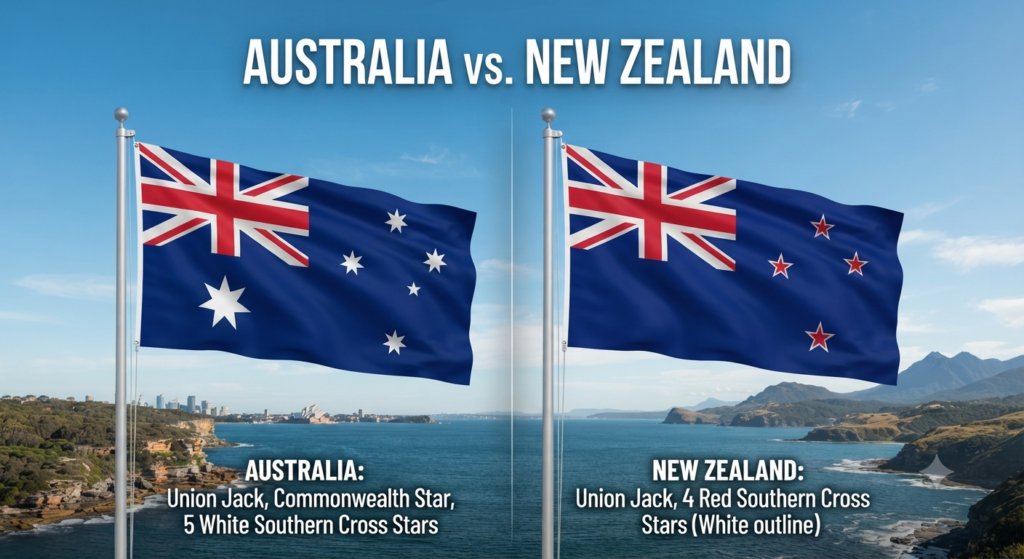
The main difference between Australian Flag vs. New Zealand Flag is that the Australian flag features the Commonwealth Star below the Union Jack and five white stars representing the Southern Cross constellation, whereas the New Zealand flag displays four red stars with white borders representing the Southern Cross and does not include the Commonwealth Star. Although both flags share a similar Blue Ensign design with the Union Jack, they differ in the number, color, size, and arrangement of their stars.
Understanding the difference between Australian Flag vs. New Zealand Flag is important for students, travelers, historians, flag enthusiasts, educators, and anyone interested in geography and national symbols because these flags reflect each country’s history, identity, heritage, and relationship with the British Commonwealth.
Australian Flag vs. New Zealand Flag Comparison Table
The table below highlights the major differences between Australian Flag vs. New Zealand Flag.
| Feature | Australian Flag | New Zealand Flag |
|---|---|---|
| Official Name | Flag of Australia | Flag of New Zealand |
| Adopted | 3 September 1901 (officially proclaimed 1903; current specifications 1954) | 24 March 1902 |
| Background | Blue Ensign | Blue Ensign |
| Union Jack | Present in the upper-left canton | Present in the upper-left canton |
| Commonwealth Star | Present below the Union Jack | Not present |
| Southern Cross | Five white stars | Four red stars with white borders |
| Number of Main Stars | Six (including Commonwealth Star) | Four |
| Star Color | White | Red with white outline |
| Largest Star | Seven-pointed Commonwealth Star | None |
| Symbolism | Federation, states, territories, Southern Hemisphere | Southern Hemisphere, national identity |
| Flag Ratio | 1:2 | 1:2 |
| Main Colors | Blue, White, Red | Blue, Red, White |
| British Heritage | Represented by Union Jack | Represented by Union Jack |
| Distinctive Feature | Commonwealth Star and five-star Southern Cross | Four red-bordered stars |
What Is the Australian Flag?
The Australian flag is the national flag of Australia. It consists of a dark blue field featuring the Union Jack in the upper-left corner, a large seven-pointed Commonwealth Star beneath it, and the Southern Cross constellation on the right side.
The flag represents Australia’s historical connection with the United Kingdom, its federation, and its geographical location in the Southern Hemisphere.
Common Applications
- Government buildings
- Schools
- Sporting events
- Military institutions
- National celebrations
- International diplomacy
Key Characteristics of the Australian Flag
- Blue Ensign design
- Union Jack in the canton
- Seven-pointed Commonwealth Star
- Five stars forming the Southern Cross
- White stars
- Official national flag
- Represents Australia’s federation
What Is the New Zealand Flag?
The New Zealand flag is the official national flag of New Zealand. It also features a blue field with the Union Jack in the upper-left corner but differs by displaying four red stars outlined in white, representing the Southern Cross constellation.
Unlike Australia’s flag, it does not include the Commonwealth Star.
Common Applications
- Government offices
- National holidays
- Sporting competitions
- Embassies
- Schools
- Maritime use
Key Characteristics of the New Zealand Flag
- Blue Ensign
- Union Jack in the canton
- Four red stars
- White borders around stars
- Southern Cross only
- No Commonwealth Star
- Represents New Zealand’s heritage and location
Australian Flag vs. New Zealand Flag: Key Differences
1. Definition
Although both are national flags based on the British Blue Ensign, they represent different nations and contain unique symbols.
The Australian flag represents the Commonwealth of Australia and includes symbols of federation and geography.
Characteristics include:
- National flag of Australia
- Commonwealth Star
- Southern Cross
- British heritage
The New Zealand flag represents New Zealand and emphasizes the Southern Cross while maintaining its British heritage.
Characteristics include:
- National flag of New Zealand
- Four-star Southern Cross
- No Commonwealth Star
- British heritage
2. Overall Design
Both flags appear similar at first glance but differ in several important design elements.
Australian Flag design features include:
- Blue background
- Union Jack
- Commonwealth Star
- Five Southern Cross stars
New Zealand Flag design features include:
- Blue background
- Union Jack
- Four Southern Cross stars
- No additional large star
The Commonwealth Star makes Australia’s flag immediately distinguishable.
3. Commonwealth Star
One of the easiest ways to distinguish the two flags is the Commonwealth Star.
Australian Flag
Characteristics include:
- Large white star
- Seven points
- Located below the Union Jack
- Represents Australia’s federation
New Zealand Flag
Characteristics include:
- No Commonwealth Star
- Simpler overall appearance
- Southern Cross only
This is one of the most obvious differences between Australian Flag vs. New Zealand Flag.
4. Southern Cross Constellation
Both flags feature the Southern Cross, but the designs differ considerably.
Australian Flag Characteristics include:
- Five stars
- White stars
- Different sizes
- One smaller five-pointed star
- Four seven-pointed stars
New Zealand Flag Characteristics include:
- Four stars
- Red stars
- White borders
- Uniform appearance
Australia uses a more astronomically detailed version of the constellation.
5. Star Colors
The color of the stars is another important distinction.
Australian Flag Star characteristics include:
- White stars
- No colored borders
- High contrast against blue background
New Zealand Flag Star characteristics include:
- Red stars
- White outlines
- Bold visual appearance
The red stars make New Zealand’s flag easier to distinguish from a distance.
6. Symbolism
Each flag carries unique national symbolism.
Australian Flag Symbols represent:
- British heritage
- Federation
- Six original states
- Territories
- Southern Hemisphere
New Zealand Flag Symbols represent:
- British heritage
- Southern Cross
- Pacific location
- National identity
Australia’s flag contains more symbolic elements than New Zealand’s.
7. Historical Development
The two flags were adopted at different times.
Australian Flag historical highlights include:
- National design competition in 1901
- Official proclamation in 1903
- Current legal form established in 1954
New Zealand Flag historical highlights include:
- Adopted in 1902
- Based on earlier Blue Ensign
- Retained after later review
Both flags have remained largely unchanged for more than a century.
8. Number of Stars
The number of stars is often used to identify the flags.
Australian Flag Includes:
- One Commonwealth Star
- Five Southern Cross stars
- Total of six stars
New Zealand Flag Includes:
- Four Southern Cross stars
- No additional stars
Australia clearly has more stars than New Zealand.
9. National Identity
Each flag reflects its country’s history and values.
Australian Flag Represents:
- Federation
- Commonwealth
- British origins
- Southern Hemisphere
New Zealand Flag Represents:
- National unity
- Pacific heritage
- Southern Hemisphere
- Historical links with Britain
Although similar, each flag symbolizes a distinct national identity.
10. International Recognition
The similarities between the two flags sometimes create confusion.
Australian Flag Recognition characteristics include:
- Frequently displayed internationally
- Distinguished by Commonwealth Star
- White Southern Cross stars
New Zealand Flag Recognition characteristics include:
- Easily recognized by red stars
- Simpler star arrangement
- No Commonwealth Star
The similarities have occasionally led to mistaken identification during international events.
11. Public Debate
Both countries have discussed whether their flags should change.
Australian Flag discussion points include:
- Retaining British heritage
- Reflecting modern Australia
- National identity
New Zealand Flag discussion points include:
- Distinguishing it from Australia’s flag
- Considering alternative designs
- Public referendum held in 2015–2016
Despite these discussions, both countries continue using their current flags.
12. Cultural Importance
Both flags are respected national symbols.
Australian Flag Used during:
- Australia Day
- National ceremonies
- Sporting events
- Military services
New Zealand Flag Used during:
- Waitangi Day
- ANZAC commemorations
- Government ceremonies
- International competitions
Similarities Between Australian Flag and New Zealand Flag
Although Australian Flag vs. New Zealand Flag have several differences, they also share many characteristics.
Some major similarities include:
- Both use the Blue Ensign design.
- Both feature the Union Jack.
- Both represent former British colonies.
- Both include the Southern Cross constellation.
- Both have a 1:2 flag ratio.
- Both use blue, red, and white colors.
- Both symbolize their Southern Hemisphere location.
- Both are official national flags.
- Both are internationally recognized.
- Both reflect historical ties to the United Kingdom.
Significance of the Australian Flag
The Australian flag represents the nation’s federation, history, and geography.
Major advantages and significance include:
- Symbolizes national unity
- Represents six states and territories
- Displays the Southern Cross
- Reflects British heritage
- Easily recognized worldwide
- Represents Australia’s Commonwealth identity
- Used in official ceremonies
- Strong historical significance
- Promotes national pride
- Internationally respected
Significance of the New Zealand Flag
The New Zealand flag represents the country’s heritage and unique place in the South Pacific.
Major advantages and significance include:
- Represents national identity
- Distinctive red stars
- Symbolizes the Southern Cross
- Honors historical heritage
- Easy to recognize
- Used in international events
- Represents New Zealand globally
- Strong cultural importance
- Reflects Pacific location
- Promotes patriotism
Which Flag Is Easier to Identify?
Both flags are visually similar, but each has distinctive features.
The Australian flag is easier to identify if you look for the large seven-pointed Commonwealth Star beneath the Union Jack and the five white stars of the Southern Cross.
The New Zealand flag is easier to identify by its four red stars with white borders and the absence of the Commonwealth Star.
A simple rule is:
- Australia = Commonwealth Star + five white stars
- New Zealand = four red stars only
Conclusion
The comparison of Australian Flag vs. New Zealand Flag shows that although both flags share the Blue Ensign design, the Union Jack, and the Southern Cross constellation, they differ in several important ways. The Australian flag includes the seven-pointed Commonwealth Star and five white stars representing the Southern Cross, while the New Zealand flag features four red stars with white borders and omits the Commonwealth Star entirely.
Understanding these differences helps students, travelers, educators, and history enthusiasts correctly identify each flag and appreciate the historical, cultural, and national significance behind their designs.
Frequently Asked Questions (FAQs)
The main difference between Australian Flag vs. New Zealand Flag is that the Australian flag includes a seven-pointed Commonwealth Star and five white stars of the Southern Cross, whereas the New Zealand flag has only four red stars with white borders and no Commonwealth Star.
Both countries were former British colonies, and the Union Jack reflects their historical ties to the United Kingdom.
Australia uses five white stars to represent the Southern Cross and includes the Commonwealth Star, while New Zealand uses four red stars with white borders to represent the Southern Cross.
The Australian flag was first adopted following Federation in 1901, while the New Zealand flag was officially adopted in 1902.
They share a blue background, the Union Jack in the canton, and the Southern Cross constellation. However, the Commonwealth Star on Australia’s flag and the red-bordered stars on New Zealand’s flag make them distinguishable.
Read Next: