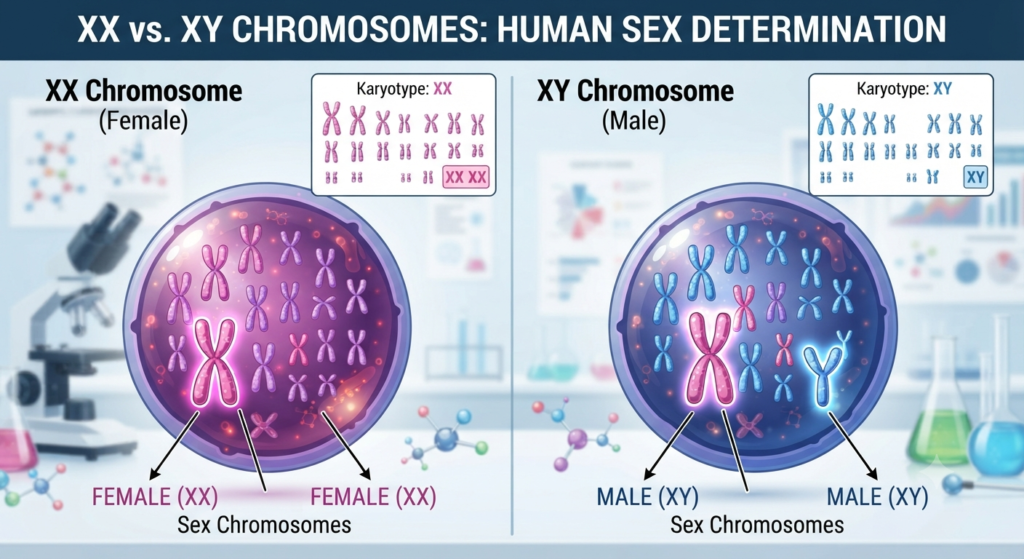
The main difference between XX vs. XY chromosome is that XX chromosomes determine the typical female genetic sex, while XY chromosomes determine the typical male genetic sex in humans. Individuals with an XX chromosome pair inherit one X chromosome from each parent, whereas individuals with an XY chromosome pair inherit an X chromosome from the mother and a Y chromosome from the father. The Y chromosome carries the SRY (Sex-determining Region Y) gene, which initiates male sexual development during early embryonic growth. Besides determining biological sex, XX and XY chromosomes differ in their structure, size, gene content, inheritance pattern, and roles in human development.
Although both XX and XY chromosome pairs are known as sex chromosomes, they are not identical. The X chromosome is much larger and contains over 800 protein-coding genes involved in reproduction, brain development, immunity, and other essential body functions. In contrast, the Y chromosome is considerably smaller and contains fewer than 100 protein-coding genes, many of which are associated with male fertility and testis development.
Understanding the differences between XX vs. XY chromosome is essential in genetics, biology, medicine, and reproductive health. It also helps explain inherited genetic disorders, chromosome abnormalities, and the biological mechanisms responsible for human sex determination.
XX vs. XY Chromosome Comparison Table
The table below summarizes the major differences between XX vs. XY chromosome.
| Feature | XX Chromosome | XY Chromosome |
|---|---|---|
| Sex Determined | Typically female | Typically male |
| Chromosome Composition | Two X chromosomes | One X chromosome and one Y chromosome |
| Inheritance | X from mother + X from father | X from mother + Y from father |
| Type of Sex | Homogametic | Heterogametic |
| Presence of SRY Gene | Absent | Present on the Y chromosome |
| Primary Function | Female development and normal body functions | Male sex determination and sperm production |
| Size | Larger overall | Smaller because of the Y chromosome |
| Number of Genes | Approximately 800–900 genes on each X chromosome | X chromosome has about 800–900 genes, while the Y chromosome has fewer than 100 protein-coding genes |
| Barr Body Formation | One X chromosome becomes inactive in most cells | No Barr body forms |
| Gametes Produced | Eggs contain only the X chromosome | Sperm carry either an X or a Y chromosome |
| Determines Offspring Sex | No | Yes, through X- or Y-bearing sperm |
| Common Chromosomal Disorders | Turner syndrome (45,X), Triple X syndrome | Klinefelter syndrome (47,XXY), XYY syndrome |
What Is an XX Chromosome?
An XX chromosome refers to the pair of sex chromosomes typically found in human females. Each female inherits one X chromosome from the mother and another X chromosome from the father, resulting in an XX chromosome pair.
The X chromosome is one of the largest human chromosomes and contains genes responsible for much more than sexual development. Many of its genes regulate brain function, immune response, blood clotting, muscle development, metabolism, and normal growth.
Since females possess two X chromosomes, one of them undergoes a process called X-chromosome inactivation during early embryonic development. This prevents cells from producing twice the amount of X-linked proteins compared to males. The inactive chromosome condenses into a structure known as the Barr body.
Unlike autosomes, the two X chromosomes are not always equally active. The choice of which X chromosome becomes inactive is random in each cell, resulting in a natural genetic mosaic where some cells express maternal X-linked genes while others express paternal X-linked genes.
Characteristics of XX Chromosome
- Consists of two X chromosomes.
- Typically determines female biological sex.
- Both chromosomes are relatively large.
- Contains approximately 800–900 protein-coding genes.
- One X chromosome becomes largely inactive through X-inactivation.
- Forms a Barr body in most body cells.
- Eggs produced during meiosis always carry an X chromosome.
- Does not contain the SRY gene responsible for male development.
- Supports numerous body functions beyond reproduction.
- Known as the homogametic sex chromosome pair because both chromosomes are the same type.
What Is an XY Chromosome?
An XY chromosome refers to the sex chromosome pair typically found in human males. Males inherit the X chromosome from their mother and the Y chromosome from their father.
The Y chromosome is significantly smaller than the X chromosome and carries relatively few genes. However, one of its most important genes is the SRY (Sex-determining Region Y) gene, which triggers the development of testes during embryonic life. Once the testes develop, they produce testosterone and other hormones that promote male reproductive development.
Unlike females, males do not undergo X-chromosome inactivation because they possess only one X chromosome. During sperm production, the X and Y chromosomes separate, producing two types of sperm:
- X-bearing sperm
- Y-bearing sperm
When an X-bearing sperm fertilizes the egg, the embryo usually develops an XX chromosome pair (female). When a Y-bearing sperm fertilizes the egg, the embryo usually develops an XY chromosome pair (male).
Characteristics of XY Chromosome
- Contains one X chromosome and one Y chromosome.
- Typically determines male biological sex.
- Carries the SRY gene responsible for initiating male development.
- The Y chromosome is much smaller than the X chromosome.
- Y chromosome contains relatively few genes, primarily involved in male reproduction.
- Does not form a Barr body.
- Produces two types of sperm: X-bearing and Y-bearing.
- Responsible for determining the genetic sex of the offspring.
- Known as the heterogametic sex chromosome pair because it contains two different chromosomes.
- Plays a vital role in sperm production and male fertility.
XX vs. XY Chromosome: Detailed Comparison
Although XX and XY chromosomes are both sex chromosomes, they differ in their genetic composition, inheritance, biological functions, and role in human development. The following detailed comparison explains the major differences between XX vs. XY chromosome.
1. Chromosome Composition
The most fundamental difference between XX vs. XY chromosome is their composition.
An XX chromosome pair consists of two X chromosomes and is typically found in females. An XY chromosome pair consists of one X chromosome and one Y chromosome and is typically found in males.
Because females possess two identical sex chromosomes, they are called the homogametic sex, whereas males are known as the heterogametic sex because they possess two different sex chromosomes.
2. Biological Sex Determination
The chromosome combination determines the biological sex of the embryo.
- XX chromosomes generally result in female development.
- XY chromosomes generally result in male development.
During fertilization, every egg contributes an X chromosome, while sperm contributes either an X or a Y chromosome. Therefore, the father’s sperm determines the chromosomal sex of the offspring.
| Fertilization | Result |
|---|---|
| X egg + X sperm | XX (typically female) |
| X egg + Y sperm | XY (typically male) |
3. Presence of the SRY Gene
One of the most important differences between XX vs. XY chromosome is the presence of the SRY (Sex-determining Region Y) gene.
The Y chromosome carries the SRY gene, which initiates the development of testes during early embryonic life. Once the testes form, they begin producing testosterone and other hormones that promote male reproductive development.
The X chromosome does not contain the SRY gene, so embryos with an XX chromosome pair typically develop female reproductive organs.
4. Chromosome Size
The X and Y chromosomes differ greatly in size.
The X chromosome is much larger than the Y chromosome and contains far more DNA.
The Y chromosome is one of the smallest human chromosomes and has lost many genes during evolution.
| Chromosome | Relative Size |
|---|---|
| X chromosome | Large |
| Y chromosome | Much smaller |
5. Number of Genes
Another major difference lies in gene content.
The X chromosome contains approximately 800–900 protein-coding genes, many of which regulate growth, metabolism, immunity, brain development, vision, blood clotting, and reproduction.
The Y chromosome contains fewer than 100 protein-coding genes, most of which are involved in male sex determination and sperm production.
This difference explains why the X chromosome contributes to many body functions beyond reproduction.
6. X-Chromosome Inactivation
Females possess two X chromosomes, but only one remains fully active in most body cells.
Early during embryonic development, one X chromosome is randomly switched off through a process called X-chromosome inactivation. The inactive chromosome becomes highly condensed and forms a Barr body.
Males possess only one X chromosome, so X-chromosome inactivation does not occur.
| Feature | XX | XY |
|---|---|---|
| X inactivation | Yes | No |
| Barr body | Present | Absent |
7. Barr Body Formation
A Barr body is an inactive X chromosome found inside the nucleus of many female cells.
Individuals with an XX chromosome pair usually have one Barr body.
Individuals with an XY chromosome pair do not normally develop a Barr body because they have only one X chromosome.
Barr body formation helps ensure that males and females produce similar amounts of X-linked proteins.
8. Gamete Production
The chromosomes passed to the next generation differ between males and females.
XX Chromosome:
During meiosis, every egg produced by a female contains only an X chromosome.
XY Chromosome:
During meiosis in males, half of the sperm receive an X chromosome, while the other half receive a Y chromosome.
This is why males determine whether a child inherits an XX or XY chromosome pair.
9. Inheritance Pattern
The inheritance of sex chromosomes follows a predictable pattern.
XX Chromosome:
- One X chromosome comes from the mother.
- The second X chromosome comes from the father.
XY Chromosome:
- The X chromosome comes from the mother.
- The Y chromosome comes exclusively from the father.
Because fathers transmit the Y chromosome only to sons, many Y-linked traits are passed directly from father to son.
10. Role in Reproduction
The reproductive roles of XX and XY chromosomes differ significantly.
The XX chromosome pair supports ovarian development, egg production, female reproductive anatomy, and many aspects of pregnancy.
The XY chromosome pair promotes testis formation, testosterone production, sperm development, and male reproductive function.
Without the Y chromosome, normal male reproductive development does not occur.
11. Genetic Diversity
The XX chromosome pair allows recombination between two X chromosomes during meiosis.
This exchange of genetic material increases genetic diversity in eggs.
In males, recombination between X and Y chromosomes occurs only within small regions called pseudoautosomal regions, making recombination much more limited.
12. X-Linked Genetic Disorders
Many inherited disorders are linked to genes located on the X chromosome.
Because males possess only one X chromosome, they are more likely to express X-linked recessive disorders, including:
- Hemophilia A
- Red-green color blindness
- Duchenne muscular dystrophy
- Fragile X syndrome
- G6PD deficiency
Females usually require mutations on both X chromosomes to fully express many recessive X-linked conditions, making these disorders less common in females.
13. Y-Linked Traits
Only males inherit Y-linked genes.
Genes located on the Y chromosome are mainly responsible for:
- Testis development
- Sperm production
- Male fertility
- Male sexual differentiation
Since daughters do not inherit the Y chromosome, Y-linked traits are transmitted only from father to son.
14. Evolutionary Differences
Scientists believe that the X and Y chromosomes evolved from an identical pair of autosomes millions of years ago.
Over time, the Y chromosome gradually lost many genes and became much smaller.
Today:
- The X chromosome remains gene-rich.
- The Y chromosome specializes mainly in male reproductive functions.
Despite its reduced size, the Y chromosome remains essential for normal male development.
15. Clinical Importance
Understanding the differences between XX vs. XY chromosome is important in genetics, reproductive medicine, prenatal diagnosis, and clinical genetics.
Healthcare professionals analyze sex chromosomes to diagnose conditions such as:
- Turner syndrome (45,X)
- Klinefelter syndrome (47,XXY)
- Triple X syndrome (47,XXX)
- XYY syndrome (47,XYY)
- Disorders of sex development (DSDs)
Chromosome analysis (karyotyping) and modern genetic testing help identify these conditions early, allowing appropriate medical management and genetic counseling.
Similarities Between XX and XY Chromosomes
Although XX and XY chromosomes differ in several ways, they also share many important characteristics because both belong to the human sex chromosome pair.
- Both are sex chromosomes that help determine biological sex.
- Both are inherited from parents during fertilization.
- Both are composed of DNA tightly packed with proteins called histones.
- Both carry genes that influence normal growth, development, and reproduction.
- Both are located in the nucleus of almost every body cell.
- Both replicate before cell division to ensure accurate genetic inheritance.
- Both contain pseudoautosomal regions (PAR1 and PAR2), where the X and Y chromosomes pair and exchange genetic material during meiosis.
- Both may develop chromosomal abnormalities that can cause genetic disorders.
- Both are analyzed during karyotyping and genetic testing.
- Both are essential for normal human reproduction.
Role of XX and XY Chromosomes in Human Sex Determination
Human biological sex is determined at the moment of fertilization.
Every egg produced by the mother contains one X chromosome, while sperm produced by the father contain either an X chromosome or a Y chromosome.
The combination formed during fertilization determines the chromosomal sex of the embryo.
| Egg | Sperm | Chromosome Pair | Typical Sex |
|---|---|---|---|
| X | X | XX | Female |
| X | Y | XY | Male |
| Egg | Sperm | Chromosome Pair | Typical Sex |
|---|---|---|---|
| X | X | XX | Female |
| X | Y | XY | Male |
The presence or absence of the SRY gene on the Y chromosome is the critical factor in typical male development.
- Without SRY (XX): The embryo typically develops ovaries and female reproductive structures.
- With SRY (XY): The embryo typically develops testes, which produce testosterone and other hormones responsible for male sexual development.
Although XX and XY are the most common chromosome patterns, biological sex development is complex, and variations in chromosomes, genes, or hormone signaling can result in differences of sex development (DSDs).
Genetic Disorders Related to XX and XY Chromosomes
Changes in the number or structure of sex chromosomes can lead to several genetic conditions.
1. Turner Syndrome (45,X)
Turner syndrome occurs when a female has only one X chromosome instead of two.
Common features include:
- Short stature
- Delayed puberty
- Infertility
- Heart abnormalities
- Learning difficulties in some individuals
2. Klinefelter Syndrome (47,XXY)
Individuals with Klinefelter syndrome have one extra X chromosome and are typically male.
Common features include:
- Small testes
- Reduced testosterone production
- Tall stature
- Infertility
- Delayed puberty
- Mild learning or language difficulties
3. Triple X Syndrome (47,XXX)
Females with Triple X syndrome have three X chromosomes.
Many individuals have few or no noticeable symptoms.
Possible features include:
- Taller-than-average height
- Mild developmental delays
- Learning difficulties
- Normal fertility in many cases
4. XYY Syndrome (47,XYY)
Males with XYY syndrome possess one extra Y chromosome.
Possible characteristics include:
- Tall stature
- Mild speech or learning difficulties
- Normal fertility in most cases
- Normal sexual development
5. Disorders of Sex Development (DSDs)
Rare genetic or hormonal variations may affect the development of reproductive organs and secondary sexual characteristics.
These conditions may involve:
- Variations in sex chromosomes
- Mutations in the SRY gene
- Differences in hormone production or hormone receptors
Diagnosis often requires chromosome analysis, hormone testing, and genetic evaluation.
Common Misconceptions About XX vs. XY Chromosome
Although XX and XY chromosomes are the two most common sex chromosome combinations in humans, they are often misunderstood. Many people assume they differ only in determining biological sex, but these chromosomes also vary in their structure, gene content, inheritance, and biological functions. Here are some common myths and the correct facts.
Myth: XX always means female and XY always means male.
Fact: XX and XY are the most common chromosomal patterns associated with typical female and male development. However, variations in chromosomes, genes, or hormone function can result in differences of sex development (DSDs), meaning biological sex development is more complex than chromosomes alone.
Myth: The Y chromosome contains more genes than the X chromosome.
Fact: The X chromosome contains significantly more genes than the Y chromosome. It carries approximately 800–900 protein-coding genes involved in numerous body functions, whereas the Y chromosome contains fewer than 100 protein-coding genes, many of which are related to male development and fertility.
Myth: The Y chromosome determines every male characteristic.
Fact: The Y chromosome initiates typical male development through the SRY gene, but many genes involved in growth, hormone regulation, and male characteristics are located on the X chromosome and the autosomes (non-sex chromosomes).
Myth: Females use both X chromosomes equally throughout life.
Fact: In most female cells, one X chromosome is largely inactivated during early embryonic development through a process called X-chromosome inactivation. This inactive chromosome forms a Barr body, although some genes remain active on both X chromosomes.
Myth: Fathers consciously determine the baby’s sex.
Fact: The father contributes either an X-bearing or a Y-bearing sperm, which determines whether the embryo typically develops as XX or XY. However, which sperm fertilizes the egg is a random biological event, and neither parent can naturally control the outcome.
Myth: The Y chromosome is unnecessary because it is much smaller than the X chromosome.
Fact: Although the Y chromosome is much smaller and contains fewer genes, it carries essential genes, including the SRY gene, that are critical for typical male sex determination, testis development, and normal sperm production.
Importance of Understanding XX vs. XY Chromosome
Understanding the differences between XX vs. XY chromosome is important in many scientific and medical fields, including:
- Human genetics
- Reproductive biology
- Embryology
- Prenatal diagnosis
- Genetic counseling
- Fertility medicine
- Pediatric medicine
- Endocrinology
- Evolutionary biology
- Personalized healthcare
Knowledge of sex chromosomes also helps healthcare professionals diagnose inherited disorders, provide genetic counseling, and understand developmental conditions.
Conclusion
Understanding the differences between XX vs. XY chromosome is fundamental to genetics, human biology, and reproductive medicine. An XX chromosome pair typically consists of two X chromosomes and is associated with female development, while an XY chromosome pair contains one X and one Y chromosome and is associated with male development. The presence of the SRY gene on the Y chromosome is a key factor that initiates typical male sexual development.
Beyond determining biological sex, the X and Y chromosomes differ in their size, gene content, inheritance patterns, and biological functions. The X chromosome contains hundreds of genes involved in normal growth, immunity, brain function, and metabolism, whereas the Y chromosome primarily carries genes important for male development and fertility.
Studying XX vs. XY chromosome also helps scientists and healthcare professionals understand inherited genetic disorders, diagnose chromosomal abnormalities, provide genetic counseling, and improve reproductive healthcare. Advances in genetics continue to expand our understanding of how these chromosomes influence human development and health.
Frequently Asked Questions (FAQs)
The primary difference is that XX chromosomes are typically associated with female development, whereas XY chromosomes are typically associated with male development. The Y chromosome carries the SRY gene, which initiates typical male sex development.
The mother always contributes an X chromosome. The father contributes either an X or a Y chromosome, so the sperm determines whether the embryo is typically XX or XY.
The X chromosome contains significantly more DNA and hundreds more genes than the Y chromosome because the Y chromosome has lost many genes over the course of evolution.
The SRY (Sex-determining Region Y) gene is located on the Y chromosome and plays a key role in initiating the development of testes during embryonic development.
Females have two X chromosomes, so one X chromosome is largely inactivated in most cells to prevent excessive production of X-linked gene products. The inactive chromosome forms the Barr body.
Read Next:
- Difference Between Ingroup and Outgroup in Biology
- Difference Between Hemolysis and Crenation
- Difference Between Cyst and Oocyst
- Difference Between Chemotaxis and Diapedesis
- Cloning vs. Subcloning
- Female Clavicle vs. Male Clavicle: What’s the Difference?
- Chemoorganotrophs vs. Chemolithotrophs
- Acantholysis vs. Acanthosis