The main difference between Incandescence vs. Iridescence is that incandescence is the emission of light caused by the high temperature of an object, whereas iridescence is the appearance of changing colors produced by the interference, diffraction, or scattering of light from microscopic surface structures. Incandescence generates its own light, while iridescence depends on reflected light and changes with the viewing angle.
Understanding the difference between Incandescence vs. Iridescence is important for students, physicists, material scientists, engineers, photographers, artists, and nature enthusiasts because these optical phenomena differ in their physical principles, light production, color formation, temperature dependence, natural occurrence, and industrial applications.
Incandescence vs. Iridescence Comparison Table
The table below highlights the major differences between Incandescence vs. Iridescence.
| Feature | Incandescence | Iridescence |
|---|---|---|
| Definition | Emission of light due to high temperature | Color-changing appearance caused by light interference |
| Light Source | Self-emitting | Requires external light |
| Primary Cause | Thermal radiation | Interference, diffraction, or scattering of light |
| Temperature Requirement | High temperature required | No heating required |
| Color | White, yellow, orange, or red depending on temperature | Rainbow-like, shifting colors |
| Color Stability | Generally constant | Changes with viewing angle |
| Mechanism | Heated atoms emit electromagnetic radiation | Structural coloration from microscopic surfaces |
| Energy Source | Heat | Reflected ambient light |
| Brightness | Produces visible light | Reflects existing light |
| Viewing Angle | Little effect | Strongly affects appearance |
| Common Examples | Incandescent bulbs, lava, molten metal, candle flame | Peacock feathers, butterfly wings, soap bubbles, opals |
| Natural Occurrence | Volcanoes, stars, fire | Insects, birds, shells, minerals |
| Industrial Uses | Lighting, furnaces, heating | Decorative coatings, security printing, cosmetics |
| Scientific Field | Thermodynamics, optics | Optics, nanotechnology, materials science |
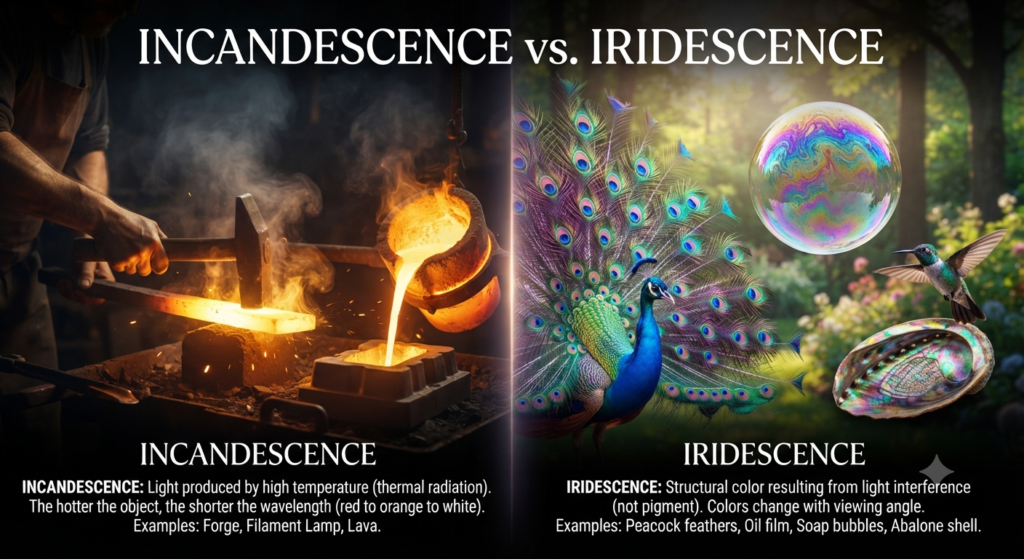
What Is Incandescence?
Incandescence is the production of visible light by an object that has been heated to a sufficiently high temperature. As temperature increases, atoms vibrate more intensely and emit electromagnetic radiation. When the temperature becomes high enough, part of this radiation falls within the visible spectrum, causing the object to glow.
The color of incandescent light changes with temperature—from dull red to orange, yellow, and eventually white or bluish-white as the object becomes hotter.
Common Examples
- Incandescent light bulbs
- Candle flames
- Molten iron
- Heated metal rods
- Lava
- The Sun and many stars
Key Characteristics of Incandescence
- Produced by heat
- Emits its own light
- Based on thermal radiation
- Continuous light spectrum
- Brightness increases with temperature
- Color depends on temperature
- Requires significant energy
- Visible glow at high temperatures
- Natural and artificial occurrence
- Used in lighting and heating
What Is Iridescence?
Iridescence is an optical phenomenon in which a surface appears to change color when viewed from different angles. Unlike pigments that absorb and reflect fixed wavelengths, iridescent colors are created by microscopic structures that interfere with reflected light.
The colors shift because different wavelengths undergo constructive and destructive interference depending on the viewing angle.
Common Examples
- Peacock feathers
- Butterfly wings
- Soap bubbles
- Oil films on water
- Opals
- Beetle shells
Key Characteristics of Iridescence
- Does not emit light
- Depends on reflected light
- Produced by microscopic structures
- Colors change with angle
- Highly colorful
- No heat required
- Structural coloration
- Common in nature
- Used in decorative materials
- Inspired by nanotechnology
Incandescence vs. Iridescence: Key Differences
1. Definition
Although both incandescence and iridescence involve visible light, they are produced through entirely different physical processes.
Incandescence is the emission of visible light from an object that has been heated to a sufficiently high temperature. As the object’s temperature rises, it emits thermal radiation, and when the temperature becomes high enough, part of this radiation falls within the visible spectrum, causing the object to glow. Common examples include incandescent light bulbs, molten metal, lava, and the Sun.
In contrast, iridescence is an optical phenomenon in which a surface appears to change color depending on the viewing or illumination angle. These shifting colors are not produced by pigments or heat but by the interference, diffraction, or scattering of light from microscopic surface structures. Peacock feathers, butterfly wings, soap bubbles, and opals are classic examples of iridescence.
This fundamental difference is the basis of Incandescence vs. Iridescence—incandescence generates light through heat, whereas iridescence creates changing colors by manipulating reflected light.
2. Light Production
One of the biggest differences between Incandescence vs. Iridescence is how visible light is produced.
Incandescence produces light directly. When an object is heated to a sufficiently high temperature, it emits thermal radiation across a broad range of wavelengths. As the temperature increases, a larger portion of this radiation falls within the visible spectrum, causing the object to glow. Since the object itself generates the light, incandescence is considered a self-luminous phenomenon.
In contrast, iridescence does not generate light. Instead, it depends entirely on an external light source such as sunlight or artificial illumination. The microscopic structures on an iridescent surface selectively reflect and interfere with incoming light, causing certain wavelengths to become more visible while others are suppressed. As the viewing or illumination angle changes, the reflected colors also change, creating the characteristic shimmering appearance.
This distinction makes Incandescence vs. Iridescence easy to understand: incandescence creates light through heat, whereas iridescence creates changing colors by manipulating reflected light.
3. Physical Mechanism
The underlying physical principles of Incandescence vs. Iridescence are fundamentally different.
Incandescence occurs because atoms and molecules within a material vibrate more vigorously as the temperature rises. These vibrations cause the object to emit electromagnetic radiation, known as thermal radiation. At sufficiently high temperatures, part of this radiation falls within the visible spectrum, producing a continuous range of colors described by blackbody radiation. The intensity and color of the emitted light are primarily determined by the object’s temperature.
In contrast, iridescence is not caused by heat but by the interaction of light with microscopic surface structures. These structures, such as thin films or multiple layered materials, cause incoming light waves to undergo interference, diffraction, and, in some cases, scattering. These optical effects selectively reinforce or cancel different wavelengths of light, producing brilliant colors that change with the viewing angle.
Therefore, the physical mechanism behind Incandescence vs. Iridescence is entirely different: incandescence is based on thermal radiation from heated objects, whereas iridescence results from the interference of reflected light by microscopic structures.
4. Temperature Dependence
Temperature is one of the most significant differences between Incandescence vs. Iridescence.
Incandescence is directly dependent on temperature. An object must be heated to a sufficiently high temperature before it begins to emit visible light. As the temperature increases, the emitted light becomes brighter and its color changes from dull red to orange, yellow, and eventually white or bluish-white. This relationship between temperature and emitted light is a defining characteristic of incandescence.
Iridescence, on the other hand, is essentially independent of temperature. It can be observed under normal environmental conditions without heating the material. The vibrant colors result from the interaction of external light with microscopic surface structures rather than from thermal energy. As long as sufficient illumination is available, the iridescent effect remains visible, regardless of the object’s temperature.
Thus, incandescence requires high temperatures to produce light, whereas iridescence produces angle-dependent colors without any need for heating.
5. Color Formation
The way colors are produced is one of the most noticeable differences between Incandescence vs. Iridescence.
In incandescence, the color of the emitted light is determined by the object’s temperature. As the temperature increases, the peak wavelength of the emitted thermal radiation shifts toward shorter wavelengths. A relatively cooler object glows dull red, then changes to orange and yellow as it becomes hotter, and eventually emits white or bluish-white light at very high temperatures. Because the color depends on temperature, it remains fairly uniform when viewed from different angles.
In iridescence, colors are created by the interference of reflected light rather than by heat. Microscopic surface structures selectively enhance or cancel specific wavelengths, producing vivid colors that often resemble a rainbow. These colors are highly dynamic and change continuously with the angle of illumination or observation, giving iridescent objects their distinctive shimmering appearance.
Therefore, incandescence produces temperature-dependent colors through thermal radiation, whereas iridescence produces angle-dependent colors through the interference of reflected light.
6. Viewing Angle
The effect of the viewing angle is another important distinction between Incandescence vs. Iridescence.
With incandescence, the emitted light appears nearly the same regardless of the observer’s position. Since the object generates light uniformly through thermal radiation, its brightness and color remain relatively constant when viewed from different angles. Any minor variations are usually due to the shape of the object or surrounding conditions rather than the light-producing mechanism itself.
In contrast, iridescence is highly dependent on the viewing and illumination angles. As the observer or light source moves, the interference of reflected light changes, causing different wavelengths to become more or less visible. This results in a dynamic display of shifting colors that can change dramatically with even a slight change in perspective.
Because of this behavior, viewing angle is one of the easiest ways to distinguish Incandescence vs. Iridescence. Incandescence maintains a relatively constant appearance from different directions, whereas iridescence produces vibrant colors that continuously change with the angle of observation.
7. Energy Source
The energy source responsible for these two optical phenomena is fundamentally different in Incandescence vs. Iridescence.
Incandescence requires thermal energy to produce light. This heat may come from electrical resistance, combustion, friction, or any process capable of raising an object’s temperature to the point where it emits visible radiation. For example, the tungsten filament in an incandescent light bulb glows because electrical energy is converted into heat, while molten metal and lava glow due to their extremely high temperatures.
Iridescence, in contrast, does not require heat or any internal energy source to create its colors. Instead, it relies on external illumination, such as sunlight or artificial lighting. The microscopic structures on the surface interact with incoming light by reflecting and interfering with different wavelengths, producing brilliant colors without generating light themselves.
Thus, incandescence depends on heat as its energy source to emit light, whereas iridescence depends on external light to produce its characteristic angle-dependent colors.
8. Natural Examples
Both incandescence and iridescence occur naturally, but they are produced by entirely different processes and are found in different environments.
Incandescence is commonly observed in extremely hot natural objects and phenomena. The Sun and other stars emit light through intense thermal processes, making them the most prominent examples of incandescence. On Earth, lava, molten rock, and forest fires glow because of their high temperatures. Even lightning plasma can briefly exhibit incandescent light due to the extremely hot ionized gases produced during an electrical discharge.
Iridescence, on the other hand, is widespread in nature and is typically found on the surfaces of plants, animals, and minerals. The brilliant colors of peacock feathers, butterfly wings, beetle shells, and hummingbird feathers are produced by microscopic structural patterns rather than pigments. Similar effects can also be seen in fish scales, seashells, opals, and even soap bubbles, where light interference creates shimmering, angle-dependent colors.
These natural examples clearly illustrate the difference in Incandescence vs. Iridescence: incandescence is associated with extremely hot objects that emit their own light, whereas iridescence occurs on structured surfaces that manipulate reflected light to produce changing colors.
9. Industrial Applications
Both incandescence and iridescence have important industrial applications, but they are used for entirely different purposes.
Incandescence is primarily used in applications where heat and light are required. Traditional incandescent light bulbs generate illumination by heating a tungsten filament until it glows. The principle of incandescence is also used in industrial heating elements, high-temperature furnaces, and metal processing, where materials must be heated to extreme temperatures. In addition, incandescent radiation is utilized in optical pyrometers and other non-contact temperature measurement instruments to estimate the temperature of hot objects based on the color and intensity of the emitted light.
Iridescence, in contrast, is valued for its ability to produce vibrant, angle-dependent colors without using pigments. It is widely used in security holograms and anti-counterfeiting labels on banknotes, passports, and identification cards. Iridescent coatings are also popular in automotive paints, decorative finishes, cosmetics, and jewelry because they create attractive color-shifting effects. In advanced technology, iridescent structures are incorporated into optical sensors, photonic materials, and nanotechnology-based devices that manipulate light for scientific and industrial applications.
Thus, incandescence is mainly applied in lighting and high-temperature engineering, whereas iridescence is primarily used in decorative, security, and advanced optical technologies.
10. Efficiency
The efficiency of Incandescence vs. Iridescence differs significantly because the two phenomena produce their visual effects in completely different ways.
Incandescence is relatively inefficient as a method of producing visible light. A large portion of the energy supplied to a heated object is converted into infrared radiation and heat rather than visible light. For example, traditional incandescent light bulbs transform only a small fraction of electrical energy into illumination, with the majority being released as heat. This results in higher energy consumption and lower lighting efficiency compared with modern lighting technologies.
Iridescence, on the other hand, is highly efficient because it does not generate light or require additional energy to produce its colors. Instead, it uses existing ambient light and manipulates it through microscopic surface structures to create brilliant, angle-dependent colors. Since no energy is expended to create the color itself, iridescent surfaces can produce vivid visual effects with minimal energy input.
Therefore, incandescence is less energy-efficient because much of its energy is lost as heat, whereas iridescence is highly efficient because it creates color by utilizing and redirecting existing light rather than producing it.
11. Scientific Importance
Both incandescence and iridescence are important scientific phenomena that contribute to our understanding of light, materials, and energy, although they are studied in different fields.
Incandescence is fundamental to the study of thermodynamics, heat transfer, and material science because it explains how heated objects emit electromagnetic radiation. The principles of incandescence are also essential in astrophysics, where scientists estimate the temperature, composition, and energy output of stars by analyzing the thermal radiation they emit. In engineering, the phenomenon helps researchers design high-temperature materials, heating systems, and thermal measurement instruments.
Iridescence, on the other hand, plays a significant role in optics, photonics, and nanotechnology. Scientists study iridescent structures to understand how microscopic surface patterns manipulate light through interference and diffraction. These principles have inspired advances in biomimicry, where natural iridescent surfaces such as butterfly wings and peacock feathers serve as models for developing innovative materials, optical devices, anti-counterfeiting technologies, and advanced surface engineering applications.
Thus, incandescence is primarily important for understanding thermal radiation and heat-related phenomena, whereas iridescence is essential for studying light manipulation, structural coloration, and modern optical technologies.
12. Appearance
The visual appearance of Incandescence vs. Iridescence is distinctly different, making it relatively easy to distinguish between the two phenomena.
Incandescence produces a bright, self-generated glow that appears relatively uniform from different viewing angles. Depending on the object’s temperature, the emitted light may range from deep red and orange to yellow, white, or bluish-white. Since the light originates from the object itself, its color generally remains constant under the same temperature conditions, giving it a steady and consistent appearance.
Iridescence, in contrast, creates a striking display of shimmering, metallic, or rainbow-like colors that continuously change as the viewing or illumination angle changes. The colors are not emitted by the object but are produced by the selective reflection and interference of light from microscopic surface structures. As a result, an iridescent surface appears dynamic, with shifting hues and brilliant reflections that vary during movement.
Therefore, incandescence is characterized by a stable, temperature-dependent glow, whereas iridescence is recognized by its vivid, angle-dependent color changes and shimmering appearance.
Similarities Between Incandescence and Iridescence
Although Incandescence vs. Iridescence have many differences, they also share several characteristics.
Some major similarities include:
- Both are optical phenomena.
- Both involve visible light.
- Both produce striking visual effects.
- Both occur naturally.
- Both have technological applications.
- Both are studied in optics.
- Both are influenced by electromagnetic radiation.
- Both are important in material science.
- Both inspire artistic designs.
- Both help scientists understand light behavior.
Advantages and Applications of Incandescence
Incandescence has been used for centuries in lighting and heating technologies.
Major advantages and applications include:
- Produces bright visible light
- Continuous light spectrum
- Simple operating principle
- Used in incandescent lamps
- Useful for heating elements
- Applied in metallurgy
- Important in temperature measurement
- Natural occurrence in stars
- Educational demonstrations
- Reliable thermal radiation source
Advantages and Applications of Iridescence
Iridescence offers unique visual effects without requiring pigments.
Major advantages and applications include:
- Brilliant structural colors
- No dyes required
- Energy-efficient coloration
- Decorative finishes
- Anti-counterfeiting technology
- Optical sensors
- High-end cosmetics
- Fashion and textiles
- Biomimetic materials
- Advanced nanotechnology research
Which Is Better—Incandescence or Iridescence?
Neither incandescence nor iridescence is universally better because they serve entirely different purposes.
Incandescence is ideal when light generation is required, such as in heating elements, incandescent lamps, and high-temperature applications.
Iridescence is preferred when dynamic color effects, decorative appearance, or advanced optical functionality are desired without generating light.
Conclusion
The comparison of Incandescence vs. Iridescence shows that although both are fascinating optical phenomena, they differ fundamentally in how they produce visible effects. Incandescence results from thermal radiation emitted by hot objects, while iridescence arises from microscopic surface structures that interfere with reflected light to create changing colors.
Understanding the differences between Incandescence vs. Iridescence helps students, researchers, engineers, designers, and nature enthusiasts appreciate the science behind glowing objects and the dazzling structural colors found throughout nature and modern technology.
Frequently Asked Questions (FAQs)
The main difference between Incandescence vs. Iridescence is that incandescence produces light through high temperatures, whereas iridescence creates changing colors by reflecting and interfering with external light.
No. Iridescence does not emit light. It reflects and modifies incoming light through microscopic surface structures.
Yes. An incandescent bulb emits visible light because its tungsten filament is heated to a very high temperature.
Butterfly wings contain microscopic layered structures that interfere with reflected light, producing brilliant colors that change with the viewing angle.
Yes. Although uncommon, an object can display both phenomena if it is hot enough to emit light while also having microscopic surface structures that create iridescent reflections.
Reference:
1. Craig Freudenrich. “How Light Works.” HowStuffWorks Science, Jan. 2020
2. “Incandescence.” Wikipedia, Wikimedia Foundation, 23 Feb. 2020
3. “Iridescence.” Wikipedia, Wikimedia Foundation, 16 Mar. 2020
Read Next: