The main difference in Phosphodiester Bond vs. Phosphoester Bond is that a phosphodiester bond connects a phosphate group to two organic molecules, forming the sugar-phosphate backbone of DNA and RNA, whereas a phosphoester bond connects a phosphate group to only one organic molecule. In simple terms, every phosphodiester bond contains two ester linkages, while a phosphoester bond contains only one.
Although both are covalent bonds involving a phosphate group, they differ in structure, formation, biological role, occurrence, and stability. Phosphodiester bonds are essential for storing and transmitting genetic information in nucleic acids, whereas phosphoester bonds are found in a wide variety of biomolecules, including ATP, phospholipids, sugars, proteins, and metabolic intermediates.
Phosphodiester Bond vs. Phosphoester Bond Comparison Table
The table below highlights the major differences between Phosphodiester Bond vs. Phosphoester Bond.
| Feature | Phosphodiester Bond | Phosphoester Bond |
|---|---|---|
| Definition | Bond where one phosphate group connects two organic molecules | Bond where one phosphate group connects one organic molecule |
| Number of Ester Linkages | Two | One |
| Main Occurrence | DNA and RNA | ATP, phospholipids, proteins, sugars, nucleotides |
| Primary Function | Forms the sugar-phosphate backbone of nucleic acids | Phosphate attachment for metabolism, signaling, and energy transfer |
| Molecules Connected | Two sugars or alcohol groups | One alcohol group and one phosphate |
| Bond Type | Covalent | Covalent |
| Biological Role | Genetic information storage | Energy metabolism and cellular regulation |
| Stability | Highly stable under physiological conditions | Varies depending on the molecule |
| Enzymes Involved | DNA polymerase, RNA polymerase, nucleases | Kinases, phosphatases, transferases |
| Hydrolysis | Broken mainly by nucleases | Broken mainly by phosphatases |
| Examples | DNA, RNA | ATP, glucose-6-phosphate, phospholipids |
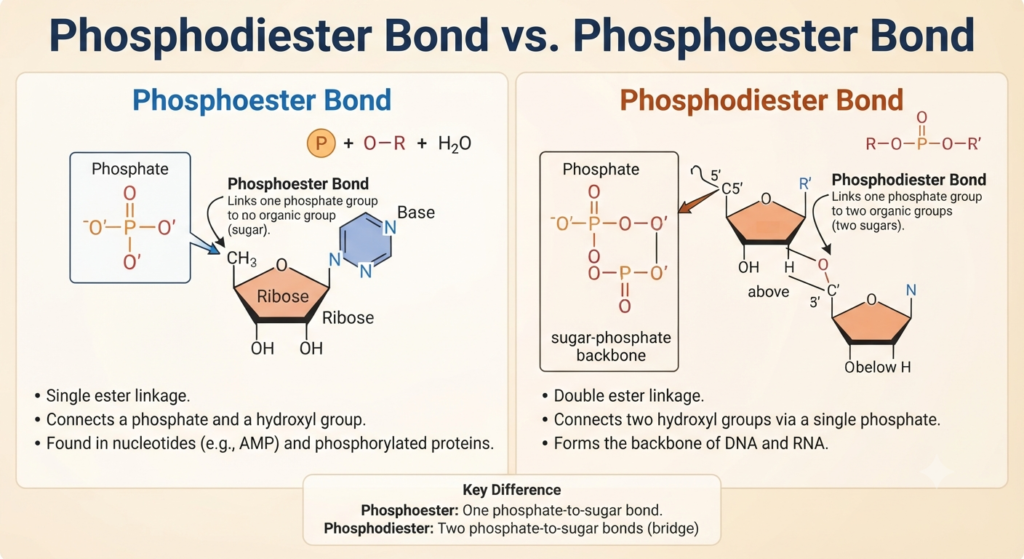
What Is a Phosphodiester Bond?
A phosphodiester bond is a strong covalent bond in which a single phosphate group forms two ester linkages, connecting adjacent nucleotides in DNA and RNA. This bond links the 3′ hydroxyl (-OH) group of one sugar molecule to the 5′ phosphate group of the next nucleotide, creating the continuous sugar-phosphate backbone of nucleic acids.
Without phosphodiester bonds, DNA and RNA molecules would not exist as long, stable chains capable of storing and transmitting genetic information. These bonds provide both structural integrity and flexibility, allowing nucleic acids to withstand normal cellular conditions while still being accessible during replication, transcription, and repair.
Phosphodiester bonds are formed through condensation (dehydration) reactions, in which a molecule of water is released as adjacent nucleotides become chemically linked. Specialized enzymes such as DNA polymerase and RNA polymerase catalyze this process during DNA replication and RNA synthesis.
Because of their remarkable stability, phosphodiester bonds protect genetic material from spontaneous breakdown while allowing specific enzymes to cleave them when DNA repair, recombination, or RNA degradation is required.
Characteristics of a Phosphodiester Bond
Phosphodiester bonds possess several unique characteristics that distinguish them from other phosphate-containing chemical bonds.
- Contains two ester linkages: A single phosphate group forms ester bonds with two separate sugar or alcohol molecules, giving the bond its name “diester.”
- Forms the backbone of DNA and RNA: Phosphodiester bonds connect adjacent nucleotides into long polynucleotide chains, creating the structural framework of nucleic acids.
- Strong covalent bond: These bonds are highly stable under normal physiological conditions, helping preserve genetic information over long periods.
- Links the 3′ and 5′ carbon atoms: The phosphate group joins the 3′ hydroxyl group of one nucleotide to the 5′ phosphate group of the next, establishing the characteristic 3′→5′ phosphodiester linkage.
- Created by dehydration synthesis: Formation of the bond involves the removal of a water molecule during nucleotide polymerization.
- Essential for genetic continuity: Stable phosphodiester linkages ensure accurate DNA replication, RNA transcription, and inheritance of genetic information.
Features of a Phosphodiester Bond
Phosphodiester bonds are indispensable for the structure and function of nucleic acids because they provide stability while supporting vital cellular processes.
- Creates a stable sugar-phosphate backbone: These bonds join nucleotides into continuous DNA and RNA strands, providing mechanical strength and maintaining molecular integrity.
- Provides structural flexibility: Despite being strong, phosphodiester bonds allow DNA to bend, coil, and supercoil, enabling efficient packaging inside chromosomes.
- Supports genetic information storage: The phosphodiester backbone positions nitrogenous bases in the correct sequence for storing hereditary information.
- Resists spontaneous hydrolysis: Under physiological conditions, phosphodiester bonds are relatively resistant to breakdown, ensuring long-term stability of genetic material.
- Enables DNA replication and transcription: DNA polymerase and RNA polymerase form phosphodiester bonds as they assemble new DNA and RNA strands.
- Allows controlled cleavage by enzymes: Specialized enzymes called nucleases can selectively break phosphodiester bonds during DNA repair, recombination, and RNA degradation.
- Maintains strand directionality: The repeating 3′→5′ phosphodiester linkage gives DNA and RNA strands their characteristic polarity, which is essential for accurate replication and protein synthesis.
Common Examples of Phosphodiester Bonds
Phosphodiester bonds are primarily found in nucleic acids and play a central role in molecular biology.
- DNA (Deoxyribonucleic Acid): Every nucleotide in DNA is connected by phosphodiester bonds, forming the sugar-phosphate backbone that stabilizes the double helix.
- RNA (Ribonucleic Acid): Messenger RNA (mRNA), transfer RNA (tRNA), ribosomal RNA (rRNA), and other RNA molecules all contain phosphodiester bonds linking adjacent ribonucleotides.
- Circular DNA: Plasmids found in bacteria and the mitochondrial DNA present in eukaryotic cells are also stabilized by phosphodiester linkages.
- Synthetic oligonucleotides: Laboratory-made DNA and RNA fragments used in PCR, DNA sequencing, CRISPR technology, and molecular diagnostics rely on phosphodiester bonds to maintain their structure.
- Gene editing and biotechnology applications: Artificial nucleic acids designed for research, gene therapy, and genetic engineering contain phosphodiester backbones similar to those found in natural DNA and RNA.
What Is a Phosphoester Bond?
A phosphoester bond is a covalent bond formed when a phosphate group is attached to a single alcohol (-OH) group of an organic molecule through an ester linkage. Unlike a phosphodiester bond, which connects two organic molecules via one phosphate group, a phosphoester bond links the phosphate group to only one molecule. These bonds are widely distributed in biological systems and play essential roles in energy transfer, cellular signaling, metabolism, membrane structure, and enzyme regulation.
Phosphoester bonds are found in numerous biomolecules, including ATP, phospholipids, sugar phosphates, nucleotides, coenzymes, and phosphorylated proteins. They are formed during phosphorylation reactions catalyzed by enzymes called kinases, while phosphatases remove phosphate groups by hydrolyzing these bonds. Because they participate in reversible phosphorylation, phosphoester bonds are fundamental to regulating cellular activities and metabolic pathways.
Characteristics of a Phosphoester Bond
Phosphoester bonds have several distinctive characteristics that make them different from phosphodiester bonds.
- Contains a single ester linkage: A phosphoester bond forms when one phosphate group is attached to a single alcohol or hydroxyl-containing organic molecule.
- Widely distributed in biological molecules: These bonds occur in ATP, phospholipids, nucleotides, carbohydrates, proteins, vitamins, and many metabolic intermediates.
- Strong covalent bond: Like phosphodiester bonds, phosphoester bonds are covalent and provide structural stability under normal physiological conditions.
- Formed during phosphorylation: Enzymes known as kinases transfer phosphate groups from ATP to target molecules, creating phosphoester bonds.
- Broken by hydrolysis: Phosphatase enzymes hydrolyze phosphoester bonds, removing phosphate groups during cellular regulation and metabolism.
- Essential for cellular metabolism: Phosphoester bonds participate in energy storage, enzyme activation, signal transduction, and biosynthetic pathways.
Features of a Phosphoester Bond
Phosphoester bonds contribute to numerous biological functions beyond the storage of genetic information.
- Connects phosphate to one organic molecule: Unlike phosphodiester bonds, phosphoester bonds involve only a single ester linkage between a phosphate group and an alcohol-containing molecule.
- Participates in energy metabolism: Many energy-rich compounds, including ATP and metabolic intermediates, contain phosphoester bonds that support cellular energy transfer.
- Supports cell signaling: Protein phosphorylation through phosphoester bond formation regulates enzyme activity, gene expression, and intracellular communication.
- Essential for membrane structure: Phospholipids contain phosphoester bonds that help form the phospholipid bilayer of cell membranes.
- Involved in carbohydrate metabolism: Sugar phosphates such as glucose-6-phosphate and fructose-6-phosphate contain phosphoester bonds that are essential for glycolysis and other metabolic pathways.
- Allows reversible phosphorylation: Cells continuously form and break phosphoester bonds to regulate biochemical reactions according to metabolic needs.
- Present in diverse biomolecules: Unlike phosphodiester bonds, phosphoester bonds occur in a wide range of biological compounds rather than being limited to nucleic acids.
Common Examples of Phosphoester Bonds
Phosphoester bonds are present in many biologically important molecules involved in metabolism, energy production, and cellular regulation.
- ATP (Adenosine Triphosphate): ATP contains phosphoester bonds between the ribose sugar and the phosphate group, making it the primary energy carrier in living cells.
- Glucose-6-phosphate: This phosphorylated sugar contains a phosphoester bond and serves as an important intermediate in glycolysis, glycogen synthesis, and the pentose phosphate pathway.
- Fructose-6-phosphate: Another key glycolytic intermediate, fructose-6-phosphate relies on a phosphoester linkage for its biological function.
- Phospholipids: The phosphate group is connected to glycerol through a phosphoester bond, helping form the structural framework of cell membranes.
- Phosphorylated proteins: Many enzymes and signaling proteins contain phosphoester bonds formed when phosphate groups are attached to amino acids such as serine, threonine, or tyrosine.
- Nucleotides (AMP, GMP, CMP, UMP): Individual nucleotides contain phosphoester bonds between the phosphate group and the sugar before they are linked together into DNA or RNA by phosphodiester bonds.
- Coenzymes and metabolic intermediates: Several coenzymes and phosphorylated metabolites involved in cellular respiration and biosynthesis also contain phosphoester bonds.
Phosphodiester Bond vs. Phosphoester Bond: Detailed Comparison
Although both bonds contain a phosphate group and are essential in biochemistry, they differ significantly in their structure, occurrence, biological function, stability, and enzymatic reactions.
1. Definition
A phosphodiester bond is a covalent bond in which one phosphate group connects two organic molecules through two ester linkages.
A phosphoester bond is a covalent bond in which one phosphate group is attached to a single organic molecule through one ester linkage.
2. Number of Ester Linkages
This is the most important structural difference.
- Phosphodiester bond: Contains two ester bonds.
- Phosphoester bond: Contains one ester bond.
The prefix “di” in phosphodiester literally means two ester linkages, while phosphoester contains only one.
3. Biological Occurrence
Phosphodiester bonds are found almost exclusively in DNA and RNA, where they link adjacent nucleotides into long chains.
Phosphoester bonds occur in a much wider variety of biological molecules, including:
- ATP
- Phospholipids
- Sugar phosphates
- Proteins
- Coenzymes
- Individual nucleotides
4. Primary Function
The primary role of phosphodiester bonds is to create the stable sugar-phosphate backbone of nucleic acids.
In contrast, phosphoester bonds are involved in energy transfer, metabolism, phosphorylation, membrane formation, and intracellular signaling.
5. Molecules Connected
A phosphodiester bond joins two sugar or alcohol groups using one phosphate bridge.
A phosphoester bond joins one phosphate group to a single alcohol-containing organic molecule.
6. Formation
Phosphodiester bonds are formed during:
- DNA replication
- RNA transcription
- Nucleotide polymerization
Phosphoester bonds are formed mainly during:
- Phosphorylation reactions
- ATP synthesis
- Biosynthetic pathways
- Metabolic reactions
7. Enzymes Involved
Different enzymes catalyze the formation and breakdown of these bonds.
Phosphodiester Bond:
- DNA polymerase
- RNA polymerase
- DNA ligase
- Nucleases
Phosphoester Bond:
- Protein kinases
- Phosphatases
- Phosphorylases
- Various metabolic enzymes
8. Stability
Phosphodiester bonds are highly stable under physiological conditions, protecting genetic information from spontaneous degradation.
Phosphoester bonds also exhibit good stability but are generally designed to undergo controlled phosphorylation and dephosphorylation during normal cellular metabolism.
9. Hydrolysis
Hydrolysis is the chemical process in which water breaks a chemical bond with the help of specific enzymes.
Phosphodiester bonds are relatively resistant to spontaneous hydrolysis, which helps preserve the integrity of DNA and RNA. However, specialized enzymes called nucleases can selectively cleave these bonds during DNA replication, repair, recombination, and RNA degradation.
Phosphoester bonds, on the other hand, are commonly hydrolyzed by phosphatases. Breaking these bonds removes phosphate groups from biomolecules, an essential process in regulating metabolism, enzyme activity, and cellular signaling.
10. Biological Importance
Both bond types are fundamental to cellular function but perform distinct roles.
Phosphodiester bonds create the sugar-phosphate backbone that gives DNA and RNA their structural stability. Without these bonds, genetic information could not be stored, copied, or transmitted accurately. They are therefore essential for DNA replication, transcription, protein synthesis, heredity, and evolution.
Phosphoester bonds participate in many biochemical pathways that sustain life. They enable ATP to store and transfer energy, allow proteins to be activated or deactivated through phosphorylation, contribute to the formation of cell membranes, and regulate metabolic pathways. These functions are vital for growth, signaling, and cellular homeostasis.
11. Overall Function
The overall functions of these bonds clearly distinguish them.
A phosphodiester bond primarily provides structural stability and continuity to nucleic acids, allowing DNA and RNA to store, replicate, and transmit genetic information.
A phosphoester bond primarily serves metabolic and regulatory functions, participating in phosphorylation reactions, energy storage, membrane formation, and cellular communication.
Similarities Between Phosphodiester Bond and Phosphoester Bond
Although Phosphodiester Bond vs. Phosphoester Bond highlights many differences, the two bonds also share several important characteristics.
- Both are covalent chemical bonds involving a phosphate group.
- Both are essential components of biological molecules.
- Both participate in numerous cellular processes.
- Both are formed through enzyme-catalyzed reactions.
- Both can be broken by hydrolysis using specific enzymes.
- Both contribute to the stability and function of biomolecules.
- Both are indispensable for normal cell growth and metabolism.
- Both are involved in nucleotide chemistry.
- Both occur naturally in living organisms.
- Both play critical roles in maintaining life at the molecular level.
Common Misconceptions About Phosphodiester Bond and Phosphoester Bond
Although these phosphate-containing bonds are related, they are frequently misunderstood. Here are some common myths and the correct facts.
Myth: Phosphodiester bonds and phosphoester bonds are the same chemical bond.
Fact: A phosphodiester bond contains two ester linkages, whereas a phosphoester bond contains only one ester linkage.
Myth: Phosphodiester bonds are found in every phosphorylated molecule.
Fact: Phosphodiester bonds are primarily found in DNA and RNA, while most phosphorylated molecules contain phosphoester bonds.
Myth: ATP contains only phosphodiester bonds.
Fact: ATP contains a phosphoester bond between ribose and the first phosphate group, while the phosphate groups are connected by phosphoanhydride bonds, not phosphodiester bonds.
Myth: Phosphoester bonds occur only in ATP.
Fact: Phosphoester bonds are also present in phospholipids, sugar phosphates, proteins, nucleotides, and numerous metabolic intermediates.
Myth: Both bonds perform identical biological functions.
Fact: Phosphodiester bonds mainly provide structural support for nucleic acids, whereas phosphoester bonds are involved in metabolism, signaling, membrane formation, and phosphorylation.
Myth: These bonds break down easily in cells.
Fact: Both bond types are relatively stable under normal physiological conditions and are usually cleaved only by specific enzymes.
Conclusion
Understanding the difference between Phosphodiester Bond vs. Phosphoester Bond is essential in molecular biology, biochemistry, and genetics. Although both are phosphate-containing covalent bonds, they differ significantly in their structure, occurrence, biological function, and enzymatic behavior.
A phosphodiester bond contains two ester linkages and primarily forms the sugar-phosphate backbone of DNA and RNA, providing the stability needed for genetic information storage and transmission. In contrast, a phosphoester bond contains a single ester linkage and is widely distributed in ATP, phospholipids, proteins, carbohydrates, and other biomolecules involved in metabolism and cell signaling.
Recognizing these differences helps students and researchers better understand DNA structure, RNA synthesis, phosphorylation, energy transfer, and numerous biochemical pathways that are fundamental to life.
Frequently Asked Questions (FAQs)
A phosphodiester bond contains two ester linkages and connects adjacent nucleotides in DNA and RNA, whereas a phosphoester bond contains one ester linkage and attaches a phosphate group to a single organic molecule.
Phosphodiester bonds are mainly found in DNA and RNA, where they connect neighboring nucleotides to form the sugar-phosphate backbone.
Phosphoester bonds occur in many biological molecules, including ATP, phospholipids, sugar phosphates, proteins, nucleotides, and metabolic intermediates.
DNA polymerase and RNA polymerase catalyze the formation of phosphodiester bonds during DNA replication and RNA transcription.
Phosphatases hydrolyze phosphoester bonds by removing phosphate groups from biomolecules.
Reference:
1. “13.10: Phosphoester Formation.” Libretext,
Read Next:
- Difference Between Ingroup and Outgroup in Biology
- Pinnatifid vs. Pinnatisect: Key Differences Explained
- Difference Between Wormwood and Sweet Wormwood
- Difference Between Hemolysis and Crenation
- Difference Between Cyst and Oocyst
- 1-Butene vs. 2-Butene: What’s the Difference?
- Chloride vs. Chlorite: What’s the Difference?
- Olefins vs. Paraffins: What’s the Difference?
- Olefin vs. Polypropylene: What’s the Difference?
- Cetyl Alcohol vs. Stearyl Alcohol: What’s the Difference?
- Teal vs. Turquoise
- Polycarbonate vs. Polyurethane
- Hydrogen Peroxide vs. Peroxide