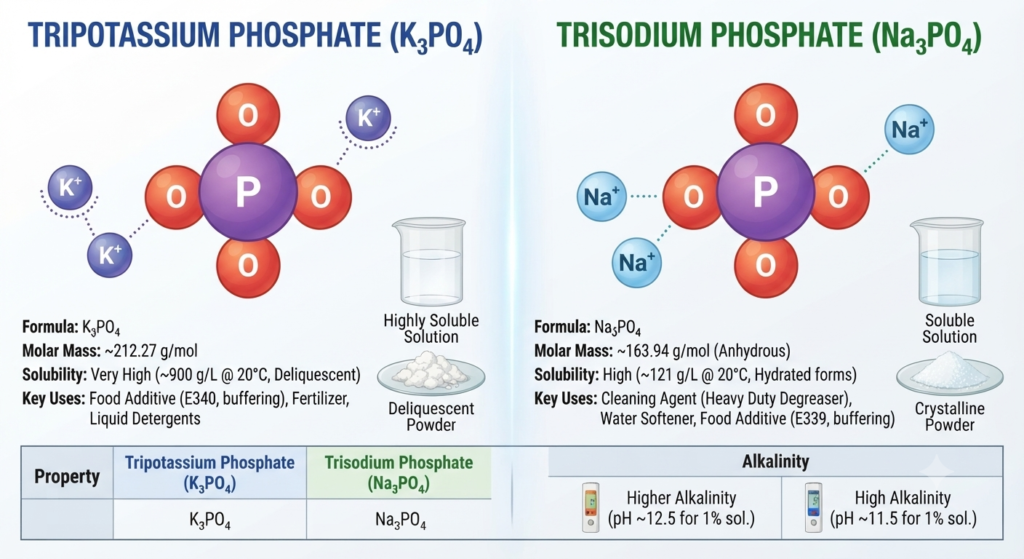
The main difference between Tripotassium Phosphate vs. Trisodium Phosphate is that tripotassium phosphate (K₃PO₄) contains potassium ions and is primarily used as a food additive, fertilizer, and buffering agent, whereas trisodium phosphate (Na₃PO₄) contains sodium ions and is mainly used as a cleaning agent, degreaser, water treatment chemical, and surface preparation compound. Although both are alkaline phosphate salts, they differ in chemical composition, solubility, applications, and industrial uses.
Understanding Tripotassium Phosphate vs. Trisodium Phosphate is important for chemists, food manufacturers, agricultural professionals, and industrial users because these compounds serve different purposes despite belonging to the same phosphate family. Their differences in cation composition, pH, safety considerations, and performance make selecting the appropriate compound essential for achieving the desired results.
Tripotassium Phosphate vs. Trisodium Phosphate Comparison Table
The table below highlights the major differences between Tripotassium Phosphate vs. Trisodium Phosphate.
| Feature | Tripotassium Phosphate | Trisodium Phosphate |
|---|---|---|
| Chemical Name | Tripotassium Phosphate | Trisodium Phosphate |
| Chemical Formula | K₃PO₄ | Na₃PO₄ |
| Cation Present | Potassium (K⁺) | Sodium (Na⁺) |
| Molecular Weight | 212.27 g/mol | 163.94 g/mol |
| Appearance | White crystalline powder | White crystalline powder |
| Water Solubility | Highly soluble | Highly soluble |
| Nature | Strongly alkaline | Strongly alkaline |
| pH in Solution | Approximately 11–12 | Approximately 12–13 |
| Food Additive | Yes | Limited food applications |
| Fertilizer Use | Common | Rare |
| Cleaning Ability | Moderate | Excellent |
| Buffering Capacity | Excellent | Good |
| Common Applications | Food processing, fertilizers, buffering solutions | Cleaning products, degreasers, paint preparation, water treatment |
What Is Tripotassium Phosphate?
Tripotassium phosphate (K₃PO₄) is an inorganic alkaline salt composed of three potassium ions (K⁺) and one phosphate ion (PO₄³⁻). It appears as a white crystalline powder that dissolves readily in water to produce a strongly alkaline solution.
It is widely used in the food industry as a pH regulator, emulsifier, and stabilizer. In agriculture, it serves as a valuable source of potassium and phosphorus in fertilizers. Tripotassium phosphate is also employed in industrial processes as a buffering agent, corrosion inhibitor, and chemical intermediate.
Because it supplies potassium rather than sodium, it is often preferred in applications where sodium content needs to be minimized.
Characteristics of Tripotassium Phosphate
- Chemical formula K₃PO₄
- White crystalline solid
- Highly water-soluble
- Strong alkaline nature
- Excellent buffering agent
- Rich source of potassium
- Common food additive
- Used in fertilizer production
- Non-flammable
- Hygroscopic (absorbs moisture from air)
What Is Trisodium Phosphate?
Trisodium phosphate (Na₃PO₄) is an inorganic compound consisting of three sodium ions (Na⁺) and one phosphate ion (PO₄³⁻). It is a white crystalline or granular solid that readily dissolves in water, producing a highly alkaline solution.
Trisodium phosphate is widely recognized as a powerful cleaning agent, degreaser, and surface preparation chemical. It is commonly used for removing grease, oil, mildew, and stubborn stains before painting or refinishing surfaces. It is also used in water treatment, industrial cleaning, and certain food-processing applications under regulated conditions.
Due to its strong alkalinity, trisodium phosphate is highly effective for heavy-duty cleaning but requires careful handling.
Characteristics of Trisodium Phosphate
- Chemical formula Na₃PO₄
- White crystalline or granular powder
- Highly water-soluble
- Strongly alkaline
- Excellent degreasing properties
- Effective cleaning agent
- Used in water treatment
- Removes grease and stains
- Non-flammable
- Requires careful handling due to high alkalinity
Tripotassium Phosphate vs. Trisodium Phosphate: Key Differences
1. Chemical Composition
The most fundamental difference between Tripotassium Phosphate vs. Trisodium Phosphate is their chemical composition.
Tripotassium phosphate consists of three potassium ions (K⁺) combined with one phosphate ion (PO₄³⁻), giving it the chemical formula K₃PO₄.
Trisodium phosphate consists of three sodium ions (Na⁺) combined with one phosphate ion (PO₄³⁻), resulting in the chemical formula Na₃PO₄.
Although both compounds belong to the phosphate family, the presence of different metal ions significantly influences their properties and applications.
2. Molecular Weight
The two compounds differ in molecular weight because potassium atoms are heavier than sodium atoms.
Tripotassium Phosphate
- Molecular weight: 212.27 g/mol
Trisodium Phosphate
- Molecular weight: 163.94 g/mol
This difference affects their concentration calculations in laboratory and industrial applications.
3. Appearance
Both compounds have a similar physical appearance.
Tripotassium Phosphate
- White crystalline powder
- Odorless
- Hygroscopic
Trisodium Phosphate
- White crystalline powder or granules
- Odorless
- Hygroscopic
Although visually similar, they are identified by their chemical composition rather than appearance.
4. Water Solubility
Both phosphate salts dissolve readily in water, but their solubility differs.
Tripotassium phosphate is more soluble in water, making it suitable for preparing concentrated buffer solutions and liquid fertilizers.
Trisodium phosphate is also highly soluble but generally exhibits slightly lower solubility than tripotassium phosphate under similar conditions.
Higher solubility often makes tripotassium phosphate preferable for applications requiring rapid dissolution.
5. Alkalinity (pH)
Both compounds produce alkaline solutions, but their alkalinity is slightly different.
Tripotassium Phosphate
- Produces a strongly alkaline solution
- Typical pH: 11–12
Trisodium Phosphate
- Produces a more strongly alkaline solution
- Typical pH: 12–13
Because of its higher alkalinity, trisodium phosphate is more effective for heavy-duty cleaning applications.
6. Primary Uses
One of the biggest differences between Tripotassium Phosphate vs. Trisodium Phosphate is their primary application.
Tripotassium phosphate is commonly used in:
- Food processing
- Beverage manufacturing
- Fertilizer production
- Buffer solutions
- Pharmaceutical formulations
- Laboratory reagents
Trisodium phosphate is widely used in:
- Household cleaners
- Industrial degreasers
- Paint surface preparation
- Water treatment
- Laundry detergents
- Industrial cleaning systems
Their intended uses reflect their different chemical properties.
7. Food Industry Applications
Food applications differ considerably.
Tripotassium phosphate is commonly approved as a food additive because it functions as:
- Acidity regulator
- Emulsifier
- Stabilizer
- Buffering agent
- Mineral supplement
Trisodium phosphate has more limited food applications and is primarily used in controlled quantities for specific food-processing purposes where permitted by regulations.
Tripotassium phosphate is therefore the preferred phosphate salt in many food formulations.
8. Agricultural Applications
Agricultural use is another important distinction.
Tripotassium phosphate is widely used as:
- Potassium fertilizer
- Phosphorus fertilizer
- Hydroponic nutrient source
- Plant nutrient supplement
Trisodium phosphate is rarely used as a fertilizer because sodium provides little nutritional value for most crops and excessive sodium may negatively affect soil quality.
9. Cleaning Performance
Cleaning efficiency is where trisodium phosphate excels.
Tripotassium phosphate
- Mild cleaning ability
- Moderate grease removal
- Mainly used where buffering is required
Trisodium phosphate
- Excellent grease removal
- Removes heavy dirt and grime
- Effective stain remover
- Used for cleaning concrete, walls, and painted surfaces
- Common in industrial degreasers
For heavy-duty cleaning, trisodium phosphate is generally the preferred option.
10. Buffering Capacity
Both compounds act as buffering agents, but tripotassium phosphate is more frequently selected for laboratory and food applications.
Tripotassium phosphate
- Excellent buffering performance
- Maintains stable pH
- Frequently used in biological and food systems
Trisodium phosphate
- Good buffering ability
- Mainly used in industrial chemical processes
Stable pH control makes tripotassium phosphate valuable in sensitive formulations.
11. Safety Considerations
Both compounds require proper handling due to their alkaline nature.
Tripotassium phosphate
- May irritate skin and eyes
- Avoid inhalation of dust
- Wear gloves and safety goggles
- Store in a dry place
Trisodium phosphate
- Stronger skin and eye irritant
- Can cause burns upon prolonged contact
- Avoid inhalation
- Use protective equipment during handling
Following standard chemical safety procedures minimizes health risks.
12. Industrial Applications
Both phosphate salts play important roles in industry, but their applications differ.
Tripotassium phosphate is commonly used in:
- Food manufacturing
- Pharmaceutical production
- Chemical synthesis
- Buffer preparation
- Fertilizer manufacturing
- Fermentation processes
Trisodium phosphate is widely used in:
- Industrial cleaning
- Boiler and cooling water treatment
- Surface preparation before painting
- Ceramic manufacturing
- Textile processing
- Metal cleaning
Selecting the appropriate phosphate depends on the intended industrial application and performance requirements.
Similarities Between Tripotassium Phosphate and Trisodium Phosphate
Although Tripotassium Phosphate vs. Trisodium Phosphate differ in their chemical composition and applications, they also share several important characteristics. Both are inorganic phosphate salts with alkaline properties and are widely used in industrial processes.
Some major similarities include:
- Both are inorganic phosphate compounds.
- Both contain the phosphate ion (PO₄³⁻).
- Both are white crystalline solids.
- Both dissolve readily in water.
- Both produce alkaline solutions.
- Both are used as pH regulators.
- Both are utilized in industrial manufacturing.
- Both require careful handling because of their alkalinity.
- Both are hygroscopic and absorb moisture from the air.
- Both are widely used in laboratories and chemical industries.
Advantages of Tripotassium Phosphate
Tripotassium phosphate is preferred in applications requiring potassium supplementation, pH stabilization, and food-grade ingredients.
Major advantages include:
- Excellent buffering capacity.
- Highly soluble in water.
- Supplies essential potassium.
- Widely approved as a food additive.
- Useful in fertilizer formulations.
- Supports hydroponic plant growth.
- Low sodium content.
- Suitable for pharmaceutical formulations.
- Helps stabilize food products.
- Effective in biological buffer solutions.
Advantages of Trisodium Phosphate
Trisodium phosphate is valued for its strong alkalinity and outstanding cleaning performance.
Major advantages include:
- Powerful degreasing action.
- Removes stubborn grease and oil.
- Excellent cleaning efficiency.
- Effective paint surface preparation.
- Prevents scale formation in water systems.
- Widely available and economical.
- Useful in heavy-duty industrial cleaning.
- Good pH adjustment capability.
- Effective in metal cleaning operations.
- Suitable for water treatment applications.
Which Is Better—Tripotassium Phosphate or Trisodium Phosphate?
Neither Tripotassium Phosphate nor Trisodium Phosphate is universally better because each compound is designed for different purposes.
Tripotassium phosphate is the better choice for applications involving food processing, pharmaceuticals, laboratory buffers, and fertilizers because it provides potassium instead of sodium and offers excellent buffering performance.
Trisodium phosphate, however, is the preferred option for industrial cleaning, degreasing, paint preparation, and water treatment due to its stronger alkalinity and superior ability to remove grease, oils, and stubborn contaminants.
In summary:
- Choose Tripotassium Phosphate for food, agricultural, laboratory, and buffering applications.
- Choose Trisodium Phosphate for cleaning, degreasing, and industrial maintenance.
Selecting the appropriate phosphate depends on the intended application, safety requirements, and desired chemical properties.
Conclusion
The comparison of Tripotassium Phosphate vs. Trisodium Phosphate shows that although both are alkaline phosphate salts, they differ significantly in chemical composition, pH, applications, and industrial uses. Tripotassium phosphate (K₃PO₄) contains potassium ions and is widely used in food processing, fertilizers, pharmaceuticals, and laboratory buffers. Trisodium phosphate (Na₃PO₄) contains sodium ions and is primarily used in cleaning products, water treatment, degreasing, and surface preparation.
Understanding Tripotassium Phosphate vs. Trisodium Phosphate helps chemists, engineers, food manufacturers, and industrial professionals select the right phosphate compound for specific applications. Choosing the appropriate chemical improves efficiency, product quality, and operational safety.
Frequently Asked Questions (FAQs)
The main difference between Tripotassium Phosphate vs. Trisodium Phosphate is that tripotassium phosphate contains potassium ions (K⁺), whereas trisodium phosphate contains sodium ions (Na⁺). Their chemical composition leads to different industrial and commercial applications.
Tripotassium phosphate is commonly used as a food additive because it functions as a pH regulator, stabilizer, and emulsifier in various food products. Trisodium phosphate has more limited food applications and is subject to regulatory restrictions depending on the country.
Trisodium phosphate is highly alkaline, making it very effective at breaking down grease, oil, dirt, and stains. This property makes it a popular ingredient in heavy-duty cleaners and degreasers.
Tripotassium phosphate is better for fertilizers because it supplies both potassium and phosphorus, two essential nutrients required for healthy plant growth.
Yes. Both tripotassium phosphate and trisodium phosphate dissolve readily in water and form strongly alkaline solutions.
Reference:
1. “Trisodium Phosphate.” Wikipedia, Wikimedia Foundation, 9 July 2018.
2. “Tripotassium Phosphate.” Wikipedia, Wikimedia Foundation, 3 July 2018.
Read Next: