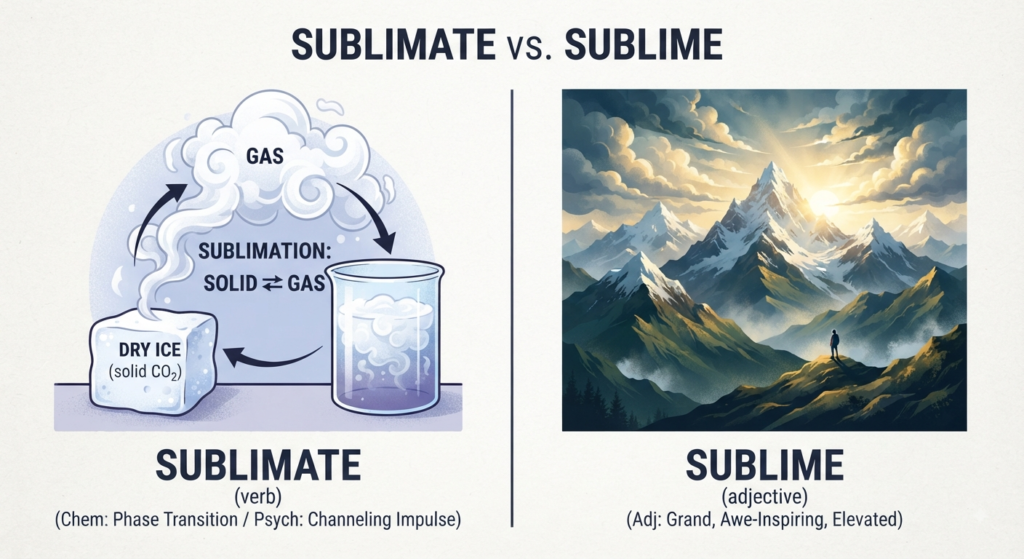
The main difference between Sublimate vs. Sublime is that sublimate is primarily a verb used to describe a scientific process in which a solid changes directly into a gas without becoming a liquid, while sublime is an adjective used to describe something exceptionally beautiful, impressive, excellent, or awe-inspiring. The two words look and sound similar, but they have different meanings, grammatical functions, and areas of use.
Sublimate is commonly associated with chemistry, physics, and psychology. In chemistry, a substance can sublimate when it changes directly from a solid state to a gaseous state. In psychology, sublimation refers to redirecting unacceptable impulses into socially constructive activities.
Sublime, on the other hand, is mainly used in everyday language, literature, art, philosophy, and aesthetics to describe something extraordinarily beautiful, impressive, or elevated.
Understanding Sublimate vs. Sublime is important because confusing these words can change the meaning of a sentence completely. Although both words are historically related to the idea of elevation or rising, their modern meanings are very different.
Sublimate vs. Sublime Comparison Table
The following table highlights the major differences between Sublimate vs. Sublime.
| Feature | Sublimate | Sublime |
|---|---|---|
| Basic Meaning | To change directly from a solid to a gas | Extremely beautiful, impressive, or excellent |
| Primary Word Type | Verb | Adjective; can also function as a noun or verb in some contexts |
| Main Field | Chemistry, physics, psychology | Literature, art, aesthetics, philosophy, everyday language |
| Scientific Meaning | Direct solid-to-gas phase change | No standard scientific phase-change meaning |
| Psychological Meaning | Redirect impulses into socially acceptable activities | Not normally used in this psychological sense |
| Physical State | Refers to a change of state | Does not describe a physical state |
| Emotional Meaning | Can describe psychological redirection | Describes awe, beauty, greatness, or excellence |
| Example | Dry ice can sublimate at room temperature | The mountain scenery was sublime |
| Common Context | Scientific and psychological | Artistic, literary, aesthetic, and general |
| Related Noun | Sublimation | Sublimity |
What Is Sublimate?
Sublimate is primarily a verb that describes the process in which a substance changes directly from a solid state to a gaseous state without passing through the liquid state.
This process is called sublimation.
For example, dry ice is solid carbon dioxide. Under ordinary atmospheric conditions, dry ice does not melt into a liquid. Instead, it changes directly from solid carbon dioxide into carbon dioxide gas. We can therefore say that:
Dry ice sublimates at room temperature.
The word sublimate is particularly common in chemistry and physics when discussing changes of state.
Sublimate in Chemistry
In chemistry, sublimation occurs when the vapor pressure of a solid becomes sufficient for molecules to escape directly into the gas phase.
Some substances that can undergo sublimation include:
- Dry ice
- Iodine
- Naphthalene
- Camphor
- Certain solid air fresheners
- Some frozen substances under suitable conditions
The reverse process, in which a gas changes directly into a solid, is generally called deposition.
Therefore:
Solid → Gas = Sublimation
Gas → Solid = Deposition
Characteristics of Sublimate
- Primarily used as a verb
- Describes a change in physical state
- Involves a solid changing directly into a gas
- Does not require an intermediate liquid state
- Commonly used in chemistry and physics
- Related to the noun sublimation
- Can also have a psychological meaning
- Often describes transformation or redirection
Common Examples of Sublimation
Some familiar examples include:
- Dry ice changing into carbon dioxide gas
- Iodine crystals producing violet vapor when heated
- Naphthalene gradually disappearing under suitable conditions
- Snow or ice slowly turning into water vapor in cold, dry environments
The exact conditions required for sublimation depend on the substance and surrounding pressure.
Sublimate in Psychology
The word sublimate also has a psychological meaning.
In psychology, to sublimate means to redirect an impulse, desire, or emotion that may be socially unacceptable into a more constructive or socially acceptable activity.
For example, a person experiencing strong aggressive feelings might channel that energy into:
- Sports
- Exercise
- Art
- Writing
- Music
- Creative work
In this context, the underlying impulse is not simply eliminated. Instead, it is redirected into a productive form.
This psychological meaning is associated with the concept of sublimation.
Therefore, the word sublimate can have two important meanings:
- Scientific: Change directly from solid to gas.
- Psychological: Redirect an impulse into a constructive or socially acceptable activity.
What Is Sublime?
Sublime is most commonly an adjective used to describe something of exceptional beauty, greatness, excellence, or grandeur.
It is often associated with feelings of admiration, wonder, or awe.
For example: The view from the mountain was sublime.
Here, sublime means extraordinarily beautiful or impressive.
The word can describe many things, including:
- Natural scenery
- Music
- Art
- Literature
- Architecture
- Ideas
- Experiences
- Human achievements
- Emotional or spiritual experiences
Sublime in Art and Literature
The word sublime has an important role in art, literature, and aesthetics.
An artistic work may be called sublime when it produces a powerful feeling of awe, wonder, grandeur, or emotional elevation.
For example:
The symphony created a sublime emotional experience.
In literature, sublime language may describe something so powerful or magnificent that it seems to transcend ordinary experience.
Nature is also frequently described as sublime, particularly when it combines beauty with immense scale or power.
Examples include:
- A huge mountain range
- A dramatic ocean
- A star-filled night sky
- A spectacular waterfall
- A powerful storm
- An extraordinary musical performance
Examples of Sublime Beauty
A breathtaking sunset, a vast mountain range, a powerful piece of music, or an extraordinary work of art may all be described as sublime.
For example:
The Himalayan landscape was sublime.
In this sentence, sublime does not describe a chemical or physical process. It describes the exceptional beauty and grandeur of the landscape.
Characteristics of Sublime
- Usually functions as an adjective
- Describes exceptional beauty or greatness
- Can express awe or admiration
- Common in literature and art
- Used in philosophical and aesthetic discussions
- Can describe experiences, emotions, or ideas
- Often suggests something elevated or extraordinary
Examples of Sublime
Example 1: The view from the mountain peak was sublime.
Here, sublime means extraordinarily beautiful or impressive.
Example 2: The musician delivered a sublime performance.
The word describes an exceptionally excellent performance.
Example 3: The sunset over the ocean was absolutely sublime.
Here, sublime expresses extraordinary beauty.
Example 4: The author’s description of nature was sublime.
The word describes the exceptional quality and emotional impact of the writing.
Sublimate vs. Sublime: Key Differences
1. Meaning
The most important difference between Sublimate vs. Sublime is their meaning.
Sublimate refers primarily to a process or action. In chemistry, it means that a solid changes directly into a gas.
Sublime describes something exceptionally impressive, beautiful, grand, or excellent.
For example:
The dry ice will sublimate.
The scenery was sublime.
The first sentence describes a physical process, while the second expresses admiration for something beautiful.
2. Part of Speech
Another important distinction is grammatical.
Sublimate is primarily used as a verb.
Example: The solid substance will sublimate when heated.
Sublime is most commonly an adjective.
Example: The painting was sublime.
Although sublime can have other grammatical uses in English, its most common modern use in this comparison is as an adjective describing exceptional quality or beauty.
3. Scientific vs. Aesthetic Meaning
Sublimate is strongly associated with scientific terminology.
Chemists and physicists use it when describing phase changes.
Sublime, by contrast, is strongly associated with aesthetics, literature, art, and philosophy.
It describes an experience or object that produces a strong sense of admiration, grandeur, or awe.
Therefore:
- Sublimate → scientific transformation
- Sublime → extraordinary beauty or greatness
4. Physical Transformation vs. Emotional Response
Sublimate can describe an actual physical transformation.
For example, solid carbon dioxide changes directly into gaseous carbon dioxide.
Sublime generally describes a person’s perception or response to something extraordinary.
For example, a beautiful landscape can produce a feeling of awe and may therefore be called sublime.
5. Chemistry vs. Literature
The contexts in which these words are used are also different.
Sublimate is common in:
- Chemistry
- Physics
- Material science
- Laboratory experiments
- Psychology
Sublime is common in:
- Literature
- Poetry
- Art
- Music
- Philosophy
- Aesthetics
- Everyday descriptions
6. Transformation vs. Excellence
Sublimate focuses on transformation.
A substance changes from one physical state to another, or an impulse is redirected into another form of expression.
Sublime focuses on excellence, grandeur, or beauty.
Something sublime rises above the ordinary in terms of quality or emotional impact.
Similarities Between Sublimate and Sublime
Although Sublimate vs. Sublime have different modern meanings, they are related historically.
Both words are associated with the idea of elevation or rising.
Their connection can be understood conceptually:
- Sublimate involves a substance rising directly from a solid state into a gaseous state.
- Sublime describes something that rises above the ordinary in beauty, greatness, or quality.
Both words can therefore suggest a movement from a lower or ordinary state toward something higher.
However, their actual modern uses are substantially different.
Major similarities include:
- Both words are related historically.
- Both are associated with elevation.
- Both can suggest movement beyond an ordinary state.
- Both can be used in figurative contexts.
- Both appear in academic and general English.
- Both can be associated with transformation or elevation in different senses.
Sublimate vs. Sublime: Common Mistakes
Because the words look similar, they are sometimes confused.
Incorrect Usage
The sunset was very sublimate.
This is incorrect if you mean that the sunset was exceptionally beautiful.
Correct Usage
The sunset was sublime.
Similarly:
Incorrect Usage
The dry ice became sublime.
This does not correctly describe the physical process.
Correct Usage
The dry ice sublimated.
Remember:
Sublimate = to undergo or cause sublimation
Sublime = extraordinarily beautiful, impressive, or excellent
Which Word Should You Use?
Choosing between sublimate and sublime depends on what you want to communicate.
Use sublimate when you are describing:
- A solid changing directly into a gas
- A chemical or physical process
- The redirection of an impulse or emotion
- A psychological process involving constructive expression
Use sublime when you are describing:
- Exceptional beauty
- Greatness
- Excellence
- Grandeur
- An awe-inspiring experience
- Artistic or literary quality
Choose Sublimate for:
- Chemistry
- Physics
- Phase changes
- Scientific writing
- Psychological redirection
Choose Sublime for:
- Art
- Literature
- Music
- Nature
- Beauty
- Excellence
- Awe-inspiring experiences
Conclusion
The comparison of Sublimate vs. Sublime shows that these similar-looking words have distinctly different meanings and applications.
Sublimate is primarily a verb associated with scientific transformation, particularly the direct conversion of a solid into a gas without passing through the liquid state. It can also describe the psychological process of redirecting an impulse or emotion into a socially constructive activity.
Sublime, on the other hand, is primarily an adjective used to describe exceptional beauty, greatness, excellence, or grandeur. It is especially common in literature, art, philosophy, music, and descriptions of extraordinary experiences.
The easiest way to remember the difference is:
Sublimate = physical or psychological transformation
Sublime = extraordinary beauty or excellence
Although both words are historically connected with the idea of elevation, they should not be used interchangeably. Understanding the distinction between Sublimate vs. Sublime helps improve both scientific writing and everyday English communication.
Frequently Asked Questions (FAQs)
The main difference between Sublimate vs. Sublime is that sublimate primarily refers to a process, especially the direct change of a solid into a gas, while sublime describes something exceptionally beautiful, impressive, excellent, or awe-inspiring.
In chemistry, sublimate means to change directly from a solid state to a gaseous state without passing through the liquid state.
Dry ice is a common example. Solid carbon dioxide changes directly into carbon dioxide gas rather than first becoming a liquid under ordinary atmospheric conditions.
Sublime means exceptionally beautiful, impressive, grand, excellent, or capable of inspiring awe and admiration.
Sublimate is primarily used as a verb when describing the process of changing directly from solid to gas or redirecting an impulse psychologically.
Read Next: