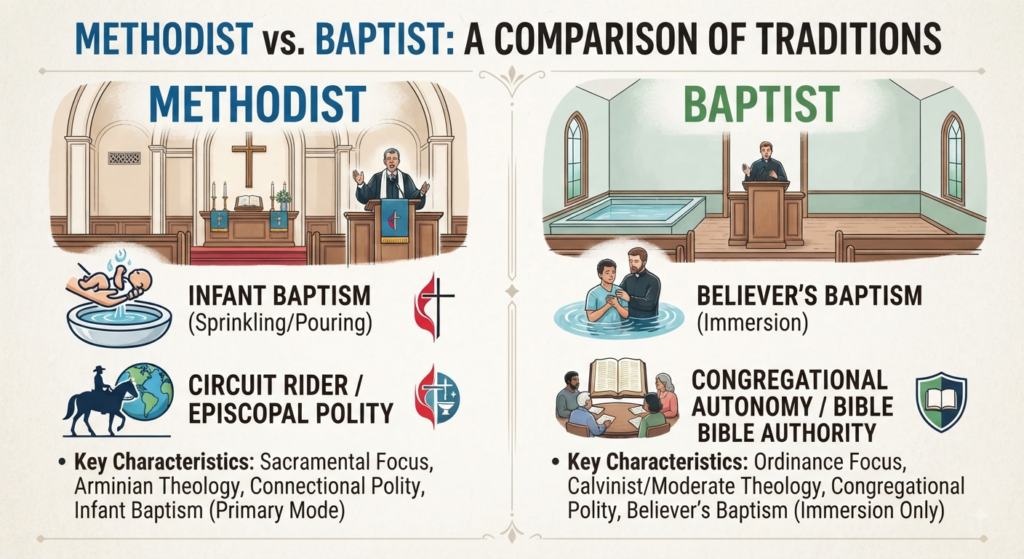
The main difference between Methodist vs Baptist Christianity is that Methodists generally practice both infant and believer baptism and are organized through connectional structures, while Baptists generally practice believer’s baptism by immersion and emphasize the autonomy of the local church. Methodists traditionally emphasize Wesleyan theology, prevenient grace, sanctification, and Christian holiness, whereas Baptists generally emphasize salvation by grace through faith, believer’s baptism, biblical authority, and congregational church governance.
Although Methodists and Baptists share many fundamental Christian beliefs—including the Trinity, the divinity of Jesus Christ, the authority of Scripture, prayer, salvation through Christ, baptism, the Lord’s Supper, evangelism, and Christian service—the two traditions differ in baptism, church governance, salvation theology, Communion, worship, and approaches to Christian discipleship.
Understanding Methodist vs Baptist differences can help students, researchers, Christians, and anyone interested in comparative religion understand how these two major Protestant traditions developed and how their beliefs and practices compare.
Methodist vs Baptist Comparison Table
The table below highlights the major differences between Methodist vs Baptist Christianity.
| Feature | Methodist | Baptist |
|---|---|---|
| Christian Tradition | Wesleyan Protestant Christianity | Baptist Protestant Christianity |
| Historical Origin | 18th-century Wesleyan revival within Anglicanism | 17th-century English Baptist movements |
| Key Historical Figures | John Wesley and Charles Wesley | John Smyth, Thomas Helwys, and other early Baptist leaders |
| Authority | Scripture is primary, interpreted with Tradition, Reason, and Experience | Scripture is the supreme authority for faith and practice |
| Church Governance | Generally connectional; many bodies have bishops and conferences | Congregational; individual churches generally govern themselves |
| Baptism | Infants and believers | Generally professing believers |
| Baptism Method | Sprinkling, pouring, or immersion may be used | Normally immersion |
| Lord’s Supper | Sacrament and means of grace | Ordinance generally understood as commemorative |
| Communion Frequency | Varies; often frequent | Varies; often monthly or quarterly |
| Salvation | Emphasizes prevenient, justifying, and sanctifying grace | Emphasizes salvation by grace through faith in Christ |
| Free Will | Generally affirms meaningful human response to grace | Varies; many Baptists emphasize human responsibility, while Calvinistic Baptists emphasize election |
| Sanctification | Strong emphasis on holiness and spiritual growth | Emphasized as growth in Christian discipleship |
| Infant Baptism | Generally accepted | Generally rejected |
| Believer’s Baptism | Accepted | Central practice |
| Papal Authority | Not recognized | Not recognized |
| Saints | Honored as Christian examples | Honored as examples but generally not invoked |
| Worship | Traditional, liturgical, or contemporary | Traditional or contemporary |
| Preaching | Important | Usually central |
| Hymn Singing | Strong historical tradition | Strong tradition, especially in evangelical worship |
| Evangelism | Important | Strong emphasis |
| Church Membership | Baptism and profession of faith, depending on denomination | Usually profession of faith and believer’s baptism |
| Major Spiritual Emphasis | Holiness, grace, discipleship, and Christian service | Faith, biblical teaching, evangelism, discipleship, and local church life |
Because Methodist and Baptist denominations are diverse, individual churches may differ in theology, worship, governance, and social teaching. The comparison above describes broad historical and denominational patterns rather than every Methodist or Baptist congregation.
What Is Methodism?
Methodism is a Protestant Christian tradition that developed during the 18th century, particularly through the ministry of John Wesley and Charles Wesley within the Church of England.
The Methodist movement began as a spiritual renewal movement emphasizing disciplined Christian living, Bible study, prayer, evangelism, small-group fellowship, and holiness.
A major feature of Methodist theology is its emphasis on grace. Wesleyan theology commonly describes God’s grace in several connected ways, including prevenient grace, justifying grace, and sanctifying grace.
Prevenient grace refers to God’s grace that comes before a person’s conscious response to God.
Justifying grace concerns forgiveness and reconciliation with God through faith in Christ.
Sanctifying grace describes God’s continuing work in believers as they grow in holiness and Christian love.
Methodists generally recognize two sacraments:
- Baptism
- The Lord’s Supper
Methodist churches may baptize infants or adults. Baptism may be administered by sprinkling, pouring, or immersion, depending on the denomination and congregation.
Methodist worship varies widely. Some churches retain traditional hymns and liturgical elements, while others use contemporary music, informal prayer, preaching, and modern worship formats.
Characteristics of Methodism
- Protestant Christian tradition
- Strong historical connection with John Wesley
- Scripture as the primary authority
- Wesleyan understanding of grace
- Strong emphasis on sanctification
- Emphasis on holiness of heart and life
- Baptism of infants and believers
- Two sacraments
- Strong tradition of hymn singing
- Emphasis on preaching and discipleship
- Christian service and social outreach
- Connectional organization in many denominations
- Wide range of worship styles
What Is the Baptist Tradition?
The Baptist tradition is a Protestant Christian movement that developed in the 17th century, particularly in England. Baptists became known for emphasizing believer’s baptism, religious liberty, the authority of Scripture, and the autonomy of the local church.
Baptists generally teach that baptism should follow a person’s conscious profession of faith in Jesus Christ. For this reason, most Baptist churches do not practice infant baptism.
Baptist baptism is normally performed by immersion, symbolizing the believer’s identification with the death, burial, and resurrection of Jesus Christ.
Baptists generally describe baptism and the Lord’s Supper as ordinances rather than sacraments in the Catholic sense. The precise theological explanation can vary among Baptist groups.
The Lord’s Supper is generally understood as a memorial observance that remembers Christ’s death and proclaims the gospel. Baptist churches differ in how frequently they celebrate Communion.
Baptist churches are also particularly associated with congregational governance. Individual congregations generally have substantial authority over their own pastors, finances, membership, and ministry decisions, although Baptist associations and conventions can cooperate in missions, education, and other activities.
Characteristics of Baptist Christianity
- Protestant Christian tradition
- Strong emphasis on biblical authority
- Believer’s baptism
- Baptism generally by immersion
- Rejection of infant baptism
- Congregational church governance
- Strong emphasis on preaching
- Evangelism and missions
- Local church autonomy
- Two ordinances: baptism and the Lord’s Supper
- Strong emphasis on personal faith
- Wide range of worship styles
- Strong tradition of Bible teaching
- Significant emphasis on Christian discipleship
Methodist vs Baptist: Key Differences
1. Baptism
Baptism is one of the clearest differences between Methodist vs Baptist Christianity.
Methodists generally permit both infant baptism and believer’s baptism. Depending on the congregation or denomination, baptism may be performed through sprinkling, pouring, or immersion.
Baptists generally practice baptism only for people who have personally professed faith in Jesus Christ. Baptist baptism is normally performed through immersion.
The basic distinction is:
Methodist: Infant and believer baptism; sprinkling, pouring, or immersion may be used.
Baptist: Believer’s baptism, normally by immersion.
For Baptists, believer’s baptism is closely associated with the idea that baptism should follow personal faith and conversion.
For Methodists, infant baptism is understood within a theology of God’s initiating grace and Christian covenant community.
2. Infant Baptism
Methodists and Baptists differ significantly over infant baptism.
Many Methodist churches baptize infants. The practice does not mean that the infant is making a personal profession of faith. Instead, Methodist theology commonly understands infant baptism as a sign of God’s grace and incorporation into the Christian community.
Baptists generally do not baptize infants because they believe baptism should follow an individual’s personal profession of faith.
Instead, Baptist churches may conduct baby dedication or child dedication. This ceremony differs from baptism because it does not represent the child’s personal profession of Christian faith.
Therefore:
Methodist: Infant baptism is generally accepted.
Baptist: Infant baptism is generally rejected; child dedication may be practiced instead.
3. Method of Baptism
The physical method of baptism is another major distinction.
Methodist churches may use:
- Sprinkling
- Pouring
- Immersion
Baptist churches overwhelmingly favor immersion.
For Baptists, immersion has particular symbolic significance because going beneath the water represents death and burial, while coming out of the water represents resurrection and new life.
Some Methodist congregations also practice immersion, but the tradition does not generally require one method in the same way many Baptist churches do.
4. Church Governance
Church governance is another important difference between Methodist vs Baptist Christianity.
Many Methodist denominations use a connectional system. Churches are connected to one another through conferences and regional or national structures. Bishops and other denominational leaders may have significant responsibilities.
Baptist churches generally emphasize local church autonomy.
A Baptist congregation normally has substantial authority over its own affairs. Members may participate directly in important decisions, including the selection of pastors and other major matters.
Baptist churches may belong to associations or conventions, but these organizations generally do not exercise the same authority over individual congregations that a connectional Methodist structure may exercise.
In simple terms:
Methodist: Connectional structure with conferences and, in many denominations, bishops.
Baptist: Congregational structure with strong local church autonomy.
5. Authority of Scripture
Both Methodists and Baptists place a high value on the Bible.
However, their theological approaches can differ.
Baptists generally emphasize the supreme authority of Scripture for Christian faith and practice. Individual Baptists and Baptist denominations may interpret Scripture differently, which contributes to considerable diversity within the Baptist tradition.
Methodists also regard Scripture as primary. Wesleyan theology traditionally considers Scripture alongside Tradition, Reason, and Experience, an approach often called the Wesleyan Quadrilateral.
This does not mean Methodists place the four elements on exactly the same level. Scripture remains foundational, while tradition, reason, and Christian experience help believers interpret and apply biblical teaching.
Therefore:
Methodist: Scripture is primary, interpreted within a Wesleyan framework involving Tradition, Reason, and Experience.
Baptist: Scripture is the supreme or final authority for faith and practice, with interpretation occurring within individual and denominational traditions.
6. Salvation
Both Methodists and Baptists teach that salvation comes through Jesus Christ and depends upon God’s grace.
However, their theological emphases can differ.
Methodist theology, particularly in the Wesleyan tradition, emphasizes God’s grace working throughout the process of salvation.
This includes:
- Prevenient grace
- Justifying grace
- Sanctifying grace
Prevenient grace prepares people to respond to God.
Justifying grace concerns forgiveness and acceptance through faith.
Sanctifying grace concerns continued growth in holiness and love.
Baptists generally emphasize salvation by grace through faith in Jesus Christ. Baptists commonly teach that a person must personally trust in Christ for salvation.
Many Baptist traditions strongly emphasize conversion, the new birth, assurance of salvation, and the believer’s personal relationship with Christ.
However, Baptist theology is diverse. Some Baptist groups are strongly Calvinistic, while others emphasize a greater role for human free response.
7. Free Will and Election
Methodist and Baptist traditions can also differ in how they understand free will and election.
Classical Wesleyan theology generally emphasizes that God’s prevenient grace enables people to respond freely to God’s invitation.
Many Baptists emphasize human responsibility to respond to the gospel. However, some Baptist denominations and churches hold Calvinistic views that strongly emphasize God’s sovereign election.
Therefore, there is no single Baptist position on free will and election.
A useful generalization is:
Methodist: Strong historical emphasis on prevenient grace and meaningful human response.
Baptist: Views vary considerably, ranging from strongly free-will traditions to Calvinistic approaches.
8. Sanctification and Holiness
Holiness is especially prominent in Methodist theology.
John Wesley taught that Christian life involves ongoing spiritual transformation. Methodists therefore place strong emphasis on sanctification and growth in Christian love.
The Methodist tradition has historically emphasized the possibility of growing in holiness through God’s grace.
Baptists also teach sanctification and Christian growth, but the terminology and theological emphasis can differ.
Baptist churches commonly emphasize:
- Bible study
- Prayer
- Discipleship
- Moral living
- Evangelism
- Fellowship
- Personal spiritual growth
Thus:
Methodist: Particularly strong historical emphasis on holiness and sanctification.
Baptist: Strong emphasis on discipleship and spiritual growth, with theological approaches varying among Baptist groups.
9. Communion or the Lord’s Supper
Both Methodists and Baptists celebrate the Lord’s Supper, but they often explain its meaning differently.
Methodists generally regard the Lord’s Supper as a sacrament and means of grace. Methodist theology affirms Christ’s presence in Communion without adopting the Catholic doctrine of transubstantiation.
Baptists generally describe the Lord’s Supper as an ordinance commanded by Christ. It is commonly understood as a memorial of Jesus’ death and an expression of Christian fellowship and faith.
The frequency also varies.
Methodist congregations may celebrate Communion weekly, monthly, or at other intervals.
Baptist churches commonly celebrate Communion monthly or quarterly, although some observe it more frequently.
Therefore:
Methodist: Sacramental understanding; Christ’s presence and grace are emphasized.
Baptist: Ordinance generally understood primarily as remembrance and proclamation of Christ’s death.
10. Worship Style
Methodist and Baptist worship can both be traditional or contemporary.
Methodist worship may include:
- Scripture readings
- Hymns
- Prayers
- Sermons
- Creeds
- Liturgical responses
- Contemporary worship music
- Communion
Baptist worship may include:
- Congregational singing
- Hymns
- Contemporary Christian music
- Scripture reading
- Sermons
- Prayer
- Testimonies
- Invitation or response
- Communion
Historically, Methodists have a particularly strong connection to hymnody through Charles Wesley and the Wesleyan revival.
Baptists also have a rich tradition of congregational singing, revival preaching, gospel music, and evangelistic services.
There is therefore considerable overlap in actual worship experiences.
11. Preaching
Preaching is important in both traditions.
Methodist worship commonly includes a sermon or proclamation of Scripture, often connected with practical Christian discipleship and holiness.
Baptist worship traditionally places particularly strong emphasis on biblical preaching.
Many Baptist churches devote a significant portion of the worship service to an extended sermon focused on biblical interpretation, Christian doctrine, evangelism, or practical application.
The distinction is therefore one of emphasis rather than an absolute difference.
Methodist: Preaching combined with liturgy, hymns, prayer, sacraments, and discipleship.
Baptist: Strong historical emphasis on biblical preaching and personal response to the gospel.
12. Church Membership
Methodist and Baptist churches can also differ in how membership is understood.
Methodist membership practices vary by denomination. Baptized Christians may become members through profession of faith, baptism, confirmation, or other forms of church affiliation.
Baptist churches generally place strong emphasis on personal profession of faith and believer’s baptism.
Because baptism is usually regarded as an outward expression of personal faith, many Baptist churches expect a person seeking membership to have experienced conversion and undergone believer’s baptism.
13. Evangelism
Both traditions emphasize evangelism and Christian mission.
Methodism has a strong historical tradition of evangelistic preaching, organized societies, missions, education, and social service.
Baptist churches have also developed extensive traditions of evangelism and missionary work.
Baptist emphasis on personal conversion has often produced a strong focus on sharing the gospel and inviting people to make a personal decision to follow Christ.
Methodists likewise emphasize evangelism but frequently connect it with social holiness and practical Christian service.
14. Social Service and Christian Action
Both Methodists and Baptists have long histories of Christian service.
Methodism has particularly emphasized the connection between personal holiness and social holiness. Methodist communities have historically been involved in education, poverty relief, healthcare, social reform, and charitable activities.
Baptists also have extensive traditions of missions, education, disaster relief, charitable work, and community outreach.
Both traditions therefore emphasize that Christian faith should influence practical life and service to others.
Similarities Between Methodists and Baptists
Despite their differences, Methodists and Baptists share a substantial Protestant Christian foundation.
Major similarities include:
- Both are Protestant Christian traditions.
- Both affirm the Trinity.
- Both believe Jesus Christ is the Son of God.
- Both affirm the death and resurrection of Jesus.
- Both regard the Bible as authoritative.
- Both practice baptism.
- Both celebrate the Lord’s Supper.
- Both emphasize personal faith in Christ.
- Both encourage prayer.
- Both emphasize Christian discipleship.
- Both support evangelism and missions.
- Both encourage moral Christian living.
- Both operate churches with ordained or recognized ministers.
- Both engage in charitable and community service.
- Both have traditional and contemporary worship expressions.
The two traditions therefore have much in common despite their differences in theology and church organization.
Historical Background of Methodists and Baptists
Understanding the historical origins of Methodist vs Baptist Christianity helps explain why the two traditions developed different practices.
Origins of Methodism
Methodism developed during the 18th century within the Church of England.
John Wesley and Charles Wesley became prominent leaders of a spiritual renewal movement emphasizing:
- Bible study
- Prayer
- Personal conversion
- Small-group fellowship
- Evangelism
- Christian discipline
- Holiness
- Service to others
The movement eventually developed into distinct Methodist churches and spread widely across Britain, North America, Africa, Asia, and other regions.
Origins of the Baptist Tradition
Baptist movements emerged in the 17th century in the context of English Separatism and the broader development of free-church Protestantism.
Early Baptists emphasized:
- Believer’s baptism
- Congregational church government
- Religious liberty
- Local church autonomy
- Biblical authority
- Personal Christian faith
Baptist churches later spread widely throughout North America and other parts of the world.
Methodist vs Baptist: Which Is More Similar to Evangelical Christianity?
Both Methodists and Baptists can be evangelical, although neither label applies identically to every denomination or congregation.
Baptist churches have historically had a particularly strong association with evangelical Christianity because of their emphasis on:
- Biblical preaching
- Personal conversion
- Believer’s baptism
- Evangelism
- Missions
- Personal Bible study
Methodism also contains strong evangelical traditions, particularly through the Wesleyan emphasis on conversion, grace, holiness, evangelism, and Christian discipleship.
Therefore, it would be inaccurate to say that every Methodist is less evangelical than every Baptist. Both traditions contain conservative, moderate, progressive, and evangelical expressions.
Methodist vs Baptist: Which Is More Conservative?
There is no universal answer because both Methodist and Baptist traditions contain significant theological diversity.
Some Baptist churches are strongly conservative and emphasize:
- Biblical inerrancy
- Traditional Christian morality
- Evangelism
- Conversion
- Believer’s baptism
Other Baptist churches hold more moderate or progressive theological positions.
Likewise, Methodist denominations and congregations vary considerably in their theological and social positions.
Therefore, the specific denomination and local congregation are more important than the label alone.
Advantages of the Methodist Tradition
The Methodist tradition offers several distinctive strengths for Christians who appreciate its theological and spiritual heritage.
Major characteristics include:
- Strong emphasis on God’s grace
- Deep Wesleyan tradition
- Emphasis on sanctification
- Strong focus on holiness
- Rich tradition of hymn singing
- Christian service and social outreach
- Small-group discipleship
- Evangelism
- Flexible baptism practices
- Connectional church structure
- Strong emphasis on practical Christian living
Advantages of the Baptist Tradition
The Baptist tradition offers several distinctive strengths.
Major characteristics include:
- Strong emphasis on Scripture
- Personal profession of faith
- Believer’s baptism
- Baptism by immersion
- Local church autonomy
- Strong biblical preaching
- Evangelistic emphasis
- Missionary tradition
- Congregational participation
- Strong discipleship programs
- Wide range of worship styles
Methodist vs Baptist: Which Is Right for You?
There is no universally correct answer to which tradition is “better.” Methodist and Baptist churches represent different approaches to baptism, governance, Communion, salvation theology, and Christian discipleship.
Someone who values Wesleyan theology, sanctification, holiness, infant baptism, connectional church structures, and a strong tradition of hymnody and Christian service may find Methodism attractive.
Someone who values believer’s baptism, immersion, local church autonomy, strong biblical preaching, personal conversion, and evangelical discipleship may find the Baptist tradition more appealing.
The decision ultimately depends on a person’s theological convictions and the particular church community they are considering.
Choose Methodism if you value:
- Wesleyan theology
- Prevenient, justifying, and sanctifying grace
- Strong emphasis on holiness
- Infant and believer baptism
- Flexible baptism methods
- Connectional church organization
- Historic hymnody
- Christian service
- Small-group discipleship
- Social outreach
Choose the Baptist tradition if you value:
- Believer’s baptism
- Baptism by immersion
- Local church autonomy
- Strong biblical preaching
- Personal conversion
- Evangelism
- Congregational participation
- Bible-centered discipleship
- Missions
- Memorial understanding of the Lord’s Supper
Conclusion
The comparison of Methodist vs Baptist Christianity reveals two Protestant traditions that share many foundational Christian beliefs while differing significantly in baptism, church governance, Communion, salvation theology, and approaches to Christian discipleship.
Methodism developed from the 18th-century Wesleyan revival and is particularly associated with grace, sanctification, holiness, discipleship, hymnody, and Christian service. Methodists generally accept both infant and believer baptism and may use sprinkling, pouring, or immersion.
The Baptist tradition developed from 17th-century English free-church movements and is particularly associated with believer’s baptism, baptism by immersion, biblical authority, personal conversion, evangelism, and local church autonomy.
One of the clearest differences is baptism. Methodists generally allow infant baptism, while Baptists normally require a personal profession of faith before baptism. Another major distinction concerns church organization: many Methodist bodies use connectional structures, while Baptist churches generally emphasize congregational independence.
Despite these differences, Methodists and Baptists share a substantial Christian foundation. Both affirm the Trinity, Jesus Christ, Scripture, prayer, baptism, the Lord’s Supper, evangelism, Christian morality, discipleship, and service.
Understanding Methodist vs Baptist differences is therefore useful not only for identifying theological distinctions but also for appreciating the diversity within Protestant Christianity. Although the two traditions developed in different historical contexts and emphasize different aspects of Christian faith, both seek to follow Jesus Christ through worship, Scripture, community, discipleship, mission, and service.
Frequently Asked Questions (FAQs)
The main difference between Methodist vs Baptist Christianity is that Methodists generally practice both infant and believer baptism and use connectional church structures, while Baptists generally practice believer’s baptism by immersion and emphasize local church autonomy.
Yes. Both Methodists and Baptists are generally classified as Protestant Christian traditions.
Yes. Most Methodist traditions permit or practice infant baptism. They may also baptize adult believers. Baptism may be performed through sprinkling, pouring, or immersion depending on the denomination and congregation.
Generally, no. Baptist churches usually practice believer’s baptism and therefore require a personal profession of faith before baptism. Many Baptist churches instead practice child or baby dedication.
Yes. Methodist churches may practice baptism by immersion, but many also permit sprinkling or pouring. Therefore, immersion is accepted in Methodism but is not generally the only method.
Read Next: