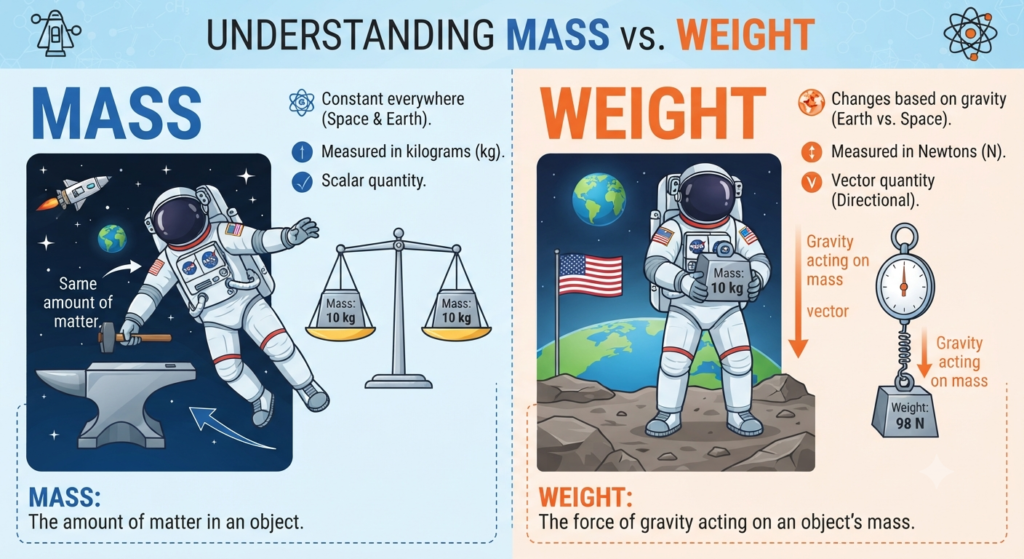
The main difference between weight vs. mass is that mass is the amount of matter in an object, while weight is the gravitational force acting on that mass. Although these terms are often used interchangeably in everyday conversation, they have different meanings in physics. Mass remains constant regardless of location, whereas weight changes with the strength of gravity.
Understanding weight vs. mass is essential for students, engineers, and science enthusiasts because it explains why an object has the same mass on Earth, the Moon, or in space, even though its weight can vary significantly.
The relationship between weight and mass is expressed by the following equation:
Where:
- W = Weight (Newton, N)
- m = Mass (Kilogram, kg)
- g = Acceleration due to gravity (9.81 m/s² on Earth)
For example, if an object has a mass of 15 kg, its weight on Earth is:
If the same object is taken to the Moon, where gravity is approximately 1.62 m/s², its weight becomes:
Notice that the mass remains 15 kg, but the weight decreases because the Moon has weaker gravity.
Weight vs Mass: Comparison Table
The table below highlights the major differences between weight and mass.
| Feature | Mass | Weight |
|---|---|---|
| Definition | The amount of matter present in an object. | The gravitational force acting on an object’s mass. |
| Meaning | Measures how much matter an object contains. | Measures how strongly gravity pulls on an object. |
| Depends On | Amount of matter only. | Mass and gravitational acceleration (g). |
| Effect of Gravity | Not affected by gravity. | Directly affected by gravity. |
| Changes with Location | No, it remains the same everywhere. | Yes, it changes with the strength of gravity. |
| Physical Quantity | Scalar quantity. | Vector quantity. |
| Direction | Has magnitude only. | Has both magnitude and direction (toward the center of gravity). |
| SI Unit | Kilogram (kg). | Newton (N). |
| Other Common Units | Gram (g), milligram (mg), tonne (t). | Kilonewton (kN), pound-force (lbf). |
| Formula | No formula; it is a fundamental property of matter. | W = m × g |
| Measuring Instrument | Beam balance or electronic balance. | Spring balance or force meter. |
| Can It Be Zero? | Only if no matter exists. | Yes, in the absence of gravity or during free fall. |
| Value on Earth and Moon | Remains the same. | Smaller on the Moon because gravity is weaker. |
| Relation to Inertia | Determines an object’s inertia. | Does not determine inertia. |
| Example | A 10 kg object has a mass of 10 kg on Earth, the Moon, and Mars. | The same object weighs about 98.1 N on Earth but only about 16.2 N on the Moon. |
What Is Mass?
Mass is the measure of the amount of matter present in an object. It is an intrinsic property, meaning it does not depend on gravity or the object’s location. Whether an object is on Earth, the Moon, Mars, or floating in outer space, its mass remains exactly the same.
Mass also represents an object’s inertia, which is its resistance to changes in motion. Objects with greater mass require more force to accelerate than objects with smaller mass.
Characteristics of Mass
- Measures the amount of matter in an object.
- Remains constant regardless of location.
- Independent of gravitational force.
- Scalar quantity with magnitude only.
- Measured in kilograms (kg), grams (g), or tonnes (t).
- Determined using a beam balance or electronic balance.
- Cannot become zero unless no matter exists.
- Used in calculations involving momentum, inertia, and density.
What Is Weight?
Weight is the force exerted by gravity on an object’s mass. Unlike mass, weight depends on the strength of the gravitational field. As gravity changes from one planet to another, the weight of an object changes even though its mass remains constant.
For this reason, astronauts weigh much less on the Moon than they do on Earth, but their mass does not change.
Characteristics of Weight
- Measures the force of gravity acting on an object.
- Depends on both mass and gravitational acceleration.
- Changes with location and planet.
- Vector quantity with both magnitude and direction.
- Always acts toward the center of the Earth or another celestial body.
- Measured in Newtons (N).
- Determined using a spring balance or force meter.
- Can become nearly zero in a gravity-free environment or during free fall.
Units of Mass and Weight
One of the most common sources of confusion in weight vs. mass is their units. Although people often say they “weigh 70 kilograms,” the kilogram is actually a unit of mass, not weight.
Units of Mass
Mass is measured in units that represent the amount of matter in an object.
Common units include:
- Milligram (mg)
- Gram (g)
- Kilogram (kg)
- Metric tonne (t)
The SI unit of mass is the kilogram (kg).
Units of Weight
Weight is a force, so it is measured using units of force.
Common units include:
- Newton (N)
- Kilonewton (kN)
- Pound-force (lbf) in the U.S. customary system
The SI unit of weight is the Newton (N).
On Earth:
1 kg mass weighs approximately 9.81 N
because
Examples of Weight vs. Mass
Understanding weight vs. mass becomes much easier with practical examples.
Example 1: Person on Earth and Moon
Suppose a person has a mass of 70 kg.
| Location | Mass | Gravity (m/s²) | Weight |
|---|---|---|---|
| Earth | 70 kg | 9.81 | 686.7 N |
| Moon | 70 kg | 1.62 | 113.4 N |
The person’s mass remains 70 kg, but their weight decreases by about 83% on the Moon because the Moon’s gravity is much weaker.
Example 2: School Bag
A school bag has a mass of 5 kg.
- On Earth: Weight = 5 × 9.81 = 49.05 N
- On Mars: Weight = 5 × 3.71 = 18.55 N
Even though the bag has the same mass, it feels much lighter on Mars because gravity is weaker than on Earth.
Example 3: Astronaut in Space
Astronauts floating inside a spacecraft appear weightless.
- Mass: Remains exactly the same.
- Weight: Becomes nearly zero because they are in continuous free fall around the Earth.
This is why astronauts experience microgravity, not because they lose their mass.
Weight vs. Mass in Everyday Life
The difference between weight vs. mass can be seen in many everyday situations. Although people often use the two terms interchangeably, science treats them differently. Understanding these examples makes it easier to distinguish between mass and weight.
1. Weighing Yourself on a Bathroom Scale
When you stand on a bathroom scale, it usually displays your value in kilograms (kg). Technically, the scale measures the force (weight) acting on your body due to gravity and then converts it into an equivalent mass assuming Earth’s gravity.
- Mass: Remains the same.
- Weight: Depends on Earth’s gravity.
2. Traveling to the Moon
Suppose your mass is 60 kg.
- Mass on Earth: 60 kg
- Mass on Moon: 60 kg
- Weight on Earth: About 589 N
- Weight on Moon: About 97 N
Although your mass does not change, you would feel much lighter on the Moon because gravity is weaker.
3. Lifting a Box
Imagine lifting a 25 kg box.
- The mass of the box is always 25 kg.
- The weight of the box depends on the gravitational pull where it is located.
A person would find the box easier to lift on the Moon than on Earth because its weight is much lower.
4. Cargo Transport in Space
Engineers planning space missions must know both mass and weight.
- Mass determines how much fuel is needed to accelerate a spacecraft.
- Weight determines the gravitational force acting on the spacecraft during launch and landing.
Even in deep space, a spacecraft still has mass, although its weight may be nearly zero.
Why Do People Confuse Weight and Mass?
Many people confuse weight vs. mass because they appear to have the same value in everyday life. On Earth, gravity remains almost constant, so a person with a mass of 70 kg is commonly said to “weigh 70 kg.”
In reality:
- 70 kg is the person’s mass.
- Their actual weight is approximately 686.7 Newtons (N).
This confusion also exists because:
- Most household scales display mass in kilograms instead of force in Newtons.
- Everyday language uses “weight” to describe body mass.
- Earth’s gravity changes very little from one location to another, so the difference is rarely noticeable.
In science and engineering, however, distinguishing between mass and weight is essential for accurate calculations.
Applications of Weight and Mass
Understanding weight vs. mass is important in many scientific and engineering fields.
| Field | Applications |
|---|---|
| Physics | Studying motion and forces, applying Newton’s laws of motion, calculating momentum and inertia |
| Mechanical Engineering | Machine design, structural load calculations, force analysis |
| Civil Engineering | Designing bridges, building foundations, and load-bearing structures |
| Aerospace Engineering | Rocket design, satellite launches, space exploration |
| Aviation | Aircraft weight and balance, fuel calculations, safe flight operations |
| Sports Science | Strength training, athletic performance analysis, exercise equipment design |
| Medical Science | Measuring body mass, calculating medication dosages, monitoring patient growth |
Common Mistakes About Weight vs. Mass
Avoid these common misconceptions:
- Mass and weight are the same.
Correct: Mass is the amount of matter, while weight is the force of gravity acting on that matter. - Weight is measured in kilograms.
Correct: The SI unit of weight is the Newton (N). - Mass changes on different planets.
Correct: Mass remains constant regardless of location. - Objects become massless in space.
Correct: Objects retain the same mass even in outer space; only their weight changes. - Heavier objects fall faster because they have more mass.
Correct: In the absence of air resistance, all objects accelerate at the same rate due to gravity.
Conclusion
Understanding weight vs. mass is essential because these two terms describe different physical quantities. Mass is the amount of matter contained in an object and remains constant regardless of location, while weight is the gravitational force acting on that mass and changes with the strength of gravity.
Although the difference is often unnoticed in everyday life because Earth’s gravity is nearly constant, it becomes significant in physics, engineering, aviation, and space exploration. For example, a person has the same mass on Earth and the Moon but weighs much less on the Moon due to its weaker gravitational pull.
By remembering that mass is measured in kilograms (kg) and weight is measured in Newtons (N), you can avoid one of the most common scientific misconceptions. Whether you’re studying physics, designing machines, or simply curious about how gravity works, understanding weight vs. mass provides a strong foundation for many scientific concepts.
Frequently Asked Questions (FAQs)
The main difference between weight vs. mass is that mass is the amount of matter in an object, whereas weight is the gravitational force acting on that mass. Mass remains constant everywhere, while weight changes depending on the strength of gravity.
Yes. The mass of an object remains the same regardless of its location. Whether you are on Earth, the Moon, or Mars, your mass does not change because the amount of matter in your body remains constant.
Weight changes because each planet has a different gravitational force. Since weight = mass × gravity (W = m × g), an object weighs less on planets or moons with weaker gravity and more on planets with stronger gravity.
The SI unit of mass is the kilogram (kg).
The SI unit of mass is the kilogram (kg).
Read Next: