The main difference between Biramous Arthropods vs. Uniramous Arthropods is that biramous arthropods possess branched appendages, where each limb divides into two branches (an inner endopod and an outer exopod), whereas uniramous arthropods have unbranched appendages consisting of a single series of segments. Biramous appendages are primarily found in crustaceans and are well adapted for swimming and multiple functions, while uniramous appendages are characteristic of insects, arachnids, and myriapods and are mainly specialized for walking, feeding, sensing, or reproduction.
Understanding the difference between Biramous Arthropods vs. Uniramous Arthropods is important for students, zoologists, evolutionary biologists, taxonomists, and researchers because these two appendage types represent distinct evolutionary adaptations that influence locomotion, respiration, habitat, feeding behavior, and overall body organization.
Biramous Arthropods vs. Uniramous Arthropods Comparison Table
The table below highlights the major differences between Biramous Arthropods vs. Uniramous Arthropods.
| Feature | Biramous Arthropods | Uniramous Arthropods |
|---|---|---|
| Definition | Arthropods with branched appendages | Arthropods with unbranched appendages |
| Appendage Structure | Two branches (endopod and exopod) | Single branch |
| Number of Limb Branches | Two | One |
| Main Function | Swimming, feeding, walking, respiration | Walking, grasping, feeding, sensing |
| Typical Habitat | Mostly aquatic | Mostly terrestrial |
| Common Groups | Crustaceans | Insects, arachnids, myriapods |
| Examples | Crab, shrimp, lobster, crayfish | Ant, butterfly, spider, centipede |
| Respiration | Mainly gills | Tracheae, book lungs, or tracheal system |
| Limb Complexity | More complex | Simpler |
| Adaptation | Multi-functional limbs | Specialized limbs |
| Evolutionary Significance | Primitive appendage type | Derived appendage type |
| Locomotion | Swimming and crawling | Walking, jumping, climbing, flying |
| Antennae | Usually two pairs | Usually one pair or absent (arachnids) |
| Body Environment | Aquatic ecosystems | Terrestrial ecosystems |
| Diversity | Less species diversity | Extremely diverse |
What Are Biramous Arthropods?
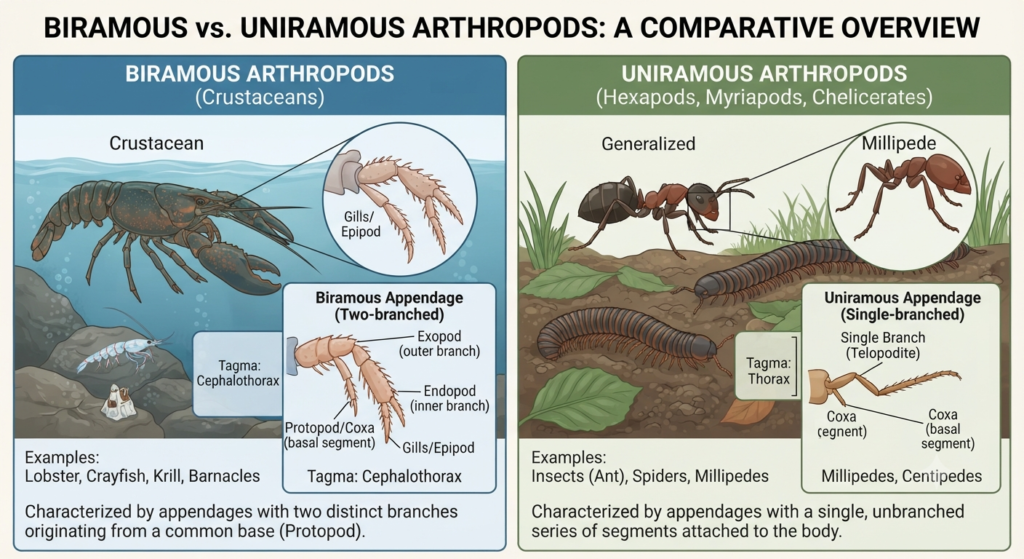
Biramous arthropods are arthropods whose appendages divide into two distinct branches. Each limb originates from a common base called the protopod, which gives rise to an endopod (inner branch) and an exopod (outer branch). These branches may perform different functions, allowing a single appendage to contribute to movement, feeding, respiration, or sensory activities simultaneously.
Biramous appendages are considered one of the earliest limb designs in arthropod evolution and are most commonly found in crustaceans. Because most crustaceans live in aquatic environments, branched appendages provide excellent efficiency for swimming while also supporting other biological functions such as handling food and circulating water over the gills.
Characteristics of Biramous Arthropods
- Possess branched appendages
- Each limb has an endopod and exopod
- Usually aquatic
- Mostly belong to Crustacea
- Efficient swimmers
- Often have two pairs of antennae
- Respire through gills
- Exoskeleton made of chitin, often strengthened with calcium salts
- Body divided into cephalothorax and abdomen in many species
- Limbs may perform multiple functions simultaneously
Examples of Biramous Arthropods
- Crab
- Lobster
- Shrimp
- Prawn
- Crayfish
- Krill
- Copepods
- Water flea (Daphnia)
What Are Uniramous Arthropods?
Uniramous arthropods are arthropods whose appendages consist of a single, unbranched series of segments. Unlike biramous limbs, these appendages do not divide into two branches. Instead, each appendage is usually modified to perform one primary function, such as walking, feeding, grasping prey, sensing the environment, or reproduction.
Uniramous appendages are characteristic of insects, arachnids, and myriapods. These animals are predominantly terrestrial and have evolved specialized limbs that enable efficient movement on land. The remarkable adaptability of uniramous appendages has contributed to the enormous evolutionary success of insects, which represent the largest group of animals on Earth.
Characteristics of Uniramous Arthropods
- Possess unbranched appendages
- Limbs consist of a single segmented branch
- Mostly terrestrial
- Highly specialized appendages
- Efficient for walking, climbing, running, and flying
- Respiration through tracheae or book lungs
- Usually one pair of antennae in insects (none in arachnids)
- Extremely diverse body forms
- Occupy nearly every terrestrial habitat
- Include the largest number of arthropod species
Examples of Uniramous Arthropods
- Ant
- Butterfly
- Grasshopper
- Beetle
- Housefly
- Spider
- Scorpion
- Centipede
- Millipede
- Cockroach
Biramous Arthropods vs. Uniramous Arthropods: Key Differences
1. Definition
The most fundamental difference between Biramous Arthropods vs. Uniramous Arthropods lies in the structure of their appendages.
Biramous arthropods possess appendages that divide into two distinct branches arising from a common base. These branches are known as the endopod (inner branch) and exopod (outer branch). The two branches often perform different functions, making the appendage highly versatile.
Uniramous arthropods, on the other hand, possess appendages with only a single branch. Each limb consists of one continuous series of segments and is usually specialized for a particular function such as walking, feeding, grasping prey, or sensing the environment.
Therefore, the primary distinction in Biramous Arthropods vs. Uniramous Arthropods is that biramous appendages are branched, whereas uniramous appendages are unbranched.
2. Appendage Structure
Appendage structure is the defining characteristic that separates these two groups.
In biramous arthropods, every appendage begins with a basal segment called the protopod, from which two branches arise:
- Endopod (inner branch)
- Exopod (outer branch)
The two branches may work together or independently to perform different biological functions.
In uniramous arthropods, each appendage develops as a single segmented limb without branching. Although these appendages may be modified into wings, claws, mouthparts, or legs, they always remain fundamentally unbranched.
Thus, biramous limbs are structurally more complex than uniramous limbs.
3. Number of Limb Branches
Another important difference between Biramous Arthropods vs. Uniramous Arthropods is the number of branches present on each appendage.
Biramous arthropods have:
- Two branches per appendage
- Inner and outer functional divisions
- Greater flexibility in limb usage
Uniramous arthropods have:
- One branch per appendage
- Simpler limb organization
- Greater specialization of individual appendages
The presence of two branches allows biramous appendages to perform multiple functions simultaneously.
4. Habitat
Habitat strongly influences the evolution of appendage structure.
Biramous arthropods are predominantly aquatic animals. Branched appendages increase surface area, making them highly effective for swimming, generating water currents, respiration, and food handling.
Typical habitats include:
- Oceans
- Rivers
- Lakes
- Estuaries
- Marine sediments
In contrast, uniramous arthropods are primarily terrestrial and have evolved limbs optimized for life on land.
Common habitats include:
- Forests
- Grasslands
- Deserts
- Agricultural fields
- Human dwellings
- Mountain ecosystems
Although a few uniramous arthropods inhabit freshwater environments, most species are adapted to terrestrial life.
5. Locomotion
Locomotion differs considerably because of the appendage design.
Biramous appendages are excellent for:
- Swimming
- Crawling underwater
- Maintaining balance in water
- Creating water currents
The exopod often acts like a paddle, while the endopod assists in walking or handling food.
Uniramous appendages are specialized for terrestrial movement such as:
- Walking
- Running
- Jumping
- Climbing
- Digging
- Flying (in insects)
This specialization allows insects and other uniramous arthropods to move efficiently across diverse terrestrial environments.
6. Functional Specialization
Both groups exhibit specialization, but in different ways.
In biramous arthropods, one appendage can perform several tasks because each branch has a different role.
For example:
- Swimming
- Feeding
- Respiration
- Cleaning body surfaces
In uniramous arthropods, different appendages are individually specialized.
Examples include:
- Walking legs
- Antennae
- Mandibles
- Maxillae
- Ovipositors
- Wings
- Pedipalps in arachnids
This division of labor has contributed significantly to the evolutionary success of insects.
7. Respiration
Respiratory organs also differ significantly in Biramous Arthropods vs. Uniramous Arthropods.
Biramous arthropods usually breathe using:
- Gills
- Gill chambers
- Branchial appendages
Many crustaceans circulate water across their gills using specialized appendages.
Uniramous arthropods employ different respiratory systems depending on the group:
- Tracheal system (insects)
- Book lungs (spiders)
- Tracheae and spiracles (myriapods)
These respiratory systems are highly efficient for terrestrial environments where extracting oxygen from air is essential.
9. Body Organization
Body organization is another important difference between Biramous Arthropods vs. Uniramous Arthropods.
Biramous arthropods, especially crustaceans, often have a body divided into a cephalothorax (fused head and thorax) and an abdomen. Their appendages are distributed along these body regions and may serve different functions such as feeding, swimming, or respiration. Many crustaceans also possess two pairs of antennae and well-developed gills that complement their aquatic lifestyle.
In contrast, uniramous arthropods exhibit greater variation in body organization. Insects typically have three distinct body regions—head, thorax, and abdomen—with three pairs of walking legs attached to the thorax. Arachnids generally have a cephalothorax and abdomen but lack antennae, while myriapods possess elongated bodies with numerous similar body segments. Their appendages are usually specialized for a single primary function rather than multiple tasks.
Thus, body organization in biramous arthropods is closely associated with aquatic adaptations, whereas uniramous arthropods display diverse body plans suited to terrestrial environments.
9. Evolutionary Significance
Evolutionary history provides another major difference between Biramous Arthropods vs. Uniramous Arthropods.
Biramous appendages are generally regarded as the ancestral appendage type found in early aquatic arthropods. Their dual-branched design was well suited for marine environments and multiple biological functions.
Uniramous appendages are considered a more specialized adaptation that evolved primarily for efficient movement and survival on land. The simplified limb structure enabled greater specialization, contributing to the extraordinary diversification of insects and other terrestrial arthropods.
Thus, biramous appendages reflect an early evolutionary design, whereas uniramous appendages represent a highly adapted terrestrial modification.
10. Diversity
Species diversity differs greatly between these two groups.
Biramous arthropods include crustaceans, which comprise tens of thousands of species inhabiting aquatic ecosystems worldwide.
Uniramous arthropods are far more diverse and include:
- More than one million described insect species
- Thousands of spiders
- Numerous scorpions
- Hundreds of centipede and millipede species
Because insects alone account for the majority of known animal species, uniramous arthropods represent the most diverse arthropod group on Earth.
11. Ecological Role
Both groups play essential ecological roles, although in different ecosystems.
Biramous Arthropods
- Form important components of aquatic food chains
- Recycle organic matter
- Filter water
- Serve as prey for fish, birds, and marine mammals
- Maintain healthy aquatic ecosystems
Uniramous Arthropods
- Pollinate flowering plants
- Decompose organic materials
- Control agricultural pests
- Improve soil quality
- Serve as food for numerous vertebrates
- Influence terrestrial ecosystem balance
Both groups are indispensable for maintaining biodiversity and ecosystem stability.
12. Economic Importance
The economic significance of these arthropods also varies considerably.
Major economic uses of Biramous Arthropods include:
- Commercial fisheries
- Aquaculture
- Seafood industry
- Biomedical research
- Marine ecology studies
Major economic impacts of Uniramous Arthropods include:
- Crop pollination
- Silk production
- Honey production
- Biological pest control
- Scientific research
- Agriculture
- Forestry
However, some uniramous arthropods also act as agricultural pests and disease vectors, making them economically important in both beneficial and harmful ways.
Similarities Between Biramous Arthropods and Uniramous Arthropods
Although Biramous Arthropods vs. Uniramous Arthropods differ mainly in the structure of their appendages, they also share several fundamental characteristics because both belong to the phylum Arthropoda.
Some major similarities include:
- Both belong to the phylum Arthropoda.
- Both are invertebrate animals.
- Both possess a hard chitinous exoskeleton.
- Both have segmented bodies.
- Both have jointed appendages.
- Both undergo molting (ecdysis) to grow.
- Both exhibit bilateral symmetry.
- Both possess an open circulatory system.
- Both have a well-developed nervous system.
- Both occupy important ecological niches in various ecosystems.
Advantages of Biramous Arthropods
Biramous appendages provide several advantages, particularly for aquatic life.
Major advantages include:
- Efficient swimming through branched limbs.
- One appendage can perform multiple functions.
- Increased surface area for gas exchange.
- Better maneuverability in water.
- Effective feeding and food handling.
- Enhanced sensory perception through specialized branches.
- Improved stability during aquatic movement.
- Adaptation to diverse aquatic habitats.
- Specialized appendages for defense in some species.
- Highly efficient for aquatic survival.
Advantages of Uniramous Arthropods
The simple, unbranched appendages of uniramous arthropods are highly effective for terrestrial environments.
Major advantages include:
- Strong and efficient walking legs.
- Better adaptation for running and climbing.
- Easier specialization of appendages.
- Supports flight in insects.
- Greater mechanical efficiency on land.
- Reduced limb complexity.
- Excellent adaptability to different habitats.
- Highly specialized feeding structures.
- Supports enormous species diversity.
- Contributes to successful terrestrial evolution.
Which Is Better—Biramous Arthropods or Uniramous Arthropods?
Neither Biramous Arthropods nor Uniramous Arthropods is universally better because each appendage type is adapted to different environments and lifestyles.
Biramous arthropods are better suited for aquatic habitats, where branched appendages provide efficient swimming, respiration, and multifunctional movement. Their limb design allows them to perform several activities simultaneously, making them highly successful in marine and freshwater ecosystems.
Uniramous arthropods, on the other hand, are better adapted to life on land. Their unbranched appendages offer greater strength, precision, and specialization for walking, climbing, jumping, digging, and flying. This specialization has enabled insects, arachnids, and myriapods to occupy almost every terrestrial habitat on Earth.
Therefore, the superiority of either group depends entirely on the environmental conditions and biological requirements rather than on the appendage structure alone.
Conclusion
The comparison of Biramous Arthropods vs. Uniramous Arthropods demonstrates how variations in appendage structure have shaped the evolution and ecological success of arthropods. Biramous arthropods possess two-branched appendages that are particularly advantageous in aquatic environments, allowing efficient swimming, respiration, and multifunctional limb use. In contrast, uniramous arthropods have single-branched appendages that are highly specialized for terrestrial locomotion, feeding, and other specific functions.
Despite these differences, both groups share the defining characteristics of arthropods, including segmented bodies, jointed appendages, a chitinous exoskeleton, and growth through molting. Together, they represent some of the most diverse and successful animal groups on Earth, playing essential roles in both aquatic and terrestrial ecosystems.
Understanding Biramous Arthropods vs. Uniramous Arthropods helps students, educators, and researchers appreciate the evolutionary adaptations that have enabled arthropods to thrive in nearly every habitat on the planet.
Frequently Asked Questions (FAQs)
The main difference is that biramous arthropods have appendages divided into two branches, whereas uniramous arthropods have appendages with only one branch.
Biramous arthropods mainly include crabs, lobsters, shrimps, prawns, crayfish, krill, and other crustaceans.
Insects, arachnids, and myriapods possess uniramous appendages. Examples include ants, butterflies, spiders, centipedes, and millipedes.
Their branched structure provides greater surface area and allows a single appendage to perform multiple functions such as swimming, feeding, and respiration, making them highly efficient in water.
All insects possess uniramous appendages, which are specialized for walking, climbing, jumping, or flying.
Reference:
1. “Arthropod Leg.” Wikipedia, Wikimedia Foundation, 15 Nov. 2019
2. Carsten, Wolff, et al. “The Clonal Composition of Biramous and Uniramous Arthropod Limbs.
Read Next: