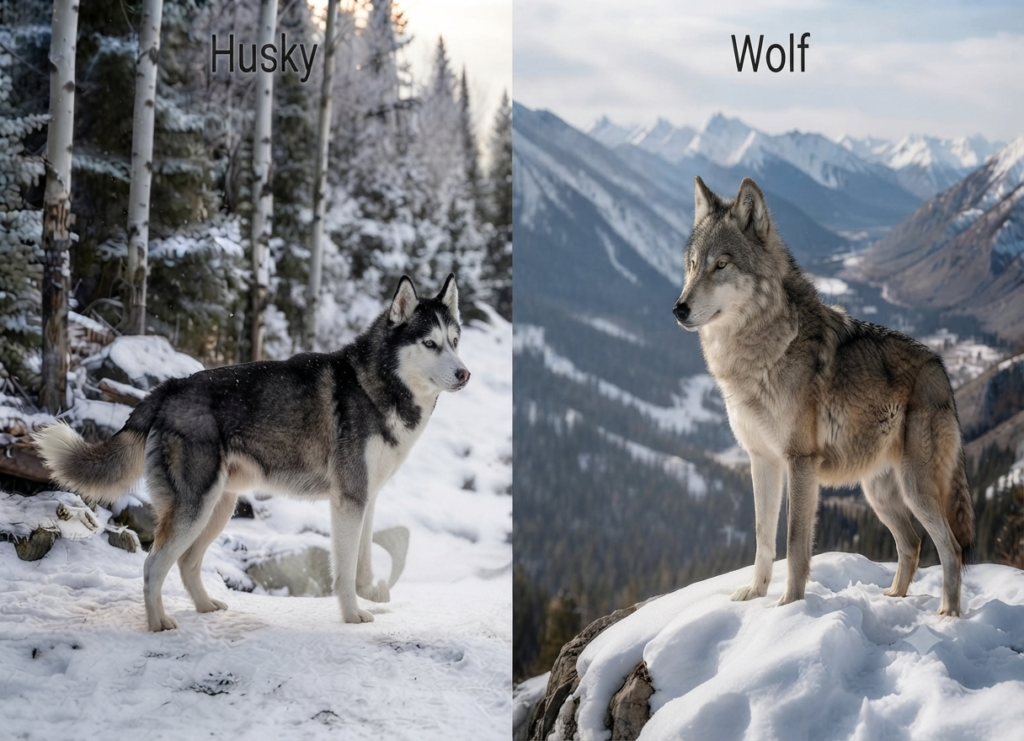
The main difference between Husky vs Wolf is that the Siberian Husky is a fully domesticated dog bred to work alongside humans, whereas the wolf is a wild predator that survives by hunting and living in highly organized packs. Although Huskies share a wolf-like appearance, wolves are much larger, stronger, and possess instincts developed through thousands of years of natural evolution.
Many people confuse Huskies with wolves because of their thick coats, erect ears, pointed muzzles, and striking facial markings. However, the difference between Husky and Wolf goes far beyond appearance. They differ in size, behavior, intelligence, social structure, diet, habitat, trainability, and relationship with humans.
Whether you’re interested in a Husky Wolf comparison, wondering Husky or Wolf, or curious about a theoretical Husky Wolf fight, this guide explains everything you need to know.
Husky vs. Wolf: Comparison Table
The table below highlights the major differences between Husky and Wolf.
| Feature | Husky | Wolf |
|---|---|---|
| Scientific Name | Canis lupus familiaris | Canis lupus |
| Family | Canidae | Canidae |
| Status | Domesticated dog | Wild animal |
| Weight | 35–60 lb (16–27 kg) | 70–150 lb (32–68 kg) |
| Height | 20–24 in (51–61 cm) | 26–32 in (66–81 cm) |
| Body Build | Athletic and lean | Large, muscular, powerful |
| Bite Force | Around 320 PSI | Around 400–1,200 PSI (estimated) |
| Eye Color | Blue, brown, amber, bi-colored | Amber, yellow, brown |
| Lifespan | 12–15 years | 6–8 years in the wild (up to 16 years in captivity) |
| Diet | Commercial dog food, meat | Wild prey and carrion |
| Habitat | Human homes worldwide | Forests, tundra, mountains, grasslands |
| Behavior | Friendly and social | Wary, territorial, highly instinctive |
| Trainability | Highly trainable | Difficult to train |
| Relationship with Humans | Companion animal | Wild predator |
What Is a Husky?
The Siberian Husky is a medium-sized working dog originally developed by the Chukchi people of northeastern Siberia. These dogs were bred to pull sleds over long distances in harsh Arctic conditions while consuming relatively little food.
Unlike wolves, Huskies have lived alongside humans for thousands of years. Selective breeding has produced a friendly, energetic, and intelligent companion capable of working in teams.
Today, Huskies are popular as:
- Family pets
- Sled dogs
- Search and rescue dogs
- Adventure companions
- Competitive racing dogs
Despite their wolf-like appearance, Huskies are entirely domesticated and generally display affectionate behavior toward people.
Key Characteristics of Huskies
- Fully domesticated dog
- Friendly and social
- Thick double coat
- Excellent endurance
- Medium-sized athletic body
- Highly energetic
- Intelligent but independent
- Loves cold climates
- Usually friendly with strangers
- Requires regular exercise
What Is a Wolf?
A wolf is a wild carnivorous mammal belonging to the species Canis lupus. Wolves are among the most successful apex predators on Earth and inhabit forests, mountains, tundra, grasslands, and Arctic regions across North America, Europe, and Asia.
Unlike Huskies, wolves have never been selectively bred for companionship. Every aspect of their body and behavior is adapted for survival in the wild, including hunting, defending territory, and raising young within a structured pack.
Gray wolves primarily hunt:
- Deer
- Elk
- Moose
- Wild boar
- Caribou
- Bison
- Smaller mammals
Their intelligence, teamwork, and endurance make them highly efficient predators capable of traveling many kilometers each day in search of prey.
Key Characteristics of Wolves
- Wild canine
- Powerful muscular body
- Large paws
- Exceptional endurance
- Strong bite force
- Highly territorial
- Excellent hunter
- Lives in organized packs
- Extremely cautious around humans
- Important apex predator
Husky vs Wolf: Key Differences
1. Scientific Classification
Although Huskies and wolves belong to the same family (Canidae) and share a common ancestor, they are not the same animal.
The Siberian Husky is a domesticated dog classified as:
- Kingdom: Animalia
- Phylum: Chordata
- Class: Mammalia
- Order: Carnivora
- Family: Canidae
- Species: Canis lupus familiaris
The gray wolf is classified as:
- Kingdom: Animalia
- Phylum: Chordata
- Class: Mammalia
- Order: Carnivora
- Family: Canidae
- Species: Canis lupus
Dogs evolved from ancient wolves through domestication over thousands of years. During this process, humans selectively bred dogs for specific traits such as friendliness, obedience, endurance, and cooperation. Wolves, on the other hand, continued evolving naturally in the wild.
Although they share much of their DNA, their lifestyles and behaviors have become dramatically different.
2. Physical Appearance
At first glance, Huskies and wolves appear remarkably similar. Both possess erect ears, almond-shaped eyes, bushy tails, and dense double coats suited for cold environments. However, closer observation reveals several important differences.
Huskies generally have:
- Compact body
- Narrow chest
- Shorter legs
- Rounded forehead
- Softer facial expression
- Curled or sickle-shaped tail
- Greater variety of coat colors
Wolves typically have:
- Larger body
- Long legs
- Broad chest
- Longer muzzle
- Massive head
- Straight bushy tail
- Longer neck
- Larger paws
Overall, wolves are built for hunting and survival, while Huskies are designed for endurance and cooperation with humans.
3. Size and Weight
One of the biggest differences in the Husky vs Wolf comparison is body size.
Adult Siberian Huskies generally weigh between 35 and 60 pounds (16–27 kg), making them medium-sized dogs.
Gray wolves are significantly larger, typically weighing 70 to 150 pounds (32–68 kg), although exceptionally large northern wolves may exceed this range.
Male wolves also stand much taller at the shoulder and possess heavier bones, broader skulls, and considerably more muscle mass.
This size difference allows wolves to hunt large prey such as elk, moose, and deer, whereas Huskies were bred primarily for endurance while pulling sleds rather than fighting or hunting large animals.
4. Coat and Fur
Another noticeable difference in the Husky vs Wolf comparison is their coat. Both animals have a thick double coat that protects them from freezing temperatures, but their fur has evolved for different purposes.
Huskies have a soft, dense undercoat covered by medium-length guard hairs. Their coat was developed to keep them warm while pulling sleds over long distances. It also comes in a wide variety of colors and patterns because of selective breeding.
Common Husky coat colors include:
- Black and white
- Gray and white
- Red and white
- Agouti
- Pure white
- Sable
- Brown
Wolves have a thicker and coarser coat designed for survival in harsh wilderness conditions. Their fur changes with the seasons, becoming much denser during winter. Most wolves display natural camouflage colors that blend into forests, mountains, and tundra.
Common wolf coat colors include:
- Gray
- Brown
- Black
- White (Arctic wolves)
- Cream
- Mixed gray-brown
Unlike Huskies, wolves rarely exhibit unusual coat colors because natural selection favors camouflage over appearance.
5. Skull, Teeth, and Bite Force
The skull structure is one of the clearest anatomical differences between Huskies and wolves.
A wolf has a much larger skull with broader cheekbones, a stronger jaw, and longer canine teeth. These adaptations allow wolves to crush bones and hold onto large prey.
Huskies possess a smaller, lighter skull designed for domestic life rather than hunting large animals.
Husky Characteristics
- Smaller skull
- Narrower muzzle
- Shorter canine teeth
- Less jaw muscle
- Bite force around 320 PSI
Wolf Characteristics
- Broad skull
- Long powerful muzzle
- Large canine teeth
- Massive jaw muscles
- Estimated bite force 400–1,200 PSI
The stronger bite force enables wolves to subdue prey such as deer, elk, and moose—tasks that are far beyond the capabilities of a domesticated Husky.
6. Eye Color
Eye color is another feature that helps distinguish a Husky from a wolf.
Huskies are famous for their striking blue eyes, although they may also have:
- Brown eyes
- Amber eyes
- One blue and one brown eye (heterochromia)
- Parti-colored eyes
Blue eyes are common and are considered a normal breed characteristic.
Wolves, however, almost never have blue eyes as adults.
Adult wolves typically have:
- Amber eyes
- Golden eyes
- Yellow eyes
- Light brown eyes
Wolf pups are born with blue eyes, but these gradually change to amber or yellow as they mature.
Therefore, seeing an adult canine with bright blue eyes strongly suggests it is a Husky or another domestic dog rather than a wolf.
7. Habitat
Habitat represents one of the biggest lifestyle differences in the difference between Husky and Wolf.
Huskies live wherever humans provide food, shelter, and care. They thrive in homes but perform especially well in colder climates due to their insulating coat.
Today, Huskies are commonly found in:
- North America
- Europe
- Asia
- Australia
- Urban areas
- Rural communities
Wolves inhabit remote wilderness regions where they have access to prey and sufficient territory.
Their habitats include:
- Boreal forests
- Arctic tundra
- Mountain ranges
- Grasslands
- Taiga
- Temperate forests
Unlike Huskies, wolves avoid heavily populated human settlements whenever possible.
8. Diet
Although both belong to the dog family, their diets differ significantly.
Modern Huskies consume food provided by humans, including:
- Commercial dog food
- Cooked meat
- Fish
- Vegetables
- Rice
- Veterinary-approved diets
Their nutritional requirements are balanced to support health rather than survival.
Wolves are strict carnivores that obtain food through hunting.
Typical prey includes:
- Deer
- Elk
- Moose
- Wild boar
- Caribou
- Rabbits
- Beavers
- Small mammals
When prey is scarce, wolves also eat:
- Carrion
- Birds
- Fish
- Fruits
- Berries
Unlike Huskies, wolves may travel many kilometers before successfully catching prey and often consume large quantities of meat after a successful hunt.
9. Behavior
Behavior is perhaps the most significant distinction in the Husky vs Wolf comparison.
Thousands of years of domestication have transformed Huskies into sociable companion animals, whereas wolves retain powerful survival instincts.
Huskies are generally:
- Friendly
- Curious
- Playful
- Energetic
- Vocal
- Independent
- Affectionate with family
Although they can be stubborn, Huskies generally enjoy interacting with people and other dogs.
Wolves are naturally:
- Cautious
- Territorial
- Highly alert
- Protective
- Independent
- Instinct-driven
Wild wolves typically avoid humans and rely on cooperation within their pack to survive.
Unlike Huskies, wolves do not naturally seek human companionship.
10. Intelligence and Problem-Solving
Both Huskies and wolves are highly intelligent, but their intelligence has evolved for different purposes.
Huskies excel at understanding human communication and working alongside people. They quickly learn routines, recognize commands, and cooperate during sled pulling or other tasks.
However, Huskies are also famous for their independent thinking. They may ignore commands if they believe there is a better option, making training both rewarding and challenging.
Wolves display remarkable intelligence in the wild. They coordinate complex hunting strategies, communicate effectively with pack members, remember territories, and solve survival challenges without human assistance.
Huskies typically:
- Learns commands quickly
- Understands human gestures
- Works well in teams
- Independent thinker
- Easily bored by repetitive training
Wolves typically:
- Exceptional survival instincts
- Advanced hunting strategies
- Excellent spatial memory
- Strong communication within packs
- Superior problem-solving in natural environments
Overall, Huskies are better suited for cooperating with humans, while wolves possess intelligence specialized for surviving in the wild.
11. Trainability
One of the clearest differences between Huskies and wolves is how easily they can be trained.
Huskies have been selectively bred for thousands of years to work with humans. Although they can be stubborn and independent, they respond well to consistent, positive training methods.
Huskies can be trained for:
- Basic obedience
- Sled pulling
- Search and rescue
- Agility sports
- Hiking and outdoor activities
Wolves, on the other hand, are not domesticated animals. Even wolves raised by humans retain strong instincts that make them unpredictable and difficult to train.
They do not naturally seek human approval and are far less responsive to commands than domestic dogs.
For this reason, wolves are not suitable as household pets.
12. Lifespan
The average lifespan is another important difference in the Husky vs Wolf comparison.
Siberian Huskies generally live much longer than wild wolves because they receive regular veterinary care, balanced nutrition, vaccinations, and protection from predators.
Husky Lifespan
- Average lifespan: 12–15 years
- Some live up to 16 years with proper care
- Common health concerns include hip dysplasia, cataracts, and progressive retinal atrophy
Wolf Lifespan
- 6–8 years in the wild
- Up to 15–16 years in captivity
Wild wolves face numerous threats that reduce their lifespan, including:
- Starvation
- Disease
- Territorial conflicts
- Injuries while hunting
- Harsh weather
- Human activities
Although wolves may live as long as Huskies in protected environments, survival in the wild is far more challenging.
13. Geographic Distribution
The difference between Husky and Wolf is also evident in where they live.
Huskies are now found around the world because they are domesticated pets and working dogs.
Huskies are commonly found in:
- North America
- Europe
- Asia
- Australia
- New Zealand
- Cold and temperate regions worldwide
Originally developed in northeastern Siberia, Huskies are now one of the most popular working dog breeds globally.
Wolves are naturally distributed across:
- Canada
- Alaska
- Northern United States
- Europe
- Russia
- Mongolia
- China
- Scandinavia
- Parts of the Middle East
Most wolf populations inhabit remote wilderness where large prey is abundant.
14. Adaptations
Both Huskies and wolves possess remarkable adaptations that allow them to survive in cold environments, but these adaptations serve different purposes.
Husky Adaptations
- Thick double coat for insulation
- Efficient metabolism during endurance work
- Large, well-padded paws for snow travel
- High stamina for long-distance sled pulling
- Friendly temperament toward humans
- Ability to work in teams
These traits make Huskies excellent working dogs capable of pulling sleds across snowy landscapes for many kilometers.
Wolf Adaptations
- Extremely powerful muscles
- Thick seasonal winter coat
- Large paws that distribute weight on snow
- Superior hearing and smell
- Powerful jaws for hunting
- Exceptional endurance while tracking prey
- Complex pack hunting strategies
- Strong territorial instincts
These adaptations enable wolves to survive in some of the harshest environments on Earth.
Similarities Between Huskies and Wolves
Although Husky vs Wolf reveals many differences, these canines also share several characteristics because domestic dogs evolved from ancient wolves.
Some of their major similarities include:
- Both belong to the Canidae family.
- Both are descendants of ancient wolves.
- Both possess thick double coats.
- Both have erect ears and bushy tails.
- Both communicate through body language and vocalizations.
- Both have an excellent sense of smell and hearing.
- Both are highly intelligent.
- Both are extremely energetic and athletic.
- Both perform well in cold climates.
- Both are social animals that thrive in groups.
These similarities explain why Huskies often resemble wolves in appearance despite thousands of years of domestication.
Husky or Wolf: Which Is Better?
Choosing between a Husky or Wolf depends entirely on the context.
Choose a Husky if you want:
- A loyal family companion
- A trainable working dog
- A hiking or outdoor partner
- A friendly and affectionate pet
- A dog that can live comfortably with humans
Wolves are better suited for:
- Maintaining healthy ecosystems
- Controlling herbivore populations
- Preserving biodiversity
- Life in natural wilderness
- Functioning as apex predators
A Husky is the clear choice as a companion animal, while wolves belong in protected wild habitats where they play an essential ecological role.
Which Animal Is Better Adapted?
Neither animal is universally “better.” Each has evolved to excel in its own environment.
Huskies are perfectly adapted for life with humans. Their endurance, intelligence, and cooperative nature make them exceptional sled dogs and family companions.
Wolves are built for survival in the wild. Their strength, endurance, hunting ability, and complex social organization allow them to thrive in forests, mountains, and tundra.
Rather than comparing which is superior, it is more accurate to appreciate how each species has evolved to succeed in its own role.
Conclusion
When comparing Husky vs Wolf, the similarities in appearance often overshadow the profound differences between these remarkable canines. Huskies are domesticated working dogs bred for companionship, endurance, and cooperation with humans, while wolves are powerful wild predators shaped by natural selection and survival in demanding environments.
The difference between Husky and Wolf extends beyond size and appearance to include behavior, intelligence, habitat, diet, trainability, and social structure. Huskies excel as loyal companions and working dogs, whereas wolves play a vital role as apex predators that help maintain healthy ecosystems.
Understanding these differences not only helps identify each animal correctly but also highlights the importance of respecting wolves in the wild while appreciating Huskies as one of the world’s most capable and beautiful domestic dog breeds.
Frequently Asked Questions (FAQs)
The main difference is that Huskies are domesticated dogs bred to work with humans, whereas wolves are wild animals adapted for hunting and survival in natural environments.
No. Huskies are not part wolf. Although all domestic dogs share ancient wolf ancestry, Siberian Huskies are fully domesticated dogs and are not genetically closer to wolves than most other dog breeds.
A wolf is much larger. Adult gray wolves typically weigh 70–150 pounds (32–68 kg), while Siberian Huskies usually weigh 35–60 pounds (16–27 kg).
A Husky may survive for a limited time, but it generally lacks the hunting skills, territorial instincts, and survival experience required to live successfully in the wild like a wolf.
Yes. Because both belong to the same species complex, Huskies and wolves can produce fertile offspring known as wolf-dog hybrids. However, these hybrids are challenging to manage and are regulated or prohibited in some regions.
Read Next: