The main difference between Percent Abundance vs. Relative Abundance is that percent abundance expresses the proportion of an isotope or component as a percentage of the total, whereas relative abundance expresses the same proportion as a decimal, fraction, or ratio without converting it into a percentage. Both terms describe the distribution of isotopes or species within a sample, but they differ in representation and mathematical expression.
Understanding Percent Abundance vs. Relative Abundance is important in chemistry, physics, environmental science, and biology because these concepts help scientists determine the composition of elements, identify isotopes using mass spectrometry, calculate average atomic mass, and analyze species distribution in ecological studies. Although they are closely related, knowing when to use each measurement improves the accuracy of scientific calculations and data interpretation.
Percent Abundance vs. Relative Abundance Comparison Table
The table below highlights the major differences between Percent Abundance vs. Relative Abundance.
| Feature | Percent Abundance | Relative Abundance |
|---|---|---|
| Definition | Percentage of a specific isotope or component in a sample | Proportion of a specific isotope or component relative to the total |
| Expression | Percentage (%) | Decimal, fraction, or ratio |
| Formula | (Number of atoms ÷ Total atoms) × 100 | Number of atoms ÷ Total atoms |
| Unit | Percentage (%) | No unit (dimensionless) |
| Value Range | 0% to 100% | 0 to 1 |
| Total Sum | Equals 100% | Equals 1 |
| Mathematical Form | Percentage | Ratio or decimal |
| Common Applications | Atomic mass calculations, isotope composition | Mass spectrometry, isotope analysis, ecology |
| Ease of Interpretation | Easier for general understanding | Better for scientific calculations |
| Used In | Chemistry, physics, geology | Chemistry, biology, ecology, environmental science |
| Conversion | Divide by 100 to obtain relative abundance | Multiply by 100 to obtain percent abundance |
| Example | 75% | 0.75 |
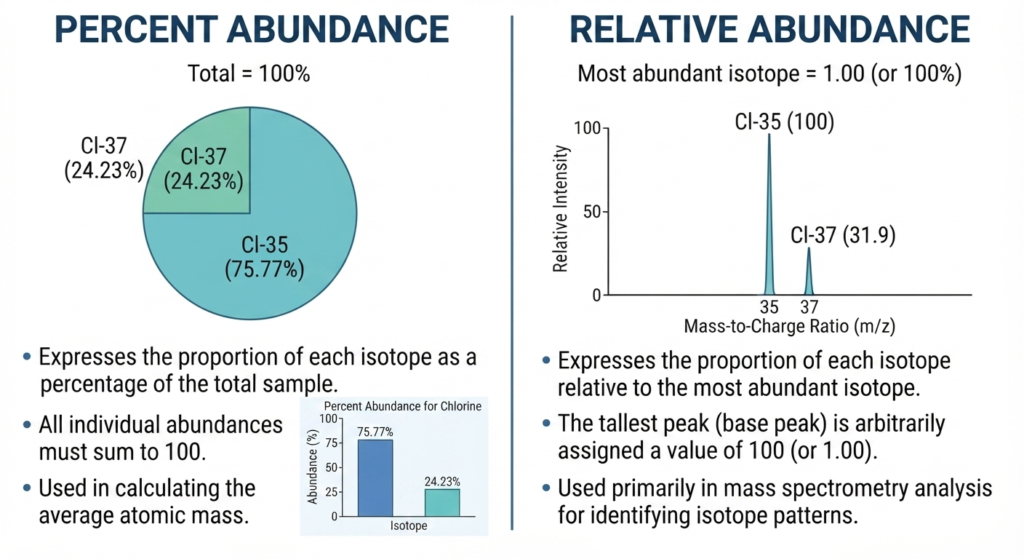
What Is Percent Abundance?
Percent abundance is the percentage of a particular isotope, element, or species present in a sample relative to the total amount of all isotopes or species. It indicates how much of a specific component exists in comparison with the entire sample and is always expressed as a percentage.
For example, naturally occurring chlorine consists of approximately 75.77% chlorine-35 and 24.23% chlorine-37. These values represent the percent abundance of each isotope and are used to calculate the average atomic mass of chlorine.
Percent abundance is widely used in chemistry, analytical laboratories, isotope studies, and educational settings because percentages are easy to understand and compare.
Characteristics of Percent Abundance
- Expressed as a percentage (%)
- Represents the proportion of one component in a sample
- Values range from 0% to 100%
- Total abundance always equals 100%
- Commonly used in isotope calculations
- Useful for calculating average atomic mass
- Easy to interpret and compare
- Frequently used in chemistry and physics
- Derived from relative abundance
- Suitable for graphical representation
What Is Relative Abundance?
Relative abundance is the proportion of a particular isotope, atom, molecule, or species relative to the total amount present in a sample. Instead of expressing the value as a percentage, it is written as a decimal, fraction, or ratio.
For instance, if an isotope has a percent abundance of 75.77%, its relative abundance is 0.7577. Relative abundance is especially useful in mathematical calculations because decimal values simplify formulas used in atomic mass determination and scientific data analysis.
Relative abundance is widely applied in chemistry, ecology, environmental science, mass spectrometry, and biological research to compare the occurrence of different components within a population or sample.
Characteristics of Relative Abundance
- Expressed as a decimal or fraction
- Represents proportional occurrence
- Values range from 0 to 1
- Total abundance equals 1
- Unitless quantity
- Used in scientific calculations
- Common in isotope analysis
- Essential in mass spectrometry
- Useful in ecology for species comparison
- Easily converted into percent abundance
Percent Abundance vs. Relative Abundance: Key Differences
1. Definition
The most fundamental difference between Percent Abundance vs. Relative Abundance lies in how the abundance of a component is expressed.
Percent abundance indicates the proportion of an isotope or species as a percentage of the total sample.
Relative abundance, on the other hand, expresses the same proportion as a decimal, fraction, or ratio without multiplying by 100.
For example:
- Percent abundance = 78.5%
- Relative abundance = 0.785
Both values represent the same quantity but are written in different formats.
2. Representation
Another major difference between Percent Abundance vs. Relative Abundance is their representation.
Percent Abundance is expressed as:
- Percentage (%)
- Whole numbers or decimals
- Easier for general interpretation
Example:
- Carbon-12 = 98.89%
- Carbon-13 = 1.11%
Relative Abundance is expressed as:
- Decimal
- Fraction
- Ratio
Example:
- Carbon-12 = 0.9889
- Carbon-13 = 0.0111
Scientists generally use relative abundance during calculations because decimals simplify mathematical operations.
3. Formula
The calculation formulas differ slightly.
Percent Abundance Formula is:
Relative Abundance Formula is:
The only mathematical difference is multiplication by 100.
4. Value Range
The numerical range also differs.
Percent Abundance Value Range:
- Minimum = 0%
- Maximum = 100%
Relative Abundance Value Range:
- Minimum = 0
- Maximum = 1
For example:
| Percent Abundance | Relative Abundance |
|---|---|
| 25% | 0.25 |
| 50% | 0.50 |
| 80% | 0.80 |
| 100% | 1.00 |
5. Total Sum
The total abundance of all isotopes or species differs only in expression.
Percent Abundance
The sum of all percentages is always:
100%
Example:
- Isotope A = 60%
- Isotope B = 30%
- Isotope C = 10%
Total = 100%
Relative Abundance
The sum of all decimal values equals:
1.00
Example:
- Isotope A = 0.60
- Isotope B = 0.30
- Isotope C = 0.10
Total = 1.00
6. Units
One important distinction between Percent Abundance vs. Relative Abundance is the unit.
Percent Abundance Unit:
- Expressed in percent (%)
- Has a percentage symbol
Relative Abundance Unit:
- Has no unit
- Pure numerical ratio
Because it is dimensionless, relative abundance is easier to incorporate into scientific equations.
7. Applications
Although both describe composition, their applications differ slightly.
Percent Abundance is commonly used in:
- Atomic structure
- Chemistry education
- Periodic table calculations
- Isotope composition tables
- Laboratory reports
- Teaching isotope concepts
Relative Abundance is commonly used in:
- Mass spectrometry
- Average atomic mass calculations
- Scientific modeling
- Ecology
- Population studies
- Environmental analysis
8. Ease of Interpretation
Percent abundance is generally easier to understand.
For example:
- 90% oxygen immediately indicates that oxygen makes up most of the sample.
Relative abundance requires interpretation.
For example:
- 0.90 oxygen abundance represents exactly the same value but is less intuitive for beginners.
Therefore, textbooks often present isotope composition as percentages.
9. Mathematical Calculations
Relative abundance is preferred in scientific calculations.
For calculating average atomic mass, decimal values eliminate the need to divide by 100 during every calculation.
For example:
Instead of:35×75.77%
Scientists use:35×0.7577
This simplifies calculations and reduces rounding errors.
10. Conversion Between the Two
Converting between Percent Abundance vs. Relative Abundance is straightforward.
Percent Abundance to Relative Abundance Conversion:
Divide by 100.
Example:
75% → 0.75
48.6% → 0.486
Relative Abundance to Percent Abundance Conversion:
Multiply by 100.
Example:
0.45 → 45%
0.987 → 98.7%
Both measurements describe exactly the same composition.
11. Importance in Isotope Studies
Both measurements are extremely important in isotope chemistry.
Scientists use them to:
- Determine isotope composition
- Calculate average atomic mass
- Interpret mass spectra
- Identify naturally occurring isotopes
- Study radioactive isotopes
- Compare elemental composition
Without abundance measurements, accurate atomic mass calculations would not be possible.
12. Use in Different Scientific Fields
The importance of Percent Abundance vs. Relative Abundance extends beyond chemistry.
Percent Abundance is widely used in:
- Chemistry
- Physics
- Geology
- Nuclear science
- Education
Relative Abundance is widely used in:
- Chemistry
- Ecology
- Biology
- Environmental science
- Microbiology
- Population ecology
- Mass spectrometry
- Biodiversity research
Relative abundance is especially valuable when comparing populations, species distributions, or isotope ratios across different samples.
Similarities Between Percent Abundance and Relative Abundance
Although Percent Abundance vs. Relative Abundance differ in their mathematical representation, both describe the composition of isotopes, elements, or species within a sample. They are closely related because one can be easily converted into the other.
Some major similarities include:
- Both measure the abundance of a component in a sample.
- Both are used to describe isotope composition.
- Both are based on the ratio of a component to the total amount.
- Both are used in average atomic mass calculations.
- Both are important in mass spectrometry.
- Both help identify naturally occurring isotopes.
- Both can be converted into each other.
- Both are used in chemistry, biology, and environmental science.
- Both provide information about sample composition.
- Both contribute to accurate scientific analysis.
Advantages of Percent Abundance
Percent abundance is widely used because it presents isotope composition in a simple and easily understandable format.
Major advantages include:
- Easy to understand and interpret.
- Expressed as a familiar percentage.
- Convenient for educational purposes.
- Useful in isotope composition tables.
- Helps compare isotope percentages directly.
- Commonly used in textbooks and laboratory reports.
- Simplifies graphical representation.
- Useful for explaining atomic composition.
- Facilitates comparison between different samples.
- Easy to convert into relative abundance.
Advantages of Relative Abundance
Relative abundance is preferred in scientific research because it simplifies mathematical calculations and statistical analysis.
Major advantages include:
- Ideal for scientific calculations.
- Eliminates repeated percentage conversions.
- Simplifies average atomic mass calculations.
- Widely used in mass spectrometry.
- Unitless quantity for easy computation.
- Suitable for computer modeling.
- Commonly used in ecological studies.
- Useful for comparing species populations.
- Reduces calculation errors.
- Easily converted into percentage values.
Which Is Better—Percent Abundance or Relative Abundance?
Neither Percent Abundance nor Relative Abundance is universally better because each serves a different purpose.
Percent abundance is better for presenting isotope composition in an easy-to-understand format. It is widely used in education, laboratory reports, and scientific publications where readers need a quick understanding of the proportion of each isotope.
Relative abundance, however, is preferred for scientific calculations because decimal values are easier to use in formulas. Chemists routinely use relative abundance when calculating average atomic masses, interpreting mass spectra, and performing computational analyses.
In simple terms:
- Choose Percent Abundance for clear presentation and interpretation.
- Choose Relative Abundance for mathematical calculations and scientific analysis.
Both measurements represent the same information and can be converted into one another by multiplying or dividing by 100.
Conclusion
The comparison of Percent Abundance vs. Relative Abundance shows that both measurements describe the proportion of isotopes or other components within a sample but differ in how they are expressed. Percent abundance presents the value as a percentage, making it easier to understand and communicate, while relative abundance expresses the same value as a decimal or ratio, making it more convenient for scientific calculations.
Understanding Percent Abundance vs. Relative Abundance is essential for students, chemists, physicists, and researchers because these concepts form the basis of isotope analysis, atomic mass calculations, mass spectrometry, ecological studies, and environmental research. Choosing the appropriate representation depends on whether the goal is clear communication or computational efficiency.
Frequently Asked Questions (FAQs)
The main difference between Percent Abundance vs. Relative Abundance is that percent abundance expresses the proportion of an isotope as a percentage, whereas relative abundance expresses the same proportion as a decimal, fraction, or ratio.
Divide the percent abundance by 100.
Example:
82% = 0.82
45.6% = 0.456
Multiply the relative abundance by 100.
Example:
0.75 = 75%
0.982 = 98.2%
Relative abundance is expressed as a decimal, which simplifies multiplication in weighted average calculations and reduces calculation errors.
Yes. The sum of the percent abundances of all isotopes or components in a sample is always 100%.
Reference:
1. “Average Atomic Mass.” Average Atomic Mass, Physics@TutorVista.com
2. “Abundance of the chemical elements.” Wikipedia, Wikimedia Foundation, 25 Feb. 2018
3. Simoes, Christian. “Abundance of the chemical elements.” Astrono
Read Next: