The main difference between Buchner Funnel vs. Hirsch Funnel is that a Buchner funnel is designed for vacuum filtration of medium to large quantities of liquid and precipitates, whereas a Hirsch funnel is specifically designed for filtering small volumes and recovering fine crystals with minimal sample loss. Although both funnels operate using vacuum filtration, they differ in size, shape, filtration area, and laboratory applications.
Understanding Buchner Funnel vs. Hirsch Funnel is important for chemistry students, laboratory technicians, researchers, and scientists because selecting the appropriate filtration funnel improves filtration speed, sample recovery, and experimental accuracy. While the Buchner funnel is commonly used for routine laboratory filtration, the Hirsch funnel is preferred for recrystallization and small-scale purification.
Buchner Funnel vs. Hirsch Funnel Comparison Table
The table below highlights the major differences between Buchner Funnel vs. Hirsch Funnel.
| Feature | Buchner Funnel | Hirsch Funnel |
|---|---|---|
| Primary Purpose | Vacuum filtration of medium to large samples | Vacuum filtration of small samples |
| Shape | Cylindrical with flat perforated plate | Conical with smaller perforated plate |
| Typical Material | Porcelain or polypropylene | Porcelain or polypropylene |
| Sample Volume | Medium to large | Small |
| Filtration Speed | Faster | Slightly slower for larger volumes |
| Crystal Recovery | Good | Excellent for small crystals |
| Filter Paper | Circular filter paper | Smaller circular filter paper |
| Vacuum Required | Yes | Yes |
| Laboratory Use | Routine filtration | Recrystallization and micro-scale experiments |
| Best For | Bulk precipitate collection | Small crystal isolation |
| Cost | Generally lower | Similar or slightly higher depending on size |
| Ease of Cleaning | Easy | Easy but smaller openings require care |
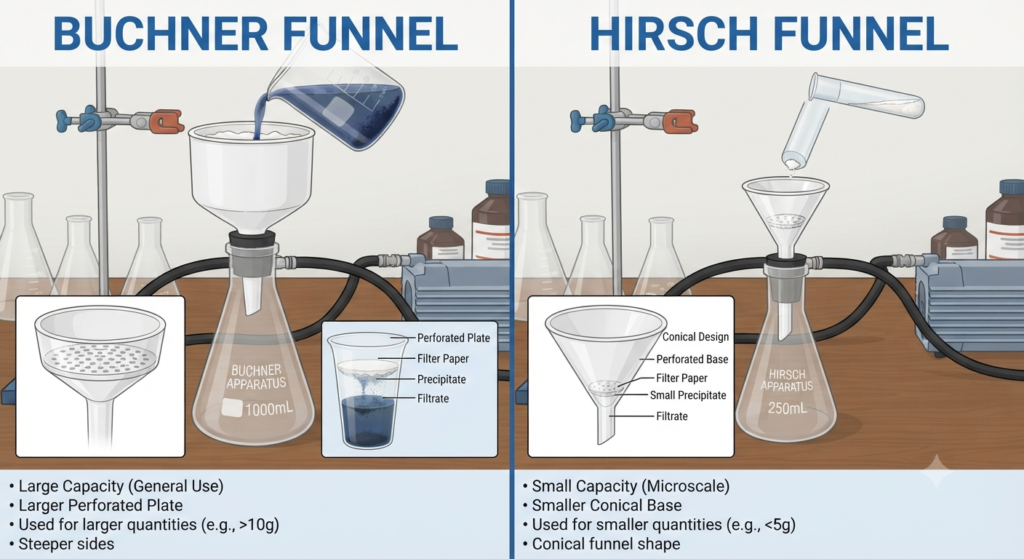
What Is a Buchner Funnel?
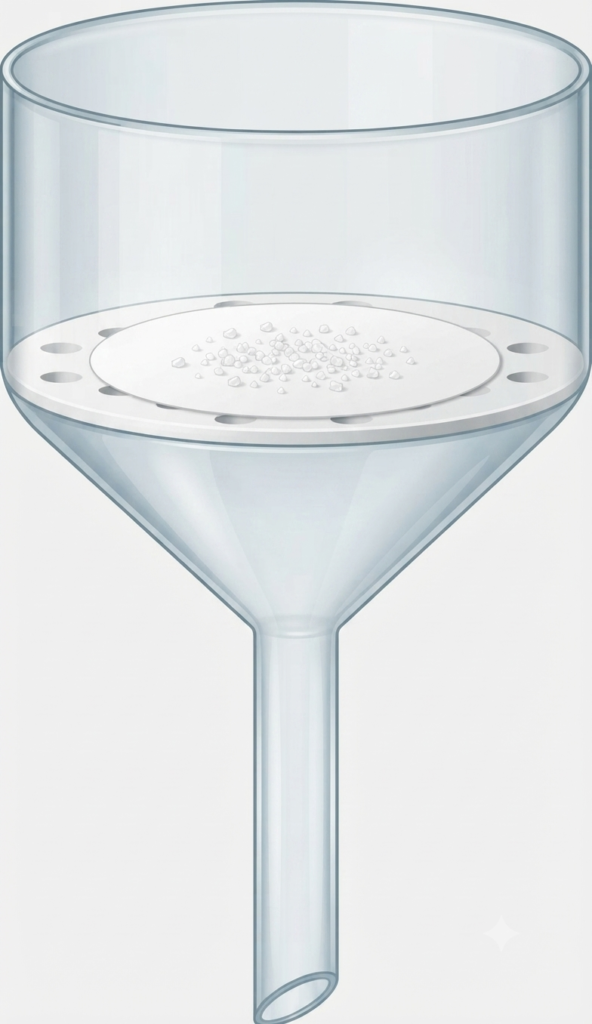
A Buchner funnel is a laboratory filtration device consisting of a cylindrical body with a flat perforated plate at its base. It is designed to perform vacuum filtration, allowing rapid separation of solids from liquids. A circular filter paper is placed over the perforated plate, and the funnel is attached to a vacuum (Buchner) flask through a rubber adapter.
When vacuum is applied, liquid passes quickly through the filter paper while solid particles remain on its surface. Because of its large filtration area, the Buchner funnel is ideal for filtering relatively large volumes of solutions and collecting precipitates efficiently.
Buchner funnels are widely used in chemistry laboratories, pharmaceutical industries, research institutions, environmental laboratories, and educational laboratories for routine filtration work.
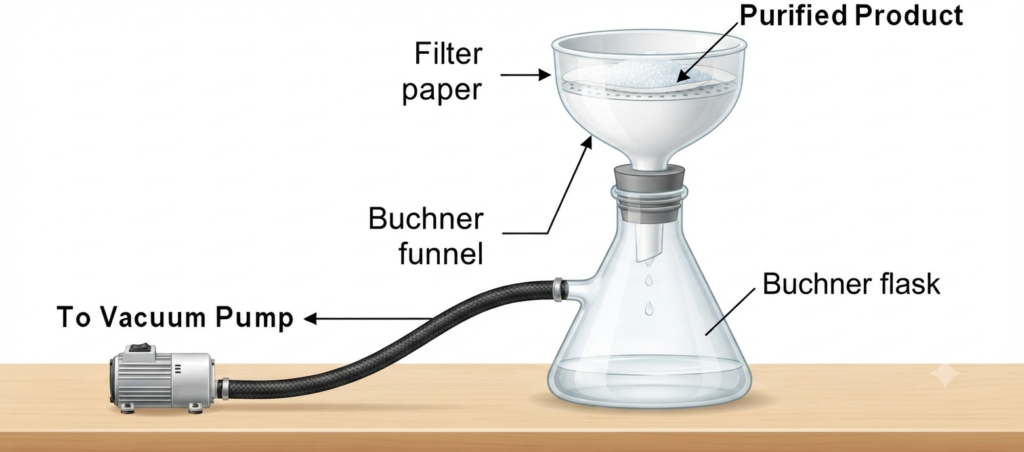
Characteristics of a Buchner Funnel
- Cylindrical body with a flat bottom
- Large perforated filtration plate
- Designed for vacuum filtration
- Requires filter paper
- Suitable for medium and large sample volumes
- Provides rapid filtration
- Commonly made of porcelain or plastic
- Compatible with Buchner flasks
- Easy to assemble and clean
- Ideal for routine laboratory filtration
What Is a Hirsch Funnel?
A Hirsch funnel is a small conical vacuum filtration funnel specifically designed for filtering small quantities of liquids, crystals, or precipitates. Unlike a Buchner funnel, it has a narrow conical body with a relatively small perforated plate located at the bottom.
Its compact filtration area minimizes sample loss and improves recovery of valuable crystalline products during laboratory experiments. The funnel is commonly used with a vacuum flask and appropriately sized filter paper to achieve rapid filtration of small samples.
Hirsch funnels are especially popular in organic chemistry laboratories, pharmaceutical research, and recrystallization experiments where preserving product yield is essential.
Characteristics of a Hirsch Funnel
- Conical body design
- Small perforated filtration plate
- Designed for vacuum filtration
- Best suited for small sample volumes
- Requires smaller filter paper
- Excellent crystal recovery
- Minimizes product loss
- Usually made of porcelain or polypropylene
- Used extensively in recrystallization
- Suitable for laboratory research and analytical work
Buchner Funnel vs. Hirsch Funnel: Key Differences
1. Design
The most noticeable difference between Buchner Funnel vs. Hirsch Funnel lies in their overall design.
A Buchner funnel features a wide cylindrical body with a flat perforated plate that provides a large filtration surface. This design makes it ideal for handling relatively large quantities of liquids and precipitates.
A Hirsch funnel, in contrast, has a conical body with a smaller perforated plate. The reduced filtration area improves the recovery of small amounts of crystals and minimizes product loss.
2. Shape
The shape of each funnel directly affects its filtration performance.
A Buchner funnel has:
- Cylindrical body
- Flat base
- Uniform filtration surface
- Large opening
A Hirsch funnel has:
- Conical body
- Narrow lower section
- Smaller filtration surface
- Compact design
The conical design of the Hirsch funnel helps concentrate solids into a smaller area, making crystal collection easier.
3. Filtration Area
Another important difference between Buchner Funnel vs. Hirsch Funnel is the size of the filtration area.
The Buchner funnel has a relatively large perforated plate, allowing liquid to pass through quickly under vacuum. This makes it suitable for filtering larger sample volumes.
The Hirsch funnel has a much smaller filtration plate, which is advantageous when working with valuable compounds because less product remains attached to the filter paper.
4. Sample Volume
Both funnels are designed for vacuum filtration, but they differ significantly in sample capacity.
Buchner Funnel suitable for:
- Medium-volume filtration
- Large-volume filtration
- Bulk precipitates
- Routine laboratory work
Hirsch Funnel suitable for:
- Small laboratory samples
- Fine crystals
- Small precipitates
- Micro-scale experiments
As a result, Buchner funnels are commonly found in routine laboratory operations, while Hirsch funnels are preferred for analytical and research applications.
5. Filtration Speed
Filtration speed is another major distinction.
Because the Buchner funnel has a larger filtration area, liquids pass through more rapidly under vacuum, reducing overall filtration time.
The Hirsch funnel filters smaller quantities efficiently, but using it for large volumes is slower because of its limited filtration surface.
Therefore, for large-scale laboratory work, the Buchner funnel offers higher productivity.
6. Vacuum Filtration
Both funnels operate using vacuum filtration, but they are optimized for different purposes.
The Buchner funnel is primarily designed for rapid vacuum filtration of larger samples.
The Hirsch funnel also requires vacuum filtration but focuses on maximizing recovery of small samples rather than processing large quantities.
Thus, both require:
- Vacuum pump or aspirator
- Vacuum flask
- Rubber adapter
- Circular filter paper
7. Filter Paper Size
Filter paper requirements vary considerably.
Buchner Funnel
- Uses larger circular filter paper
- Covers a wide perforated plate
- Suitable for high flow rates
Hirsch Funnel
- Uses smaller filter paper
- Requires less filtration material
- Reduces waste
The smaller filter paper used in Hirsch funnels also lowers operating costs for small laboratory experiments.
8. Crystal Recovery
Crystal recovery is one of the biggest reasons researchers choose a Hirsch funnel.
A Buchner funnel performs well for general precipitate collection but may allow valuable crystals to spread over a larger area, making complete recovery more difficult.
The Hirsch funnel concentrates crystals in a small region, allowing researchers to recover a greater percentage of the final product with minimal handling.
For expensive laboratory compounds, this advantage is particularly valuable.
9. Laboratory Applications
Both funnels are widely used in scientific laboratories, but their applications differ.
Common applications of Buchner Funnel include:
- General vacuum filtration
- Chemical synthesis
- Environmental laboratories
- Industrial quality control
- Pharmaceutical manufacturing
- Water analysis
- Biological laboratories
Common applications of Hirsch Funnel include:
- Recrystallization
- Organic synthesis
- Analytical chemistry
- Pharmaceutical research
- Small-scale purification
- Academic laboratory experiments
- Recovery of valuable crystals
10. Materials of Construction
Both funnels are manufactured using chemically resistant materials.
Common materials of Buchner Funnel include:
- Porcelain
- Polypropylene
- PTFE
- Glass (specialized models)
Common materials of Hirsch Funnel include:
- Porcelain
- Polypropylene
- PTFE
Porcelain funnels are preferred for their excellent chemical resistance and durability, while polypropylene funnels are lightweight and resistant to breakage.
11. Ease of Cleaning
Cleaning requirements differ slightly due to design.
The Buchner funnel is easier to clean because of its larger perforated plate and wider opening.
The Hirsch funnel, with its smaller perforations and compact design, requires more careful cleaning to prevent clogging, especially after filtering fine precipitates.
Proper cleaning ensures consistent filtration performance and extends the life of both funnels.
12. Cost
In terms of price, both funnels are relatively affordable laboratory tools.
Buchner funnels are available in a wider range of sizes and are generally economical for routine laboratory work.
Hirsch funnels are similarly priced but are typically purchased in smaller sizes for specialized applications.
For most laboratories, the choice depends more on filtration requirements than on cost.
Similarities Between Buchner Funnel and Hirsch Funnel
Although Buchner Funnel vs. Hirsch Funnel differ in size, design, and intended applications, they also share many common features because both are laboratory filtration devices used for vacuum filtration.
Some major similarities include:
- Both are used for vacuum filtration.
- Both separate solids from liquids.
- Both require filter paper.
- Both are connected to a vacuum (filter) flask.
- Both improve filtration speed compared to gravity filtration.
- Both are commonly made of porcelain or polypropylene.
- Both are reusable laboratory equipment.
- Both are resistant to many laboratory chemicals.
- Both are widely used in chemistry and pharmaceutical laboratories.
- Both help collect precipitates and crystalline solids efficiently.
Advantages of Buchner Funnel
The Buchner funnel is one of the most widely used filtration devices because it offers rapid and efficient filtration for routine laboratory work.
Major advantages include:
- Fast vacuum filtration.
- Suitable for medium and large sample volumes.
- Large filtration area improves flow rate.
- Easy to assemble and operate.
- Durable and chemically resistant.
- Compatible with various filter paper grades.
- Ideal for routine laboratory filtration.
- Available in many different sizes.
- Reduces filtration time significantly.
- Widely used in research, educational, and industrial laboratories.
Advantages of Hirsch Funnel
Although smaller in size, the Hirsch funnel offers several unique benefits, especially when working with valuable or limited samples.
Major advantages include:
- Excellent recovery of small crystals.
- Minimizes product loss.
- Requires less filter paper.
- Ideal for recrystallization experiments.
- Suitable for micro-scale laboratory work.
- Provides efficient filtration of small sample volumes.
- Compact and lightweight.
- Easy to handle.
- Conserves valuable laboratory chemicals.
- Preferred for analytical and research applications.
Which Is Better—Buchner Funnel or Hirsch Funnel?
Neither Buchner Funnel nor Hirsch Funnel is universally better because each is designed for a different laboratory purpose.
A Buchner funnel is the better choice when filtering medium to large volumes of liquid. Its larger filtration area allows rapid vacuum filtration, making it ideal for routine laboratory work, industrial applications, and bulk precipitate collection.
A Hirsch funnel, however, is the preferred option when working with small quantities of crystals or precious compounds. Its compact filtration area minimizes sample loss and improves crystal recovery, making it indispensable for recrystallization and analytical chemistry.
In simple terms:
- Choose a Buchner funnel for speed and larger sample volumes.
- Choose a Hirsch funnel for maximum recovery of small samples and fine crystals.
The best choice depends on the quantity of material being filtered and the objectives of the laboratory experiment.
Conclusion
The comparison of Buchner Funnel vs. Hirsch Funnel highlights two essential laboratory filtration tools that operate using vacuum filtration but serve different purposes. A Buchner funnel is best suited for filtering larger volumes of liquids and precipitates quickly, making it a standard choice for routine laboratory operations. In contrast, a Hirsch funnel is specifically designed for small-scale filtration and excellent crystal recovery, making it ideal for recrystallization and analytical research.
Understanding the differences between Buchner Funnel vs. Hirsch Funnel helps students, chemists, researchers, and laboratory technicians select the most suitable filtration equipment for improved efficiency, higher product recovery, and more accurate experimental results.
Frequently Asked Questions (FAQs)
The main difference between Buchner Funnel vs. Hirsch Funnel is that the Buchner funnel is designed for vacuum filtration of medium to large sample volumes, whereas the Hirsch funnel is intended for filtering small quantities and recovering fine crystals efficiently.
Yes. A Buchner funnel is specifically designed to be used with a vacuum flask and a vacuum source to achieve rapid filtration.
A Hirsch funnel has a smaller filtration area, which minimizes product loss and allows better recovery of small crystals during recrystallization.
Yes. Both Buchner and Hirsch funnels require circular filter paper placed over the perforated plate before filtration.
For medium and large sample volumes, the Buchner funnel generally filters faster because of its larger filtration surface. The Hirsch funnel is more efficient for small samples.
Reference:
1. “Buchner-funnels” Fisher Scientific.
Read Next: