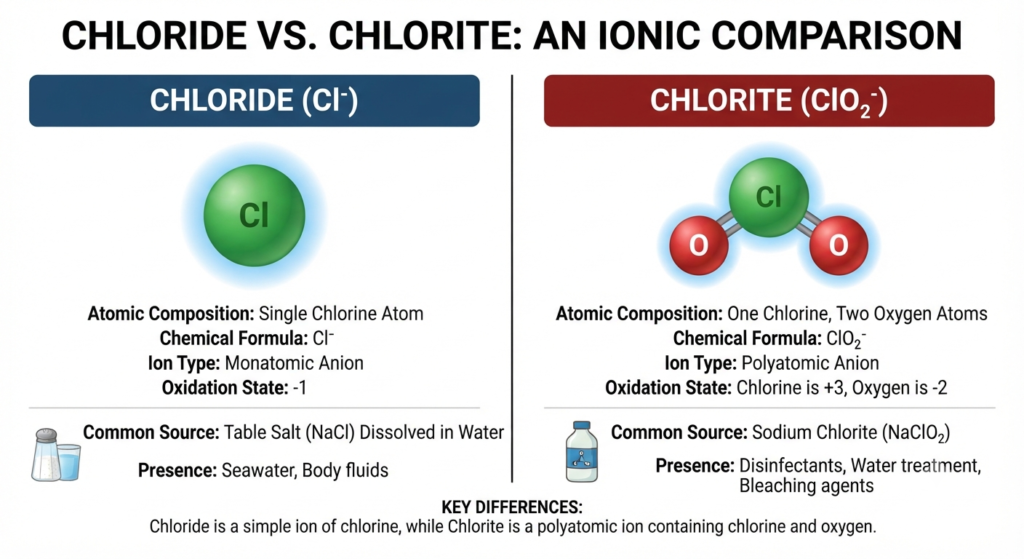
The main difference between Chloride vs. Chlorite is that chloride (Cl⁻) is a simple chlorine ion containing only one chlorine atom with a −1 oxidation state, whereas chlorite (ClO₂⁻) is an oxyanion containing one chlorine atom and two oxygen atoms, with chlorine in the +3 oxidation state. Chloride is an essential electrolyte found naturally in living organisms and salts such as sodium chloride (table salt), while chlorite is a strong oxidizing agent mainly used for water treatment, bleaching, and industrial disinfection.
Understanding the difference between Chloride vs. Chlorite is important for chemistry students, researchers, water treatment professionals, and industrial engineers because these two chlorine-containing ions have completely different chemical structures, properties, reactivity, and applications. Although their names sound similar, they should never be confused in scientific or industrial settings.
Chloride vs. Chlorite: Comparison Table
The table below highlights the major differences between Chloride vs. Chlorite.
| Feature | Chloride | Chlorite |
|---|---|---|
| Chemical Formula | Cl⁻ | ClO₂⁻ |
| Type of Ion | Monatomic anion | Polyatomic oxyanion |
| Chlorine Oxidation State | −1 | +3 |
| Oxygen Atoms | None | Two |
| Molecular Mass | 35.45 g/mol | 67.45 g/mol |
| Derived From | Hydrochloric acid (HCl) | Chlorous acid (HClO₂) |
| Oxidizing Ability | Not an oxidizing agent | Strong oxidizing agent |
| Stability | Highly stable | Less stable than chloride |
| Reactivity | Comparatively low | Highly reactive |
| Water Solubility | Highly soluble in most salts | Soluble in water |
| Biological Importance | Essential electrolyte | No biological role |
| Common Compounds | Sodium chloride (NaCl), Potassium chloride (KCl), Calcium chloride (CaCl₂) | Sodium chlorite (NaClO₂), Potassium chlorite (KClO₂) |
| Major Uses | Food, medicine, chemical industry, de-icing | Water treatment, bleaching, disinfectants |
| Color | Colorless in solution | Usually colorless in solution |
| Toxicity | Low under normal conditions | Can be harmful at high concentrations |
What Is Chloride?
Chloride is a negatively charged ion with the chemical formula Cl⁻. It forms when a chlorine atom gains one electron, giving it a stable electron configuration similar to the noble gas argon.
Chloride is one of the most abundant anions found in nature. It occurs naturally in seawater, underground water, rocks, minerals, and many salts. The most familiar chloride compound is sodium chloride (NaCl), commonly known as table salt.
In the human body, chloride is an essential electrolyte that helps regulate fluid balance, maintain osmotic pressure, support nerve impulse transmission, and produce hydrochloric acid (HCl) in the stomach for digestion.
Industrially, chloride compounds are widely used in food preservation, water softening, chemical manufacturing, metal processing, pharmaceuticals, and de-icing roads during winter.
Key Characteristics of Chloride
- Chemical formula: Cl⁻
- Monatomic anion
- Chlorine oxidation state: −1
- Highly stable ion
- Excellent electrolyte in aqueous solutions
- Naturally abundant in seawater and minerals
- Essential for human and animal health
- Found in common salts such as sodium chloride and potassium chloride
- Generally not an oxidizing agent
- Widely used in food, medicine, agriculture, and industry
What Is Chlorite?
Chlorite is a polyatomic oxyanion with the chemical formula ClO₂⁻. It consists of one chlorine atom bonded to two oxygen atoms, with chlorine having an oxidation state of +3.
Unlike chloride, chlorite does not occur naturally in significant amounts. It is mainly produced industrially and is commonly found in compounds such as sodium chlorite (NaClO₂).
One of the most important characteristics of chlorite is its strong oxidizing ability. Because of this property, chlorite compounds are widely used to generate chlorine dioxide (ClO₂), a highly effective disinfectant employed in municipal drinking water treatment, wastewater treatment, food processing, and paper bleaching.
Although chlorite has many industrial applications, excessive exposure can be hazardous because of its oxidizing nature. Therefore, its handling, storage, and use require proper safety precautions.
Key Characteristics of Chlorite
- Chemical formula: ClO₂⁻
- Polyatomic oxyanion
- Contains one chlorine atom and two oxygen atoms
- Chlorine oxidation state: +3
- Strong oxidizing agent
- More chemically reactive than chloride
- Commonly found in sodium chlorite
- Used to produce chlorine dioxide
- Important in water disinfection and bleaching
- Requires careful handling because of its oxidizing properties
Chloride vs. Chlorite: Key Differences
1. Definition
Although chloride and chlorite both contain chlorine, they are entirely different chemical ions with distinct structures and functions.
Chloride (Cl⁻) is a simple monatomic anion formed when a chlorine atom gains one electron. It is one of the most common anions found in nature and is essential for many biological processes. Chloride occurs naturally in seawater, minerals, and salts such as sodium chloride (NaCl).
Chlorite (ClO₂⁻), on the other hand, is a polyatomic oxyanion consisting of one chlorine atom bonded to two oxygen atoms. It is primarily produced for industrial purposes and is known for its strong oxidizing properties. Chlorite compounds are widely used in water treatment and bleaching applications.
2. Chemical Formula
One of the easiest ways to distinguish Chloride vs. Chlorite is by comparing their chemical formulas.
The chemical formula of chloride is:
Cl⁻
It contains only one chlorine atom carrying a single negative charge.
The chemical formula of chlorite is:
ClO₂⁻
It contains one chlorine atom and two oxygen atoms with an overall negative charge.
The presence of oxygen atoms significantly changes the chemical behavior of chlorite compared to chloride.
3. Chemical Structure
The structures of chloride and chlorite are completely different.
Chloride Structure:
Chloride consists of a single chlorine atom that has gained one electron. Since it is a monatomic ion, it has no chemical bonds within the ion itself.
Characteristics
- Single chlorine atom
- Monatomic ion
- No oxygen atoms
- Spherical electron cloud
- Stable noble-gas electron configuration
Chlorite Structure:
Chlorite is a polyatomic ion in which one chlorine atom is covalently bonded to two oxygen atoms. Due to the presence of lone electron pairs on chlorine, the ion has a bent (V-shaped) molecular geometry rather than a linear arrangement.
Characteristics
- One chlorine atom
- Two oxygen atoms
- Bent molecular geometry
- Polyatomic ion
- Covalent Cl–O bonds
Because of this more complex structure, chlorite exhibits very different chemical properties from chloride.
4. Oxidation State
The oxidation state of chlorine is one of the most important differences between Chloride vs. Chlorite.
In chloride ions, chlorine has an oxidation state of:
−1
This is the lowest oxidation state commonly exhibited by chlorine and represents its fully reduced form.
In chlorite ions, chlorine has an oxidation state of:
+3
Because chlorine is in a higher oxidation state, chlorite can readily accept electrons and participate in oxidation-reduction reactions.
This difference explains why chlorite behaves as an oxidizing agent while chloride generally does not.
5. Physical Properties
Although both ions are generally colorless in solution, their physical characteristics differ because of their chemical structures.
Physical Properties of Chloride:
- Colorless in aqueous solution
- Monatomic ion
- Molecular mass: 35.45 g/mol
- Highly soluble in water
- Stable under normal conditions
- Forms crystalline salts with many metals
- Excellent electrical conductivity in aqueous solutions
- Odorless
Physical Properties of Chlorite
- Usually colorless in dilute aqueous solutions
- Polyatomic oxyanion
- Molecular mass: 67.45 g/mol
- Water soluble
- Less stable than chloride
- Commonly found as sodium chlorite crystals
- Strong oxidizing characteristics
- Can slowly decompose under certain conditions
Although both ions dissolve readily in water, chlorite compounds require more careful storage because they can decompose when exposed to heat, light, or contamination.
6. Chemical Properties
The chemical behavior of chloride and chlorite differs significantly.
Chemical Properties of Chloride
- Chemically stable
- Forms ionic compounds with metals
- Does not readily oxidize other substances
- Participates mainly in ionic reactions
- Exists abundantly in natural waters and minerals
- Can act as a weak reducing agent under certain conditions
Chemical Properties of Chlorite
- Strong oxidizing agent
- Can oxidize organic and inorganic compounds
- Reacts readily with reducing agents
- Produces chlorine dioxide under acidic conditions
- More chemically reactive than chloride
- Used in oxidation and disinfection processes
These differences make chlorite much more useful in industrial oxidation processes, while chloride is mainly valued for its stability.
7. Oxidizing Ability
The oxidizing ability is perhaps the most significant difference between Chloride vs. Chlorite.
Chloride ions are already in the lowest oxidation state of chlorine (−1). Because of this, they have almost no tendency to gain additional electrons and therefore are not oxidizing agents.
Chlorite contains chlorine in the +3 oxidation state, allowing it to accept electrons from other substances. As a result, chlorite acts as a strong oxidizing agent and is widely used for disinfection, bleaching, and water purification.
This property is the primary reason chlorite compounds are valuable in many industrial applications.
8. Stability
The stability of these ions also differs considerably.
Chloride is extremely stable under ordinary environmental conditions. It does not decompose easily and remains chemically unchanged in most natural environments.
Chlorite is comparatively less stable because of its higher oxidation state. It may decompose when exposed to:
- Strong acids
- Heat
- Ultraviolet light
- Organic contaminants
- Reducing agents
Proper storage is therefore essential for chlorite-containing chemicals.
9. Reactivity
The difference in oxidation state also affects chemical reactivity.
Chloride ions exhibit relatively low chemical reactivity. They mainly participate in ionic reactions such as precipitation, dissolution, and electrolyte formation.
Chlorite ions are significantly more reactive because of their oxidizing nature. They readily participate in oxidation-reduction reactions and are commonly used to destroy microorganisms, oxidize contaminants, and generate chlorine dioxide.
In simple terms:
- Chloride is chemically stable and relatively unreactive.
- Chlorite is chemically active and readily participates in oxidation reactions.
10. Solubility
Both chloride and chlorite compounds are generally soluble in water, but their behavior in solution differs because of their chemical structures and reactivity.
Chloride salts such as sodium chloride (NaCl), potassium chloride (KCl), and calcium chloride (CaCl₂) dissolve readily in water, producing free chloride ions that conduct electricity efficiently. This high solubility makes chloride compounds useful in biological systems, chemical manufacturing, and electrolyte solutions.
Chlorite salts, particularly sodium chlorite (NaClO₂), are also water-soluble. However, chlorite ions are chemically more reactive and can undergo oxidation-reduction reactions in solution. Under acidic conditions, chlorite can generate chlorine dioxide (ClO₂), an effective disinfectant widely used in water treatment.
Although both ions are water soluble, chloride solutions remain relatively stable, whereas chlorite solutions require careful handling because they may decompose under unfavorable conditions.
11. Industrial Production
The manufacturing processes for chloride and chlorite differ significantly because one occurs naturally in abundance while the other is mainly produced through industrial chemical reactions.
Production of Chloride
Chloride compounds are obtained from several natural and industrial sources, including:
- Mining of rock salt (halite)
- Evaporation of seawater
- Extraction from underground brine deposits
- Chemical production during chlor-alkali processes
- Neutralization reactions involving hydrochloric acid
Since chloride is naturally abundant, its commercial production is relatively simple and economical.
Production of Chlorite
Chlorite compounds are manufactured through controlled chemical processes rather than being extracted directly from nature.
Common production methods include:
- Reduction of sodium chlorate
- Controlled oxidation-reduction reactions involving chlorine compounds
- Industrial synthesis of sodium chlorite
- Production as an intermediate for chlorine dioxide generation
Because chlorite is less stable than chloride, its production requires carefully controlled operating conditions to ensure product quality and safety.
12. Industrial Uses
Although both ions contain chlorine, their industrial applications are entirely different because of their chemical properties.
Common Uses of Chloride
Chloride compounds are among the most widely used chemicals in the world.
Major applications include:
- Table salt and food preservation
- Electrolyte solutions
- Water softening
- Chemical manufacturing
- Metal processing
- Pharmaceutical formulations
- De-icing roads and highways
- Fertilizer production
- Textile processing
- Oil and gas drilling fluids
Common Uses of Chlorite
Chlorite compounds are primarily valued for their strong oxidizing and disinfecting properties.
Major applications include:
- Drinking water treatment
- Wastewater disinfection
- Production of chlorine dioxide
- Paper and pulp bleaching
- Textile bleaching
- Food processing sanitation
- Industrial cooling water treatment
- Surface disinfection
- Odor control
- Microbial control in industrial systems
In summary, chloride is mainly used where chemical stability is required, while chlorite is selected when oxidation or disinfection is needed.
13. Biological Importance
One of the biggest differences between Chloride vs. Chlorite is their role in living organisms.
Chloride is an essential mineral and electrolyte required for normal physiological functions. It helps maintain fluid balance, supports nerve impulse transmission, regulates muscle function, and contributes to the production of hydrochloric acid in the stomach for digestion. Chloride ions are present in blood, body fluids, and every living cell, making them indispensable for human health.
Chlorite, however, has no known biological function in the human body. Instead, it is considered an industrial chemical. Because of its strong oxidizing nature, excessive exposure to chlorite may damage cells and tissues. Therefore, chlorite concentrations in drinking water are carefully regulated to protect public health.
14. Environmental Impact
Both chloride and chlorite can affect the environment, but their impacts are quite different.
Large amounts of chloride released into the environment—especially from road salts, industrial wastewater, and mining activities—can increase the salinity of rivers, lakes, and groundwater. Elevated chloride levels may harm freshwater ecosystems, reduce soil fertility, and affect plant growth.
Chlorite, on the other hand, is not commonly found in nature but may enter the environment through water treatment or industrial discharge. Because it is a strong oxidizing agent, excessive chlorite concentrations can be harmful to aquatic organisms and may alter water chemistry. Fortunately, chlorite usually breaks down into other chlorine-containing compounds over time under appropriate environmental conditions.
Overall, responsible handling, treatment, and disposal of both chloride- and chlorite-containing chemicals are essential to minimize their environmental impact.
Similarities Between Chloride and Chlorite
Although chloride and chlorite have different chemical structures and applications, they also share several characteristics because both are negatively charged ions derived from chlorine.
Some of their major similarities include:
- Both are chlorine-containing anions.
- Both carry a −1 electrical charge.
- Both readily dissolve in water when combined with suitable metal ions.
- Both form ionic compounds with metals such as sodium and potassium.
- Both are important in industrial chemical processes.
- Both are commonly used in water-related applications.
- Both can conduct electricity in aqueous solutions because they exist as free ions.
- Both are produced commercially on a large scale.
- Both require proper storage and handling in industrial settings.
- Both play important roles in chemistry and chemical manufacturing.
Despite these similarities, the presence of oxygen atoms in chlorite gives it properties that are very different from those of chloride.
Advantages and Uses of Chloride
Chloride is one of the most widely used anions in nature and industry. Its excellent stability, high solubility, and biological importance make it valuable across numerous applications.
Some of the major advantages and uses of chloride include:
- Essential electrolyte for maintaining fluid balance in the human body.
- Supports normal nerve transmission and muscle function.
- Required for the production of hydrochloric acid during digestion.
- Major component of table salt (sodium chloride).
- Used in food preservation and seasoning.
- Important raw material in the chlor-alkali industry.
- Used in manufacturing chlorine, caustic soda, and hydrochloric acid.
- Calcium chloride is widely used for road de-icing and dust control.
- Potassium chloride is an important agricultural fertilizer.
- Used in water softening and industrial water treatment.
- Serves as an electrolyte in batteries and electrochemical processes.
- Used in pharmaceuticals, medical saline solutions, and laboratory chemicals.
Its abundance, low cost, and chemical stability make chloride indispensable in everyday life and industrial manufacturing.
Advantages and Uses of Chlorite
Chlorite compounds are primarily valued for their strong oxidizing and antimicrobial properties. Although they are used in much smaller quantities than chloride compounds, they are essential in several industrial sectors.
Major advantages and uses of chlorite include:
- Strong oxidizing agent for industrial chemical processes.
- Used to produce chlorine dioxide, a highly effective disinfectant.
- Removes bacteria, viruses, fungi, and algae from drinking water.
- Used in municipal and industrial water treatment plants.
- Effective bleaching agent for paper, pulp, and textiles.
- Controls microbial growth in cooling towers and process water.
- Helps remove unpleasant tastes and odors from water.
- Oxidizes iron, manganese, and sulfides during water purification.
- Used in food processing equipment sanitation.
- Suitable for industrial disinfection where strong oxidizing action is required.
Because of its effectiveness at low concentrations, chlorite remains an important chemical in modern water treatment and sanitation industries.
Safety and Handling
Both chloride and chlorite should be handled according to recommended safety practices, although chlorite requires much greater caution because of its oxidizing nature.
When handling these compounds, follow these general safety guidelines:
- Store chemicals in properly labeled containers.
- Keep containers tightly closed when not in use.
- Wear appropriate personal protective equipment (PPE), including gloves and safety goggles.
- Avoid unnecessary inhalation of dust, vapors, or concentrated solutions.
- Prevent accidental ingestion.
- Keep chemicals away from children and unauthorized personnel.
Additional precautions for chlorite compounds include:
- Keep away from heat, sparks, and open flames.
- Avoid contact with strong acids unless the reaction is intended, as chlorine dioxide gas may be released.
- Do not mix with combustible or reducing materials.
- Store in a cool, dry, and well-ventilated area.
- Follow local regulations for storage, transportation, and disposal.
Proper handling helps ensure safe use while minimizing health and environmental risks.
Which Is More Important?
Neither chloride nor chlorite is universally more important because each serves a different purpose.
Chloride is indispensable in nature and everyday life. It is an essential electrolyte for humans, occurs abundantly in the environment, and is widely used in food, medicine, agriculture, and countless industrial processes. Without chloride, many biological functions and manufacturing operations would not be possible.
Chlorite, in contrast, is valuable because of its powerful oxidizing properties. It plays a critical role in producing chlorine dioxide for drinking water disinfection, wastewater treatment, bleaching, and industrial sanitation. Although it has no biological function, it is essential for applications that require effective oxidation and microbial control.
Ultimately, the choice between chloride and chlorite depends entirely on the intended application. Chloride is preferred for its stability and biological importance, whereas chlorite is selected when strong oxidation and disinfection are required.
Conclusion
The comparison of Chloride vs. Chlorite shows that although both are negatively charged chlorine-containing ions, they differ significantly in their chemical composition, oxidation state, reactivity, stability, and applications. Chloride (Cl⁻) is a simple monatomic ion that is chemically stable, naturally abundant, and essential for human health. It plays a vital role in maintaining electrolyte balance, supporting nerve function, and numerous industrial processes.
Chlorite (ClO₂⁻), on the other hand, is a polyatomic oxyanion containing oxygen atoms. It is a strong oxidizing agent primarily used in water treatment, bleaching, and the production of chlorine dioxide. Unlike chloride, chlorite has no biological role and must be handled carefully because of its reactive nature.
Understanding the differences between Chloride vs. Chlorite helps students, researchers, and industry professionals select the appropriate compound for scientific, medical, environmental, and industrial applications.
Frequently Asked Questions (FAQs)
The main difference between Chloride vs. Chlorite is that chloride (Cl⁻) is a simple chlorine ion without oxygen atoms, whereas chlorite (ClO₂⁻) is an oxyanion containing two oxygen atoms. Chloride is chemically stable, while chlorite is a strong oxidizing agent.
No. Although their names are similar, they are different chemical ions with different structures, oxidation states, and uses.
Chlorite is a strong oxidizing agent because chlorine is in the +3 oxidation state. Chloride is not an oxidizing agent since chlorine is already in its lowest oxidation state (−1).
The chemical formula of chloride is:
Cl⁻
It consists of a single chlorine atom carrying one negative charge.
The chemical formula of chlorite is:
ClO₂⁻
It contains one chlorine atom and two oxygen atoms.
Reference:
1. “Halogens as Oxidizing Agents.” Chemistry LibreTexts, Libretexts.
Read Next:
- Difference Between Methyl and Methylene Group (CH3 vs CH2)
- Difference Between Molecular Equation and Ionic Equation
- Difference Between Detergent and Chaotropic Agent
- 1-Butene vs. 2-Butene: What’s the Difference?
- Phosphodiester Bond vs. Phosphoester Bond
- Olefins vs. Paraffins: What’s the Difference?
- Olefin vs. Polypropylene: What’s the Difference?
- Cetyl Alcohol vs. Stearyl Alcohol: What’s the Difference?
- Buchner Funnel vs. Hirsch Funnel
- Teal vs. Turquoise
- Polycarbonate vs. Polyurethane
- Hydrogen Peroxide vs. Peroxide
- Aluminium vs. Alumina