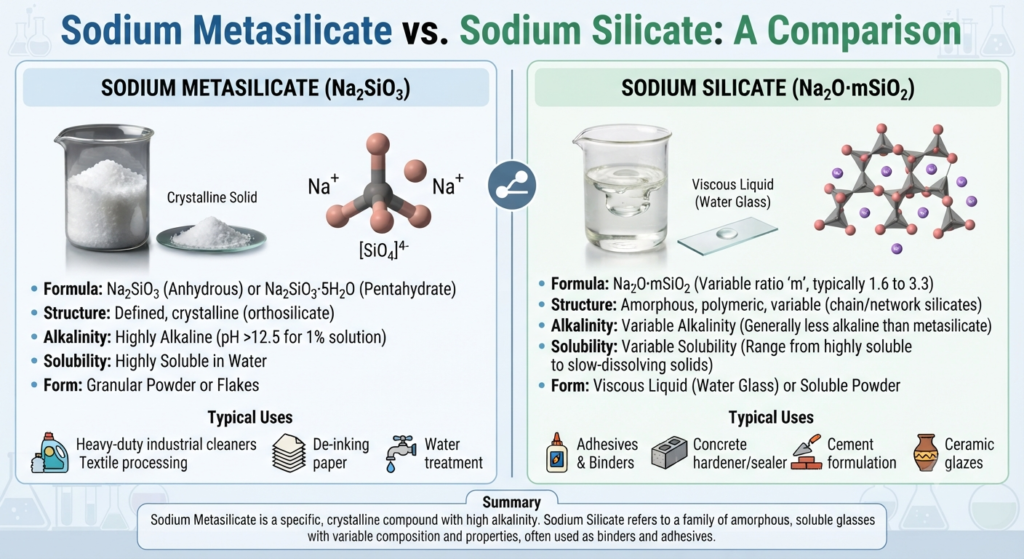
The main difference between Sodium Metasilicate vs. Sodium Silicate is that sodium metasilicate (Na₂SiO₃) is a specific silicate compound with a fixed chemical composition that is mainly used in detergents, industrial cleaners, and metal treatment, whereas sodium silicate is a broader family of sodium silicate compounds with varying sodium oxide-to-silica ratios, commonly used as adhesives, binders, sealants, water treatment chemicals, and construction materials. Although sodium metasilicate is a type of sodium silicate, their chemical structures, alkalinity, and industrial applications differ significantly.
Understanding Sodium Metasilicate vs. Sodium Silicate is important for chemists, manufacturers, cleaning professionals, and industrial engineers. While both compounds are alkaline and water-soluble, selecting the appropriate material depends on the required cleaning strength, binding properties, corrosion resistance, and manufacturing process.
Sodium Metasilicate vs. Sodium Silicate Comparison Table
The table below highlights the major differences between Sodium Metasilicate vs. Sodium Silicate.
| Feature | Sodium Metasilicate | Sodium Silicate |
|---|---|---|
| Chemical Formula | Na₂SiO₃ | General formula: Na₂O·nSiO₂ |
| Chemical Type | Specific sodium silicate compound | Family of sodium silicate compounds |
| Composition | Fixed ratio of sodium and silica | Variable sodium-to-silica ratio |
| Appearance | White crystalline powder or granules | Colorless liquid, glassy solid, or powder |
| Water Solubility | Highly soluble | Solubility depends on silica ratio |
| pH | Approximately 12–13 | Approximately 10–12 |
| Alkalinity | Very high | High |
| Cleaning Ability | Excellent | Moderate |
| Adhesive Properties | Limited | Excellent |
| Common Uses | Detergents, industrial cleaners, metal cleaning | Adhesives, sealants, water treatment, foundry binders |
| Corrosion Inhibition | Good | Excellent in many applications |
| Industrial Importance | Cleaning and surface treatment | Construction, manufacturing, water treatment |
What Is Sodium Metasilicate?
Sodium metasilicate is an inorganic alkaline compound with the chemical formula Na₂SiO₃. It is one of the simplest members of the sodium silicate family and is widely recognized for its strong cleaning performance.
Because it produces a highly alkaline solution, sodium metasilicate effectively removes grease, oils, proteins, and stubborn dirt. It is commonly used in industrial detergents, dishwashing products, textile processing, metal cleaning, and ceramic manufacturing.
Its excellent buffering capacity and corrosion-inhibiting properties also make it valuable in many industrial cleaning formulations.
Characteristics of Sodium Metasilicate
- Chemical formula Na₂SiO₃
- White crystalline powder or granules
- Highly water-soluble
- Strongly alkaline
- Excellent detergent builder
- Effective degreasing agent
- Good corrosion inhibitor
- Used in industrial cleaners
- Hygroscopic
- Non-flammable
What Is Sodium Silicate?
Sodium silicate, often called water glass or liquid glass, is a family of inorganic compounds made by combining sodium oxide (Na₂O) with silicon dioxide (SiO₂) in different proportions. Unlike sodium metasilicate, sodium silicate does not have a single fixed chemical formula because it exists in several grades with varying silica-to-sodium ratios.
Sodium silicate is widely used as an adhesive, binder, sealant, corrosion inhibitor, water treatment chemical, fireproofing material, and raw material in the manufacture of detergents, paper, ceramics, and construction products.
Its versatility makes it one of the most important industrial silicate chemicals.
Characteristics of Sodium Silicate
- General formula Na₂O·nSiO₂
- Available as liquid, powder, or glassy solid
- Water-soluble (depending on grade)
- Strongly alkaline
- Excellent adhesive properties
- Good binding strength
- Resistant to high temperatures
- Used in construction and manufacturing
- Corrosion-resistant
- Available in multiple silica ratios
Sodium Metasilicate vs. Sodium Silicate: Key Differences
1. Chemical Composition
The most important difference between Sodium Metasilicate vs. Sodium Silicate is their chemical composition.
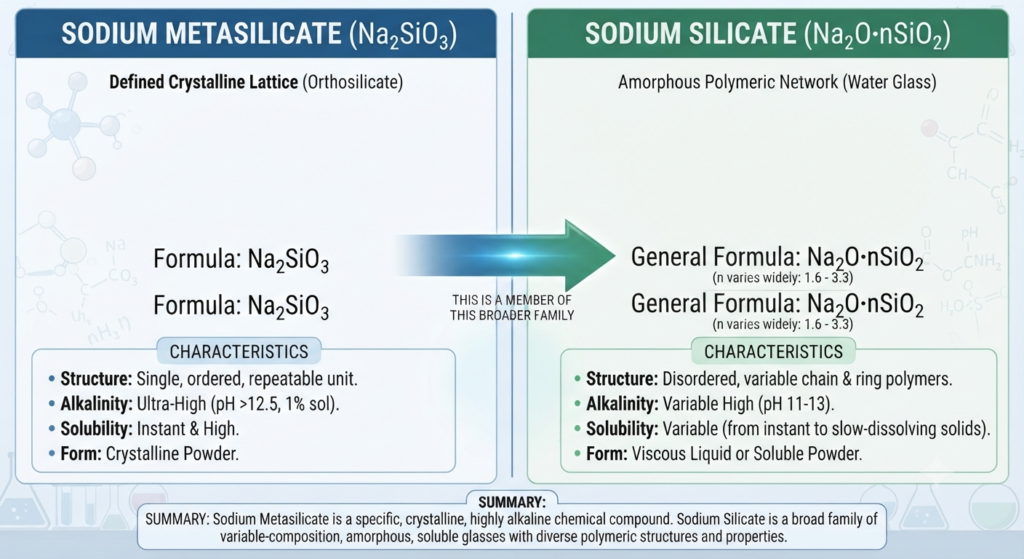
Sodium Metasilicate is a single, well-defined chemical compound with the formula Na₂SiO₃.
Sodium Silicate refers to a family of sodium silicate compounds that contain varying proportions of sodium oxide (Na₂O) and silicon dioxide (SiO₂). Its general formula is written as Na₂O·nSiO₂, where n varies depending on the product grade.
This makes sodium metasilicate one specific member of the broader sodium silicate family.
2. Chemical Structure
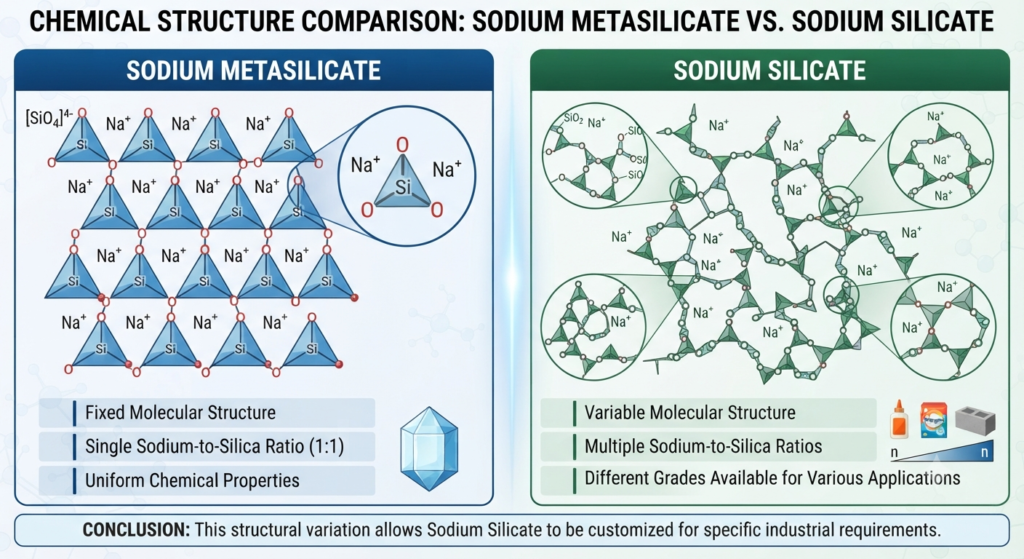
The internal chemical structure also differs.
Sodium Metasilicate
- Fixed molecular structure
- Single sodium-to-silica ratio
- Uniform chemical properties
Sodium Silicate
- Variable molecular structure
- Multiple sodium-to-silica ratios
- Different grades available for various applications
This variation allows sodium silicate to be customized for specific industrial requirements.
3. Appearance
Both compounds are available in solid form, but sodium silicate is sold in more physical forms.
Sodium Metasilicate
- White crystalline powder
- White granules
- Odorless solid
Sodium Silicate
- Clear to slightly cloudy liquid
- White powder
- Glass-like solid
- Granular form
Liquid sodium silicate is especially common in industrial manufacturing.
4. Water Solubility
Water solubility varies between the two compounds.
Sodium Metasilicate
- Highly soluble in water
- Dissolves rapidly
- Produces a strongly alkaline solution
Sodium Silicate
- Solubility depends on the silica ratio
- Lower silica grades dissolve more easily
- Higher silica grades dissolve more slowly
This difference influences their industrial applications.
5. Alkalinity (pH)
Both compounds are alkaline, but sodium metasilicate generally produces a stronger alkaline solution.
Sodium Metasilicate
- Typical pH: 12–13
- Highly alkaline
- Excellent grease removal
Sodium Silicate
- Typical pH: 10–12
- Moderately to strongly alkaline
- Suitable for binding and corrosion protection
The higher alkalinity of sodium metasilicate contributes to its superior cleaning ability.
6. Cleaning Performance
Cleaning efficiency is one of the biggest differences between Sodium Metasilicate vs. Sodium Silicate.
Sodium Metasilicate
- Excellent degreaser
- Removes heavy oils
- Removes protein deposits
- Breaks down stubborn dirt
- Common in industrial detergents
Sodium Silicate
- Mild cleaning ability
- Used mainly as a detergent additive
- Provides water softening
- Improves detergent performance
For heavy-duty cleaning applications, sodium metasilicate is generally preferred.
7. Adhesive and Binding Properties
When comparing Sodium Metasilicate vs. Sodium Silicate, sodium silicate offers significantly stronger binding performance.
Sodium Metasilicate
- Weak adhesive characteristics
- Seldom used for bonding applications
Sodium Silicate
- High adhesive performance
- Superior bonding properties
- Utilized in cement manufacturing
- Applied in refractory materials
- Serves as a binder in foundry operations
Because of its exceptional bonding ability, sodium silicate is extensively utilized across the construction and industrial manufacturing sectors.
8. Industrial Applications
The two chemicals serve different industries.
Sodium Metasilicate is commonly used in:
- Industrial cleaners
- Laundry detergents
- Automatic dishwasher detergents
- Metal cleaning
- Textile processing
- Ceramic manufacturing
- Food processing equipment cleaning
Sodium Silicate is widely used in:
- Adhesives
- Construction materials
- Paper manufacturing
- Water treatment
- Foundry molds
- Fireproof coatings
- Drilling fluids
- Refractory products
Their industrial applications reflect their unique chemical properties.
9. Corrosion Protection
Both compounds provide corrosion resistance, but they function differently.
Sodium Metasilicate
- Protects metal surfaces during cleaning
- Helps prevent flash rust
- Used in metal cleaning formulations
Sodium Silicate
- Creates a protective surface layer
- Reduces corrosion in water treatment systems
- Applied for concrete surface protection
- Increases the durability of construction materials
For long-term corrosion resistance, sodium silicate is generally the preferred choice.
10. Construction Applications
Construction is another area where their uses differ.
Sodium Metasilicate
- Limited construction use
- Occasionally used in specialty formulations
Sodium Silicate
- Concrete densifier
- Cement additive
- Fire-resistant coatings
- Masonry sealers
- Soil stabilization
- Waterproofing treatments
It has a much broader role in construction because of its strengthening, sealing, and protective properties.
11. Safety Considerations
Both compounds should be handled carefully because of their alkaline nature.
Sodium Metasilicate
- May cause skin irritation
- Can damage eyes
- Avoid inhalation of dust
- Wear gloves and goggles
Sodium Silicate
- May irritate skin and eyes
- Liquid solutions may cause burns after prolonged exposure
- Use protective equipment
- Avoid direct contact
Proper storage and personal protective equipment (PPE) are recommended for both chemicals.
12. Cost and Availability
Both compounds are commercially available, but pricing varies according to grade and application.
Sodium Metasilicate
- Readily available
- Generally economical
- Commonly sold as cleaning-grade powder or granules
Sodium Silicate
- Available in numerous industrial grades
- Sold as liquid, powder, and solid glass
- Price depends on silica ratio and purity
Selecting between the two depends more on the intended application than on cost alone.
Similarities Between Sodium Metasilicate and Sodium Silicate
Although Sodium Metasilicate vs. Sodium Silicate differ in chemical composition, alkalinity, and industrial applications, they also share several important characteristics because sodium metasilicate belongs to the sodium silicate family.
Some major similarities include:
- Both are inorganic silicate compounds.
- Both contain sodium, silicon, and oxygen.
- Both are alkaline chemicals.
- Both dissolve in water to produce alkaline solutions.
- Both are used in detergent formulations.
- Both act as corrosion inhibitors in various applications.
- Both are widely used in industrial manufacturing.
- Both improve cleaning and processing efficiency.
- Both require proper handling due to their alkalinity.
- Both are commercially available in multiple industrial grades.
Advantages of Sodium Metasilicate
Sodium metasilicate is valued for its powerful cleaning performance and high alkalinity.
Major advantages include:
- Excellent degreasing ability.
- Highly effective in industrial cleaning.
- Removes oils, grease, and protein deposits.
- Strong alkaline buffering capacity.
- Good corrosion protection for metals during cleaning.
- Highly soluble in water.
- Improves detergent performance.
- Suitable for textile and ceramic industries.
- Economical for heavy-duty cleaning.
- Easy to store and transport in powder form.
Advantages of Sodium Silicate
Sodium silicate is one of the most versatile industrial chemicals because of its excellent binding and sealing properties.
Major advantages include:
- Outstanding adhesive strength.
- Excellent binder for foundries and refractories.
- Used in concrete densification.
- Provides corrosion protection.
- Improves fire resistance of materials.
- Useful in water treatment.
- Available in various silica ratios.
- Suitable for paper and ceramic manufacturing.
- Acts as an effective sealant.
- Widely used across multiple industries.
Which Is Better—Sodium Metasilicate or Sodium Silicate?
Neither Sodium Metasilicate nor Sodium Silicate is universally better because they are designed for different industrial purposes.
Sodium Metasilicate is the preferred choice when strong cleaning power, grease removal, and highly alkaline solutions are required. It is widely used in detergents, industrial cleaning products, food processing equipment cleaners, textile processing, and metal surface treatment.
Sodium Silicate, on the other hand, is better suited for applications requiring strong adhesive properties, binding strength, corrosion protection, sealing, and construction materials. It is extensively used in concrete, water treatment, paper manufacturing, ceramics, and foundry operations.
In summary:
- Choose Sodium Metasilicate for industrial cleaning, detergents, and degreasing applications.
- Choose Sodium Silicate for adhesives, construction, water treatment, and industrial binding applications.
The best choice depends on the intended application, required alkalinity, and desired material properties.
Conclusion
The comparison of Sodium Metasilicate vs. Sodium Silicate shows that while both are alkaline silicate compounds, they differ significantly in chemical composition, pH, cleaning performance, adhesive properties, and industrial uses. Sodium Metasilicate is a specific chemical compound with exceptional cleaning and degreasing capabilities, making it ideal for detergents and industrial maintenance. Sodium Silicate is a broader family of compounds valued for its versatility in construction, adhesives, water treatment, and manufacturing.
Understanding Sodium Metasilicate vs. Sodium Silicate helps manufacturers, engineers, and industrial users select the right compound for their specific applications, improving efficiency, product performance, and operational safety.
Frequently Asked Questions (FAQs)
The main difference between Sodium Metasilicate vs. Sodium Silicate is that sodium metasilicate (Na₂SiO₃) is a specific compound mainly used for industrial cleaning, while sodium silicate is a family of silicate compounds used as adhesives, binders, sealants, and water treatment chemicals.
Yes. Sodium metasilicate is one specific member of the sodium silicate family with the chemical formula Na₂SiO₃.
Sodium metasilicate is generally more alkaline, with a typical pH of 12–13, whereas sodium silicate usually has a pH between 10 and 12, depending on its composition.
Sodium metasilicate is better for heavy-duty cleaning because it provides:
Strong grease removal
Excellent detergent performance
High alkalinity
Effective stain removal
Yes. Both compounds are water-soluble, although the solubility of sodium silicate varies depending on its silica-to-sodium ratio, while sodium metasilicate readily dissolves in water.
Read Next: