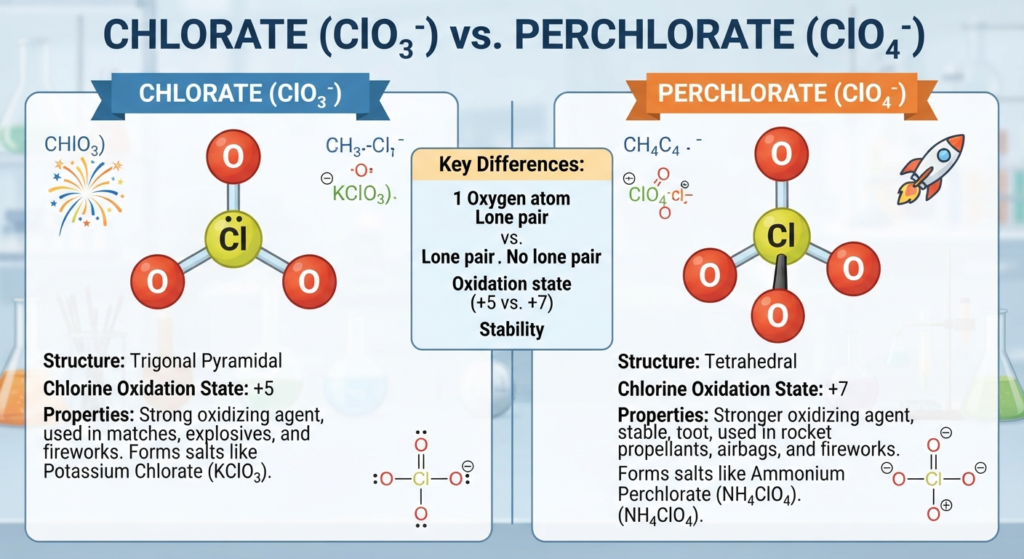
The main difference between Chlorate vs. Perchlorate is that chlorate (ClO₃⁻) contains three oxygen atoms and chlorine in the +5 oxidation state, whereas perchlorate (ClO₄⁻) contains four oxygen atoms and chlorine in the +7 oxidation state. Chlorate is generally more reactive and less thermally stable than perchlorate, while perchlorate is usually more stable under ordinary conditions but can act as a strong oxidizing agent under appropriate conditions.
Understanding Chlorate vs. Perchlorate is important in chemistry, environmental science, industrial processing, and materials science because these chlorine oxyanions have different structures, chemical behavior, stability, and applications. They are also important in understanding the different oxidation states of chlorine and the chemistry of oxygen-containing chlorine compounds.
Chlorate vs. Perchlorate Comparison Table
The table below highlights the major differences between Chlorate vs. Perchlorate.
| Feature | Chlorate | Perchlorate |
|---|---|---|
| Chemical Formula | ClO₃⁻ | ClO₄⁻ |
| Number of Oxygen Atoms | Three oxygen atoms | Four oxygen atoms |
| Oxidation State of Chlorine | +5 | +7 |
| Charge | −1 | −1 |
| Molecular Structure | Trigonal pyramidal | Tetrahedral |
| Relative Stability | Less thermally stable | Generally more thermally stable |
| Oxidizing Behavior | Strong oxidizing agent | Strong oxidizing agent under suitable conditions |
| Common Compounds | Sodium chlorate, potassium chlorate | Sodium perchlorate, potassium perchlorate, ammonium perchlorate |
| Major Applications | Pulp and paper, pyrotechnics, chemical processing | Rocket propellants, pyrotechnics, chemical processing |
| Environmental Concern | Can contaminate water and affect organisms at elevated exposure | Persistent in water and can interfere with iodide uptake by the thyroid |
| Chlorine Oxyanion Series | Higher than chlorite, lower than perchlorate | Highest common chlorine oxyanion |
What Is Chlorate?
Chlorate is a chlorine oxyanion with the chemical formula ClO₃⁻. It consists of one chlorine atom bonded to three oxygen atoms and has an overall charge of −1. In chlorate, chlorine has an oxidation state of +5.
Chlorate compounds are commonly used as oxidizing agents and have applications in industrial chemistry, pulp and paper production, pyrotechnics, and other chemical processes. Common examples include sodium chlorate (NaClO₃) and potassium chlorate (KClO₃).
Characteristics of Chlorate
- Chemical formula is ClO₃⁻.
- Contains three oxygen atoms.
- Chlorine has a +5 oxidation state.
- Has an overall −1 charge.
- Acts as an oxidizing agent.
- Generally has lower thermal stability than perchlorate.
- Many chlorate salts are soluble in water.
- Used in industrial and chemical processes.
- Important in chlorine dioxide production.
- Can participate in oxidation-reduction reactions.
Examples of Chlorate Compounds
- Sodium chlorate
- Potassium chlorate
- Calcium chlorate
- Magnesium chlorate
- Barium chlorate
- Other metal chlorates
What Is Perchlorate?
Perchlorate is a chlorine oxyanion with the chemical formula ClO₄⁻. It contains one chlorine atom bonded to four oxygen atoms and has an overall charge of −1. Chlorine in perchlorate has an oxidation state of +7.
Perchlorate compounds are important in aerospace, pyrotechnics, chemical manufacturing, and other specialized applications. Common examples include sodium perchlorate (NaClO₄), potassium perchlorate (KClO₄), and ammonium perchlorate (NH₄ClO₄).
Characteristics of Perchlorate
- Chemical formula is ClO₄⁻.
- Contains four oxygen atoms.
- Chlorine has a +7 oxidation state.
- Has an overall −1 charge.
- Generally more thermally stable than chlorate.
- Can act as an oxidizing agent.
- Has a tetrahedral molecular geometry.
- Used in aerospace and pyrotechnic applications.
- Can persist in water and groundwater.
- Forms salts with many positively charged ions.
Examples of Perchlorate Compounds
- Sodium perchlorate
- Potassium perchlorate
- Ammonium perchlorate
- Lithium perchlorate
- Magnesium perchlorate
- Other metal perchlorates
Chlorate vs. Perchlorate: Key Differences
1. Chemical Formula
The most obvious difference between Chlorate vs. Perchlorate is their chemical formula.
Chlorate has the formula ClO₃⁻, meaning that it contains one chlorine atom and three oxygen atoms.
Perchlorate has the formula ClO₄⁻, meaning that it contains one chlorine atom and four oxygen atoms.
Thus, perchlorate contains one more oxygen atom than chlorate.
2. Oxidation State of Chlorine
The oxidation state of chlorine is another major difference.
In chlorate (ClO₃⁻), chlorine has an oxidation state of +5.
In perchlorate (ClO₄⁻), chlorine has an oxidation state of +7.
Therefore, chlorine is in a higher oxidation state in perchlorate than in chlorate.
3. Molecular Structure
The two ions also have different molecular geometries.
Chlorate has a trigonal pyramidal molecular geometry because chlorine is surrounded by three oxygen atoms and has a lone pair of electrons.
Perchlorate has a tetrahedral molecular geometry, with four oxygen atoms surrounding the central chlorine atom.
This structural difference contributes to differences in their electronic properties and chemical behavior.
4. Stability
Stability is another important difference between Chlorate vs. Perchlorate.
Perchlorate compounds are generally more thermally stable than corresponding chlorate compounds. Chlorates can decompose more readily when heated, depending on the particular salt and reaction conditions.
For example, potassium chlorate can undergo thermal decomposition to form potassium chloride and oxygen:
2KClO₃ → 2KCl + 3O₂
Perchlorates generally require more severe conditions or specific chemical environments to undergo significant decomposition.
5. Oxidizing Properties
Both chlorate and perchlorate can act as oxidizing agents.
Chlorates can participate readily in oxidation-reduction reactions under suitable conditions. Their oxidizing properties make them useful in several industrial and pyrotechnic applications.
Perchlorates also have chlorine in a very high oxidation state. However, the perchlorate ion is relatively kinetically stable under ordinary conditions. Therefore, its oxidizing behavior depends strongly on temperature, reactants, catalysts, and reaction conditions.
Thus, a higher oxidation state does not automatically mean that perchlorate reacts faster than chlorate.
The solubility behavior of chlorate and perchlorate also deserves consideration.
Many chlorate salts are readily soluble in water. However, the solubility of perchlorates varies considerably depending on the cation.
For example, sodium perchlorate is highly soluble in water, whereas potassium perchlorate has substantially lower solubility.
Therefore, solubility cannot be determined solely from the chlorate or perchlorate ion. The identity of the positive ion in the salt is also important.
7. Environmental Impact
The environmental behavior of chlorate and perchlorate is another important distinction.
Chlorate can enter water systems through industrial processes and the use of chlorine-based chemicals. At elevated concentrations, chlorate exposure can have adverse effects on organisms.
Perchlorate is particularly important as an environmental contaminant because it can persist in groundwater and surface water. At sufficiently high exposure levels, perchlorate can interfere with the thyroid’s uptake of iodide, which is important for thyroid hormone production.
Therefore, both compounds require appropriate environmental management when present at significant concentrations.
8. Industrial and Commercial Applications
Chlorate and perchlorate have different major applications.
Chlorates are widely associated with industrial processes, particularly the production of chlorine dioxide, which is used in pulp and paper bleaching. Chlorates are also used in pyrotechnics and other chemical processes.
Perchlorates have important applications as oxidizers in specialized formulations. Ammonium perchlorate, for example, is widely associated with composite solid rocket propellants. Other perchlorates are used in pyrotechnics, chemical processing, and analytical applications.
Thus, their applications reflect differences in stability, reactivity, and chemical behavior.
9. Position in the Chlorine Oxyanion Series
Chlorate and perchlorate are members of a series of chlorine oxyanions.
The commonly recognized sequence is:
- Hypochlorite: ClO⁻
- Chlorite: ClO₂⁻
- Chlorate: ClO₃⁻
- Perchlorate: ClO₄⁻
As the number of oxygen atoms increases, the oxidation state of chlorine also increases.
Chlorate therefore represents the +5 oxidation state, while perchlorate represents the +7 oxidation state.
Understanding this series makes it easier to remember the difference between chlorate and perchlorate.
Similarities Between Chlorate and Perchlorate
Although Chlorate and Perchlorate differ in their formulas and chemical properties, they also share several important characteristics. Both are chlorine oxyanions that contain oxygen bonded to chlorine and carry an overall negative charge. Both can form salts with metals and can act as oxidizing agents under appropriate conditions.
Some important similarities between chlorate and perchlorate include:
- Both contain chlorine and oxygen.
- Both are polyatomic oxyanions.
- Both have an overall −1 charge.
- Both can form salts with metals.
- Both can act as oxidizing agents.
- Both contain chlorine in a positive oxidation state.
- Both participate in oxidation-reduction chemistry.
- Both have industrial applications.
- Both can be relevant to environmental contamination.
- Both are members of the chlorine oxyanion family.
Advantages of Chlorate
Chlorate compounds have several useful properties that make them valuable in industrial and chemical applications. Their oxidizing behavior and chemical composition allow them to participate in important manufacturing processes.
Some major advantages of chlorate compounds include:
- Useful as oxidizing agents.
- Important in chlorine dioxide production.
- Widely used in pulp and paper processing.
- Useful in selected pyrotechnic applications.
- Available in several commercially important salts.
- Can participate in oxidation-reduction reactions.
- Useful in industrial chemical processing.
- Many chlorate salts have good water solubility.
- Important in the manufacture of certain chemical products.
- Useful for controlled oxidation processes.
Advantages of Perchlorate
Perchlorate compounds have properties that make them particularly valuable in specialized applications. Their relatively high thermal stability and oxidizing potential are important characteristics in applications requiring an oxidizer that can remain stable under storage and handling conditions.
Some major advantages of perchlorate compounds include:
- Generally higher thermal stability than chlorates.
- Strong oxidizing potential under suitable conditions.
- Important in solid rocket propellant systems.
- Useful in selected pyrotechnic applications.
- Used in specialized chemical processes.
- Available as salts with different physical properties.
- Useful in analytical chemistry.
- Can remain relatively stable under ordinary conditions.
- Important in aerospace-related applications.
- Useful where a stable oxidizing compound is required.
Which Is Better—Chlorate or Perchlorate?
Neither chlorate nor perchlorate is universally better because the appropriate compound depends on the intended chemical or industrial application.
Chlorate may be more suitable when its particular reactivity, solubility, or role in industrial oxidation processes is required. It is especially important in chlorine dioxide production and certain chemical and pyrotechnic applications.
On the other hand, perchlorate may be more suitable when greater thermal stability and a strong oxidizing compound are required. Perchlorates are particularly important in specialized applications such as solid rocket propellants and certain pyrotechnic systems.
In summary:
- Choose chlorate when studying ClO₃⁻, chlorine in the +5 oxidation state, industrial oxidation, and chlorine dioxide production.
- Choose perchlorate when studying ClO₄⁻, chlorine in the +7 oxidation state, higher thermal stability, and specialized oxidizing applications.
Rather than one being universally superior, both chlorate and perchlorate have distinct chemical properties that make them useful for different purposes.
Conclusion
The comparison of Chlorate vs. Perchlorate demonstrates two closely related but distinct chlorine oxyanions. Chlorate (ClO₃⁻) contains three oxygen atoms and chlorine in the +5 oxidation state, while perchlorate (ClO₄⁻) contains four oxygen atoms and chlorine in the +7 oxidation state.
Although both compounds can act as oxidizing agents, they differ in molecular structure, stability, reactivity, solubility behavior, environmental significance, and applications. Chlorates are particularly important in chlorine dioxide production and several industrial processes, while perchlorates are widely associated with specialized oxidizing applications such as solid rocket propellants.
Understanding Chlorate vs. Perchlorate makes it easier to distinguish the chlorine oxyanion series and recognize how the addition of oxygen changes the oxidation state and chemical behavior of chlorine compounds.
Frequently Asked Questions (FAQs)
The primary difference between Chlorate vs. Perchlorate is their chemical formula and oxidation state. Chlorate has the formula ClO₃⁻ and chlorine in the +5 oxidation state, whereas perchlorate has the formula ClO₄⁻ and chlorine in the +7 oxidation state.
Perchlorate has more oxygen atoms. Chlorate contains three oxygen atoms, while perchlorate contains four oxygen atoms.
Perchlorate has the higher oxidation state. Chlorine has a +5 oxidation state in chlorate and a +7 oxidation state in perchlorate.
Perchlorate is generally more thermally stable than chlorate. However, the exact stability depends on the specific salt and the conditions under which the compound is heated or reacted.
Yes. Both chlorate and perchlorate can act as oxidizing agents, although their reactivity differs depending on the reaction conditions. Perchlorate is often relatively kinetically stable under ordinary conditions.
Reference:
1. “Chlorate.” Wikipedia, Wikimedia Foundation, 27 Aug. 2019
Read Next: