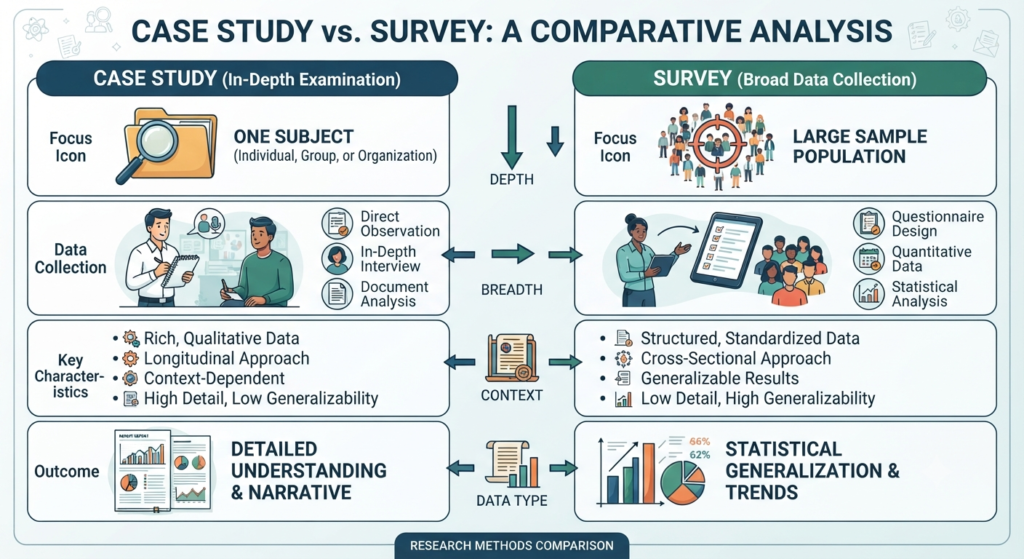
The main difference between Case Study vs. Survey is that a case study is an in-depth research method that investigates a single individual, group, organization, event, or phenomenon to gain detailed insights, whereas a survey is a research method that collects standardized information from a large number of participants using questionnaires or interviews to identify patterns, trends, or opinions. While case studies emphasize depth and context, surveys focus on breadth and statistical analysis.
Understanding Case Study vs. Survey is essential for students, researchers, educators, business analysts, healthcare professionals, and social scientists because choosing the appropriate research method directly affects the quality, reliability, and applicability of research findings. Although both methods gather valuable information, they differ significantly in objectives, sample size, data collection techniques, analysis, time requirements, and outcomes.
Case Study vs. Survey Comparison Table
The table below summarizes the major differences between Case Study vs. Survey.
| Feature | Case Study | Survey |
|---|---|---|
| Definition | In-depth investigation of a specific case | Research method using standardized questions |
| Research Type | Primarily qualitative | Primarily quantitative (can include qualitative questions) |
| Purpose | Explore and understand a phenomenon deeply | Measure opinions, behaviors, or characteristics across many participants |
| Sample Size | Small | Large |
| Data Collection | Interviews, observations, records, documents | Questionnaires, interviews, online forms |
| Depth of Information | Very detailed | Broad but less detailed |
| Generalizability | Limited | High (with representative sampling) |
| Time Required | Long | Short to moderate |
| Cost | Usually higher | Usually lower per participant |
| Data Analysis | Thematic and descriptive | Statistical and numerical |
| Flexibility | Highly flexible | More structured |
| Best For | Complex or unique situations | Large-scale population studies |
What Is a Case Study?
A case study is a detailed research method that focuses on one specific subject, such as an individual, organization, event, project, or community. Rather than collecting limited information from many participants, researchers gather extensive data from a single case to understand its background, behavior, challenges, outcomes, and contributing factors.
Case studies often combine multiple sources of evidence, including interviews, observations, official documents, photographs, reports, and historical records. Because of this comprehensive approach, they provide a deep understanding of real-world situations.
Case studies are widely used in:
- Business research
- Psychology
- Medicine
- Education
- Sociology
- Law
- Marketing
- Public policy
They are particularly useful when researchers want to answer “how” and “why” questions about complex phenomena.
Characteristics of a Case Study
- Focuses on one case or a few cases
- Provides in-depth analysis
- Uses multiple data sources
- Often qualitative
- Flexible research design
- Explores real-life situations
- Useful for hypothesis generation
- Requires extensive data collection
- Rich contextual information
- Ideal for complex problems
What Is a Survey?
A survey is a research method used to collect information, opinions, attitudes, behaviors, or characteristics from a group of people. Instead of studying one individual or case in depth, researchers typically collect standardized responses from a larger number of participants to identify patterns, trends, or relationships within a population.
Surveys commonly use questionnaires, online forms, telephone interviews, face-to-face interviews, or other structured methods to gather data. The collected information can be analyzed using statistical methods to understand the views, experiences, or characteristics of the target population.
Surveys are widely used in:
- Business research
- Psychology
- Education
- Sociology
- Marketing
- Healthcare
- Political research
- Public policy
They are particularly useful when researchers want to answer questions about “what,” “how many,” or “how often” something occurs within a population.
Characteristics of a Survey
- Collects data from many participants
- Uses standardized questions
- Often quantitative
- Can include qualitative questions
- Uses questionnaires or structured interviews
- Provides information about a population
- Allows statistical analysis
- Identifies patterns and trends
- Can be conducted online or offline
- Useful for measuring opinions, attitudes, and behaviors
Case Study vs. Survey: Key Differences
1. Definition
The most fundamental difference between Case Study vs. Survey lies in the scope of the research.
A case study is an intensive investigation of a single individual, organization, event, process, or small group of related cases. Its primary goal is to understand a phenomenon in great depth by examining it within its real-life context. Researchers often use multiple sources of evidence to build a comprehensive picture of the case.
A survey, in contrast, is a research method designed to collect standardized information from a large number of participants. It uses structured questionnaires or interviews to gather data about opinions, behaviors, attitudes, or characteristics, allowing researchers to identify trends and make statistical conclusions about a broader population.
2. Research Purpose
The objectives of these research methods differ significantly.
A case study seeks to explore complex issues, understand relationships, explain why events occur, and generate detailed insights. It is particularly useful when little information exists about a topic or when researchers need to investigate unique or unusual situations.
A survey aims to measure and quantify information across a large sample. It helps researchers estimate frequencies, compare groups, identify patterns, test hypotheses, and evaluate public opinion. Surveys are ideal when the goal is to obtain information that represents an entire population.
3. Sample Size
The number of participants is one of the most noticeable differences.
A case study usually focuses on one subject or a very small number of carefully selected cases. Since the emphasis is on depth rather than quantity, researchers spend considerable time gathering detailed information from each participant or organization.
A survey, however, typically includes dozens, hundreds, or even thousands of respondents. Larger sample sizes increase the reliability and representativeness of the results, especially when probability sampling techniques are used.
4. Data Collection Methods
The techniques used to gather information vary considerably.
A case study often combines several methods, including:
- In-depth interviews
- Direct observations
- Focus group discussions
- Official records
- Personal diaries
- Medical records
- Organizational documents
- Audio and video recordings
- Photographs
- Field notes
Using multiple sources helps researchers verify findings and develop a complete understanding of the case.
A survey generally relies on standardized tools such as:
- Online questionnaires
- Paper surveys
- Telephone interviews
- Face-to-face interviews
- Mobile app surveys
- Email questionnaires
Because every participant receives the same questions, surveys produce consistent and comparable data.
5. Type of Data
The nature of the collected data also differs.
A case study primarily generates qualitative data, including narratives, descriptions, observations, participant experiences, and contextual information. Although numerical data may also be included, qualitative insights are usually the main focus.
A survey mainly produces quantitative data in the form of numbers, percentages, ratings, rankings, frequencies, and statistical measurements. Some surveys also include open-ended questions that provide limited qualitative information.
6. Depth of Analysis
The level of detail obtained from each method is substantially different.
A case study provides a deep, comprehensive understanding of a specific situation. Researchers examine multiple variables, historical background, environmental influences, behaviors, and interactions to understand the entire context.
A survey provides a broad overview of many participants but offers less detail about each individual. It focuses on identifying common patterns rather than exploring personal experiences in depth.
7. Flexibility
Research flexibility is another important distinction.
A case study is highly flexible. Researchers can modify interview questions, collect additional evidence, explore unexpected findings, and adapt the research process as new information emerges.
A survey is much more structured. Once the questionnaire has been distributed, making changes is difficult because consistency across all respondents must be maintained to preserve data validity.
8. Time and Cost
The resources required for each method differ considerably.
A case study usually requires significant time and financial investment. Researchers spend weeks or months collecting, organizing, and analyzing detailed information from multiple sources.
A survey is generally faster and more cost-effective, particularly when conducted online. Modern survey platforms allow thousands of responses to be collected within a few days, making surveys suitable for large-scale research projects with limited budgets.
9. Data Analysis
The methods used to interpret findings are quite different.
A case study relies on qualitative analysis techniques such as:
- Thematic analysis
- Content analysis
- Narrative analysis
- Pattern matching
- Cross-case comparison
- Process tracing
These methods help researchers identify themes, relationships, and explanations within the collected data.
A survey uses statistical methods, including:
- Descriptive statistics
- Frequency distributions
- Mean and median calculations
- Correlation analysis
- Regression analysis
- Hypothesis testing
- Cross-tabulation
Statistical analysis allows researchers to summarize data and draw conclusions about larger populations.
10. Generalizability
The applicability of research findings differs greatly.
A case study has limited generalizability because it focuses on a specific case or a small number of cases. While the findings provide valuable insights, they may not represent the experiences of an entire population.
A survey, when based on a representative sample, offers much greater generalizability. Researchers can use survey findings to make broader conclusions about the target population with a measurable level of confidence.
Similarities Between Case Study and Survey
Although Case Study vs. Survey are different research methods, they share several common characteristics. Both are systematic approaches used to collect, analyze, and interpret data for answering research questions. Depending on the research objectives, both methods can produce valuable evidence for academic studies, business decision-making, healthcare research, education, and social sciences.
Some important similarities include:
- Both are recognized scientific research methods.
- Both are used to collect primary data.
- Both help answer specific research questions.
- Both require careful planning and research design.
- Both involve collecting information from participants or real-world sources.
- Both can include qualitative and quantitative data.
- Both require ethical approval when human participants are involved.
- Both use data analysis to draw conclusions.
- Both contribute to evidence-based decision-making.
- Both are widely used in academic and professional research.
Advantages of Case Study
A case study is ideal when researchers need a thorough understanding of a specific subject or situation. It allows detailed exploration that may not be possible with broader research methods.
Major advantages include:
- Provides detailed and comprehensive information.
- Explores real-world situations in depth.
- Identifies causes and underlying factors.
- Uses multiple data sources for better accuracy.
- Useful for studying rare or unique cases.
- Helps generate new theories and hypotheses.
- Captures contextual and environmental influences.
- Allows flexible research design.
- Supports longitudinal studies over time.
- Produces rich qualitative insights.
Advantages of Survey
Surveys are valuable when researchers need information from a large population quickly and efficiently. Their standardized format makes data collection and analysis straightforward.
Major advantages include:
- Collects data from large populations.
- Cost-effective for large studies.
- Faster than most qualitative methods.
- Produces measurable and statistical results.
- Easy to distribute online.
- Allows comparison between different groups.
- Results can often be generalized to larger populations.
- Standardized questions improve consistency.
- Suitable for trend and opinion analysis.
- Easy to summarize using charts and graphs.
Limitations of Case Study
Understanding the limitations helps researchers select the most appropriate method.
- Small sample size
- Time-consuming
- Expensive to conduct
- Difficult to generalize findings
- Potential researcher bias
- Extensive data management required
- Complex interpretation
- Results may not represent larger populations
Limitations of Survey
- Limited depth of information
- Response bias may occur
- Participants may misunderstand questions
- Low response rates can reduce accuracy
- Cannot easily explain why behaviors occur
- Restricted by questionnaire design
- Less flexibility after data collection begins
- Self-reported data may be inaccurate
Which Is Better—Case Study or Survey?
Neither Case Study nor Survey is universally better because each research method serves a different purpose.
A case study is the better choice when the objective is to understand a complex issue in depth. It is particularly useful for investigating rare events, organizational problems, medical cases, educational practices, or business strategies where detailed contextual information is essential.
A survey, however, is the preferred option when researchers need information from a large number of people. It is ideal for measuring public opinion, customer satisfaction, employee engagement, market trends, educational outcomes, or population characteristics because it provides statistically reliable data that can often be generalized.
In summary:
- Choose a Case Study for:
- In-depth investigation
- Complex research questions
- Rare or unique cases
- Exploratory research
- Context-rich analysis
- Theory development
- Choose a Survey for:
- Large populations
- Statistical analysis
- Opinion polls
- Market research
- Customer feedback
- Population-based studies
The best choice depends on the research objectives, available resources, sample size, timeline, and the type of information needed.
Conclusion
The comparison of Case Study vs. Survey shows that although both are valuable research methods, they differ significantly in purpose, scope, sample size, data collection, analysis, and outcomes. A case study focuses on gaining an in-depth understanding of a single case or a small number of cases through detailed qualitative investigation, while a survey gathers standardized information from a large group of participants to identify trends and support statistical analysis.
Understanding the differences between Case Study vs. Survey enables researchers, students, educators, business professionals, and policymakers to select the most appropriate method for their research objectives. Choosing the right approach improves the quality, reliability, and usefulness of research findings.
Frequently Asked Questions (FAQs)
The main difference between Case Study vs. Survey is that a case study investigates a specific individual, group, organization, or event in great detail, whereas a survey collects standardized information from many participants to identify patterns, opinions, or trends.
A survey is better for large populations because it allows researchers to collect data from hundreds or thousands of respondents and perform statistical analysis that can often be generalized to the broader population.
A case study is primarily a qualitative research method because it emphasizes detailed observations, interviews, and contextual analysis. However, it may also include quantitative data to support the findings.
Researchers should use a survey when they need to measure opinions, behaviors, preferences, attitudes, or characteristics across a large sample using standardized questions and statistical analysis.
Yes. Many researchers use a mixed-methods approach, combining case studies and surveys. A survey provides broad quantitative data, while a case study offers detailed qualitative insights, giving a more comprehensive understanding of the research problem.
Read Next: