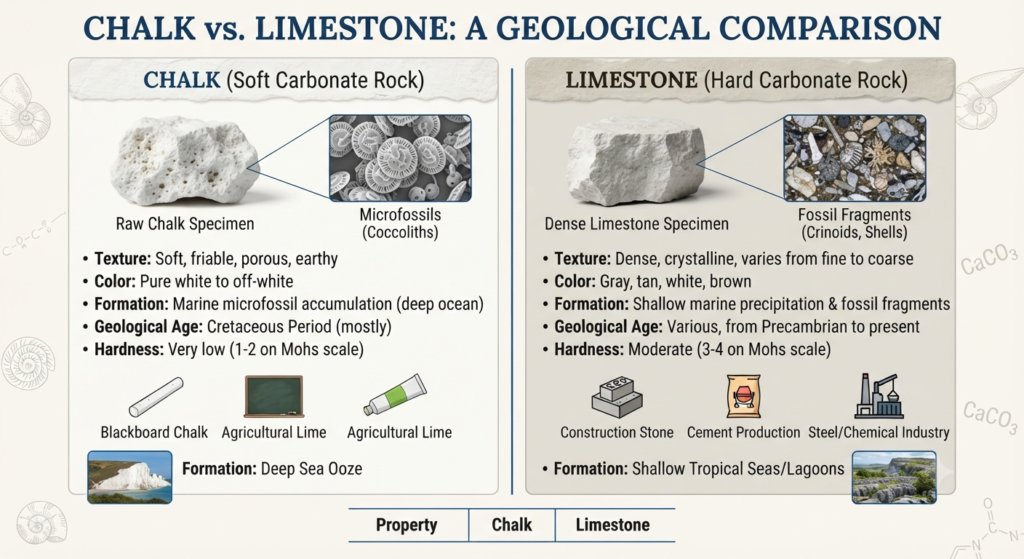
The main difference between Chalk vs. Limestone is that chalk is a soft, fine-grained, highly porous variety of limestone formed primarily from microscopic marine organisms called coccolithophores, whereas limestone is a broader category of sedimentary rock composed mainly of calcium carbonate and formed from shells, coral, algae, and other marine materials. Although both rocks contain calcium carbonate (CaCO₃), they differ in texture, hardness, formation, appearance, porosity, and industrial applications.
Understanding Chalk vs. Limestone is important for geologists, construction professionals, students, farmers, and manufacturers because these sedimentary rocks have distinct physical properties and uses. While chalk is valued for writing materials, agriculture, and soil treatment, limestone is widely used in construction, cement manufacturing, steel production, and environmental applications.
Chalk vs. Limestone Comparison Table
The table below highlights the major differences between Chalk vs. Limestone.
| Feature | Chalk | Limestone |
|---|---|---|
| Rock Type | Soft variety of limestone | Sedimentary rock |
| Composition | Mostly calcium carbonate (CaCO₃) | Mostly calcium carbonate (CaCO₃) |
| Formation | Microscopic coccolith remains | Shells, coral, algae, fossils, and calcium carbonate sediments |
| Texture | Very fine-grained and powdery | Fine to coarse-grained |
| Hardness | Very soft | Harder and denser |
| Mohs Hardness | About 1–2 | About 3–4 |
| Color | White or light gray | White, gray, cream, yellow, brown, black |
| Porosity | Very high | Low to moderate |
| Fossil Content | Mainly microscopic fossils | Large fossils and shell fragments common |
| Main Uses | Blackboard chalk, agriculture, fillers | Construction, cement, lime production, steel industry |
What Is Chalk?
Chalk is a naturally occurring, soft, white sedimentary rock composed almost entirely of calcium carbonate (CaCO₃). It is a specialized type of limestone formed from the accumulation of microscopic marine plankton known as coccolithophores. Their tiny calcite plates, called coccoliths, settled on the ocean floor over millions of years and gradually compacted into thick chalk deposits.
Because of its extremely fine texture and high porosity, chalk is soft enough to be scratched with a fingernail. These characteristics make it suitable for writing, soil conditioning, fillers, pigments, and industrial processing. Large chalk formations, such as the White Cliffs of Dover in England, are among the world’s most recognizable geological landmarks.
In agriculture, powdered chalk helps neutralize acidic soils and improves crop productivity. It is also used in pharmaceuticals, paper manufacturing, plastics, rubber products, ceramics, and environmental applications.
Characteristics of Chalk
- Composed mainly of calcium carbonate (CaCO₃)
- Soft sedimentary rock
- Fine-grained texture
- White to light gray color
- Highly porous
- Easily crumbles into powder
- Formed from microscopic coccolith fossils
- Low density
- Reacts readily with dilute acids
- Used in agriculture, education, and manufacturing
What Is Limestone?
Limestone is a common sedimentary rock composed primarily of calcium carbonate (CaCO₃), although some varieties also contain magnesium carbonate and other mineral impurities. Unlike chalk, limestone encompasses a wide range of rock types formed from shells, coral reefs, algae, skeletal fragments, and chemical precipitation of calcium carbonate in marine environments.
Limestone occurs in numerous textures and colors depending on its composition, fossil content, and depositional environment. Some varieties are dense and crystalline, while others are fossil-rich or porous. Because of its greater strength and durability, limestone is one of the most important construction materials used worldwide.
It is the primary raw material for producing cement, quicklime, and hydrated lime. Limestone is also extensively used in road construction, building facades, monuments, glass manufacturing, water treatment, steel production, and flue gas desulfurization systems in power plants.
Characteristics of Limestone
- Primarily composed of calcium carbonate (CaCO₃)
- Naturally occurring sedimentary rock
- Harder than chalk
- Fine to coarse-grained texture
- Available in many colors
- Moderate to low porosity
- Frequently contains visible fossils
- Excellent durability
- Reacts with dilute hydrochloric acid
- Widely used in construction and industry
Chalk vs. Limestone: Key Differences
1. Composition
The most fundamental difference between Chalk vs. Limestone lies in their composition and biological origin.
Chalk is composed almost entirely of microscopic calcium carbonate shells produced by marine plankton called coccolithophores. It contains very few impurities, making it one of the purest natural forms of limestone.
Limestone, although also primarily made of calcium carbonate (CaCO₃), is formed from a much broader range of materials, including shells, corals, algae, foraminifera, skeletal fragments, and chemically precipitated calcium carbonate. Many limestone varieties also contain impurities such as clay, silica, iron oxides, and magnesium carbonate.
The wider range of materials gives limestone much greater variation in texture, color, and strength.
2. Formation Process
The way these rocks form is another major difference.
Chalk develops in deep, calm marine environments where billions of microscopic coccoliths gradually settle on the ocean floor. Over millions of years, these tiny fossil remains become compacted into thick chalk deposits.
Limestone forms in many different environments, including shallow tropical seas, coral reefs, lagoons, caves, rivers, and lakes. It may originate from accumulated shells, coral reefs, marine organisms, or direct precipitation of calcium carbonate from water.
As a result, limestone occurs in a much wider variety of geological settings than chalk.
3. Texture
Texture is one of the easiest characteristics to distinguish.
Chalk has an extremely fine-grained, powdery texture because it is composed of microscopic fossil particles. It feels soft and smooth and can easily leave a white powder on the hands.
Limestone varies from fine-grained to coarse-grained depending on its origin. Some varieties contain visible shell fragments and fossils, while others appear crystalline or compact.
Because of these differences, limestone generally has a much more solid and durable texture.
4. Hardness
The hardness of these rocks differs considerably.
Chalk is one of the softest sedimentary rocks, typically having a Mohs hardness of about 1–2. It can easily be scratched with a fingernail and crumbles under moderate pressure.
Limestone is significantly harder, usually ranging from Mohs hardness 3–4. It resists scratching better and can withstand cutting, shaping, and polishing for construction purposes.
This greater hardness makes limestone suitable for structural applications where strength and durability are required.
5. Color
Although both rocks often appear light-colored, their color range is quite different.
Chalk is almost always white, off-white, or light gray because it contains very pure calcium carbonate with minimal impurities.
Limestone occurs in many colors, including:
- White
- Gray
- Cream
- Beige
- Yellow
- Brown
- Bluish-gray
- Black
Its color depends largely on the presence of minerals, clay, organic matter, or iron compounds during formation.
6. Porosity
Porosity greatly influences the physical behavior of these rocks.
Chalk is highly porous and contains numerous microscopic pores that allow it to absorb and retain significant amounts of water. Despite this high porosity, many of the pores are extremely small, affecting how water moves through the rock.
Limestone generally has lower porosity, although it varies depending on the rock type. Dense limestones absorb very little water, while some fossil-rich or weathered limestones may be moderately porous.
Lower porosity often makes limestone more resistant to weathering and structural deterioration.
7. Fossil Content
Both rocks contain fossils, but the type and visibility differ considerably.
Chalk mainly contains microscopic fossils of coccolithophores that are invisible without magnification. These tiny fossil plates form the bulk of the rock.
Limestone frequently contains visible fossils such as:
- Shells
- Corals
- Brachiopods
- Crinoids
- Mollusks
- Foraminifera
- Algae
Many limestone varieties are classified according to their fossil content, making them valuable for geological and paleontological studies.
8. Industrial Applications
The two rocks serve different industrial purposes.
Chalk is commonly used in:
- Agricultural lime
- Soil pH correction
- Classroom chalk
- Paint fillers
- Rubber manufacturing
- Plastic fillers
- Toothpaste
- Pharmaceuticals
- Animal feed supplements
- Polishing compounds
Limestone is widely used in:
- Cement manufacturing
- Building stone
- Road construction
- Concrete aggregate
- Lime production
- Steel manufacturing
- Glass production
- Water treatment
- Flue gas desulfurization
- Chemical manufacturing
Because of its higher strength, limestone has far broader structural and industrial applications.
9. Durability
Durability is another significant distinction.
Chalk is relatively fragile because of its softness and high porosity. It erodes more easily under physical wear and prolonged exposure to weather.
Limestone is much more durable and resistant to abrasion, making it suitable for buildings, monuments, bridges, pavements, and architectural structures that must withstand long-term environmental exposure.
Many historic buildings constructed from limestone have remained intact for centuries.
10. Economic Importance
Both rocks are economically valuable, but in different industries.
Chalk is economically important in:
- Agriculture
- Education
- Pharmaceuticals
- Paper manufacturing
- Rubber industry
- Plastics
- Paint production
- Environmental management
Limestone is one of the world’s most economically important industrial minerals because it supports:
- Construction industry
- Cement manufacturing
- Steel production
- Chemical processing
- Glass manufacturing
- Water purification
- Environmental pollution control
- Infrastructure development
Its versatility makes limestone one of the most heavily mined sedimentary rocks worldwide.
Similarities Between Chalk and Limestone
Although Chalk vs. Limestone differ in texture, hardness, formation, and applications, they also share several important characteristics because chalk is a specialized variety of limestone. Both rocks are primarily composed of calcium carbonate and play significant roles in geology, construction, agriculture, and industry.
Some major similarities include:
- Both are sedimentary rocks.
- Both are composed mainly of calcium carbonate (CaCO₃).
- Both are formed from marine deposits.
- Both react vigorously with dilute acids, producing carbon dioxide.
- Both contain fossil remains of marine organisms.
- Both occur naturally in extensive geological formations.
- Both are used to manufacture lime.
- Both help neutralize acidic soils in agriculture.
- Both are important raw materials in numerous industries.
- Both are recyclable and environmentally useful in many applications.
Advantages of Chalk
Chalk is highly valued because of its purity, softness, and excellent chemical properties. It is widely used in education, agriculture, manufacturing, and environmental management.
Major advantages include:
- Highly pure source of calcium carbonate.
- Soft and easy to process.
- Excellent soil conditioner for acidic soils.
- Improves soil fertility by raising pH.
- Useful in animal feed supplements.
- Commonly used in pharmaceuticals.
- Excellent filler for paper, plastics, and rubber.
- Non-toxic and environmentally friendly.
- Easily ground into fine powder.
- Cost-effective industrial raw material.
Advantages of Limestone
Limestone is one of the world’s most versatile industrial minerals because of its strength, durability, and wide range of applications.
Major advantages include:
- Strong and durable construction material.
- Primary raw material for cement production.
- Used extensively in road construction.
- Produces quicklime and hydrated lime.
- Essential in steel manufacturing.
- Removes impurities during metal refining.
- Used in glass and ceramic production.
- Effective in water treatment plants.
- Helps reduce sulfur emissions from power plants.
- Long-lasting and weather-resistant building stone.
Which Is Better—Chalk or Limestone?
Neither Chalk nor Limestone is universally better because each is designed by nature for different purposes.
Chalk is the better choice when softness, purity, fine particle size, and easy processing are required. It is widely used in agriculture for soil conditioning, as a filler in paper and plastics, in pharmaceuticals, and for educational writing materials. Its high calcium carbonate content also makes it valuable in various chemical and environmental applications.
Limestone, however, is the preferred option for structural and industrial applications. Its greater hardness, durability, and strength make it ideal for building construction, cement manufacturing, road bases, steel production, water treatment, and countless engineering projects.
In summary:
Choose Chalk for:
- Soil improvement
- Agricultural lime
- Writing materials
- Industrial fillers
- Pharmaceutical products
- Fine calcium carbonate applications
Choose Limestone for:
- Construction projects
- Cement manufacturing
- Concrete production
- Steel industry
- Glass manufacturing
- Road construction
- Water treatment
- Environmental pollution control
The best choice depends entirely on the intended application, required strength, and desired physical properties.
Conclusion
The comparison of Chalk vs. Limestone shows that while both rocks are primarily composed of calcium carbonate, they differ significantly in texture, hardness, porosity, formation, and practical applications. Chalk is a soft, fine-grained, highly porous variety of limestone formed mainly from microscopic coccolithophore fossils, making it ideal for agriculture, fillers, pharmaceuticals, and educational uses. Limestone, by contrast, is a broader category of sedimentary rock formed from shells, coral, algae, and other marine materials, giving it greater strength and versatility for construction and industrial purposes.
Understanding Chalk vs. Limestone enables geologists, engineers, farmers, architects, and manufacturers to select the most suitable material for specific applications. Whether the goal is improving soil fertility, producing cement, constructing buildings, or manufacturing industrial products, choosing the appropriate rock ensures better performance, durability, and cost-effectiveness.
Frequently Asked Questions (FAQs)
The main difference between Chalk vs. Limestone is that chalk is a soft, fine-grained, porous variety of limestone formed primarily from microscopic marine organisms, whereas limestone is a broader sedimentary rock composed of shells, coral, algae, and other calcium carbonate materials.
Yes. Chalk is a naturally occurring variety of limestone composed almost entirely of microscopic calcium carbonate fossils called coccoliths.
Limestone is much harder than chalk. Chalk has a Mohs hardness of about 1–2, while limestone generally has a hardness of 3–4, making limestone more durable for construction.
Limestone is rich in calcium carbonate, which is the primary raw material required for producing clinker—the main component of Portland cement. Its abundance and suitable chemical composition make it ideal for cement manufacturing.
Yes. Both chalk and limestone react readily with dilute acids, releasing carbon dioxide gas. This reaction is commonly used to identify rocks containing calcium carbonate.
Read Next: