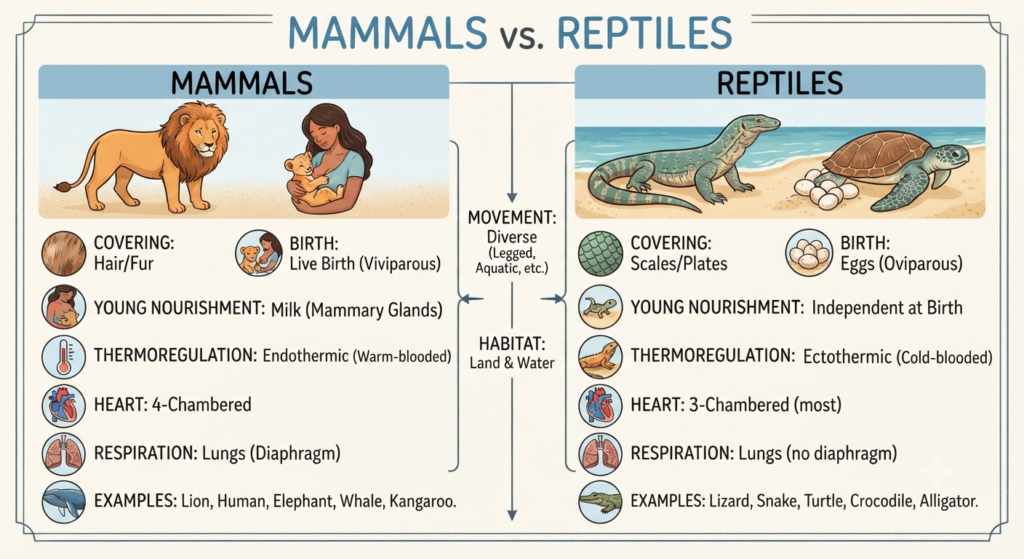
The main difference between Mammals vs. Reptiles is that mammals are endothermic vertebrates that have hair or fur and mammary glands, while reptiles are generally ectothermic vertebrates with scales or scutes and usually reproduce by laying eggs. Mammals produce milk to feed their young, while reptiles do not have mammary glands.
Both mammals and reptiles are vertebrate animals. They have backbones, lungs, a nervous system, and internal skeletons. However, they differ in body temperature regulation, body covering, reproduction, feeding, respiration, heart structure, and parental care.
For example, humans, dogs, cats, elephants, and whales are mammals. Snakes, lizards, turtles, crocodiles, and many other similar animals are reptiles.
Understanding Mammals vs. Reptiles helps explain how different groups of vertebrates have adapted to their environments.
Mammals vs. Reptiles Comparison Table
The table below highlights the major differences between Mammals vs. Reptiles.
| Feature | Mammals | Reptiles |
|---|---|---|
| Scientific Class | Mammalia | Reptilia |
| Body Temperature | Endothermic | Generally ectothermic |
| Body Covering | Hair or fur | Scales or scutes |
| Mammary Glands | Present | Absent |
| Milk Production | Females produce milk | Do not produce milk |
| Respiration | Lungs | Lungs |
| Heart | Four chambers | Usually three chambers; crocodilians have four |
| Fertilization | Internal | Usually internal |
| Reproduction | Mostly live birth; monotremes lay eggs | Mostly egg-laying; some give live birth |
| Eggs | Monotremes lay eggs | Usually shelled or leathery eggs |
| Metabolic Rate | Generally high | Generally lower |
| Body Temperature Control | Mainly controlled internally | Strongly influenced by surroundings |
| Parental Care | Often well developed | Varies greatly among species |
| Growth | Usually slows greatly after maturity | Some species continue growing throughout life |
| Examples | Humans, cows, bats, whales | Snakes, lizards, turtles, crocodiles |
What Are Mammals?
Mammals are vertebrate animals belonging to the class Mammalia. One of their most important characteristics is the presence of mammary glands, which allow females to produce milk for their young.
Mammals also have hair or fur at some stage of their life. Hair can provide insulation, protection, camouflage, or sensory functions.
Most mammals give birth to live young. However, there are exceptions. The monotremes, such as the platypus and echidnas, lay eggs.
Mammals are found in almost every major habitat on Earth. They live on land, in water, underground, and even in the air.
Examples of mammals include:
- Humans
- Dogs
- Cats
- Elephants
- Horses
- Cows
- Bats
- Dolphins
- Whales
- Monkeys
Main Characteristics of Mammals
Mammals generally have the following characteristics:
- They are vertebrates.
- They have hair or fur.
- They have mammary glands.
- Females produce milk for their young.
- They are endothermic.
- They breathe through lungs.
- They have a four-chambered heart.
- Most give birth to live young.
- They often provide extended parental care.
- They generally have a relatively high metabolic rate.
What Are Reptiles?
Reptiles are vertebrate animals that belong to the traditional group called Reptilia. They are generally characterized by dry skin covered with scales or scutes.
Unlike mammals, reptiles do not have mammary glands and do not produce milk to feed their young.
Most reptiles are ectothermic. This means that their body temperature is strongly influenced by environmental conditions. They may bask in sunlight to warm themselves or move into shade to cool down.
Most reptiles lay eggs, although reproduction varies among species. Some snakes and lizards give birth to live young.
Examples of reptiles include:
- Snakes
- Lizards
- Turtles
- Tortoises
- Crocodiles
- Alligators
- Tuatara
Main Characteristics of Reptiles
Reptiles generally have the following characteristics:
- They are vertebrates.
- Their skin usually has scales or scutes.
- They are generally ectothermic.
- They breathe through lungs.
- Most reproduce through internal fertilization.
- Most species lay eggs.
- Some species give birth to live young.
- They do not have mammary glands.
- Most have a three-chambered heart.
- Crocodilians have a four-chambered heart.
Mammals vs. Reptiles: Key Differences
1. Body Temperature Regulation
One of the most important differences between Mammals vs. Reptiles is how they regulate body temperature.
Mammals are endothermic. They generate much of their body heat internally through metabolism. This allows many mammals to maintain a relatively stable body temperature even when the surrounding temperature changes.
Reptiles are generally ectothermic. Their body temperature depends more strongly on the environment.
For example, a lizard may bask in the sun to warm its body. It may move into shade when it becomes too hot.
Therefore:
Mammals → Mainly regulate body temperature internally
Reptiles → Rely strongly on environmental heat
2. Body Covering
Mammals are characterized by hair or fur.
Hair can perform several functions. It can help insulate the body, protect the skin, provide camouflage, and act as a sensory structure.
Reptiles generally have scales or scutes covering their skin.
These structures help protect the body and reduce water loss.
For example, snake scales protect the skin, while turtle shells include large modified structures called scutes over the shell.
3. Mammary Glands
The presence of mammary glands is a defining feature of mammals.
Female mammals produce milk to nourish their offspring.
For example, a cow produces milk for her calf, and a human mother produces milk for her baby.
Reptiles do not have mammary glands and do not feed their young with milk.
This is one of the clearest biological differences between mammals and reptiles.
4. Reproduction
Reproduction is another important area of comparison.
Most mammals give birth to live young. The developing embryo is usually protected and nourished inside the mother’s body.
However, not all mammals give birth to live young. Monotremes, such as the platypus and echidnas, lay eggs.
Most reptiles lay eggs. Their eggs often have protective shells or leathery coverings.
However, some reptiles give birth to live young. Therefore, it is more accurate to say that most reptiles are egg-laying rather than all reptiles being egg-laying.
5. Fertilization
Both mammals and reptiles generally use internal fertilization.
In mammals, sperm and egg unite inside the female reproductive tract.
In reptiles, fertilization also usually occurs inside the female’s body.
Therefore, unlike some other vertebrate groups, both mammals and reptiles commonly use internal fertilization.
6. Respiration
Both mammals and reptiles breathe using lungs.
Mammalian lungs are highly specialized for efficient gas exchange. The diaphragm plays an important role in breathing in mammals.
Reptiles also use lungs for respiration. Their breathing mechanisms vary among species.
For example, snakes have highly specialized respiratory systems that allow them to breathe efficiently despite their elongated bodies.
Thus:
Mammals → Lungs + diaphragm-based breathing
Reptiles → Lungs + species-specific breathing mechanisms
7. Heart Structure
Mammals have a four-chambered heart.
The four chambers are:
- Right atrium
- Right ventricle
- Left atrium
- Left ventricle
This structure separates oxygen-rich blood from oxygen-poor blood and supports the high metabolic demands of mammals.
Most reptiles have a three-chambered heart with two atria and one ventricle.
However, there is an important exception.
Crocodilians, including crocodiles and alligators, have a four-chambered heart.
Therefore, the simple statement that “all reptiles have three-chambered hearts” is not correct.
8. Metabolic Rate
Mammals generally have a higher metabolic rate than reptiles.
Their high metabolic rate helps generate the internal heat needed for endothermy.
Reptiles generally have a lower metabolic rate. Because they rely more heavily on environmental heat, they often require less energy to maintain body temperature.
This difference also affects feeding behavior.
Many mammals need to eat regularly to support their high energy demands. Some reptiles can survive for relatively long periods without food, depending on their species, body size, and environmental conditions.
9. Parental Care
Many mammals provide extensive care for their offspring.
Mothers feed their young with milk and may protect, groom, teach, and care for them for months or even years.
Examples include:
- Elephants caring for calves
- Lions caring for cubs
- Primates caring for infants
- Humans caring for children
Parental care in reptiles varies widely.
Some reptiles provide little or no care after laying eggs. Others show more complex parental behavior.
For example, crocodilians protect nests and may guard their young after hatching.
Therefore, mammals generally show more prolonged parental investment, but reptiles are not completely without parental care.
10. Growth
Mammals generally reach a mature body size and then experience much slower growth.
Reptiles often show a different growth pattern. Some species can continue growing throughout much of their lives, although the rate of growth usually decreases with age.
Growth also depends on factors such as:
- Species
- Food availability
- Temperature
- Habitat
- Age
- Health
Therefore, growth patterns are useful for comparison but are not identical in every species.
11. Physical Characteristics
The physical appearance of mammals and reptiles is usually easy to distinguish.
Mammals commonly have:
- Hair or fur
- External ears in many species
- Specialized teeth
- Four limbs in many species
- A relatively large brain
- A four-chambered heart
However, mammals are highly diverse. Whales have no external limbs, bats have modified forelimbs for flight, and humans walk on two legs.
Reptiles commonly have:
- Scales or scutes
- Dry skin
- Claws in many species
- Tails
- Four limbs in many species
But reptiles also show great diversity.
Snakes have lost their limbs, turtles have protective shells, and crocodilians have powerful jaws and tails.
12. Adaptations
Both mammals and reptiles have evolved specialized adaptations that allow them to survive in different environments.
Mammals have developed adaptations such as:
- Thick fur for cold environments
- Blubber in aquatic mammals
- Specialized teeth for different diets
- Large ears for heat loss
- Hooves for running
- Wings in bats
- Powerful limbs for digging
- Specialized limbs for swimming
For example, polar bears have thick fur and a layer of body fat that helps them survive in cold environments.
Whales have streamlined bodies and thick layers of blubber that help them live in water.
Reptiles also have many specialized adaptations.
These include:
- Scales that reduce water loss
- Camouflage
- Venom in some snakes
- Protective shells in turtles
- Powerful jaws in crocodilians
- Specialized limbs for climbing
- Streamlined bodies for swimming
- Heat-seeking abilities in some snakes
These adaptations allow reptiles to survive in deserts, forests, wetlands, oceans, grasslands, and other habitats.
13. Habitat
Mammals live in almost every major habitat on Earth.
They can be found in:
- Deserts
- Forests
- Grasslands
- Mountains
- Oceans
- Polar regions
- Underground habitats
- Urban environments
Reptiles also occupy a wide range of habitats.
They can live in:
- Deserts
- Tropical forests
- Grasslands
- Wetlands
- Rivers
- Lakes
- Coastal areas
- Oceans
Their ability to survive in diverse habitats demonstrates the adaptability of both groups.
14. Feeding
Mammals have a wide range of diets.
Depending on the species, mammals may be:
- Herbivores
- Carnivores
- Omnivores
- Insectivores
For example, cows are herbivores, lions are carnivores, and humans are omnivores.
Reptiles also have diverse feeding habits.
Some reptiles are carnivorous, while others are herbivorous or omnivorous.
Examples include:
- Snakes → Mostly carnivorous
- Crocodiles → Carnivorous
- Many turtles → Omnivorous or herbivorous, depending on species
- Many lizards → Insectivorous, herbivorous, or omnivorous
15. Ecological Importance
Both mammals and reptiles play important roles in ecosystems.
Mammals can act as:
- Predators
- Herbivores
- Prey
- Seed dispersers
- Pollinators
- Scavengers
For example, fruit-eating mammals can spread seeds over large distances.
Predatory mammals can also help regulate populations of other animals.
Reptiles also contribute to ecosystem balance.
They can act as:
- Predators
- Prey
- Scavengers
- Population controllers
- Seed dispersers
Snakes, for example, can help control populations of rodents and other small animals.
Turtles can also contribute to aquatic ecosystems by influencing food webs and nutrient movement.
16. Evolutionary History
Mammals and reptiles belong to different major evolutionary branches of amniote vertebrates.
Both groups are part of the broader Amniota, a group of vertebrates adapted for reproduction away from water through the development of the amniotic egg and related membranes.
The evolutionary history is more complex than simply saying that mammals evolved from modern reptiles.
Mammals evolved from synapsid ancestors, while reptiles and birds belong to the sauropsid lineage.
The two lineages diverged from a common amniote ancestor hundreds of millions of years ago.
This evolutionary history explains why mammals and reptiles share some fundamental characteristics while also possessing many distinct adaptations.
Mammals vs. Reptiles: Similarities
Although mammals and reptiles have many differences, they also share several important characteristics.
Both groups:
- Are vertebrates.
- Have a backbone.
- Have an internal skeleton.
- Have a well-developed nervous system.
- Have lungs for breathing.
- Have a closed circulatory system.
- Have a heart.
- Have bilateral body symmetry.
- Reproduce sexually in most species.
- Generally use internal fertilization.
- Have well-developed sense organs.
- Can live in a wide range of environments.
These similarities reflect their shared position within the broader evolutionary history of vertebrate animals.
Mammals vs. Reptiles: Which Are Warm-Blooded?
Mammals are endothermic, meaning they generate and regulate much of their body heat internally.
Reptiles are generally ectothermic, meaning their body temperature is strongly influenced by environmental conditions.
The terms warm-blooded and cold-blooded are commonly used in basic biology, but endothermic and ectothermic are more precise scientific terms.
This does not mean that reptiles are always cold or that mammals always have exactly the same body temperature. It refers to how each group manages body heat.
Mammals vs. Reptiles: Which Lay Eggs?
Most reptiles lay eggs.
However, some reptiles give birth to live young.
Most mammals give birth to live young, but monotremes are an important exception because they lay eggs.
Therefore, the most accurate comparison is:
Mammals → Mostly live-bearing, with egg-laying monotremes
Reptiles → Mostly egg-laying, with some live-bearing species
This is more accurate than saying that all mammals give birth to live young or that all reptiles lay eggs.
Mammals vs. Reptiles: Which Have Hair?
Mammals have hair or fur, which is one of their defining characteristics.
Reptiles do not have hair. Their bodies are generally covered by scales or scutes.
Hair in mammals can provide:
- Insulation
- Protection
- Camouflage
- Sensory functions
- Communication
Reptile scales mainly provide protection and help reduce water loss.
Mammals vs. Reptiles: Which Have Better Parental Care?
Mammals generally provide more extensive parental care than reptiles.
This is closely related to milk production and the long developmental period of many mammalian young.
However, parental care varies within both groups.
Some reptiles show impressive parental behavior. Crocodilians, for example, protect their nests and young.
Therefore, it is better to say that extensive parental care is more common among mammals, rather than claiming that reptiles never care for their young.
Why Are Mammals and Reptiles Different?
The differences between mammals and reptiles developed through millions of years of evolution.
Each group evolved adaptations suited to its environment and lifestyle.
Mammals evolved characteristics such as:
- Endothermy
- Hair
- Mammary glands
- Efficient lungs
- Four-chambered hearts
- Complex teeth
Reptiles evolved characteristics such as:
- Scaly skin
- Ectothermy
- Shelled or leathery eggs in many species
- Water-conserving adaptations
- Specialized jaws and limbs
These adaptations helped both groups occupy diverse ecological niches.
Frequently Asked Questions (FAQs)
The main difference between Mammals vs. Reptiles is that mammals have hair and mammary glands and are endothermic, while reptiles generally have scales and are ectothermic. Mammals usually give birth to live young, whereas most reptiles lay eggs.
Yes. Both mammals and reptiles are vertebrate animals. They have a backbone and an internal skeleton.
Mammals are generally described as warm-blooded because they are endothermic. They generate much of their body heat internally and maintain a relatively stable body temperature.
No. Most mammals give birth to live young, but monotremes such as the platypus and echidnas lay eggs.
No. Reptiles do not have mammary glands and do not produce milk to feed their young.
Reference:
1.Rafferty, John P. “5 Vertebrate Groups.” Encyclopædia Britannica, Encyclopædia Britannica, Inc.
Read Next: