The main difference between CO vs. Co is that CO is the chemical formula for carbon monoxide, a colorless and highly toxic gas made of one carbon atom and one oxygen atom, while Co is the chemical symbol for cobalt, a metallic chemical element with atomic number 27. Although CO and Co look very similar, they represent completely different substances.
Understanding CO vs. Co is important in chemistry, laboratory work, industrial applications, engineering, and safety. The difference is determined by capitalization: the first letter of a chemical element symbol is always capitalized, while the second letter is lowercase. Therefore, CO and Co cannot be used interchangeably.
CO vs. Co Comparison Table
The following table highlights the major differences between CO vs. Co.
| Feature | CO | Co |
|---|---|---|
| Chemical Name | Carbon monoxide | Cobalt |
| Type | Chemical compound | Chemical element |
| Chemical Notation | CO | Co |
| Composition | 1 carbon + 1 oxygen atom | Cobalt atoms |
| Atomic Number | Not applicable | 27 |
| Molar Mass | About 28.01 g/mol | About 58.93 g/mol |
| Physical State at Room Temperature | Gas | Solid metal |
| Appearance | Colorless gas | Silvery-gray metal |
| Odor | Odorless | Metallic solid; odor is not a defining property |
| Flammability | Flammable | Not classified as a flammable metal in ordinary bulk form |
| Toxicity | Highly toxic when inhaled | Can be harmful depending on exposure and compound |
| Main Concern | Carbon monoxide poisoning | Metal and compound exposure |
| Common Uses | Chemical synthesis, metallurgy, industrial processes | Alloys, batteries, pigments, catalysts |
| Key Identification | Capital C + capital O | Capital C + lowercase o |
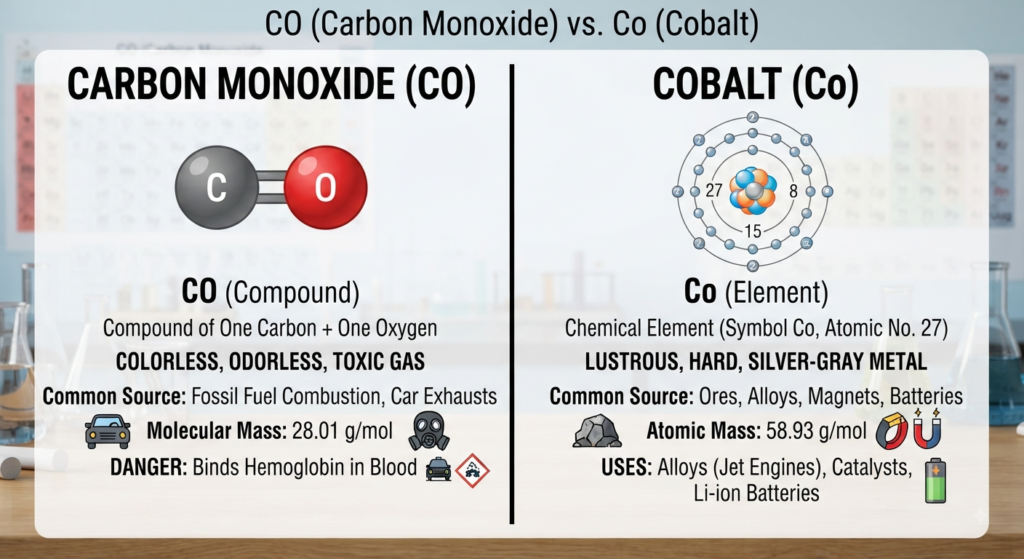
What Is CO?
CO is the chemical formula for carbon monoxide. It contains one carbon atom chemically bonded to one oxygen atom.
Carbon monoxide is a colorless, odorless gas that can be produced when carbon-containing fuels undergo incomplete combustion. Sources can include vehicle exhaust, furnaces, generators, fires, and other fuel-burning equipment.
CO is particularly dangerous because people cannot normally detect it through their senses. When inhaled, carbon monoxide interferes with the blood’s ability to transport oxygen to tissues and organs.
Characteristics of CO
- Chemical formula: CO
- Common name: Carbon monoxide
- Contains carbon and oxygen
- One carbon atom per molecule
- One oxygen atom per molecule
- Molar mass: approximately 28.01 g/mol
- Colorless gas
- Odorless
- Highly toxic when inhaled
- Produced by incomplete combustion
- Can burn under suitable conditions
- Important in several industrial processes
The formula CO indicates the number and identity of atoms in one molecule: one carbon atom and one oxygen atom.
What Is Co?
Co is the chemical symbol for cobalt, a naturally occurring chemical element.
Cobalt is a transition metal belonging to the d-block of the periodic table. Its atomic number is 27, meaning a neutral cobalt atom contains 27 protons.
Unlike CO, cobalt is not a molecular gas. At room temperature, it is a solid metallic element with a characteristic silvery-gray appearance.
Characteristics of Co
- Chemical name: Cobalt
- Chemical symbol: Co
- Atomic number: 27
- Transition metal
- Solid at room temperature
- Silvery-gray appearance
- Relatively high melting point
- Forms numerous chemical compounds
- Used in alloys and industrial materials
- Used in some battery technologies
- Used to produce pigments
- Important in catalysts and specialized materials
The lowercase o is essential. Co means cobalt, while CO means carbon monoxide.
CO vs. Co: Key Differences
1. Chemical Identity
The most important difference between CO vs. Co is their chemical identity.
CO represents a compound: carbon monoxide.
Co represents an element: cobalt.
Carbon monoxide contains atoms of two different elements chemically bonded together. Cobalt consists of atoms of a single element.
Therefore:
CO = carbon monoxide = compound
Co = cobalt = element
This is one of the most important distinctions to remember when reading chemical formulas.
2. Chemical Formula and Symbol
The notation is different because the two substances belong to different chemical categories.
CO is a molecular formula:
- C = carbon
- O = oxygen
The two letters are both uppercase because they represent separate element symbols.
Co is an element symbol:
- C = cobalt begins with C
- o = the second letter of the symbol is lowercase
Chemical symbols follow strict capitalization rules. Changing the capitalization can completely change the meaning.
For example:
CO ≠ Co
This small difference can be extremely important in laboratory records, technical specifications, chemical labels, and safety documents.
3. Composition
CO and Co have completely different compositions.
A carbon monoxide CO molecule contains:
- 1 carbon atom
- 1 oxygen atom
Its molecular composition can therefore be written as:
C + O → CO
Cobalt Co is an element, so a sample of cobalt metal consists of cobalt atoms.
It does not contain carbon and oxygen as part of its elemental symbol.
This makes CO a compound and Co an element.
4. Physical State
Another major difference between CO vs. Co is their physical state at normal room conditions.
Carbon monoxide CO is a gas.
It is colorless and odorless, making accidental exposure particularly difficult to detect without a suitable detector.
Cobalt Co is a solid metal at room temperature.
It has a metallic appearance and can be processed into various forms for industrial applications.
Therefore:
CO → gas
Co → solid metal
5. Chemical Properties
CO and Co also behave very differently chemically.
Properties of CO
Carbon monoxide is a relatively small molecule and can participate in oxidation and other chemical reactions. It is also used as a chemical feedstock and reducing agent in industrial processes.
Carbon monoxide can be produced when there is insufficient oxygen for complete combustion.
Properties of Co
Cobalt is a transition metal with variable oxidation states, particularly +2 and +3 in many compounds.
It can form:
- Cobalt oxides
- Cobalt salts
- Coordination compounds
- Metal alloys
- Catalytically active compounds
Thus, the chemical behavior of CO is that of a small molecular compound, while Co exhibits the characteristic chemistry of a transition metal.
6. Toxicity and Safety
Safety is an especially important part of the CO vs. Co comparison.
CO Safety
Carbon monoxide is highly dangerous when inhaled.
It can bind strongly to hemoglobin, reducing the blood’s ability to transport oxygen. Exposure can cause symptoms such as:
- Headache
- Dizziness
- Weakness
- Nausea
- Confusion
- Loss of consciousness
- Death in severe cases
Because CO is colorless and odorless, detection equipment is important in areas where carbon monoxide may accumulate.
Co Safety
Cobalt also requires appropriate handling, but the risks are different from those associated with carbon monoxide gas.
Exposure concerns depend on the form of cobalt, the route of exposure, concentration, and duration. Certain cobalt compounds can be hazardous, so appropriate industrial hygiene practices and personal protective equipment should be used.
The important point is:
CO is an inhalation hazard primarily because it interferes with oxygen transport.
Co presents hazards associated with exposure to cobalt metal and, especially, particular cobalt compounds and forms.
7. Industrial Applications
CO and Co have very different industrial uses.
Uses of CO
Carbon monoxide is used in several industrial processes, including:
- Metallurgical processes
- Production of chemicals
- Hydrogen-related chemical processes
- Production of methanol
- Metal processing
- Chemical synthesis
- Reducing metal oxides
Carbon monoxide is also involved in metallurgical processes because of its ability to participate in reactions with metal oxides.
Uses of Co
Cobalt has a broad range of applications, including:
- Superalloys
- Hard metals
- Battery materials
- Pigments
- Catalysts
- Magnetic materials
- High-temperature alloys
- Specialized industrial materials
Cobalt’s useful physical and chemical properties make it valuable in applications requiring heat resistance, wear resistance, magnetic properties, or specific electrochemical performance.
8. Occurrence
The sources and occurrence of CO vs. Co are also different.
Carbon monoxide CO is mainly associated with incomplete combustion of carbon-containing fuels. It can be generated when there is insufficient oxygen during combustion.
Examples include:
- Vehicle exhaust
- Fuel-burning appliances
- Industrial furnaces
- Fires
- Generators
- Heating equipment
Cobalt Co is a naturally occurring element found in minerals and ores. It is recovered through mining and processing of cobalt-containing mineral resources.
Therefore, CO is commonly encountered as a combustion-related gas, whereas Co is obtained as a metallic element from mineral resources.
9. Atomic and Molecular Structure
The difference becomes even clearer when their structures are considered.
CO Structure
Carbon monoxide is a diatomic molecule containing two atoms:
C—O
It has one carbon atom and one oxygen atom.
Co Structure
Cobalt is not normally present as separate Co molecules. Elemental cobalt forms a metallic solid in which cobalt atoms are arranged in a metallic structure.
Therefore:
CO → molecular compound
Co → metallic element
This structural difference explains many of their different physical and chemical properties.
10. Naming and Capitalization
Capitalization is the easiest way to distinguish CO vs. Co.
CO: Both letters are capitalized:
This represents carbon monoxide.
Co: Only the first letter is capitalized:
This represents cobalt.
Chemical notation follows a strict convention in which an element symbol contains either one or two letters. The first letter is uppercase, while the second letter, when present, is lowercase.
This means that writing CO when you mean cobalt is incorrect, just as writing Co when you mean carbon monoxide is incorrect.
Similarities Between CO and Co
Although CO vs. Co refers to two completely different substances, they have a few similarities.
Both:
- Begin with the letter C.
- Are associated with carbon-related terminology in the case of CO, while cobalt’s symbol also begins with C.
- Are important in industrial chemistry.
- Can be involved in metallurgical processes.
- Require appropriate handling in industrial environments.
- Can appear in technical documents, laboratory reports, and engineering specifications.
However, these similarities should not cause confusion because their identities and properties are fundamentally different.
Why Is the Difference Between CO and Co Important?
Correct chemical notation is important because a capitalization error can change the identity of a substance.
For example, imagine a technical document stating:
“Co detector required in the furnace area.”
This could be interpreted as a reference to cobalt rather than carbon monoxide.
If the intended substance is carbon monoxide, the correct notation is:
“CO detector required in the furnace area.”
This distinction is especially important in:
- Industrial safety documents
- Laboratory reports
- Chemical inventories
- Material specifications
- Process diagrams
- Engineering drawings
- Safety data sheets
- Research papers
- Chemical labels
In safety-critical environments, confusing CO with Co could lead to the wrong material, detector, handling procedure, or safety precaution being selected.
Which Is More Dangerous: CO or Co?
It is not appropriate to compare them simply as “more dangerous” because their hazards are different.
CO is particularly dangerous because it is a toxic gas that can interfere with oxygen transport in the body. Its lack of color and odor makes accidental exposure difficult to recognize without detection equipment.
Co requires careful handling because cobalt and some cobalt compounds can present health hazards depending on their form and exposure conditions.
For immediate gas-related safety concerns, CO is the substance that requires particular attention because it can accumulate without visible or detectable warning signs.
Conclusion
The main difference between CO vs. Co is that CO represents carbon monoxide, a toxic gaseous compound containing carbon and oxygen, whereas Co represents cobalt, a solid metallic element with atomic number 27.
The difference is entirely dependent on chemical notation and capitalization. CO has two uppercase letters because it represents carbon monoxide using the symbols for carbon and oxygen. Co has a lowercase “o” because it is the official symbol for the single element cobalt.
Understanding this distinction is essential in chemistry, engineering, industrial safety, laboratory work, and technical documentation. A simple capitalization difference can represent two substances with completely different compositions, physical properties, hazards, and applications.
Frequently Asked Questions (FAQs)
The main difference between CO vs. Co is that CO is carbon monoxide, a gaseous chemical compound, while Co is cobalt, a metallic chemical element.
No. CO and Co are completely different. CO means carbon monoxide, while Co is the chemical symbol for cobalt.
CO stands for carbon monoxide. It contains one carbon atom and one oxygen atom.
Co is the chemical symbol for cobalt, a transition metal with atomic number 27.
Yes. Carbon monoxide (CO) is a colorless, odorless gas at normal room temperature and pressure.
Reference:
1. “Cobalt – Element Information, Properties and Uses: Periodic Table.” RSC.
2. “Carbon Monoxide.” Encyclopædia Britannica, Encyclopædia Britannica, Inc.
Read Next: