The main difference between Flatbread vs. Pita is that flatbread is a broad category of thin breads that may be leavened or unleavened, whereas pita is a specific type of yeast-leavened flatbread that forms a signature pocket during baking. Flatbread comes in countless varieties from around the world, while pita is traditionally associated with Middle Eastern and Mediterranean cuisines.
Although both breads are made primarily from flour, water, and salt, they differ in texture, preparation, ingredients, shape, thickness, baking process, and culinary uses. Understanding Flatbread vs. Pita can help you choose the right bread for wraps, sandwiches, pizzas, dips, and other recipes.
Flatbread vs. Pita Comparison Table
The table below highlights the major differences between Flatbread vs. Pita.
| Feature | Flatbread | Pita |
|---|---|---|
| Definition | A broad category of thin bread | A specific type of flatbread with a pocket |
| Origin | Found worldwide | Middle East and Mediterranean |
| Dough | May be leavened or unleavened | Always yeast-leavened |
| Thickness | Thin to moderately thick | Medium thickness |
| Usually absent | Characteristic pocket forms during baking | |
| Texture | Soft, chewy, or crispy depending on type | Soft, chewy, and airy |
| Shape | Round, oval, rectangular, or irregular | Mostly round |
| Baking Method | Griddle, skillet, oven, or tandoor | High-temperature oven |
| Common Uses | Pizza, wraps, dipping, side bread | Sandwiches, shawarma, falafel, gyros |
| Examples | Naan, Lavash, Tortilla, Roti | Greek pita, Arabic pita, Lebanese pita |
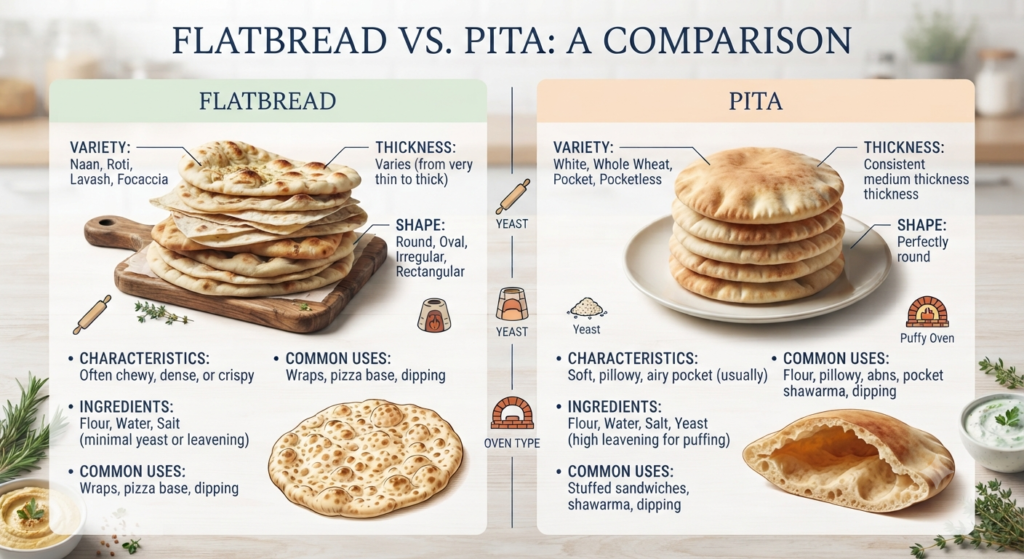
What Is Flatbread?
Flatbread is a general term for bread that is rolled into a relatively thin sheet before cooking. It has been consumed for thousands of years and is one of the oldest forms of bread known to humanity. Flatbread is prepared using simple ingredients such as flour, water, and salt, while some varieties also include yeast, yogurt, milk, oil, or herbs.
Unlike many traditional loaves, flatbread is usually baked without rising into a large loaf. Depending on the recipe, it may be soft and flexible or crisp and crunchy.
Flatbread exists in almost every culture around the world, including Indian roti and naan, Mexican tortillas, Armenian lavash, Italian focaccia, and Scandinavian crispbread.
Characteristics of Flatbread
- Broad category of bread
- Can be leavened or unleavened
- Usually thin
- Cooked on a griddle, skillet, oven, or tandoor
- Available in numerous regional varieties
- Soft, chewy, or crispy depending on recipe
- Suitable for wraps, pizzas, dipping, and side dishes
- Found in cuisines worldwide
What Is Pita?
Pita is a specific variety of flatbread that originated in the Middle East. It is made from wheat flour, water, yeast, salt, and sometimes olive oil. During baking at very high temperatures, steam causes the dough to puff dramatically, creating its well-known hollow pocket.
Once cooled, the pocket remains inside the bread, allowing it to be filled with vegetables, meats, falafel, hummus, or other ingredients. This unique feature distinguishes pita from most other flatbreads.
Pita is widely consumed throughout the Middle East, Mediterranean countries, Greece, Turkey, and many other parts of the world.
Characteristics of Pita
- Specific type of flatbread
- Always yeast-leavened
- Forms a hollow pocket during baking
- Soft and chewy texture
- Usually round
- Made mainly with wheat flour
- Excellent for stuffed sandwiches
- Common in Middle Eastern cuisine
Flatbread vs. Pita: Key Differences
1. Definition
The most fundamental difference between Flatbread vs. Pita lies in their classification and scope.
Flatbread is a broad category of bread that is rolled into a relatively thin shape before cooking. It encompasses numerous varieties from different parts of the world, including naan, tortilla, roti, chapati, lavash, focaccia, injera, and pita. Depending on the recipe and region, flatbreads may be soft, chewy, crispy, thick, or paper-thin, making them one of the most versatile bread types.
Pita, in contrast, is a specific variety of flatbread that originated in the Middle East. It is made from yeast-leavened wheat dough and is best known for developing a hollow pocket during baking. This pocket makes pita ideal for stuffing with meats, vegetables, cheeses, and sauces. In simple terms, every pita is a flatbread, but only one type of flatbread is pita.
2. Origin
The historical background of these breads also highlights important differences.
Flatbread is one of the oldest prepared foods in human history. Archaeological evidence suggests that ancient civilizations were making simple flatbreads over 10,000 years ago using ground grains mixed with water and cooked on heated stones. Over time, nearly every culture developed its own version, including Indian chapati, Mexican tortilla, Ethiopian injera, Armenian lavash, Italian focaccia, and Central Asian naan.
Pita has a more specific geographical origin. It developed in the Middle East, where it became a staple food in countries such as Lebanon, Syria, Jordan, Israel, Palestine, and Turkey. As Mediterranean cuisine spread worldwide, pita gained international popularity and is now commonly served with falafel, shawarma, gyros, kebabs, hummus, and other Middle Eastern dishes.
3. Dough Composition
The ingredients and dough preparation methods also distinguish these breads.
Flatbread recipes vary greatly depending on local traditions and culinary preferences. While flour, water, and salt form the basic ingredients, many recipes also incorporate yeast, baking powder, yogurt, milk, butter, olive oil, herbs, or spices. Whole wheat flour, refined flour, rye flour, corn flour, and even gluten-free flours may be used depending on the variety.
Pita has a more standardized recipe consisting mainly of wheat flour, water, yeast, salt, and occasionally a small amount of olive oil or sugar. The dough is kneaded thoroughly and allowed to ferment before baking. The yeast fermentation is essential because it creates the gas bubbles that later expand into the famous pita pocket.
4. Leavening
The way these breads rise is one of their defining differences.
Flatbread offers tremendous flexibility in leavening. Depending on the type, it may be:
- Unleavened
- Yeast-leavened
- Baking powder leavened
- Naturally fermented
- Sourdough fermented
Because different leavening methods are used, flatbreads range from dense and chewy to soft and fluffy.
Pita, however, is almost always yeast-leavened. During fermentation, yeast produces carbon dioxide that expands the dough. When baked at high temperatures, moisture rapidly turns into steam, inflating the dough like a balloon. As the bread cools, the inflated center collapses slightly, leaving behind the characteristic pocket.
5. Texture
Texture is another noticeable difference between Flatbread vs. Pita.
Flatbread can have many textures depending on its ingredients and preparation. Some varieties, such as naan, are soft, fluffy, and slightly chewy, while tortillas are thin and flexible. Others, like lavash or crispbread, become dry and crunchy after baking. This wide range of textures makes flatbread suitable for numerous culinary applications.
Pita has a more consistent texture. It is generally soft, tender, and moderately chewy, with thin outer layers enclosing an airy interior. Because of its flexibility, pita can be folded or opened without breaking, making it perfect for sandwiches and stuffed meals.
6. Pocket Formation
One of the most recognizable differences is the presence of an internal pocket.
Most flatbreads remain solid throughout after cooking. They do not naturally separate into layers and therefore cannot be opened to create a cavity. Instead, they are wrapped around fillings or served alongside curries, soups, grilled meats, and dips.
Pita is unique because it develops a hollow pocket during baking. When exposed to extremely high temperatures, steam builds up rapidly inside the dough and forces the upper and lower layers apart. Once cooled, this hollow space remains intact, allowing the bread to be filled with ingredients such as falafel, grilled chicken, vegetables, cheese, or hummus.
7. Shape and Thickness
Both breads differ in appearance and dimensions.
Flatbread is available in numerous shapes, including round, oval, rectangular, square, or irregular forms. Thickness also varies considerably—from extremely thin tortillas and lavash to thicker naan and focaccia. This diversity reflects the traditions of different regions around the world.
Pita is usually round with a uniform medium thickness. Maintaining an even thickness is important because it allows steam to distribute evenly during baking, ensuring proper pocket formation. If the dough is rolled unevenly, the pocket may fail to develop.
8. Cooking Method
Cooking techniques greatly influence the final characteristics of each bread.
Flatbread can be cooked using several methods, including:
- Cast-iron skillet
- Griddle (tawa)
- Tandoor oven
- Clay oven
- Baking stone
- Conventional oven
- Open flame
Each cooking method creates a distinctive flavor, texture, and appearance.
Pita requires very high baking temperatures, typically 450–500°F (230–260°C). The intense heat rapidly converts moisture inside the dough into steam, causing the bread to puff dramatically within a few minutes. This quick expansion is essential for forming the internal pocket.
9. Culinary Uses
Both breads are extremely versatile but are typically used for different purposes.
Flatbread is commonly used for:
- Pizza crusts
- Wraps
- Sandwiches
- Side bread with curries
- Dipping into soups and stews
- Serving with grilled meats
- Cheese platters
- Appetizers
- Breakfast dishes
- Snack recipes
Its versatility makes flatbread suitable for cuisines around the world.
Pita is especially valued for recipes that take advantage of its pocket, including:
- Falafel sandwiches
- Shawarma wraps
- Gyros
- Stuffed vegetable pockets
- Chicken pita sandwiches
- Hummus dipping
- Mediterranean platters
- Kebab sandwiches
- Greek-style sandwiches
- Healthy lunch wraps
Because the pocket securely holds fillings, pita is often preferred for portable meals.
10. Popular Varieties
The diversity of flatbread is much greater than that of pita.
Common flatbread varieties include:
- Naan
- Roti
- Chapati
- Tortilla
- Lavash
- Focaccia
- Paratha
- Injera
- Barbari
- Piadina
- Matzo
- Crispbread
Each variety reflects the ingredients, cooking techniques, and culinary traditions of its region.
Common pita varieties include:
- Greek pita
- Arabic pita
- Lebanese pita
- Syrian pita
- Turkish pita
- Whole wheat pita
- Pocket pita
- Mini pita
- White pita
- Multigrain pita
Although these pita varieties differ slightly in thickness, flour type, or texture, they all retain the defining characteristics of pita bread: a soft, yeast-leavened dough and a versatile structure that is ideal for serving with Mediterranean and Middle Eastern cuisine.
Similarities Between Flatbread and Pita
Although Flatbread and Pita are not exactly the same, they share many characteristics because pita itself belongs to the flatbread family. Both are made using simple ingredients, have ancient origins, and are enjoyed in cuisines around the world. Their versatility and ease of preparation have made them staple foods for centuries.
Some key similarities include:
- Both are made primarily from flour, water, and salt.
- Both belong to the family of flat breads.
- Both are usually round or oval in shape.
- Both can be served warm or cold.
- Both pair well with meat, vegetables, cheese, and dips.
- Both are commonly used for wraps and sandwiches.
- Both can be baked in ovens or cooked on hot surfaces.
- Both are staple foods in Middle Eastern and Mediterranean cuisines.
- Both are available in whole wheat and refined flour versions.
- Both provide carbohydrates that serve as an important energy source.
Advantages of Flatbread
Flatbread has remained popular for thousands of years because of its simplicity, versatility, and adaptability. Different cultures have created their own unique versions, making flatbread one of the most widely consumed bread types in the world.
Some major advantages of flatbread include:
- Available in countless regional varieties.
- Can be made with or without yeast.
- Quick and easy to prepare.
- Suitable for pizzas, wraps, sandwiches, and side dishes.
- Can be cooked using a skillet, tandoor, oven, or griddle.
- Easy to customize with herbs, spices, seeds, or whole grains.
- Often contains fewer ingredients than traditional loaf bread.
- Portable and convenient for meals on the go.
- Can be soft or crispy depending on the recipe.
- Fits a wide range of cuisines, from Indian to Mediterranean and Mexican.
Advantages of Pita
Pita offers several unique benefits that distinguish it from other flatbreads. Its signature pocket and soft texture make it one of the most practical breads for stuffed sandwiches and healthy meals.
Some key advantages of pita include:
- Forms a convenient pocket for fillings.
- Ideal for sandwiches, wraps, and stuffed meals.
- Soft and easy to chew.
- Less messy than many open flatbreads.
- Excellent with hummus, baba ganoush, and other dips.
- Widely used in Mediterranean and Middle Eastern cuisine.
- Available in whole wheat varieties for added fiber.
- Easy to portion into halves or wedges.
- Can be toasted into crispy pita chips.
- Suitable for both hot and cold dishes.
Which One Should You Choose?
Choosing between Flatbread vs. Pita depends largely on the type of meal you are preparing, the texture you prefer, and how you intend to serve the bread.
Choose flatbread if you need:
- Pizza crusts
- Thin wraps
- Side bread with curries
- Bread for dipping
- Rustic artisan breads
- Greater variety of flavors and textures
- Crispy or chewy bread options
Choose pita if you need:
- Stuffed sandwiches
- Falafel wraps
- Shawarma
- Gyros
- Portable lunches
- Bread with a built-in pocket
- Mediterranean-style meals
Neither bread is universally better—the best choice depends on the recipe and your personal preference.
Conclusion
The comparison of Flatbread vs. Pita shows that while both breads share common ingredients and culinary traditions, they differ in several important ways. Flatbread is a broad category that includes numerous bread varieties from around the world, each with its own unique texture, preparation method, and cultural significance. Some flatbreads are unleavened, while others use yeast or other leavening agents, making them suitable for everything from pizzas and wraps to side dishes and snacks.
Pita, in contrast, is a specific type of yeast-leavened flatbread famous for its soft texture and hollow pocket that forms during high-temperature baking. This distinctive pocket makes pita especially useful for stuffing with meats, vegetables, cheeses, and sauces, making it a staple of Middle Eastern and Mediterranean cuisine.
When comparing Flatbread vs. Pita, the choice ultimately depends on how you plan to use the bread. If you want versatility and a wide range of styles, flatbread offers countless options. If you need a bread designed for stuffed sandwiches and handheld meals, pita is the ideal choice. Both are delicious, nutritious, and continue to be enjoyed worldwide.
Frequently Asked Questions (FAQs)
The primary difference between Flatbread vs. Pita is that flatbread is a general category of thin breads, whereas pita is a specific yeast-leavened flatbread that develops a hollow pocket during baking.
Yes. Pita is one type of flatbread, but not all flatbreads are pita. The defining characteristic of pita is its hollow pocket formed during high-temperature baking.
The pocket forms because moisture inside the yeast-leavened dough turns into steam when baked at very high temperatures. The steam separates the dough into two layers, creating a hollow interior.
The nutritional value depends on the ingredients used. Whole wheat flatbread and whole wheat pita generally contain more fiber, vitamins, and minerals than versions made with refined flour. Portion size and added ingredients also affect their overall healthfulness.
Yes. Many flatbreads can be used instead of pita for wraps, sandwiches, or serving with dips. However, they usually lack the characteristic pocket that makes pita convenient for stuffing.
Read Next: