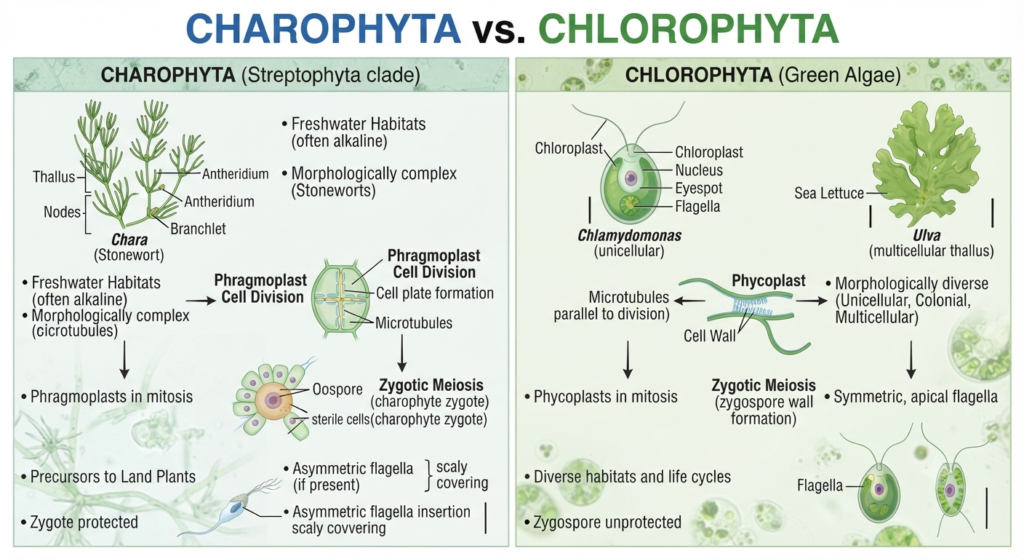
The main difference between Charophyta vs. Chlorophyta is that Charophyta are the closest living relatives of land plants and primarily inhabit freshwater environments, whereas Chlorophyta are a diverse group of green algae found in freshwater, marine, and terrestrial habitats. Charophyta possess several structural and reproductive features similar to terrestrial plants, while Chlorophyta exhibit greater diversity in form, habitat, and life cycles.
Although both groups belong to the green algae lineage and perform photosynthesis using chlorophyll a and b, they differ in habitat, morphology, reproduction, evolutionary significance, cellular organization, and ecological roles. Understanding Charophyta vs. Chlorophyta is essential for students of botany, biology, and evolutionary science because these groups illustrate the evolutionary transition from aquatic algae to land plants.
Charophyta vs. Chlorophyta Comparison Table
The table below highlights the major differences between Charophyta vs. Chlorophyta.
| Feature | Charophyta | Chlorophyta |
|---|---|---|
| Kingdom | Plantae (Green algae lineage) | Plantae (Green algae lineage) |
| Common Name | Stoneworts and related algae | Green algae |
| Habitat | Mostly freshwater | Freshwater, marine, and terrestrial |
| Evolutionary Position | Closest relatives of land plants | Earlier-diverging green algae |
| Body Organization | Mostly multicellular | Unicellular, colonial, filamentous, or multicellular |
| Cell Division | Phragmoplast formation | Usually phycoplast formation |
| Flagellated Cells | Present in many species | Present in many species |
| Reproduction | Sexual and asexual | Sexual and asexual |
| Examples | Chara, Nitella, Coleochaete | Chlamydomonas, Ulva, Volvox, Spirogyra |
| Ecological Role | Freshwater ecosystem stabilization | Primary producers in diverse ecosystems |
What Is Charophyta?
Charophyta is a group of green algae that represents the closest living relatives of terrestrial plants. These algae are primarily found in freshwater habitats such as ponds, lakes, marshes, and slow-moving rivers. Scientists consider Charophyta highly significant because many of their cellular and reproductive characteristics resemble those of modern land plants.
Most charophytes are multicellular and possess relatively complex body structures compared to many other green algae. Some species develop node-like and internode-like regions, while others exhibit branching patterns that resemble primitive plants.
Chlorophyta, commonly called green algae, can look very different depending on the species. They may appear as green, thread-like filaments, flat sheets, branched structures, or small spherical cells. Their green color comes mainly from chlorophyll a and chlorophyll b, which give them their characteristic bright to dark green appearance.
Some Chlorophyta, such as Spirogyra, look like long green threads, while others, such as Chlamydomonas, are microscopic single cells. More complex forms, such as Ulva, can look like thin, leaf-like sheets growing in marine environments.
Chlorophyta is divided into several classes, including Chlorophyceae, Ulvophyceae, Trebouxiophyceae, and Charophyceae.
Charophyta play an important ecological role by stabilizing sediments, producing oxygen through photosynthesis, and providing shelter for aquatic organisms.
Characteristics of Charophyta
- Mostly freshwater algae
- Closest relatives of land plants
- Primarily multicellular
- Possess chlorophyll a and b
- Cell walls mainly composed of cellulose
- Store starch inside chloroplasts
- Complex reproductive structures
- Phragmoplast-assisted cell division
- Important in plant evolution
- Examples include Chara, Nitella, and Coleochaete
What Is Chlorophyta?
Chlorophyta is a large and highly diverse division of green algae found in marine, freshwater, and terrestrial environments. Unlike Charophyta, Chlorophyta includes species with a remarkable variety of body forms, ranging from microscopic single cells to large multicellular seaweeds.
These algae perform photosynthesis using chlorophyll a and b, making them important primary producers in aquatic ecosystems. Many Chlorophyta species contribute significantly to global oxygen production and aquatic food chains.
Due to their diversity and adaptability, Chlorophyta occupy nearly every type of illuminated aquatic habitat and even moist terrestrial environments.
Characteristics of Chlorophyta
- Found in freshwater, marine, and terrestrial habitats
- Extremely diverse body organization
- Unicellular, colonial, filamentous, or multicellular
- Possess chlorophyll a and b
- Cellulose cell walls
- Store starch as food reserve
- Various reproductive methods
- Usually exhibit phycoplast during cell division
- Important primary producers
- Examples include Chlamydomonas, Volvox, Ulva, and Spirogyra
Charophyta vs. Chlorophyta: Key Differences
1. Evolutionary Relationship
The most significant difference between Charophyta vs. Chlorophyta is their evolutionary relationship with land plants.
Charophyta are considered the closest living relatives of terrestrial plants. Molecular, genetic, and structural studies show that modern land plants evolved from a charophyte-like ancestor hundreds of millions of years ago. Because of this close relationship, Charophyta possess several advanced cellular features that are also found in embryophytes (land plants).
Chlorophyta, although they are also green algae, represent an earlier-diverging lineage. They share many basic characteristics with land plants, such as chlorophyll a and b, but lack many of the specialized features that link Charophyta to terrestrial plants.
2. Habitat
Habitat is another major distinction between these two groups.
Charophyta are found predominantly in freshwater ecosystems, including ponds, lakes, marshes, swamps, canals, and slow-flowing streams. Many species prefer clean, calcium-rich freshwater environments and are sensitive to pollution, making them useful indicators of water quality.
Chlorophyta, by contrast, occupy a much broader range of environments. They occur in freshwater, oceans, estuaries, damp soil, tree bark, snowfields, and even symbiotic associations with fungi to form lichens. Their adaptability allows them to thrive under diverse environmental conditions.
3. Body Organization
The structural complexity of these algae differs considerably.
Charophyta are generally multicellular with relatively complex body organization. Many species possess differentiated structures resembling stems, nodes, internodes, and branches, making them appear similar to primitive aquatic plants.
Chlorophyta exhibit tremendous diversity in body form. They may be:
- Unicellular
- Colonial
- Filamentous
- Sheet-like
- Tubular
- Multicellular
This diversity allows Chlorophyta to occupy a wide variety of ecological niches.
4. Cell Division
Cell division provides one of the strongest pieces of evidence supporting the close relationship between Charophyta and land plants.
During cell division, Charophyta form a phragmoplast, which guides the formation of the new cell wall. This mechanism is almost identical to that found in higher plants.
Chlorophyta generally produce a phycoplast, where microtubules develop parallel to the plane of cell division. This represents a simpler mechanism and differs from that of terrestrial plants.
5. Reproductive Structures
Reproductive complexity also distinguishes these algae.
Charophyta possess highly specialized multicellular reproductive organs. Their gametes often develop within protective structures, reducing the risk of damage and increasing reproductive success. This feature is considered an important evolutionary step toward land plant reproduction.
Chlorophyta generally have simpler reproductive structures. Many species release gametes directly into water, while others reproduce through fragmentation, zoospores, or simple sexual reproduction without highly specialized reproductive organs.
6. Complexity of Life Cycle
The life cycles of these algae also differ.
Charophyta generally exhibit more complex developmental patterns that resemble early land plants. Their reproductive cycles involve greater cellular specialization and more advanced embryological features.
Chlorophyta display highly variable life cycles depending on the species. Some have simple haploid life cycles, while others show alternation of generations or isomorphic life cycles. Overall, their developmental organization is usually less specialized than that of Charophyta.
7. Evolutionary Importance
Charophyta occupy a unique position in evolutionary biology.
Charophyta provide crucial evidence for understanding how aquatic plants successfully colonized land. Many characteristics of terrestrial plants—including plasmodesmata, phragmoplast formation, cellulose synthesis, and similar enzyme systems—are believed to have originated in Charophyta.
Chlorophyta, although evolutionarily important as primary producers, are not considered the direct ancestors of modern land plants. Instead, they illustrate the remarkable diversity and adaptability of green algae across aquatic and terrestrial ecosystems.
8. Diversity
Species diversity varies greatly between these two groups.
Charophyta contain comparatively fewer species, most of which are confined to freshwater habitats. Their evolutionary specialization has limited their ecological diversity.
Chlorophyta, however, comprise thousands of species distributed worldwide. Their remarkable adaptability has enabled them to evolve into numerous forms capable of inhabiting freshwater, marine, and terrestrial environments.
9. Ecological Role
Both groups contribute significantly to ecosystems, but in different ways.
Charophyta stabilize sediments, improve water clarity, recycle nutrients, produce oxygen, and provide shelter for fish, aquatic insects, and microorganisms. They often dominate healthy freshwater ecosystems.
Chlorophyta serve as primary producers across marine and freshwater food webs. They convert solar energy into organic matter, support aquatic food chains, release oxygen, and contribute substantially to global carbon fixation.
10. Examples
Representative species further illustrate the differences between these groups.
Common Charophyta include:
- Chara
- Nitella
- Coleochaete
- Klebsormidium
- Zygnema
Common Chlorophyta include:
- Chlamydomonas
- Volvox
- Ulva
- Ulothrix
- Chlorella
- Oedogonium
Similarities Between Charophyta and Chlorophyta
Although Charophyta and Chlorophyta belong to different evolutionary lineages of green algae, they share numerous structural, physiological, and biochemical characteristics. Both groups are photosynthetic organisms that contribute significantly to aquatic ecosystems and play an essential role in oxygen production and carbon fixation. They also possess several common cellular features that distinguish green algae from other algal groups.
Some major similarities include:
- Both are classified as green algae.
- Both contain chlorophyll a and b.
- Both perform photosynthesis.
- Both possess cellulose cell walls.
- Both store starch as their primary food reserve.
- Both reproduce sexually and asexually.
- Both contribute oxygen to the environment.
- Both are important primary producers.
- Both possess chloroplasts surrounded by two membranes.
- Both belong to the Viridiplantae (green plant lineage).
Advantages of Charophyta
Charophyta possess several advanced characteristics that make them one of the most important groups in plant evolution. Their close relationship with terrestrial plants has made them a valuable subject of research in botany, evolutionary biology, genetics, and ecology.
Some important advantages of Charophyta include:
- Closest living relatives of land plants.
- Provide evidence for the evolution of terrestrial plants.
- Stabilize freshwater sediments.
- Improve water clarity by reducing suspended particles.
- Produce large amounts of oxygen through photosynthesis.
- Serve as habitat for fish, insects, and aquatic microorganisms.
- Help recycle nutrients in freshwater ecosystems.
- Useful indicators of clean and healthy freshwater environments.
- Possess advanced cellular structures similar to higher plants.
- Important research organisms in evolutionary biology.
Advantages of Chlorophyta
Chlorophyta are among the most diverse and ecologically important groups of algae. Their adaptability enables them to thrive in a wide variety of habitats, making them vital components of many ecosystems.
Some major advantages of Chlorophyta include:
- Extremely diverse with thousands of species.
- Found in freshwater, marine, and terrestrial habitats.
- Major producers of atmospheric oxygen.
- Form the base of many aquatic food chains.
- Important in global carbon fixation.
- Some species are cultivated as nutritional supplements.
- Used in biotechnology and biofuel research.
- Certain species help in wastewater treatment.
- Serve as model organisms for biological studies.
- Contribute significantly to marine and freshwater biodiversity.
Which Is More Evolutionarily Significant—Charophyta or Chlorophyta?
Both Charophyta and Chlorophyta are important groups of green algae, but their significance differs depending on the context.
Charophyta are considered more evolutionarily significant because they represent the closest living relatives of land plants. Numerous molecular, genetic, and structural studies indicate that terrestrial plants evolved from a charophyte-like ancestor approximately 470–500 million years ago. Features such as phragmoplast formation during cell division, plasmodesmata, cellulose synthesis, and similar reproductive mechanisms strongly support this evolutionary relationship.
Chlorophyta, however, are more ecologically diverse. They include thousands of species inhabiting oceans, freshwater bodies, soils, and other environments. Their remarkable adaptability allows them to contribute extensively to global primary productivity, oxygen generation, and aquatic food webs.
Choose Charophyta when discussing:
- Evolution of land plants
- Plant ancestry
- Advanced green algae
- Evolutionary biology
- Freshwater plant evolution
- Comparative botany
- Embryophyte origins
Choose Chlorophyta when discussing:
- Diversity of green algae
- Marine ecosystems
- Freshwater phytoplankton
- Oxygen production
- Biotechnology applications
- Biofuel research
- Aquatic food chains
Both groups are indispensable to biology, but Charophyta hold greater importance in understanding the origin and evolution of terrestrial plants, whereas Chlorophyta dominate in terms of ecological diversity and environmental impact.
Conclusion
The comparison of Charophyta vs. Chlorophyta highlights two important divisions of green algae that share many photosynthetic characteristics but differ in evolutionary history, habitat, morphology, and ecological significance. Charophyta are primarily freshwater algae with advanced cellular and reproductive features that closely resemble those of land plants. Their evolutionary relationship with terrestrial plants makes them one of the most extensively studied groups in plant biology.
Chlorophyta, in contrast, represent a highly diverse group of green algae found in freshwater, marine, and terrestrial environments. Their remarkable adaptability allows them to exist in a wide range of habitats, where they function as primary producers and play a crucial role in global oxygen production and aquatic ecosystems.
Understanding Charophyta vs. Chlorophyta helps students, researchers, and biology enthusiasts appreciate the evolutionary transition from aquatic algae to terrestrial plants while recognizing the ecological importance of both groups. Although they share common photosynthetic pigments and cellular structures, their differences provide valuable insights into plant evolution, biodiversity, and ecosystem functioning.
Frequently Asked Questions (FAQs)
The main difference between Charophyta vs. Chlorophyta is that Charophyta are the closest living relatives of land plants and are mainly freshwater algae, whereas Chlorophyta are a diverse group of green algae found in freshwater, marine, and terrestrial habitats.
Charophyta possess several characteristics shared with land plants, including phragmoplast-assisted cell division, plasmodesmata, similar cellulose synthesis mechanisms, and comparable reproductive features. These similarities indicate that land plants evolved from a charophyte-like ancestor.
Chlorophyta occur in a wide range of environments, including oceans, lakes, rivers, ponds, damp soil, rocks, tree bark, and even snow-covered regions. Their adaptability makes them one of the most widespread groups of algae.
Yes. Both groups contain chlorophyll a and chlorophyll b, enabling them to perform photosynthesis and produce oxygen while converting sunlight into chemical energy.
Chlorophyta are considerably more diverse than Charophyta. They include thousands of species with unicellular, colonial, filamentous, sheet-like, and multicellular body forms distributed across numerous habitats.
Reference:
1.“Chlorophyta.” Biology, 12 May 2014
2. “Green Algae: Precursors of Land Plants.” Lumen
Read Next: