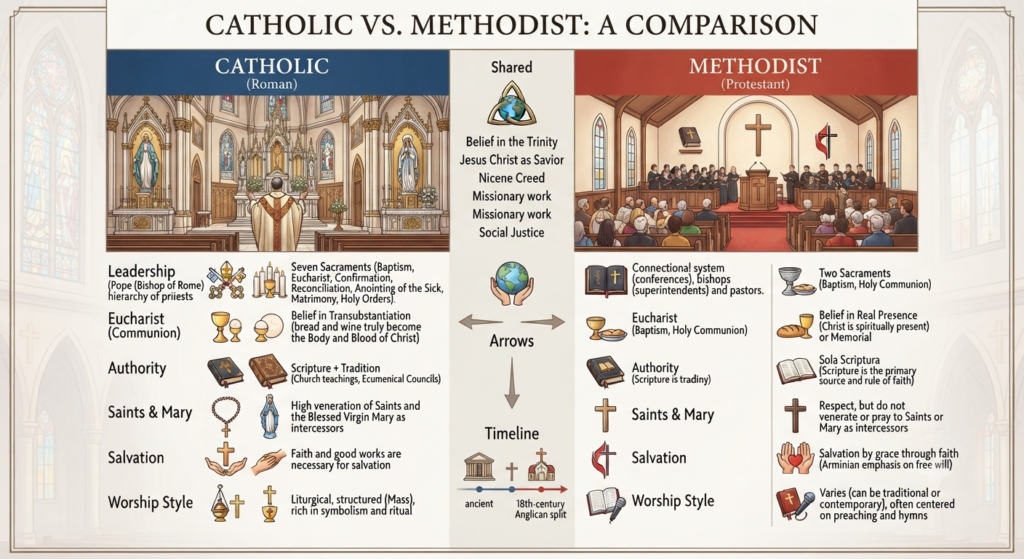
The main difference between Catholic vs. Methodist Christianity is that Catholicism recognizes the authority of the Pope, Sacred Tradition, and the Magisterium and practices seven sacraments, while Methodism gives primary authority to Scripture and recognizes two sacraments: Baptism and the Lord’s Supper. Catholics follow a highly structured sacramental and liturgical tradition centered on the Mass and Eucharist, whereas Methodist worship generally places greater emphasis on preaching, hymn singing, personal faith, spiritual growth, and practical holiness.
Although Catholics and Methodists share many foundational Christian beliefs—including the Trinity, the divinity of Jesus Christ, baptism, communion, prayer, Scripture, and Christian service—the two traditions differ in church authority, sacramental theology, worship, salvation, the role of Mary and the saints, and church governance.
Understanding Catholic vs. Methodist differences can help students, researchers, Christians, and anyone interested in comparative religion understand how these two major Christian traditions developed and how their beliefs and worship practices differ.
Catholic vs. Methodist Comparison Table
The table below highlights the major differences between Catholic vs. Methodist Christianity.
| Feature | Catholic | Methodist |
|---|---|---|
| Christian Tradition | Roman Catholic Christianity | Wesleyan Protestant Christianity |
| Historical Origin | Apostolic Christianity | 18th-century renewal movement |
| Founder/Key Figures | Jesus and the apostles; developed through the historic Church | John Wesley and Charles Wesley |
| Authority | Scripture and Sacred Tradition interpreted by the Magisterium | Scripture as primary authority, interpreted with Tradition, Reason, and Experience |
| Papal Authority | Recognized | Not recognized |
| Church Leadership | Pope, bishops, priests, and deacons | Bishops, clergy, and conference structures, depending on denomination |
| Sacraments | Seven | Two |
| Baptism | Practiced for infants and adults | Practiced for infants and adults |
| Communion | Eucharist celebrated at Mass | Lord’s Supper celebrated with frequency varying by congregation |
| Eucharistic Belief | Real Presence through transubstantiation | Real presence/spiritual presence without transubstantiation |
| Worship | Formal and liturgical | Traditional, liturgical, or contemporary |
| Salvation | Grace, faith, charity, sacraments, and Christian life | Grace, faith, conversion, and sanctification |
| Mary and Saints | Veneration and intercession | Honored as examples but generally not invoked |
| Church Structure | Centralized hierarchical structure | Connectional structure with conferences |
| Confession | Sacramental confession | Repentance and prayer; no sacrament of confession in the Catholic sense |
| Communion Practice | Ordinarily reserved for Catholics in good standing | Open communion in many Methodist congregations |
| Major Spiritual Emphasis | Sacramental life and participation in the Church | Holiness, discipleship, evangelism, and practical Christian living |
The reference material similarly identifies papal authority, the number of sacraments, Eucharistic theology, worship, and governance as major areas of distinction.
What Is Catholicism?
Catholicism is the Christian tradition centered on the Roman Catholic Church. Catholics understand their Church as having historical continuity with the apostolic community founded by Jesus Christ and the apostles.
The Catholic Church places significant emphasis on Sacred Scripture, Sacred Tradition, and the teaching authority of the Magisterium. The Pope, as Bishop of Rome, has a unique leadership role within the worldwide Catholic Church.
Catholic religious life is strongly sacramental. Catholics recognize seven sacraments:
- Baptism
- Confirmation
- Eucharist
- Penance or Reconciliation
- Anointing of the Sick
- Holy Orders
- Matrimony
The Eucharist has a central place in Catholic worship. Catholics teach that Christ is truly present in the Eucharist and explain this belief through the doctrine of transubstantiation.
Catholic worship is usually highly structured and centers on the Mass, which includes Scripture readings, prayers, the Creed, the Liturgy of the Eucharist, and Holy Communion.
Characteristics of Catholicism
- Recognizes the authority of the Pope
- Emphasizes apostolic succession
- Recognizes seven sacraments
- Centers worship on the Mass
- Teaches the Real Presence of Christ in the Eucharist
- Gives an important role to Sacred Tradition
- Honors Mary and the saints
- Maintains a worldwide hierarchical church structure
- Places strong emphasis on sacramental and liturgical life
What Is Methodism?
Methodism is a Protestant Christian tradition that developed during the 18th century, particularly through the work of John Wesley and Charles Wesley within the Church of England.
Methodism emphasizes personal conversion, spiritual discipline, Christian discipleship, evangelism, and holiness. The Methodist tradition is particularly associated with the idea of holiness of heart and life.
Methodists generally regard Scripture as the primary authority while using Tradition, Reason, and Experience to help understand and apply biblical teaching. This approach is commonly known as the Wesleyan Quadrilateral.
Methodists generally recognize two sacraments:
- Baptism
- The Lord’s Supper
Methodist worship can vary considerably. Some congregations use traditional liturgy and hymns, while others use contemporary music, preaching, testimonies, and informal prayer.
Characteristics of Methodism
- Scripture has primary authority
- Rejects papal authority
- Recognizes two sacraments
- Emphasizes personal faith and spiritual growth
- Strong focus on holiness and sanctification
- Values preaching and hymn singing
- Encourages Christian service and evangelism
- Uses connectional church structures in many Methodist denominations
- Allows considerable variation in worship style
The reference material describes Methodism as emphasizing Scripture, practical holiness, and episcopal or connectional governance.
Catholic vs. Methodist: Key Differences
1. Authority and Church Leadership
One of the most important differences in Catholic vs. Methodist Christianity concerns religious authority.
Catholics recognize Scripture and Sacred Tradition as part of the deposit of faith and rely on the Magisterium to authentically interpret that faith. The Pope and bishops have important teaching and governing roles.
Methodists give primary authority to Scripture. The Wesleyan Quadrilateral uses Scripture together with Tradition, Reason, and Experience when interpreting Christian faith and practice.
Methodists do not recognize papal jurisdiction.
In simple terms:
Catholic: Scripture + Sacred Tradition + Magisterium
Methodist: Scripture as primary authority, interpreted with Tradition, Reason, and Experience
2. Number of Sacraments
The number of sacraments is another major difference.
The Catholic Church recognizes seven sacraments, while Methodists generally recognize two sacraments: Baptism and the Lord’s Supper.
Catholic Sacraments
- Baptism
- Confirmation
- Eucharist
- Penance or Reconciliation
- Anointing of the Sick
- Holy Orders
- Matrimony
Methodist Sacraments
- Baptism
- The Lord’s Supper
This difference reflects broader theological differences concerning how God’s grace is understood and expressed through the life of the Church.
3. Eucharist and Communion
The Eucharist is central to Catholic worship.
Catholics teach that Christ is truly present in the Eucharist and explain this through transubstantiation. The Mass therefore has a deeply sacramental character.
Methodists also regard the Lord’s Supper as an important means of grace and affirm Christ’s presence, but they do not teach Catholic transubstantiation. Methodist teaching generally describes Christ’s presence in spiritual or sacramental terms rather than as a change of substance.
Therefore:
- Catholic: Real Presence through transubstantiation
- Methodist: Christ is truly present, without teaching transubstantiation
4. Worship Style
Catholic worship is generally more formal and follows a defined liturgical structure.
A Catholic Mass commonly includes:
- Scripture readings
- Prayers
- Hymns
- Creed
- Homily
- Liturgy of the Eucharist
- Holy Communion
Methodist worship can range from traditional liturgy to contemporary services.
A Methodist service may include:
- Hymns
- Contemporary Christian music
- Scripture readings
- Sermons
- Set prayers
- Spontaneous prayer
- Testimonies
- Communion
The reference material notes that Catholic worship is generally formal and liturgical, whereas Methodist worship may range from traditional liturgy to contemporary formats.
5. Salvation
Catholics and Methodists both teach that salvation depends upon God’s grace, but they explain Christian salvation using somewhat different theological frameworks.
Catholic theology emphasizes grace, faith, charity, the sacraments, and a life of Christian virtue. Justification and sanctification are closely connected in Catholic theology.
Methodism strongly emphasizes prevenient grace, justifying grace, and sanctifying grace.
- Prevenient grace prepares and enables people to respond to God.
- Justifying grace concerns forgiveness and new birth.
- Sanctifying grace describes continuing growth in holiness.
Methodism therefore places particularly strong emphasis on spiritual transformation and Christian holiness.
6. Mary and the Saints
Another significant difference concerns Mary and the saints.
Catholics honor Mary in a particularly important way and recognize various Marian doctrines and devotions. Catholics also venerate the saints and may ask for their intercession.
Methodists respect Mary as the mother of Jesus and recognize the importance of Christian saints as examples of faithful living. However, Methodists generally do not invoke saints in prayer or seek their intercession in the same way Catholics do.
The distinction is therefore:
Catholic: Veneration of Mary and the saints, including requests for intercession
Methodist: Respect for Mary and the saints as examples, while prayer is directed to God through Christ
7. Confession
Catholicism includes Penance or Reconciliation as one of its seven sacraments.
Catholics may confess sins to a priest and receive sacramental absolution.
Methodists emphasize repentance, prayer, confession to God, and spiritual accountability but do not recognize sacramental confession in the same way as Catholicism.
This difference reflects the broader distinction between Catholic sacramental theology and Methodist Protestant theology.
8. Church Governance
Catholic and Methodist churches both have ordained clergy and forms of episcopal leadership, but their organizational structures differ.
The Catholic Church has a centralized worldwide hierarchy headed by the Pope. Bishops oversee dioceses, while priests normally serve individual parishes.
Many Methodist denominations use connectional governance, involving conferences and bishops or other forms of regional leadership.
In Methodism, major decisions may involve representatives of both clergy and laity through conferences or synods.
Therefore:
Catholic: Centralized hierarchical structure
Methodist: Connectional structure with conferences and regional leadership
9. Baptism
Both Catholics and Methodists practice baptism and may baptize infants as well as adults.
Catholic baptism is closely connected with incorporation into the Catholic Church and the sacramental life of Christianity.
Methodists understand baptism in terms of God’s covenantal grace and Christian initiation. Many Methodist churches also practice infant baptism while permitting baptism of believers.
Thus, although both traditions baptize infants and adults, the theological context surrounding baptism differs.
10. Communion Practice
Catholic and Methodist churches can also differ in their approach to Communion.
Catholics celebrate the Eucharist at every Mass, and reception is governed by Catholic sacramental and ecclesial requirements.
Many Methodist congregations practice an open table, inviting baptized Christians to participate, although practices can vary among Methodist denominations and congregations.
11. Everyday Religious Life
Daily religious practices can also differ.
Catholic life may include:
- Sunday Mass
- Daily prayer
- Confession
- Eucharistic devotion
- Rosary prayer
- Observance of Lent
- Holy days
- Parish activities
- Charitable work
- Religious education
Catholic spirituality often follows the liturgical calendar, with seasons such as Advent, Christmas, Lent, Easter, and Ordinary Time.
Methodist life commonly emphasizes:
- Bible reading
- Personal prayer
- Small-group participation
- Worship
- Hymn singing
- Evangelism
- Christian service
- Social outreach
- Spiritual accountability
- Growth in holiness
The Methodist tradition particularly emphasizes the practical expression of faith through both personal spirituality and service to others.
12. Historical Background
Catholicism and Methodism developed in very different historical circumstances.
Catholicism traces its roots to the early Christian Church and the apostolic community. Over centuries, the Catholic Church developed its doctrines, sacramental practices, organizational structures, councils, and canon law.
Methodism emerged much later, during the 18th century, through the ministry and organizational work of John and Charles Wesley.
The Wesley brothers sought spiritual renewal within the Church of England. Their movement emphasized disciplined prayer, Bible study, small groups, preaching, evangelism, and holiness.
Methodism subsequently developed into a worldwide family of denominations and churches.
The source material identifies Methodism’s origins in the 18th-century Church of England and associates its development particularly with John and Charles Wesley.
Similarities Between Catholics and Methodists
Despite their differences, Catholic vs. Methodist should not be understood as a comparison between two completely unrelated religions. Both belong to the broader Christian tradition and share many fundamental beliefs.
Major similarities include:
- Both believe in one God in three persons—the Trinity.
- Both affirm the divinity of Jesus Christ.
- Both believe in the incarnation of Christ.
- Both affirm the death and resurrection of Jesus.
- Both practice baptism.
- Both celebrate the Lord’s Supper or Eucharist.
- Both use the Bible in worship and teaching.
- Both emphasize prayer.
- Both encourage moral and ethical Christian living.
- Both engage in Christian mission and evangelism.
- Both support charitable and community service.
- Both have ordained clergy and organized church communities.
The reference source similarly identifies the Trinity, Scripture, baptism, communion, prayer, mission, service, and ordained leadership as important areas of common ground.
Which Is Older: Catholicism or Methodism?
Catholicism is much older than Methodism.
Catholic Christianity traces its origins to the earliest Christian communities associated with Jesus and the apostles.
Methodism emerged approximately eighteen centuries later as an 18th-century renewal movement within Anglican Christianity.
Therefore:
Catholicism: Ancient Christian tradition with roots in the apostolic Church
Methodism: 18th-century Protestant renewal movement
Is Methodist Protestant?
Yes. Methodism is generally classified as a Protestant Christian tradition.
It developed within the Church of England and retained several elements of Anglican heritage while developing its own theological emphasis on grace, conversion, sanctification, Christian perfection, and disciplined spiritual life.
Catholicism, by contrast, is not classified as Protestant. The Roman Catholic Church represents a distinct major Christian tradition with its own sacramental, hierarchical, and doctrinal structures.
Catholic vs. Methodist: Which Is More Similar to Protestant Christianity?
Methodism is more closely associated with Protestant Christianity because it developed from the Protestant Reformation tradition through Anglicanism.
Important Protestant characteristics of Methodism include:
- Scripture as primary authority
- Rejection of papal jurisdiction
- Two sacraments
- Emphasis on personal faith
- Strong preaching tradition
- Emphasis on conversion and sanctification
Catholicism maintains a different theological framework centered on Scripture and Sacred Tradition, the Magisterium, the seven sacraments, apostolic succession, and papal leadership.
Advantages of Catholic Tradition
Catholicism offers a highly developed sacramental and liturgical tradition.
Major characteristics include:
- Strong connection to historic Christianity
- Seven-sacrament system
- Structured liturgical worship
- Worldwide church organization
- Strong emphasis on Eucharistic worship
- Rich traditions of prayer and spirituality
- Historic connection to apostolic succession
- Extensive educational and charitable institutions
Advantages of Methodist Tradition
Methodism emphasizes practical Christian living and spiritual growth.
Major characteristics include:
- Strong focus on Scripture
- Emphasis on personal faith
- Strong preaching tradition
- Emphasis on sanctification
- Active Christian service
- Evangelistic tradition
- Small-group discipleship
- Flexible worship styles
- Significant lay participation
Catholic vs. Methodist: Which Is Right for You?
There is no simple answer to which tradition is universally “better.” Catholicism and Methodism represent different approaches to Christian theology, worship, authority, and spiritual practice.
Someone attracted to historic liturgy, sacramental worship, apostolic succession, and a centralized church structure may find Catholicism particularly meaningful.
Someone who prefers strong biblical preaching, flexible worship, small-group discipleship, and a pronounced emphasis on holiness and practical Christian service may appreciate Methodist traditions.
The choice ultimately depends on a person’s theological convictions, spiritual priorities, church community, and understanding of Christian faith.
Choose Catholicism if you value:
- The seven sacraments
- The Mass
- Eucharistic devotion
- Apostolic succession
- Papal authority
- Sacred Tradition
- Catholic devotional practices
- A worldwide hierarchical Church
Choose Methodism if you value:
- Scripture as primary authority
- Wesleyan theology
- Preaching and hymn singing
- Personal conversion
- Sanctification and holiness
- Flexible worship
- Small-group discipleship
- Christian service and evangelism
Catholic vs. Methodist: Key Takeaways
The most important differences can be summarized as follows:
- Authority: Catholics recognize Scripture, Sacred Tradition, and the Magisterium; Methodists give primary authority to Scripture.
- Papal authority: Catholics recognize the Pope; Methodists do not.
- Sacraments: Catholics recognize seven; Methodists generally recognize two.
- Eucharist: Catholics teach transubstantiation; Methodists affirm Christ’s presence without transubstantiation.
- Worship: Catholic worship is generally formal and liturgical; Methodist worship can range from traditional to contemporary.
- Salvation: Both emphasize God’s grace, but their theological explanations differ.
- Mary and saints: Catholics venerate Mary and the saints; Methodists generally honor them without invoking their intercession.
- Governance: Catholicism has a centralized hierarchy; many Methodist bodies use connectional conference structures.
- Confession: Catholics have sacramental Reconciliation; Methodists emphasize repentance and prayer.
- Spiritual emphasis: Catholicism strongly emphasizes sacramental life, while Methodism places particular emphasis on holiness and discipleship.
Conclusion
The comparison of Catholic vs. Methodist Christianity reveals two Christian traditions that share important beliefs while differing significantly in authority, sacraments, worship, salvation, church governance, and devotional practices.
Catholicism is characterized by papal authority, apostolic succession, Sacred Tradition, seven sacraments, the Mass, and Eucharistic theology centered on the Real Presence through transubstantiation. Methodism, meanwhile, emphasizes Scripture, grace, personal faith, sanctification, holiness, preaching, hymnody, Christian service, and two sacraments.
Despite these differences, Catholics and Methodists share a substantial Christian foundation. Both affirm the Trinity, Jesus Christ, baptism, communion, Scripture, prayer, Christian morality, mission, and service to others.
Understanding Catholic vs. Methodist differences is therefore useful not only for comparing doctrines but also for appreciating the diversity within Christianity. The two traditions have different historical origins and theological frameworks, yet both seek to express Christian faith through worship, discipleship, community, and service.
Frequently Asked Questions (FAQs)
The main difference between Catholic vs. Methodist is that Catholics recognize papal authority, Sacred Tradition, the Magisterium, and seven sacraments, while Methodists give primary authority to Scripture and generally recognize two sacraments: Baptism and the Lord’s Supper.
No. Methodism and Catholicism are different Christian traditions. Methodism is generally classified as a Protestant tradition, while Roman Catholicism represents the Catholic Christian tradition.
Yes. Both Catholics and Methodists affirm Jesus Christ as the Son of God and believe in his death and resurrection.
Catholics recognize seven sacraments, while Methodists generally recognize two sacraments: Baptism and the Lord’s Supper.
Yes. Methodists celebrate the Lord’s Supper and affirm Christ’s presence, although their understanding differs from the Catholic doctrine of transubstantiation.
Read Next: