The main difference between Sphynx vs Donskoy is that the Sphynx originated in Canada and has a muscular, stocky body with a fine layer of peach-like fuzz, whereas the Donskoy originated in Russia and has a longer, leaner body with hairlessness caused by a different genetic mutation. Although both breeds are often called “hairless cats,” they differ in their genetics, appearance, personality, health concerns, grooming needs, and overall care requirements.
If you’re considering adopting one of these unique cats or simply want to understand how they compare, knowing the differences between Sphynx and Donskoy will help you choose the breed that best fits your lifestyle.
Sphynx vs Donskoy: Comparison Table
The table below highlights the major differences between Sphynx and Donskoy Cat.
| Feature | Sphynx | Donskoy |
|---|---|---|
| Origin | Canada | Russia |
| Breed Type | Hairless cat | Hairless cat |
| Hairlessness Gene | Recessive | Dominant |
| Body Shape | Muscular and compact | Long, lean, and elegant |
| Skin Texture | Soft suede-like fuzz | Mostly hairless with wrinkled skin |
| Head Shape | Wedge-shaped | Triangular |
| Eyes | Large, lemon-shaped | Large, almond-shaped |
| Ears | Very large and open | Large and upright |
| Personality | Social and playful | Loyal and affectionate |
| Intelligence | Very intelligent | Highly intelligent |
| Grooming | Regular skin cleaning | Regular skin cleaning |
| Average Lifespan | 8–14 years | 12–15 years |
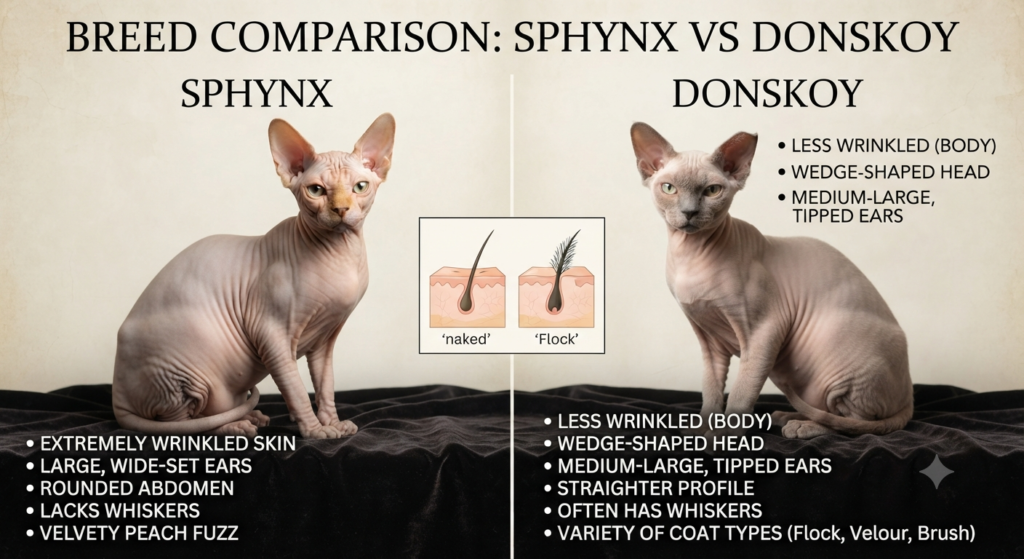
What Is a Sphynx Cat?
The Sphynx is one of the world’s most recognizable cat breeds because of its nearly hairless appearance. Despite looking completely bald, most Sphynx cats are covered with a very fine layer of soft fuzz that gives their skin a warm, suede-like texture.
The breed originated in Canada during the 1960s after a natural genetic mutation produced a hairless kitten. Selective breeding programs later established the modern Sphynx breed while maintaining its distinctive appearance and friendly temperament.
Sphynx cats are medium-sized but surprisingly heavy due to their muscular bodies. Their large ears, prominent cheekbones, wrinkled skin, and expressive eyes give them a striking appearance unlike any other domestic cat.
Beyond their unique looks, Sphynx cats are famous for their affectionate personalities. They enjoy human companionship, love attention, and often follow their owners around the house. Their energetic and curious nature makes them entertaining family pets.
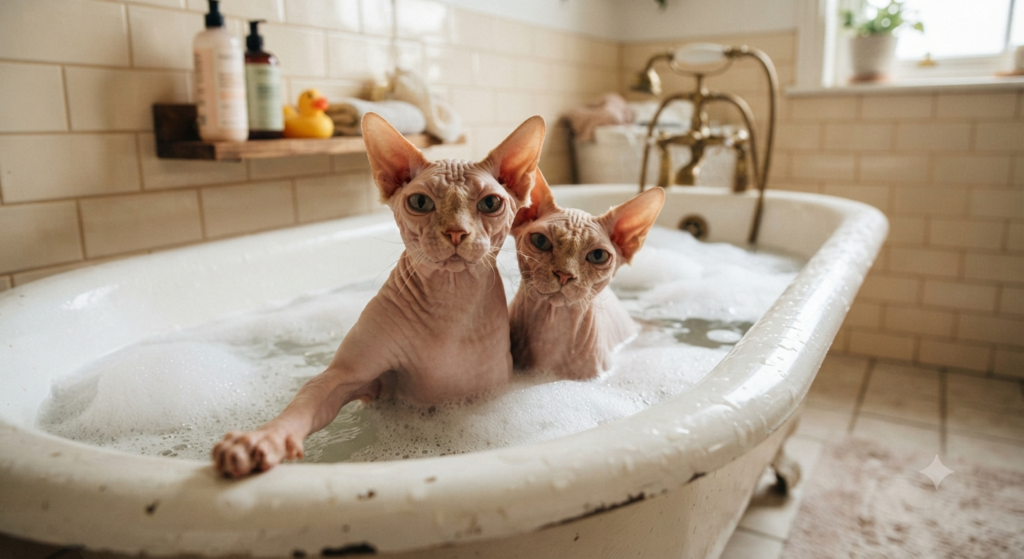
Key Characteristics of the Sphynx
- Originated in Canada through a natural genetic mutation.
- Nearly hairless with a soft, peach-like fuzz covering the skin.
- Muscular, medium-sized body that feels heavier than it appears.
- Large ears, prominent cheekbones, and expressive lemon-shaped eyes.
- Highly affectionate and enjoys constant human companionship.
- Extremely playful, energetic, and curious throughout adulthood.
- Intelligent and quick to learn routines, tricks, and interactive games.
- Gets along well with children, other cats, and cat-friendly dogs.
- Loves warm environments and often seeks cuddles or blankets.
- Produces minimal shedding but requires regular skin cleaning.
- Best suited as an indoor cat because of sensitivity to sun and cold.
- Forms deep emotional bonds and dislikes being left alone for long periods.
What Is a Donskoy Cat?
The Donskoy, also called the Don Sphynx or Russian Hairless, is another distinctive hairless cat breed. It originated in Russia during the late 1980s after a naturally occurring genetic mutation caused hair loss in a rescued kitten.
Although the Donskoy resembles the Sphynx at first glance, the two breeds are genetically unrelated. The Donskoy’s hairlessness is produced by a dominant gene, while the Sphynx’s hairlessness results from a recessive mutation.
Donskoy cats have a lean, elegant body with long legs, large ears, wrinkled skin, and expressive almond-shaped eyes. Some kittens are born with a small amount of fur that gradually disappears as they mature, while others remain completely hairless throughout life.
Known for their loyalty and affectionate nature, Donskoy cats form strong bonds with their owners. Many people describe them as having dog-like personalities because they enjoy following family members, greeting visitors, and participating in household activities.
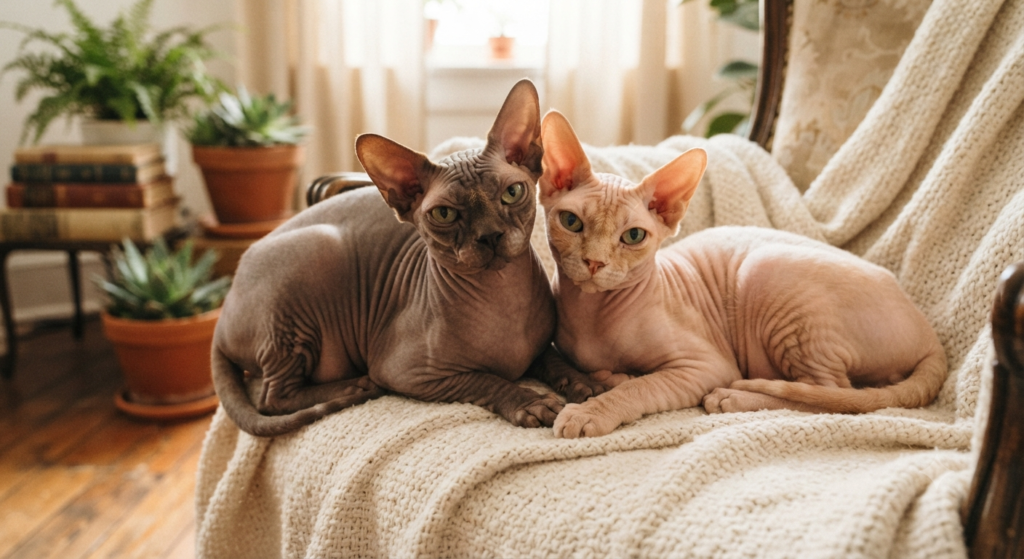
Key Characteristics of the Donskoy
- Originated in Russia from a naturally occurring dominant genetic mutation.
- Hairlessness is controlled by a dominant gene, unlike the Sphynx.
- Long, lean, athletic body with graceful movements.
- Wrinkled skin with little or no fur, although some cats retain a light coat.
- Large upright ears and expressive almond-shaped eyes.
- Highly affectionate, loyal, and deeply attached to family members.
- Intelligent, observant, and responds well to training.
- Curious, playful, and enjoys climbing and exploring.
- Friendly with children, other cats, and dogs.
- Requires regular skin care, ear cleaning, and protection from extreme temperatures.
- Adapts well to indoor living and enjoys interactive play.
- Often displays a dog-like personality by following owners and seeking attention.
Sphynx vs Donskoy: Key Differences
1. Origin
One of the easiest ways to distinguish Sphynx vs Donskoy breeds is by their origin.
The Sphynx was developed in Canada after a naturally occurring genetic mutation produced hairless kittens. Breeders carefully developed the breed through selective breeding, resulting in the modern Sphynx known today for its friendly temperament and distinctive appearance.
The Donskoy, on the other hand, originated in Russia. The breed traces its history to the city of Rostov-on-Don, where a rescued cat with unusual hair loss became the foundation of the breed. Unlike the Sphynx, the Donskoy developed from a completely different genetic mutation.
2. Appearance
Although both cats are commonly called hairless breeds, their appearance differs in several noticeable ways.
The Sphynx has a rounded, muscular body with broad shoulders, a sturdy chest, and a slightly rounded abdomen. Its skin often feels like warm suede because of the fine layer of fuzz covering the body. Prominent cheekbones, oversized ears, and large lemon-shaped eyes give the breed an alert and expressive look.
The Donskoy has a more elongated and elegant appearance. It features a lean body, long legs, a wedge-shaped face, and large almond-shaped eyes. Its skin is usually more heavily wrinkled, especially around the face, neck, legs, and tail. Some Donskoy cats may retain a small amount of soft hair depending on age and genetic type.
3. Coat and Hairlessness
Hairlessness is where these breeds appear similar, but the underlying genetics and coat characteristics are quite different.
The Sphynx usually has a thin layer of soft, velvety fuzz that covers much of its body. This fine coating helps protect the skin and gives the cat its characteristic warm, suede-like feel. Complete baldness is uncommon.
The Donskoy, in contrast, may be completely hairless, partially hairless, or born with a light coat that gradually sheds as it matures. Depending on its genetic variation, a Donskoy can display different coat types throughout its life, ranging from completely bald to a soft brush-like coat.
4. Body Structure
Body build is another reliable way to tell these breeds apart.
The Sphynx has a compact, muscular physique with a broad chest, strong shoulders, and solid bone structure. Even though it is medium-sized, it often feels heavier than expected because of its dense muscles.
The Donskoy has a slimmer, longer body with an athletic appearance. Its long limbs, elegant posture, and flexible build give it a graceful look that contrasts with the stockier frame of the Sphynx.
5. Genetics
One of the most significant differences between Sphynx vs Donskoy lies in the genetics responsible for hairlessness.
The Sphynx carries a recessive gene, meaning both parent cats must pass on the hairless gene for kittens to inherit the characteristic hairless appearance.
The Donskoy, however, possesses a dominant hairless gene. This means only one parent carrying the gene is usually sufficient for offspring to inherit the trait. Although both breeds look similar, their hairlessness evolved independently through entirely different genetic mutations.
6. Personality
Although both breeds are affectionate and people-oriented, their personalities have some noticeable differences.
The Sphynx is known for being extremely social, energetic, and playful. These cats thrive on human interaction and enjoy being the center of attention. They often greet visitors at the door, climb onto shoulders, and happily participate in family activities. Their curious nature and love of exploration make them entertaining companions.
The Donskoy, while equally affectionate, tends to be calmer and more devoted to its family. It forms deep bonds with its owners and is often described as having a dog-like personality because it enjoys following people from room to room. Donskoy cats are intelligent, gentle, and usually adapt well to children, other cats, and even dogs.
7. Intelligence
Both breeds are considered highly intelligent, but they display their intelligence in different ways.
The Sphynx is an active problem solver that enjoys interactive toys, climbing structures, and puzzle feeders. It learns routines quickly and often invents its own games, making it an excellent choice for owners who enjoy engaging with their pets.
The Donskoy is equally smart but generally more observant and responsive to training. It learns commands quickly, adapts easily to new environments, and responds well to positive reinforcement. Many owners find the Donskoy easier to train because of its eagerness to please and strong attachment to people.
8. Grooming Requirements
Despite their hairless appearance, neither breed is maintenance-free. In fact, both require regular grooming to keep their skin healthy.
The Sphynx produces natural skin oils that would normally be absorbed by fur. Since it lacks a full coat, these oils accumulate on the skin and must be removed through routine bathing. The breed also needs regular ear cleaning, nail trimming, and occasional eye cleaning to prevent oil buildup and infections.
The Donskoy has similar grooming needs because its exposed skin also accumulates oil and dirt. Depending on the individual cat’s coat type, some Donskoy cats may require slightly less frequent bathing than a Sphynx. However, routine skin care, ear cleaning, and nail maintenance remain essential for both breeds.
Grooming Tips
- Bathe every 1–3 weeks using a mild cat shampoo.
- Clean ears regularly to remove excess wax.
- Trim nails every few weeks.
- Wipe skin folds to prevent oil buildup.
- Protect the skin from excessive sunlight and cold weather.
- Use soft bedding to avoid skin irritation.
9. Health Issues
Both breeds are generally healthy, but each has certain health concerns that potential owners should understand.
The Sphynx may be predisposed to:
- Hypertrophic cardiomyopathy (HCM)
- Skin infections
- Sunburn
- Periodontal (dental) disease
- Respiratory infections in cold environments
- Excessive oil buildup on the skin
The Donskoy may experience:
- Skin irritation
- Sunburn
- Sensitivity to extreme temperatures
- Dental problems
- Skin dryness or excessive oil production
- Occasional hereditary health conditions associated with selective breeding
Routine veterinary checkups, proper nutrition, and regular skin care can significantly reduce the risk of many of these conditions.
10. Lifespan
With proper care, both breeds can enjoy long and healthy lives, although their average lifespan differs slightly.
The Sphynx typically lives between 8 and 14 years. Many individuals exceed this range when provided with high-quality nutrition, regular veterinary care, and a safe indoor environment.
The Donskoy generally has a lifespan of 12 to 15 years, and some cats live even longer with excellent care. Maintaining a healthy weight, protecting the skin, and scheduling routine health screenings contribute to a longer lifespan.
11. Climate Tolerance
Because they have little or no fur, both breeds are more sensitive to temperature changes than most domestic cats.
The Sphynx prefers warm indoor environments and can become chilled quickly in cold weather. During winter, many owners provide sweaters or heated beds to help maintain body temperature. The breed is also prone to sunburn if exposed to direct sunlight for extended periods.
The Donskoy shares many of the same sensitivities. Its exposed skin requires protection from intense sunlight, while cold weather may necessitate warm bedding or protective clothing. Keeping either breed indoors is generally recommended to minimize weather-related health risks.
12. Recognition and Popularity
Although both are unique hairless breeds, their popularity and recognition differ around the world.
The Sphynx is one of the most well-known hairless cat breeds and is recognized by major cat registries such as The International Cat Association (TICA) and the Cat Fanciers’ Association (CFA). It is widely bred and relatively easy to find through reputable breeders.
The Donskoy is less common outside Eastern Europe. While it is recognized by organizations such as TICA and the World Cat Federation (WCF), it remains a rarer breed in many countries, making it more difficult to locate and sometimes more expensive to purchase.
Similarities Between Sphynx and Donskoy
Despite their different origins and genetic backgrounds, Sphynx and Donskoy cats share several characteristics that make them popular among cat enthusiasts. Both breeds are affectionate, intelligent, and require specialized care because of their hairless or nearly hairless appearance.
Some of their major similarities between Sphynx vs Donskoy include:
- Both are considered hairless cat breeds.
- Both have medium-sized, muscular bodies.
- Both possess large ears and expressive eyes.
- Both display wrinkled skin, especially around the face and neck.
- Both are highly social and people-oriented.
- Both enjoy attention and close interaction with their owners.
- Both are intelligent and quick learners.
- Both require regular skin cleaning due to oil buildup.
- Both are sensitive to cold weather and direct sunlight.
- Both thrive as indoor pets with proper care.
Sphynx vs Donskoy: Which Breed Is Better?
Choosing between these two remarkable breeds depends largely on your lifestyle, experience with pets, and personal preferences.
The Sphynx is an excellent choice for owners seeking an energetic, playful, and highly social companion. Its outgoing personality makes it ideal for active households where someone is usually home to provide attention and interaction.
The Donskoy, on the other hand, is better suited for people looking for a loyal, intelligent, and slightly calmer companion. Its affectionate and gentle nature makes it a wonderful pet for families, seniors, and multi-pet households.
Neither breed is universally better than the other. The right choice depends on whether you prefer the lively, entertaining personality of the Sphynx or the devoted, dog-like companionship of the Donskoy.
Conclusion
When comparing Sphynx vs Donskoy, both breeds stand out for their distinctive hairless appearance, affectionate personalities, and strong bonds with their owners. However, they differ in several important ways. The Sphynx originated in Canada and has a muscular, compact body with hairlessness caused by a recessive gene, while the Donskoy originated in Russia and features a leaner body with hairlessness resulting from a dominant gene. They also vary in appearance, grooming requirements, temperament, health considerations, and genetic background.
If you prefer an energetic, playful, and highly social cat that loves constant interaction, the Sphynx is an excellent choice. If you’re looking for a loyal, intelligent, and calm companion with a dog-like personality, the Donskoy may be the better fit. Understanding these differences will help you select the breed that best matches your lifestyle and ensure you can provide the specialized care these remarkable cats require.
Frequently Asked Questions (FAQs)
No. Although both are hairless cats, they are separate breeds with different origins and different genetic mutations responsible for their hairlessness.
The Sphynx was developed in Canada during the 1960s, while the Donskoy originated in Russia in the late 1980s.
Hairlessness results from natural genetic mutations, but the mutations are different. The Sphynx has a recessive gene, whereas the Donskoy carries a dominant gene.
Both breeds are highly affectionate. The Sphynx is generally more playful and outgoing, while the Donskoy is often considered more loyal and deeply attached to its family.
No. Although they shed very little, both breeds still produce allergens in their saliva and skin oils, so they are not completely hypoallergenic.
Reference:
1. “Sphynx Cat Breed Information and Personality Traits.” Hill’s Pet
2. “Donskoy: Cat Breed Profile, Characteristics & Care.” The Spruce Pets.
Read Next: