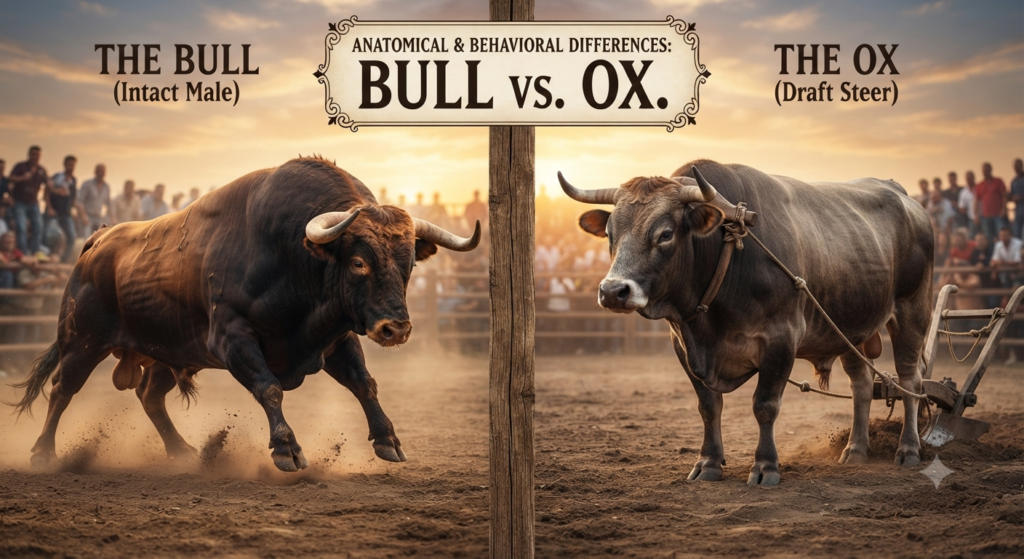
The main difference between Ox vs. Bull is that an ox is a castrated male cattle trained for work, while a bull is an uncastrated male cattle primarily used for breeding. Although both belong to the same species (Bos taurus), they differ in physical characteristics, temperament, purpose, training, and behavior.
Many people use the terms interchangeably because oxen and bulls look similar at first glance. However, understanding their differences is important for farming, animal husbandry, livestock management, and agriculture. In this guide, you’ll learn everything about Ox vs. Bull, including their characteristics, uses, similarities, differences, and which one is better suited for different purposes.
Ox vs. Bull: Comparison Table
The table below highlights the major differences between Ox and Bull.
| Feature | Ox | Bull |
|---|---|---|
| Definition | Castrated male cattle trained for work | Intact (uncastrated) male cattle |
| Scientific Name | Bos taurus | Bos taurus |
| Reproductive Ability | Cannot reproduce | Used for breeding |
| Castration | Yes | No |
| Primary Purpose | Farm work and transportation | Breeding and genetics |
| Temperament | Calm and obedient | Aggressive and territorial |
| Training | Specially trained for labor | Generally not trained for draft work |
| Strength | Excellent endurance | Greater raw muscle power |
| Hormone Levels | Lower testosterone | High testosterone |
| Behavior | Easy to handle | Requires experienced handlers |
| Lifespan Role | Working animal | Breeding animal |
| Common Uses | Plowing, hauling carts, logging | Natural breeding, herd improvement |
What Is an Ox?
An ox is a castrated adult male cattle that has been trained to perform heavy work. Oxen have served humans for thousands of years by pulling plows, wagons, carts, and timber. Castration reduces aggressive behavior, making them calmer, easier to train, and more reliable for demanding agricultural tasks.
Unlike bulls, oxen are selected for their patience, endurance, and ability to work long hours rather than reproductive capabilities.
Key Characteristics of an Ox
- Castrated adult male cattle
- Trained for farm and draft work
- Calm and gentle temperament
- Highly obedient
- Excellent endurance
- Strong pulling ability
- Works in pairs or teams
- Used in agriculture and forestry
- Lower testosterone levels
- Easier to manage than bulls
What Is a Bull?
A bull is an adult male cattle that has not been castrated. Bulls are mainly raised for breeding because they retain their reproductive ability. Their naturally high testosterone levels make them larger, stronger, and more muscular than many other cattle, but also more aggressive.
Bulls play a vital role in improving herd genetics and producing healthy offspring in both dairy and beef farming.
Key Characteristics of a Bull
- Intact adult male cattle
- Used primarily for breeding
- High testosterone levels
- Muscular body
- Larger neck and shoulders
- Strong territorial instincts
- More aggressive behavior
- Essential for herd reproduction
- Requires careful handling
- Valuable in livestock breeding programs
Ox vs. Bull: Key Differences
1. Reproductive Status
The biggest difference in Ox vs. Bull is their reproductive status.
A bull is an intact (uncastrated) male cattle that remains sexually mature and capable of breeding throughout its adult life. Bulls are specifically kept for reproduction and play an essential role in improving herd genetics and producing healthy offspring.
An ox, on the other hand, is a castrated male cattle. Because of castration, an ox loses its reproductive ability and cannot breed. Instead of being used for reproduction, oxen are trained for farm work, transportation, and other heavy labor, where their calm temperament and endurance make them highly valuable.
2. Purpose
The primary purpose of an ox and a bull is completely different, even though they belong to the same species.
An ox is trained to perform heavy physical work such as plowing fields, pulling carts and wagons, transporting goods, hauling timber, and other agricultural tasks. Its calm temperament and exceptional endurance make it an ideal draft animal for long hours of labor.
A bull, in contrast, is primarily raised for breeding. Bulls are selected for their superior genetics and reproductive ability to improve the quality of beef and dairy herds. They are rarely used for farm labor because their natural aggression and high testosterone levels make them more difficult to train and handle.
- Ox: Farm work, transportation, and draft labor
- Bull: Breeding, herd improvement, and reproduction
3. Temperament
One of the most noticeable differences in Ox vs. Bull is their temperament.
An ox is generally calm, patient, and easy to handle. Since it has been castrated, its testosterone levels are significantly lower, making it more obedient and responsive to training. This gentle nature allows oxen to work safely alongside farmers for long hours.
A bull, on the other hand, has high testosterone levels that contribute to its dominant and territorial behavior. Bulls can be unpredictable and aggressive, particularly during the breeding season or when they perceive a threat. For this reason, they require experienced handlers and secure enclosures to ensure safety.
- Ox: Calm, obedient, and easy to train
- Bull: Aggressive, territorial, and more difficult to handle
Oxen are known for their calm nature.
4. Physical Appearance
Although both oxen and bulls are large, muscular cattle, they have several noticeable physical differences due to their reproductive status and hormone levels.
A bull typically has a thicker neck, broader chest, larger shoulders, and heavier muscle development because of its high testosterone levels. These features give bulls a powerful and imposing appearance, which is important for breeding and dominance within the herd.
An ox, on the other hand, generally has a slightly leaner neck and less pronounced muscle mass. However, because castration delays the closure of growth plates, oxen often continue growing for a longer period and may become taller or larger than bulls of the same breed. Their bodies are built for endurance and sustained pulling power rather than aggression or dominance, making them ideal for heavy farm work.
5. Training
Another important difference in Ox vs. Bull is the level of training they receive.
An ox is carefully trained from a young age to perform heavy agricultural work. Through consistent handling, oxen learn to respond to voice commands, hand signals, and the guidance of their handler. They are often trained to work in pairs, allowing them to pull plows, wagons, carts, and other heavy loads efficiently over long distances. Their calm temperament and willingness to cooperate make them excellent draft animals.
A bull, in contrast, is rarely trained for labor because its primary role is breeding. Due to its high testosterone levels and more aggressive nature, a bull is generally more difficult to train and control. Instead, farmers focus on maintaining the bull’s health and reproductive performance rather than teaching it to perform work.
Ox Training:
- Trained from a young age
- Learns voice commands and hand signals
- Works efficiently in pairs
- Performs farm and transportation tasks
Bull Training:
- Rarely trained for draft work
- Primarily managed for breeding
- Requires experienced handling due to its aggressive nature
6. Strength
Many people assume that a bull is stronger than an ox because of its muscular build and aggressive nature. While bulls do possess greater raw muscle power, strength depends on the type of work being performed.
A bull is capable of generating greater explosive power and short bursts of force, making it well-suited for activities that require speed, dominance, and breeding-related behavior. Its high testosterone levels contribute to its muscular physique and powerful appearance.
An ox, however, is specifically trained for sustained physical labor. Although it may not match a bull’s explosive strength, it has exceptional endurance, steady pulling power, and the ability to work for long hours without tiring quickly. These qualities make oxen the preferred choice for plowing fields, hauling heavy loads, logging, and other demanding agricultural tasks.
For continuous heavy work, an ox often outperforms a bull because of its patience, stamina, and ability to maintain consistent pulling force over extended periods.
Bull Strength:
- Greater explosive muscle power
- Stronger for short bursts of force
- Built for dominance and breeding
Ox Strength:
- Superior pulling strength
- Excellent endurance and stamina
- Better suited for long-duration farm work and heavy hauling
7. Behavior Around Humans
Another major difference in Ox vs. Bull is how they interact with people.
An ox is generally calm, cooperative, and comfortable working alongside farmers and handlers. Because it has been castrated and trained from a young age, it is less likely to display aggressive behavior. Oxen readily follow commands and can safely perform daily farm tasks such as plowing, hauling, and transportation under human supervision.
A bull, on the other hand, can be unpredictable and more difficult to manage. Its high testosterone levels and strong territorial instincts may cause aggressive behavior, especially around unfamiliar people, other bulls, or during the breeding season. Even well-managed bulls can react suddenly if they feel threatened or challenged.
For safety reasons, bulls require secure fencing, proper restraint systems, and experienced livestock handlers who understand their behavior. Extra caution is always recommended when working around breeding bulls.
Ox Behavior:
- Calm and cooperative with humans
- Easy to handle and train
- Works safely alongside farmers
- Responds well to commands
Bull Behavior:
- Can be unpredictable and territorial
- More likely to display aggressive behavior
- Requires strong fencing and secure enclosures
- Best handled by experienced livestock professionals
8. Hormone Levels
Hormone levels play a significant role in the differences between Ox vs. Bull, influencing their behavior, physical development, and overall temperament.
An ox has been castrated, which greatly reduces its testosterone production. Lower testosterone levels make oxen calmer, less aggressive, and easier to train. As a result, they become more obedient and are well-suited for farm work that requires patience, consistency, and close interaction with humans.
A bull, in contrast, retains naturally high testosterone levels throughout adulthood. This hormone promotes greater muscle development, reproductive ability, and dominant behavior. However, it also makes bulls more competitive, territorial, and prone to aggression, especially during the breeding season or when challenged by other animals.
Ox
- Low testosterone levels
- Calm and gentle temperament
- Less aggressive
- Easier to train and handle
- Ideal for farm labor and draft work
Bull
- High testosterone levels
- Strong reproductive drive
- Competitive and dominant behavior
- More territorial and aggressive
- Primarily used for breeding and herd improvement
9. Agricultural Uses
Ox Uses
Oxen have been used in agriculture for centuries because of their strength, endurance, and ability to perform steady physical work. Their calm nature makes them suitable for various farm and rural activities.
- Plowing fields and preparing soil for cultivation
- Pulling carts, wagons, and agricultural equipment
- Transporting crops, grains, and farm materials
- Carrying heavy loads over long distances
- Forestry work such as moving timber and logs
- Logging operations in areas with limited machinery access
- Traditional farming practices in rural regions
- Supporting small-scale farming where tractors are unavailable
Bull Uses
Bulls are mainly valued for their reproductive role in livestock management. Their primary purpose is to improve and maintain cattle populations through breeding.
- Natural breeding with cows and heifers
- Use in artificial insemination programs for genetic improvement
- Improving cattle genetics through selective breeding
- Producing stronger and healthier offspring
- Supporting beef cattle production
- Maintaining desirable traits in cattle herds
- Breeding programs for dairy herd improvement
- Developing cattle breeds with better growth, milk, or disease resistance characteristics
10. Lifespan Role
Throughout their life, oxen and bulls generally serve different purposes based on their training, physical characteristics, and reproductive status.
Ox Role Throughout Life
An ox is primarily a working animal. After training, it continues to support agricultural and transport activities for many years.
- Remains a draft and farm work animal throughout its productive life
- Used for plowing fields and pulling heavy loads
- Provides steady labor due to its calm temperament and endurance
- Continues working until age, health, or physical ability limits its performance
- Often valued as a long-term agricultural partner
Bull Role Throughout Life
A bull is mainly maintained as a breeding animal unless its role changes due to management decisions.
- Remains a breeding animal for producing offspring
- Used for maintaining and improving cattle genetics
- May be retired when fertility or performance decreases
- Can be castrated later and used for work or other purposes in some farming systems
- Usually managed separately because of its strength, hormones, and territorial behavior
Similarities Between Ox and Bull
Despite their differences, oxen and bulls share several characteristics because they belong to the same cattle species.
- Both are male cattle.
- Both belong to Bos taurus.
- Both have horns in many breeds.
- Both are herbivores.
- Both chew cud (ruminants).
- Both have cloven hooves.
- Both possess four-chambered stomachs.
- Both are raised on farms worldwide.
- Both contribute to agriculture.
- Both can weigh over 1,000 pounds depending on breed.
Ox vs. Bull: Which One Is Better?
The better choice depends entirely on your purpose.
Choose an ox if you need:
- A reliable working animal
- Farm labor
- Pulling heavy equipment
- Calm behavior
- Easy handling
Choose a bull if you need:
- Breeding livestock
- Genetic improvement
- Beef production
- Dairy herd reproduction
- Strong offspring
Neither is universally better. They simply serve different roles in livestock farming.
Conclusion
Understanding Ox vs. Bull is straightforward once you know their primary roles. An ox is a castrated male cattle trained for heavy agricultural work, valued for its calm temperament, endurance, and reliability. A bull, on the other hand, is an intact male cattle raised primarily for breeding, known for its muscular build, strength, and reproductive capabilities.
While both belong to the same species and share many physical characteristics, their behavior, purpose, training, and usefulness on the farm are entirely different. If your goal is farm labor and transportation, an ox is the ideal choice. If you need to improve herd genetics or maintain livestock reproduction, a bull is indispensable. Knowing these differences helps farmers, students, and animal enthusiasts better understand cattle management and livestock production.
Frequently Asked Questions (FAQs)
No. A bull becomes an ox only after being castrated and trained for work.
No. Oxen are castrated and cannot breed.
Castration significantly lowers testosterone levels, reducing aggression and making oxen easier to train.
Bulls have greater raw muscular power, while oxen have superior endurance and pulling ability for sustained work.
Bulls are naturally territorial and have high testosterone levels, making them more likely to display aggressive behavior than oxen.
Read Next: