The main difference between Deer vs. Gazelles is that deer belong to the family Cervidae and usually have antlers that are shed and regrown each year, whereas gazelles belong to the family Bovidae and have permanent horns that remain throughout life. Although both are graceful herbivorous mammals, they differ in their appearance, habitat, speed, behavior, diet, social structure, and adaptations for survival.
If you’re wondering whether a deer and a gazelle are the same animal, this detailed comparison will help you understand the major differences and similarities between them.
Deer vs. Gazelles: Comparison Table
The table below highlights the major differences between Deer and Gazelles.
| Feature | Deer | Gazelles |
|---|---|---|
| Scientific Family | Cervidae | Bovidae |
| Order | Artiodactyla | Artiodactyla |
| Distribution | North America, Europe, Asia, South America, Africa | Africa and parts of Asia |
| Habitat | Forests, woodlands, mountains, grasslands | Grasslands, savannas, semi-deserts |
| Body Size | Medium to very large | Small to medium |
| Head Ornament | Antlers (mostly males) | Permanent horns (both sexes in many species) |
| Speed | Up to 48 km/h (30 mph) to 72 km/h (45 mph) depending on species | Up to 97 km/h (60 mph) or more |
| Diet | Leaves, shoots, grasses, fruits, bark | Mainly grasses, herbs, shrubs |
| Social Behavior | Solitary or small herds | Often large herds |
| Lifespan | 10–20 years (species dependent) | 10–15 years |
| Main Defense | Camouflage, jumping, antlers, running | Exceptional speed, agility, herd vigilance |
| Conservation Status | Varies by species | Varies by species |
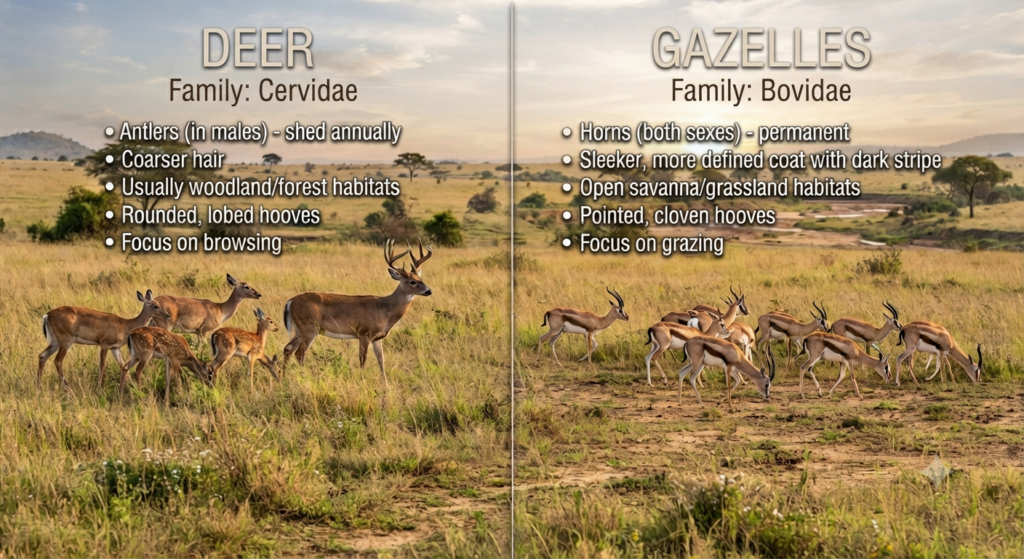
What Is a Deer?
A deer is a hoofed herbivorous mammal belonging to the Cervidae family. There are more than 50 species of deer, including white-tailed deer, red deer, elk, moose, and sambar deer.
One of the most distinctive features of deer is their antlers, which are typically found only in males (except reindeer, where females also grow antlers). These antlers are made of bone and are shed and regrown every year.
Deer inhabit a wide range of environments, from dense forests and mountains to grasslands and wetlands. Their adaptability has allowed them to spread across much of the world.
Key Characteristics of Deer
- Belong to the Cervidae family.
- Found across North America, Europe, Asia, South America, and Africa.
- Most males grow antlers annually.
- Medium to large body size depending on species.
- Herbivorous browsers and grazers.
- Excellent hearing and sense of smell.
- Can leap long distances while escaping predators.
- Live alone or in small groups.
- Adapt well to forests and wooded habitats.
- Many species migrate seasonally.
What Is a Gazelle?
A gazelle is a fast-running antelope belonging to the Bovidae family. Several gazelle species inhabit Africa and parts of Asia, including Thomson’s gazelle, Grant’s gazelle, and Dorcas gazelle.
Gazelles are famous for their incredible speed, agility, and endurance, allowing them to escape predators such as cheetahs, lions, leopards, and wild dogs.
Unlike deer, gazelles possess permanent horns made of keratin over a bony core. These horns are not shed and remain throughout life.
Gazelles thrive in open habitats where speed is their primary defense.
Key Characteristics of Gazelles
- Belong to the Bovidae family.
- Native mainly to Africa and western Asia.
- Possess permanent horns.
- Slim, lightweight body.
- Extremely fast runners.
- Prefer open grasslands and savannas.
- Live in large social herds.
- Primarily graze on grasses.
- Excellent eyesight for detecting predators.
- Capable of high leaps known as stotting or pronking.
Deer vs. Gazelles: Key Differences
1. Scientific Classification
The biggest distinction between Deer vs. Gazelles lies in their biological classification. Although both are even-toed hoofed mammals belonging to the order Artiodactyla, they belong to different animal families and have evolved along separate evolutionary paths.
Deer belong to the Cervidae family, while gazelles belong to the Bovidae family alongside antelopes, goats, sheep, and cattle. This difference in classification explains many of their unique features, including antlers versus horns, body structure, behavior, and habitat preferences.
While they may appear similar at first glance, deer and gazelles possess distinct anatomical characteristics and adaptations that enable them to thrive in different environments.
2. Physical Appearance
Although both animals have graceful, slender bodies, there are several noticeable differences in their physical appearance. Their body shape, size, and head features have evolved to suit their respective habitats and lifestyles.
Deer generally have:
- Larger and heavier bodies
- Longer necks
- Broad chests and sturdy frames
- Short tails
- Seasonal antlers in most males
- Strong, muscular legs for running and jumping
Gazelles typically have:
- Smaller, lightweight bodies
- Long, slender legs
- Narrow faces with large eyes
- Permanent, curved horns
- Distinct facial stripes in many species
- Lean, aerodynamic build designed for speed
Overall, gazelles appear specially built for high-speed running across open grasslands, whereas deer have a stronger, more robust body that allows them to move efficiently through forests, mountains, and varied terrains.
3. Antlers vs. Horns
One of the easiest and most reliable ways to distinguish Deer vs. Gazelles is by examining the structures on their heads. While they may look similar from a distance, deer have antlers, whereas gazelles have horns, and these structures differ in composition, growth, and function.
Deer are characterized by antlers that:
- Are made entirely of bone.
- Grow and are shed every year.
- Regrow annually, often becoming larger and more branched with age.
- Are found primarily in males (except species such as reindeer, where females also have antlers).
- Are mainly used during the breeding season for fighting rivals and attracting mates.
Gazelles possess permanent horns that:
- Have a bony core covered with a keratin sheath.
- Remain throughout the animal’s life and are never shed.
- Are usually present in both males and females, although female horns are often smaller.
- Are generally slender, ringed, and gracefully curved.
- Serve as defensive weapons and are also used in territorial and mating competitions.
This difference between antlers and horns is one of the defining characteristics of Deer vs. Gazelles and is often the quickest way to identify which animal you are observing.
4. Habitat
Habitat is another major difference between Deer vs. Gazelles. While both animals are adaptable herbivores, they thrive in different environments based on their survival strategies.
Deer are highly adaptable and can live in a wide variety of habitats, including:
- Forests
- Mountains
- Wetlands
- Grasslands
- Temperate woodlands
Gazelles are primarily found in open landscapes such as:
- Savannas
- Open plains
- Dry grasslands
- Semi-deserts
Unlike deer, gazelles generally avoid dense forests because open terrain allows them to spot predators from a distance and use their exceptional speed to escape quickly.
5. Body Size
Body size is another noticeable difference between Deer vs. Gazelles. In general, deer are larger and heavier, while gazelles are smaller, lighter, and more streamlined.
Some deer species, such as moose and elk, can weigh several hundred kilograms, making them among the largest members of the deer family. Even medium-sized deer are typically bulkier than most gazelles.
Gazelles, on the other hand, have lightweight, slender bodies that help them accelerate quickly and maintain high speeds over long distances. Their smaller size and agile build are key adaptations for escaping predators in open grasslands and savannas.
6. Speed
Speed is one of the most significant differences between Deer vs. Gazelles. While both animals are fast runners, gazelles are among the fastest land mammals and are specially adapted for life in open grasslands.
Deer can run at speeds of approximately 48–72 km/h (30–45 mph), depending on the species. They are also excellent jumpers, using their powerful hind legs to leap over fences, fallen trees, and other obstacles while escaping predators.
Gazelles can reach speeds of up to 97 km/h (60 mph) and maintain high speeds over longer distances. They also perform rapid zigzag movements and high leaps to confuse predators such as cheetahs and lions.
Although both animals rely on speed for survival, gazelles have the advantage in terms of top speed, endurance, and agility in open habitats.
Speed is one of the greatest strengths of gazelles.
7. Diet
Both deer and gazelles are herbivores, but their feeding habits differ based on their habitats and the food available to them.
Deer are mainly browsers and feed on a wide variety of plant materials, including:
- Leaves
- Twigs
- Fruits
- Bark
- Grass
- Shrubs
This varied diet allows deer to adapt to forests, woodlands, and other habitats with diverse vegetation.
Gazelles, in contrast, are primarily grazers and feed on:
- Grasses
- Herbs
- Small shrubs
- Young shoots
Many gazelle species obtain most of the moisture they need from the plants they eat, enabling them to survive in dry grasslands and semi-desert environments where water sources may be limited.
8. Social Behavior
The social behavior of Deer vs. Gazelles differs considerably. While both animals may form groups, the size and structure of these groups vary depending on the species and habitat.
Deer are often solitary, especially adult males outside the breeding season. Females usually live in small family groups with their young, while males may form temporary bachelor groups or remain alone for much of the year.
Gazelles are highly social animals that typically live in herds. Depending on the species and season, herd sizes can range from a few individuals to several hundred animals. Living in groups improves predator detection, provides greater protection, and increases the chances of survival in open habitats.
9. Defense Mechanisms
Both Deer vs. Gazelles have evolved effective defense mechanisms, but they use different strategies to avoid predators and survive in their natural habitats.
Deer rely on a combination of physical strength and concealment, using:
- Camouflage to blend into forests and woodlands
- Powerful kicks to defend themselves
- Antlers for fighting rivals and, in some cases, deterring predators
- Long-distance jumping to clear obstacles
- Fast running to escape danger
Gazelles depend primarily on speed and agility, using:
- Exceptional running speed
- Sudden sharp turns while sprinting
- High jumping, known as stotting or pronking, to confuse predators
- Herd vigilance, where many eyes help detect threats early
Overall, gazelles rely mainly on their remarkable speed and quick maneuvers, while deer combine speed, camouflage, jumping ability, and defensive antlers to increase their chances of survival.
10. Reproduction
The reproductive behavior of Deer vs. Gazelles differs in terms of mating strategies and breeding seasons, although both mammals give birth to live young.
During the breeding season, male deer compete fiercely for access to females by using their antlers in dramatic displays and physical battles. The strongest males usually earn the opportunity to mate.
Male gazelles establish and defend territories using their permanent horns. They challenge rival males through displays and fights to secure breeding rights within their territory.
Both deer and gazelles typically give birth to a single offspring, although twins may occasionally occur in some species. The mothers carefully protect and nurse their young until they are strong enough to move with the herd or survive independently.
11. Lifespan
The average lifespan of Deer vs. Gazelles varies depending on the species, habitat, availability of food, and the presence of predators.
Deer generally live between 10 and 20 years, although larger species and those living in protected environments may live even longer. Their lifespan is influenced by factors such as disease, hunting, habitat quality, and predation.
Gazelles typically have a lifespan of 10 to 15 years in the wild. Because they inhabit regions with numerous predators, many individuals do not reach their maximum lifespan. However, gazelles living in protected reserves or captivity often survive longer.
For both deer and gazelles, factors such as predation, habitat conditions, food availability, climate, and human activities play a significant role in determining their longevity.
12. Geographic Distribution
Another important difference between Deer vs. Gazelles is their geographic distribution. Deer are found across a much wider range of the world, while gazelles are mainly confined to Africa and parts of Asia.
Deer are distributed across:
- North America
- Europe
- Asia
- South America
- Africa
They inhabit a variety of ecosystems, including forests, grasslands, mountains, and wetlands, making them one of the most widespread groups of hoofed mammals.
Gazelles are primarily found in:
- Africa
- The Middle East
- Parts of Central and Western Asia
Most gazelle species prefer open grasslands, savannas, and semi-arid regions, where their speed and agility provide an effective defense against predators.
13. Adaptations
Both Deer vs. Gazelles have evolved remarkable adaptations that help them survive in their respective environments. While deer are well suited to forests and woodlands, gazelles are specially adapted for life in open grasslands and semi-arid regions.
Deer have several adaptations that enhance their survival, including:
- Seasonal antler growth for mating displays and competition
- Camouflage coloring that helps them blend into forests
- A strong sense of smell to detect predators
- Excellent hearing for early warning of danger
- Powerful hind legs for fast running and high jumping
Gazelles possess adaptations that make them highly effective at escaping predators, such as:
- A lightweight skeleton for greater speed
- Long, efficient legs designed for rapid running
- Exceptional endurance during long chases
- Large eyes that provide excellent vision for detecting threats
- The ability to survive with limited water by obtaining moisture from vegetation
These specialized adaptations allow each animal to thrive in its preferred habitat and improve its chances of survival in the wild.
Similarities Between Deer and Gazelles
Although Deer vs. Gazelles have many differences, they also share several characteristics because both are even-toed hoofed mammals adapted for life on land.
Some of their major similarities include:
- Both are herbivorous mammals.
- Both belong to the order Artiodactyla (even-toed ungulates).
- Both have four-chambered stomachs and chew cud (ruminants).
- Both possess cloven hooves that help them move across different terrains.
- Both rely on speed and agility to escape predators.
- Both have excellent eyesight, hearing, and sense of smell.
- Both give birth to live young and nurse them with milk.
- Both are prey animals for large carnivores.
- Both play an important role in maintaining healthy ecosystems through grazing and browsing.
- Both communicate using body language, sounds, and scent markings.
Deer vs. Gazelles: Which Animal Is Better Adapted?
Choosing whether a deer or a gazelle is “better” depends entirely on the environment in which it lives.
Deer are better adapted to forests, mountains, and woodlands. Their camouflage, strong legs, and ability to browse a wide variety of plants allow them to survive in habitats with dense vegetation. Antlers also provide an advantage during breeding competitions and territorial disputes.
Gazelles, on the other hand, are specialists of open grasslands and savannas. Their lightweight bodies, exceptional speed, sharp eyesight, and ability to detect predators from long distances make them perfectly suited to open landscapes where hiding places are scarce.
Neither animal is universally superior. Each has evolved unique adaptations that maximize survival in its natural habitat.
Conclusion
When comparing Deer vs. Gazelles, both animals are elegant herbivorous mammals, but they differ in several important ways. Deer belong to the Cervidae family and are recognized by their seasonal antlers, larger bodies, and ability to live in forests, mountains, and grasslands. Gazelles belong to the Bovidae family and are known for their permanent horns, slender build, remarkable speed, and preference for open savannas and grasslands.
While deer rely on camouflage, jumping ability, and antlers for survival, gazelles depend mainly on extraordinary speed, agility, and herd behavior to escape predators. Understanding these differences makes it easier to appreciate how each species has evolved to thrive in its own environment.
Frequently Asked Questions (FAQs)
The main difference is that deer belong to the Cervidae family and grow antlers that are shed annually, while gazelles belong to the Bovidae family and have permanent horns that remain throughout life.
No. Gazelles are not deer. They are antelopes belonging to the Bovidae family, whereas deer belong to the Cervidae family.
Gazelles are generally faster. Many species can reach speeds of up to 97 km/h (60 mph), while most deer species run between 48–72 km/h (30–45 mph).
No. Deer usually have antlers, while gazelles have permanent horns. Antlers are shed and regrown each year, whereas horns remain for life.
Deer are found across North America, Europe, Asia, South America, and parts of Africa in forests, mountains, and grasslands. Gazelles mainly inhabit the grasslands, savannas, and semi-deserts of Africa and parts of Asia.
Read Next: