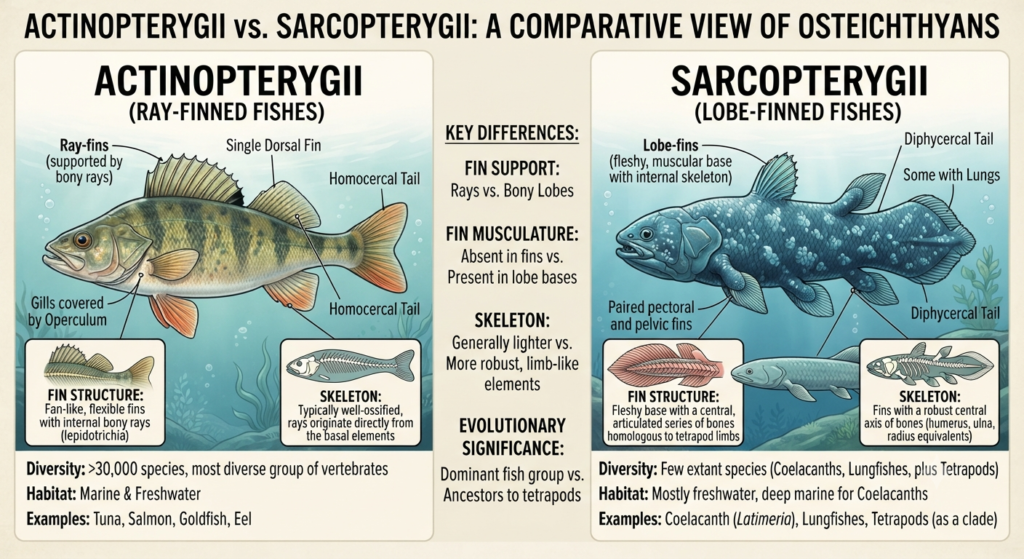
The main difference between Actinopterygii vs. Sarcopterygii is that Actinopterygii (ray-finned fishes) have fins supported by thin, flexible bony rays, whereas Sarcopterygii (lobe-finned fishes) possess fleshy, muscular fins with internal bones. Actinopterygii comprise over 99% of all living fish species and inhabit nearly every aquatic environment. In contrast, Sarcopterygii include only a few surviving species, such as lungfish and coelacanths, but they are evolutionarily significant because they gave rise to tetrapods, including amphibians, reptiles, birds, and mammals.
Understanding Actinopterygii vs. Sarcopterygii is important for biology students, zoologists, and evolutionary scientists because these two classes represent distinct evolutionary pathways of bony fishes. Their differences in fin structure, respiration, skeletal anatomy, habitat, and evolution illustrate how vertebrates adapted to diverse aquatic and terrestrial environments.
Actinopterygii vs. Sarcopterygii Comparison Table
The table below highlights the major differences between Actinopterygii vs. Sarcopterygii.
| Feature | Actinopterygii | Sarcopterygii |
|---|---|---|
| Common Name | Ray-finned fishes | Lobe-finned fishes |
| Scientific Class | Actinopterygii | Sarcopterygii |
| Fin Structure | Thin fins supported by bony rays | Fleshy, muscular fins supported by bones |
| Number of Living Species | Over 34,000 | Only a few living species |
| Skeleton | Mostly lightweight bony skeleton | Robust bony skeleton |
| Respiration | Primarily through gills | Gills; lungfish also possess functional lungs |
| Swim Bladder | Usually present | Usually absent or modified into lungs in some species |
| Habitat | Freshwater and marine | Mainly freshwater; coelacanths inhabit deep marine waters |
| Evolutionary Importance | Dominant modern fish group | Ancestors of tetrapods |
| Locomotion | Fast and flexible swimming | Strong fin movement and bottom walking |
| Representative Species | Salmon, tuna, goldfish, carp | Lungfish, coelacanth |
| Evolutionary Success | Extremely high | Limited modern diversity but great evolutionary significance |
What Is Actinopterygii?
Actinopterygii is the largest class of bony fishes and is commonly known as ray-finned fishes. Their defining feature is the presence of fins supported by numerous thin, flexible bony rays rather than fleshy lobes. This fin structure allows efficient swimming, rapid maneuverability, and adaptation to virtually every aquatic habitat.
Actinopterygii include more than 34,000 living species, making them the most diverse group of vertebrates on Earth. They inhabit freshwater rivers, lakes, estuaries, coral reefs, and the open ocean. Familiar fishes such as salmon, trout, tuna, cod, catfish, goldfish, and carp all belong to this class.
Most ray-finned fishes possess a swim bladder that helps regulate buoyancy, enabling them to remain suspended in water with minimal energy expenditure. Their remarkable adaptability has allowed them to dominate aquatic ecosystems worldwide.
Characteristics of Actinopterygii
- Commonly known as ray-finned fishes.
- Fins are supported by thin bony rays.
- Largest class of vertebrates.
- More than 34,000 living species.
- Found in freshwater and marine habitats.
- Usually possess a swim bladder.
- Primarily breathe through gills.
- Lightweight bony skeleton.
- Excellent swimmers with high maneuverability.
- Represent over 99% of living fish species.
What Is Sarcopterygii?
Sarcopterygii is the class of lobe-finned fishes, distinguished by paired fins that are fleshy, muscular, and supported by internal bones. These fins resemble the basic limb structure of terrestrial vertebrates and are considered a crucial evolutionary step toward the development of limbs.
Only a few living representatives of Sarcopterygii remain today, including lungfish and coelacanths. Despite their low diversity, they hold enormous evolutionary importance because scientists recognize this group as the ancestral lineage from which tetrapods evolved.
Lungfish possess functional lungs in addition to gills, allowing them to survive in oxygen-poor waters and even breathe atmospheric air. Coelacanths inhabit deep marine environments and are often referred to as “living fossils” because they have changed relatively little over millions of years.
Characteristics of Sarcopterygii
- Commonly known as lobe-finned fishes.
- Possess fleshy, muscular paired fins.
- Fins contain internal bones similar to early limbs.
- Include lungfish and coelacanths.
- Evolutionary ancestors of tetrapods.
- Lungfish can breathe atmospheric air.
- Generally have heavier skeletons.
- Mostly inhabit freshwater environments.
- Much less diverse than Actinopterygii.
- Extremely important in vertebrate evolution.
Actinopterygii vs. Sarcopterygii: Key Differences
1. Fin Structure
The most significant difference between Actinopterygii vs. Sarcopterygii lies in the structure of their fins.
Actinopterygii possess ray fins supported by numerous thin, flexible bony rays called lepidotrichia. These fins provide excellent flexibility and precise swimming control.
Sarcopterygii, on the other hand, have fleshy, muscular fins supported by strong internal bones. These lobed fins resemble the basic limb structure of early terrestrial vertebrates.
2. Internal Skeleton of Fins
The internal anatomy of the fins differs considerably.
In Actinopterygii, the fins contain numerous slender rays with relatively little muscle extending into the fin.
In Sarcopterygii, the paired fins contain large muscles and bones extending deep into the fin, making them stronger and more suitable for weight-bearing movements.
This structural difference played a key role in vertebrate evolution.
3. Number of Living Species
Another important difference between Actinopterygii vs. Sarcopterygii is species diversity.
Actinopterygii are the most diverse vertebrate group, with more than 34,000 living species.
Sarcopterygii have only a few surviving fish species today, including six species of lungfish and two species of coelacanths.
Thus, ray-finned fishes dominate modern aquatic ecosystems.
4. Habitat
Both groups occupy aquatic habitats but differ in their distribution.
Actinopterygii inhabit almost every aquatic environment, including:
- Rivers
- Lakes
- Streams
- Coral reefs
- Estuaries
- Open oceans
- Deep seas
Sarcopterygii have a much narrower distribution. Lungfish are mainly freshwater species, whereas coelacanths inhabit deep marine environments.
5. Respiration
Respiratory adaptations distinguish Actinopterygii vs. Sarcopterygii.
Most Actinopterygii rely exclusively on gills for respiration throughout life.
Sarcopterygii also possess gills, but lungfish have well-developed lungs that enable them to breathe atmospheric air when oxygen levels in water become low.
This adaptation allows lungfish to survive in habitats unsuitable for many other fishes.
6. Swim Bladder
Buoyancy control differs between the two classes.
Most Actinopterygii possess a swim bladder, an air-filled organ that helps maintain buoyancy without continuous swimming.
In Sarcopterygii, the swim bladder is generally absent or has evolved into functional lungs in lungfish.
Consequently, buoyancy regulation relies more on body movement and fin activity.
7. Locomotion
Locomotion is another distinguishing feature.
Actinopterygii swim primarily through rapid fin movements and body undulations, allowing fast and agile movement.
Sarcopterygii use their muscular lobed fins for stronger, slower movements. Some lungfish can even “walk” along the bottom using coordinated fin movements.
These locomotor adaptations reflect their different evolutionary histories.
8. Evolutionary Importance
One of the most significant differences between Actinopterygii vs. Sarcopterygii is their evolutionary significance.
Actinopterygii represent the dominant lineage of modern fishes and have diversified into thousands of species.
Sarcopterygii are considered the ancestral group from which tetrapods evolved. Amphibians, reptiles, birds, and mammals all trace their evolutionary origin to ancient lobe-finned fishes.
This makes Sarcopterygii one of the most important vertebrate groups in evolutionary biology.
9. Body Structure
Their body structures also differ.
Actinopterygii generally have streamlined, lightweight bodies that facilitate efficient swimming over long distances.
Sarcopterygii possess relatively heavier bodies with stronger musculature and robust paired fins that provide greater stability and support.
10. Ecological Diversity
The ecological diversity of the two groups varies greatly.
Actinopterygii occupy nearly every aquatic ecological niche, from tiny freshwater minnows to massive oceanic predators like tuna and swordfish.
Sarcopterygii occupy comparatively few ecological niches because only a small number of species remain today.
Despite their limited diversity, they remain ecologically and evolutionarily valuable.
11. Representative Species
Examples further illustrate the difference between Actinopterygii vs. Sarcopterygii.
Common Actinopterygii include:
- Salmon
- Tuna
- Goldfish
- Carp
- Trout
- Catfish
- Tilapia
Common Sarcopterygii include:
- African lungfish
- Australian lungfish
- South American lungfish
- Coelacanth
These examples highlight the enormous diversity of ray-finned fishes compared with lobe-finned fishes.
12. Evolutionary Success
Another important distinction is their evolutionary success.
Actinopterygii have undergone extensive adaptive radiation, making them the dominant fish group in both freshwater and marine ecosystems.
Sarcopterygii, although represented by only a few surviving species today, have had an extraordinary evolutionary impact because they gave rise to all four-limbed vertebrates.
Thus, Actinopterygii are the most successful modern fishes, while Sarcopterygii are among the most significant groups in vertebrate evolutionary history.
Similarities Between Actinopterygii and Sarcopterygii
Although Actinopterygii vs. Sarcopterygii differ significantly in fin structure and evolutionary history, they also share many common features because both belong to the superclass Osteichthyes (bony fishes).
Some major similarities include:
- Both are classes of bony fishes.
- Both belong to the phylum Chordata.
- Both possess an internal bony skeleton.
- Both are vertebrates with a backbone.
- Both have paired fins.
- Both breathe primarily through gills during at least part of their life cycle.
- Both possess scales covering the body.
- Both have a two-chambered heart.
- Both are ectothermic (cold-blooded) animals.
- Both play vital ecological roles in aquatic ecosystems.
Advantages of Actinopterygii
Actinopterygii are the most successful group of modern fishes due to their remarkable diversity and adaptability.
Major advantages include:
- Highly efficient swimming due to flexible ray fins.
- Occupy nearly every freshwater and marine habitat.
- Extremely high species diversity.
- Excellent maneuverability in water.
- Usually possess a swim bladder for buoyancy control.
- Adapted to a wide variety of feeding habits.
- Rapid evolutionary diversification.
- Important source of food for humans.
- Crucial for commercial and recreational fisheries.
- Dominate modern aquatic ecosystems worldwide.
Advantages of Sarcopterygii
Although fewer in number, Sarcopterygii possess unique characteristics with immense evolutionary significance.
Major advantages include:
- Muscular fins provide powerful movement.
- Internal fin bones resemble early vertebrate limbs.
- Lungfish can breathe atmospheric air.
- Better survival in oxygen-poor environments.
- Some species can survive temporary droughts.
- Strong fins assist movement along the substrate.
- Important model organisms for evolutionary research.
- Ancestors of all tetrapods.
- Demonstrate transitional features between fishes and land vertebrates.
- Provide valuable insights into vertebrate evolution.
Which Is Better—Actinopterygii or Sarcopterygii?
Neither Actinopterygii nor Sarcopterygii is universally better because each group has evolved to thrive under different environmental conditions.
Actinopterygii are better adapted for modern aquatic life. Their lightweight skeletons, flexible ray fins, and swim bladders allow efficient swimming and occupation of nearly every aquatic habitat. Their extraordinary diversity makes them the dominant fish group on Earth.
Sarcopterygii, however, are evolutionarily more significant. Their muscular lobed fins and limb-like skeletal structure represent the evolutionary transition from aquatic fishes to terrestrial vertebrates. Lungfish also possess lungs, enabling survival in low-oxygen environments.
Thus, Actinopterygii excel in ecological diversity and aquatic success, whereas Sarcopterygii are unmatched in their evolutionary importance.
Conclusion
The comparison of Actinopterygii vs. Sarcopterygii highlights two major evolutionary branches of bony fishes. Actinopterygii, or ray-finned fishes, possess flexible fins supported by bony rays and represent over 99% of all living fish species. Their adaptability has enabled them to dominate freshwater and marine ecosystems worldwide.
Sarcopterygii, or lobe-finned fishes, possess muscular, bone-supported fins that resemble the limbs of early land vertebrates. Although only a few species survive today, they are of immense scientific importance because they gave rise to amphibians, reptiles, birds, and mammals.
Understanding Actinopterygii vs. Sarcopterygii provides valuable insight into fish classification, vertebrate evolution, anatomical adaptations, and the origins of terrestrial life.
Frequently Asked Questions (FAQs)
The main difference between Actinopterygii vs. Sarcopterygii is that Actinopterygii have ray-supported fins, whereas Sarcopterygii possess fleshy, muscular lobed fins with internal bones.
Actinopterygii are commonly known as ray-finned fishes.
Sarcopterygii are commonly known as lobe-finned fishes.
Actinopterygii contain more than 34,000 living species, making them the largest class of vertebrates, whereas Sarcopterygii have only a few surviving species.
Sarcopterygii are considered the ancestors of tetrapods, giving rise to amphibians, reptiles, birds, and mammals.
Reference:
1. “Sarcopterygii and Actinopterygii” GEOL431 – Vertebrate Paleobiology, University of Maryland.
Read Next: