The main difference between Adenoma vs. Papilloma is that an adenoma is a benign tumor that develops from glandular epithelial tissue, whereas a papilloma is a benign tumor that arises from surface epithelial tissue and typically forms finger-like or wart-like projections. Although both are non-cancerous growths, they differ in their origin, appearance, causes, locations, and potential to become malignant.
Understanding Adenoma vs. Papilloma is important for medical students, healthcare professionals, and patients because these tumors can occur in different organs and require different diagnostic and treatment approaches. While adenomas are often associated with glands such as the colon, thyroid, and pituitary gland, papillomas commonly develop on the skin, respiratory tract, urinary tract, or mucous membranes. Recognizing their differences helps ensure early diagnosis, appropriate treatment, and effective monitoring.
Adenoma vs. Papilloma Comparison Table
The table below highlights the major differences between Adenoma vs. Papilloma.
| Feature | Adenoma | Papilloma |
|---|---|---|
| Definition | Benign tumor arising from glandular tissue | Benign tumor arising from epithelial tissue |
| Tissue of Origin | Glandular epithelium | Surface epithelium |
| Appearance | Rounded or gland-like mass | Finger-like or wart-like projections |
| Common Locations | Colon, thyroid, pituitary, adrenal gland, breast | Skin, cervix, larynx, bladder, oral cavity |
| Growth Pattern | Solid or nodular | Papillary (finger-like) |
| Cause | Genetic mutations, hormonal changes, aging | Often associated with HPV or epithelial cell overgrowth |
| Malignant Potential | Some types may become cancerous | Usually low, but depends on location and type |
| Symptoms | Depends on organ involved | Depends on location and size |
| Diagnosis | Imaging, biopsy, endoscopy, histopathology | Physical examination, biopsy, endoscopy |
| Treatment | Observation or surgical removal | Observation, excision, laser therapy, cryotherapy |
| Recurrence | Possible in some types | May recur, especially if HPV-related |
| Prognosis | Generally excellent with treatment | Excellent in most cases |
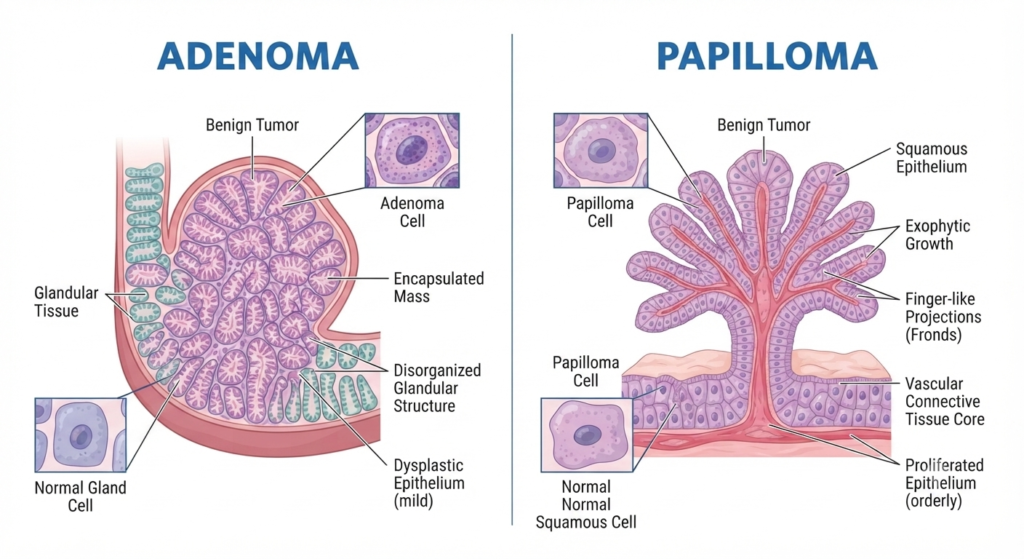
What Is an Adenoma?
An adenoma is a benign (non-cancerous) tumor that originates from glandular epithelial tissue, which forms the secretory portions of many organs. These tumors develop when glandular cells multiply abnormally, forming a localized mass. Although adenomas are benign, some types—particularly those found in the colon—can gradually develop into malignant tumors if left untreated.
Adenomas can occur in many organs, including the colon, thyroid gland, pituitary gland, adrenal gland, liver, prostate, and breast. Depending on their location, they may produce hormones, obstruct nearby structures, or remain completely asymptomatic.
Routine medical screening often detects adenomas before they cause symptoms, allowing early treatment and reducing the risk of complications.
Characteristics of an Adenoma
- Benign glandular tumor
- Develops from glandular epithelial cells
- Usually forms a rounded mass
- Can occur in multiple organs
- May produce hormones in endocrine glands
- Some types have precancerous potential
- Often slow-growing
- Diagnosed by imaging and biopsy
- Usually treated by surgical removal or monitoring
- Common in middle-aged and older adults
What Is a Papilloma?
A papilloma is a benign epithelial tumor characterized by finger-like projections that extend outward from the surface of the affected tissue. These growths develop from squamous or transitional epithelial cells and may appear on the skin or within internal organs lined by epithelium.
Papillomas commonly occur in the skin, mouth, throat, larynx, bladder, cervix, nasal cavity, and breast ducts. Many papillomas are associated with human papillomavirus (HPV) infection, although not all papillomas are caused by viruses.
Most papillomas remain benign throughout life, but certain HPV-associated papillomas, particularly those involving the cervix, require careful monitoring because some HPV strains increase the risk of cancer.
Characteristics of a Papilloma
- Benign epithelial tumor
- Forms finger-like or wart-like projections
- Develops from surface epithelial cells
- Often associated with HPV infection
- Can occur on skin or mucous membranes
- Usually slow-growing
- Generally non-cancerous
- May occur as single or multiple lesions
- Diagnosed through examination and biopsy
- Treated with surgical excision, laser therapy, or cryotherapy
Adenoma vs. Papilloma: Key Differences
1. Tissue of Origin
The most significant difference between Adenoma vs. Papilloma lies in the tissue from which they develop.
An adenoma originates from glandular epithelial tissue, which is responsible for producing and secreting substances such as hormones, mucus, enzymes, or other bodily fluids.
A papilloma, in contrast, develops from surface epithelial tissue, which covers the skin, internal organs, and mucous membranes.
Because they arise from different tissues, they differ in appearance, behavior, and clinical significance.
2. Appearance
The physical appearance of these tumors is another distinguishing feature.
Adenoma typically appears as:
- Rounded mass
- Smooth surface
- Well-defined borders
- Gland-like structure
- Solid growth
Papilloma usually appears as:
- Finger-like projections
- Wart-like growth
- Irregular surface
- Small protruding lesion
- Papillary architecture
Papillomas are generally easier to recognize visually because of their characteristic outward projections.
3. Growth Pattern
The growth patterns differ considerably.
An adenoma usually grows inward as a compact, localized mass within glandular tissue.
A papilloma grows outward from the epithelial surface, producing multiple finger-like projections that extend into a body cavity or above the skin.
This unique papillary growth gives papillomas their name.
4. Common Locations
Another major difference between Adenoma vs. Papilloma is where they commonly occur.
Adenoma frequently develops in:
- Colon
- Thyroid gland
- Pituitary gland
- Adrenal gland
- Liver
- Breast
- Prostate
- Parathyroid gland
Papilloma commonly occurs in:
- Skin
- Cervix
- Larynx (voice box)
- Oral cavity
- Nose
- Bladder
- Breast ducts
- Respiratory tract
Their preferred locations reflect the tissues from which they originate.
5. Causes
The causes of adenomas and papillomas are different.
Adenoma may develop due to:
- Genetic mutations
- Aging
- Hormonal imbalance
- Chronic inflammation
- Family history
- Certain inherited syndromes
Papilloma may develop due to:
- Human papillomavirus (HPV) infection
- Chronic irritation
- Epithelial cell overgrowth
- Genetic factors
- Environmental influences
Although many papillomas are linked to HPV, not every papilloma is caused by a viral infection.
6. Malignant Potential
One of the most clinically important differences between Adenoma vs. Papilloma is their potential to become cancerous.
Certain adenomas, particularly colorectal adenomas, are considered precancerous lesions because they may gradually develop into adenocarcinoma if left untreated.
Most papillomas remain benign throughout life. However, papillomas associated with high-risk HPV strains, especially in the cervix, may increase the risk of cancer.
Therefore, adenomas generally carry a higher malignant potential than papillomas.
7. Symptoms
Symptoms vary depending on the location and size of the tumor.
Adenoma may cause:
- Rectal bleeding
- Changes in bowel habits
- Hormonal imbalance
- Headaches
- Vision problems
- Abdominal pain
- Difficulty swallowing
- Fatigue
Papilloma may cause:
- Wart-like growths
- Hoarseness
- Difficulty speaking
- Difficulty swallowing
- Abnormal bleeding
- Nasal blockage
- Blood in urine
- Skin lesions
Small tumors of either type may remain symptom-free for years.
8. Diagnosis
Accurate diagnosis usually requires a combination of clinical examination and laboratory investigations.
Adenoma is commonly diagnosed using:
- Physical examination
- CT scan
- MRI
- Ultrasound
- Colonoscopy
- Endoscopy
- Hormone testing
- Biopsy
- Histopathological examination
Papilloma is commonly diagnosed using:
- Physical examination
- Endoscopy
- Laryngoscopy
- Cystoscopy
- HPV testing (when indicated)
- Biopsy
- Histopathological examination
A biopsy remains the gold standard for confirming both adenomas and papillomas.
9. Treatment
Treatment depends on the size, location, symptoms, and risk of complications.
Adenoma may be treated with:
- Regular monitoring
- Endoscopic removal
- Surgical excision
- Hormonal therapy (for hormone-producing adenomas)
- Radiofrequency ablation in selected cases
Papilloma may be treated with:
- Observation
- Surgical excision
- Laser removal
- Cryotherapy
- Electrocautery
- Antiviral management in selected HPV-related cases
Most benign tumors can be successfully treated with minimally invasive procedures.
10. Recurrence
The likelihood of recurrence varies.
Adenomas may recur if they are incompletely removed or if the patient has an underlying genetic condition that predisposes them to developing new tumors.
Papillomas, particularly those associated with HPV infection, have a higher tendency to recur because the underlying viral infection may persist even after the visible lesion has been removed.
Regular follow-up helps detect recurrent growths early.
11. Prognosis
The outlook for both conditions is generally excellent with timely diagnosis and appropriate treatment.
Most adenomas are cured after complete removal, although some require long-term surveillance due to their precancerous nature.
Most papillomas also have an excellent prognosis, especially when treated early. HPV-related papillomas may require periodic monitoring to detect recurrence or changes associated with high-risk viral strains.
12. Clinical Importance
Understanding the clinical significance of Adenoma vs. Papilloma is essential for appropriate patient management.
Adenoma is clinically important because it:
- May be precancerous
- Requires regular surveillance in some cases
- Can produce hormones
- May affect organ function
- Early removal can prevent cancer development
Papilloma is clinically important because it:
- Is usually benign
- May interfere with normal function depending on location
- Can be associated with HPV infection
- May recur after treatment
- Certain types require monitoring for malignant changes
Recognizing these differences helps healthcare professionals choose the most appropriate diagnostic, treatment, and follow-up strategies.
Similarities Between Adenoma and Papilloma
Although Adenoma vs. Papilloma differ in their tissue of origin, appearance, and malignant potential, they also share several important characteristics. Both are benign tumors that result from abnormal cell growth and often require medical evaluation to confirm their diagnosis.
Some major similarities include:
- Both are benign (non-cancerous) tumors.
- Both arise from epithelial tissues.
- Both result from abnormal cell proliferation.
- Both can occur in various organs of the body.
- Both are usually slow-growing.
- Both may remain asymptomatic in the early stages.
- Both can be diagnosed through biopsy and histopathological examination.
- Both may require surgical removal if symptomatic or suspicious.
- Both can recur after treatment in certain cases.
- Both require regular medical follow-up in selected patients.
Advantages of Early Detection of Adenoma
Early diagnosis of an adenoma significantly improves treatment outcomes and reduces the risk of complications.
Major advantages include:
- Prevents progression to cancer in precancerous adenomas.
- Enables minimally invasive treatment.
- Preserves normal organ function.
- Reduces the risk of obstruction or bleeding.
- Allows timely monitoring of hormone-producing adenomas.
- Improves long-term prognosis.
- Decreases the need for extensive surgery.
- Helps detect multiple adenomas in hereditary conditions.
- Improves patient quality of life.
- Increases the success rate of treatment.
Advantages of Early Detection of Papilloma
Although most papillomas are benign, early diagnosis helps prevent complications and improves treatment success.
Major advantages include:
- Allows early removal before symptoms worsen.
- Prevents obstruction in affected organs.
- Reduces discomfort caused by enlarging lesions.
- Helps identify HPV-related lesions early.
- Lowers the risk of recurrence through appropriate treatment.
- Improves cosmetic outcomes for skin papillomas.
- Preserves normal organ function.
- Facilitates early monitoring for suspicious changes.
- Minimizes the chance of secondary infection.
- Provides excellent long-term prognosis.
Which Is More Serious—Adenoma or Papilloma?
Neither Adenoma nor Papilloma is always more serious because their clinical significance depends on the type, size, location, and associated risk factors.
An adenoma is generally considered more clinically significant because certain types, such as colorectal adenomas, can develop into malignant tumors if left untreated. Hormone-producing adenomas may also disrupt normal endocrine function and cause systemic health problems.
A papilloma is usually less likely to become cancerous. However, papillomas associated with high-risk human papillomavirus (HPV) or those occurring in sensitive locations such as the larynx, bladder, or cervix may require close monitoring and treatment to prevent complications.
In general:
- Choose prompt evaluation for adenomas because some have precancerous potential.
- Treat papillomas appropriately, particularly when they are symptomatic, recurrent, or associated with high-risk HPV infection.
Early diagnosis and appropriate management are essential for both conditions.
Conclusion
The comparison of Adenoma vs. Papilloma highlights two common types of benign epithelial tumors that differ in their tissue of origin, appearance, growth pattern, and clinical behavior. Adenomas arise from glandular epithelial tissue and may carry a higher risk of malignant transformation, especially in organs such as the colon. Papillomas, on the other hand, originate from surface epithelial tissue and are characterized by finger-like projections, with most remaining benign throughout life.
Understanding Adenoma vs. Papilloma enables healthcare professionals, students, and patients to recognize their distinguishing features, choose appropriate diagnostic methods, and determine the most effective treatment strategy. Early detection and regular medical follow-up remain the key to preventing complications and ensuring favorable outcomes.
Frequently Asked Questions (FAQs)
The main difference between Adenoma vs. Papilloma is that an adenoma develops from glandular epithelial tissue, whereas a papilloma develops from surface epithelial tissue and typically forms finger-like projections.
No. An adenoma is a benign tumor. However, some adenomas, particularly colorectal adenomas, have the potential to become cancerous if left untreated.
Some papillomas are associated with human papillomavirus (HPV) infection, but not all papillomas are caused by HPV. Their cause depends on the type and location.
Certain adenomas have a greater risk of malignant transformation than papillomas, especially adenomas of the colon.
Both are diagnosed using a combination of physical examination, imaging or endoscopic procedures (when appropriate), and biopsy with histopathological examination, which confirms the diagnosis.
Reference:
1. “Trisodium Phosphate.” Wikipedia, Wikimedia Foundation, 9 July 2018.
2. “Tripotassium Phosphate.” Wikipedia, Wikimedia Foundation, 3 July 2018.
Read Next: