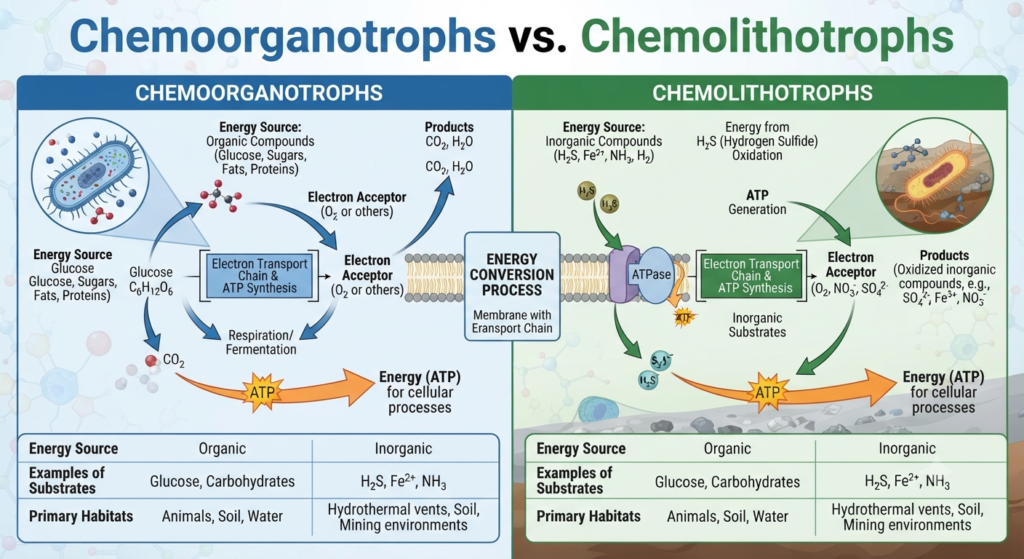
The main difference between chemoorganotrophs vs. chemolithotrophs is that chemoorganotrophs obtain energy by oxidizing organic compounds such as carbohydrates, fats, proteins, and organic acids, whereas chemolithotrophs obtain energy by oxidizing inorganic compounds such as ammonia (NH₃), hydrogen sulfide (H₂S), ferrous iron (Fe²⁺), hydrogen gas (H₂), and nitrite (NO₂⁻). While chemoorganotrophs depend on organic matter for energy, chemolithotrophs utilize inorganic chemicals and often play a vital role in Earth’s biogeochemical cycles.
Understanding the difference between chemoorganotrophs vs. chemolithotrophs is important for microbiology students, biotechnology researchers, environmental scientists, medical professionals, and industrial microbiologists because these organisms differ significantly in their energy sources, habitats, metabolic pathways, ecological roles, and industrial applications.
Chemoorganotrophs vs. Chemolithotrophs Comparison Table
The table below highlights the major differences between chemoorganotrophs vs. chemolithotrophs.
| Feature | Olefin | Polypropylene |
| Definition | Family of unsaturated hydrocarbons (alkenes) | Thermoplastic polymer made from propylene |
| Chemical Type | Hydrocarbon | Polymer |
| Basic Unit | Ethylene, Propylene, Butene, etc. | Repeating propylene units |
| Chemical Formula | General formula: CₙH₂ₙ | (C₃H₆)ₙ |
| Double Bond | Present | Absent after polymerization |
| Molecular Structure | Small hydrocarbon molecules | Long-chain polymer |
| Physical Form | Gas or liquid | Solid plastic |
| Reactivity | Highly reactive | Chemically stable |
| Polymerization | Easily polymerized | Already polymerized |
| Density | Lower | Approximately 0.90–0.91 g/cm³ |
| Melting Point | Depends on compound | About 160–170°C |
| Chemical Resistance | Moderate to high | Excellent |
| Common Uses | Petrochemical feedstock | Packaging, fibers, automotive parts |
| Recycling Code | Not applicable | #5 (PP) |
| Industrial Importance | Raw material | Finished engineering plastic |
What Are Chemoorganotrophs?
Chemoorganotrophs are organisms that obtain energy by oxidizing organic compounds. These compounds include carbohydrates, proteins, fats, amino acids, alcohols, and organic acids.
Most animals, fungi, protozoa, and many bacteria belong to this group. During metabolism, organic molecules are broken down through respiration or fermentation to produce ATP.
Most chemoorganotrophs are heterotrophs because they obtain both energy and carbon from organic matter.
Common Examples
- Humans
- Animals
- Fungi
- Escherichia coli
- Pseudomonas
- Yeast
Key Characteristics of Chemoorganotrophs
- Use organic compounds as electron donors
- Depend on organic matter for energy
- Usually heterotrophic
- Perform aerobic respiration, anaerobic respiration, or fermentation
- Found in almost every ecosystem
- Important decomposers and consumers
- Essential for nutrient recycling
What Are Chemolithotrophs?
Chemolithotrophs are microorganisms that obtain energy by oxidizing inorganic compounds instead of organic molecules.
They derive energy from chemicals such as ammonia, hydrogen sulfide, ferrous iron, hydrogen gas, sulfur, or nitrite. The released electrons pass through an electron transport chain to generate ATP.
Many chemolithotrophs are chemoautotrophs that fix atmospheric carbon dioxide into organic compounds through chemosynthesis.
Common Examples
- Nitrosomonas
- Nitrobacter
- Thiobacillus
- Acidithiobacillus ferrooxidans
- Hydrogen-oxidizing bacteria
Key Characteristics of Chemolithotrophs
- Use inorganic chemicals as energy sources
- Often utilize carbon dioxide as the carbon source
- Perform chemosynthesis
- Mostly bacteria and archaea
- Common in extreme environments
- Important in nutrient cycling
- Support ecosystems lacking sunlight
Chemoorganotrophs vs. Chemolithotrophs: Key Differences
1. Definition
The primary distinction lies in the type of chemical compounds used to obtain energy.
Chemoorganotrophs
- Obtain energy from organic compounds
- Break down complex organic molecules
Chemolithotrophs
- Obtain energy from inorganic compounds
- Oxidize minerals and reduced inorganic substances
2. Energy Source
The energy source is the biggest difference between chemoorganotrophs vs. chemolithotrophs. Both groups obtain energy through chemical reactions, but they differ in the type of compounds they oxidize to generate ATP.
Chemoorganotrophs
Chemoorganotrophs obtain energy by oxidizing organic compounds. These energy-rich molecules are broken down during cellular respiration or fermentation to release electrons, which are used to produce ATP. Organic compounds are typically derived from living organisms or decaying organic matter.
Common energy sources include:
- Glucose
- Proteins
- Lipids (fats)
- Organic acids
- Alcohols
- Amino acids
Chemolithotrophs
Chemolithotrophs obtain energy by oxidizing inorganic compounds rather than organic molecules. The energy released from these oxidation reactions is used to generate ATP, and in many species, it also powers the fixation of carbon dioxide through chemosynthesis.
Common energy sources include:
- Ammonia (NH₃)
- Nitrite (NO₂⁻)
- Hydrogen sulfide (H₂S)
- Hydrogen gas (H₂)
- Ferrous iron (Fe²⁺)
- Sulfur compounds
- Elemental sulfur (S)
Because they rely on different energy sources, chemoorganotrophs dominate environments rich in organic matter, whereas chemolithotrophs thrive in habitats where inorganic chemicals are abundant, such as hydrothermal vents, sulfur springs, and mineral-rich soils.
3. Electron Donor
The electron donor is one of the most important differences between chemoorganotrophs vs. chemolithotrophs because it determines how organisms generate ATP during cellular respiration or other energy-producing pathways.
Chemoorganotrophs use organic molecules as electron donors. During metabolism, compounds such as glucose, fatty acids, amino acids, and other organic substances are oxidized, releasing electrons. These electrons pass through the electron transport chain to produce ATP.
Common organic electron donors include:
- Glucose
- Fatty acids
- Amino acids
- Organic acids
- Alcohols
Chemolithotrophs use inorganic chemicals as electron donors instead of organic compounds. They obtain electrons by oxidizing reduced inorganic substances, which are then transferred through the electron transport chain to generate ATP.
Common inorganic electron donors include:
- Ammonia (NH₃)
- Nitrite (NO₂⁻)
- Hydrogen sulfide (H₂S)
- Hydrogen gas (H₂)
- Ferrous iron (Fe²⁺)
- Elemental sulfur (S)
This difference in electron donors forms the foundation of their metabolic strategies, allowing chemoorganotrophs to thrive in environments rich in organic matter, while chemolithotrophs can survive in habitats where only inorganic compounds are available.
4. Carbon Source
The carbon source is another important difference between chemoorganotrophs vs. chemolithotrophs because carbon is required to build cellular components such as carbohydrates, proteins, lipids, and nucleic acids.
Chemoorganotrophs generally use organic carbon obtained from living organisms or decaying organic matter. Since they cannot produce organic compounds from carbon dioxide, they depend on other organisms directly or indirectly for their carbon supply.
Characteristics include:
- Usually utilize organic carbon compounds
- Depend on plants, animals, or other microorganisms for carbon
- Most are heterotrophic organisms
- Obtain both energy and carbon from organic matter
Many chemolithotrophs use carbon dioxide (CO₂) as their primary carbon source. These organisms are known as chemolithoautotrophs because they use energy from inorganic compounds to fix CO₂ into organic molecules through chemosynthesis.
However, not all chemolithotrophs are autotrophs. Some species, called chemolithoheterotrophs, obtain energy from inorganic compounds but use organic carbon for growth and biosynthesis.
Characteristics include:
- Frequently use carbon dioxide (CO₂) as the carbon source
- Fix CO₂ into organic compounds through chemosynthesis
- Some species utilize organic carbon (chemolithoheterotrophs)
- Many act as primary producers in ecosystems where sunlight is absent
Because many chemolithotrophs can convert inorganic carbon into organic matter, they serve as primary producers, forming the foundation of food webs in environments such as deep-sea hydrothermal vents, hot springs, and other ecosystems where photosynthesis is not possible..
5. Metabolic Pathway
Chemoorganotrophs generate energy by oxidizing organic compounds such as glucose, fatty acids, and amino acids. These molecules are broken down through well-known metabolic pathways to release electrons, which are transferred through the electron transport chain to produce ATP. In the absence of oxygen, many chemoorganotrophs can also generate energy through fermentation.
Major metabolic pathways include:
- Glycolysis
- Krebs (Citric Acid) Cycle
- Electron Transport Chain (ETC)
- Fermentation
Chemolithotrophs obtain energy by oxidizing inorganic compounds such as ammonia (NH₃), hydrogen sulfide (H₂S), hydrogen gas (H₂), ferrous iron (Fe²⁺), sulfur, or nitrite (NO₂⁻). The electrons released from these compounds pass through the electron transport chain to generate ATP. Many chemolithotrophs then use this energy to fix carbon dioxide into organic compounds through chemosynthesis.
Major metabolic pathways include:
- Oxidation of inorganic compounds
- Electron Transport Chain (ETC)
- Chemiosmosis
- Carbon fixation pathways (such as the Calvin cycle)
The difference in metabolic pathways enables chemoorganotrophs to obtain energy from organic matter, whereas chemolithotrophs derive energy from inorganic substances and often use that energy to synthesize organic compounds from carbon dioxide.
6. Organisms
The organisms belonging to each group vary considerably. Chemoorganotrophs are found across a wide range of life forms, whereas chemolithotrophs are almost exclusively microorganisms.
Chemoorganotrophs include organisms that obtain energy by oxidizing organic compounds. This group is widespread and includes both unicellular and multicellular organisms.
Examples include:
- Humans
- Animals
- Plants (during cellular respiration)
- Fungi
- Protozoa
- Numerous bacteria
Chemolithotrophs are found mainly among bacteria and archaea. They obtain energy by oxidizing inorganic compounds and are commonly found in environments rich in minerals or inorganic chemicals.
Examples include:
- Nitrifying bacteria (Nitrosomonas, Nitrobacter)
- Sulfur-oxidizing bacteria (Thiobacillus)
- Iron-oxidizing bacteria (Acidithiobacillus ferrooxidans)
- Hydrogen-oxidizing bacteria
- Various archaeal species
Unlike chemoorganotrophs, no known animals, plants, or fungi are true chemolithotrophs. Their unique metabolism is largely confined to specialized microorganisms that play essential roles in nutrient cycling and extreme environments.
7. Habitat
The habitats of chemoorganotrophs and chemolithotrophs largely depend on the availability of their preferred energy sources. While chemoorganotrophs thrive in environments rich in organic matter, chemolithotrophs inhabit locations where inorganic compounds are abundant.
Chemoorganotrophs are widely distributed because organic compounds are readily available in most ecosystems. They are commonly found in environments containing living organisms or decaying organic material.
Common habitats include:
- Soil
- Freshwater
- Oceans
- Plants
- Animals
- Decaying organic matter
- Sewage and wastewater
- Compost and forest litter
Chemolithotrophs are typically found in environments rich in inorganic chemicals that serve as their energy source. Many species inhabit extreme environments where sunlight and organic nutrients are limited.
Common habitats include:
- Deep-sea hydrothermal vents
- Hot springs
- Sulfur deposits
- Acidic mine drainage
- Deep underground environments
- Nitrogen-rich soils
- Volcanic regions
- Iron-rich groundwater
These specialized habitats allow chemolithotrophs to obtain energy from inorganic compounds and support ecosystems where most other organisms cannot survive.
8. Ecological Role
Their ecological contributions differ significantly.
Chemoorganotrophs
- Decompose organic matter
- Recycle nutrients
- Support food chains
- Act as consumers
Chemolithotrophs
- Nitrogen cycling
- Sulfur cycling
- Iron cycling
- Carbon fixation
- Primary production in dark environments
9. ATP Production
Both chemoorganotrophs and chemolithotrophs synthesize ATP through oxidation-reduction (redox) reactions, but they differ in the compounds they oxidize to obtain energy.
Chemoorganotrophs
Chemoorganotrophs produce ATP by oxidizing organic compounds such as carbohydrates, fats, proteins, and organic acids. Depending on the availability of oxygen, ATP is generated through aerobic respiration, anaerobic respiration, or fermentation.
ATP is produced through:
- Cellular respiration
- Fermentation
- Oxidation of organic substrates
Chemolithotrophs
Chemolithotrophs produce ATP by oxidizing inorganic compounds such as ammonia, hydrogen sulfide, hydrogen gas, ferrous iron, sulfur, or nitrite. The electrons released during oxidation are transferred through the electron transport chain, where ATP is generated primarily by oxidative phosphorylation.
ATP is produced through:
- Oxidation of inorganic compounds
- Electron transport chain
- Oxidative phosphorylation
Although both groups ultimately generate ATP, chemoorganotrophs rely on the energy stored in organic molecules, whereas chemolithotrophs harness energy from inorganic chemicals to power their cellular processes.
10. Carbon Fixation
One of the major differences between chemoorganotrophs vs. chemolithotrophs is their ability to perform carbon fixation. Carbon fixation is the process of converting inorganic carbon dioxide (CO₂) into organic compounds that can be used for growth and cellular functions.
Chemoorganotrophs
Chemoorganotrophs generally do not fix carbon dioxide. Instead, they obtain preformed organic compounds from plants, animals, or other organisms and use them as their carbon source for building cellular components.
Characteristics include:
- Rarely fix carbon dioxide (CO₂)
- Depend on preformed organic compounds
- Obtain carbon from organic matter
- Most are heterotrophic organisms
Chemolithotrophs
Many chemolithotrophs are capable of fixing carbon dioxide using the energy released from the oxidation of inorganic compounds. This process, known as chemosynthesis, enables them to produce carbohydrates and other organic molecules without relying on sunlight.
Characteristics include:
- Frequently fix carbon dioxide (CO₂)
- Produce organic molecules through chemosynthesis
- Many are chemolithoautotrophs
- Serve as primary producers in ecosystems without sunlight
Because many chemolithotrophs can convert CO₂ into organic matter using chemical energy, they can thrive in environments such as deep-sea hydrothermal vents, hot springs, and underground ecosystems where photosynthesis is impossible.
11. Environmental Importance
Both chemoorganotrophs and chemolithotrophs play essential roles in maintaining healthy ecosystems. Although they obtain energy from different sources, both groups contribute significantly to nutrient cycling, ecosystem stability, and the flow of energy through the environment.
Chemoorganotrophs
Chemoorganotrophs are primarily responsible for breaking down organic matter and recycling nutrients back into the environment. By decomposing dead plants, animals, and other organic materials, they help maintain soil fertility and support the growth of new organisms.
Their environmental roles include:
- Decompose dead plants and animals
- Recycle essential nutrients such as carbon, nitrogen, and phosphorus
- Maintain soil fertility
- Support ecosystem productivity
- Drive the decomposition process in terrestrial and aquatic ecosystems
Chemolithotrophs
Chemolithotrophs play a crucial role in Earth’s biogeochemical cycles by transforming inorganic compounds into forms that other organisms can use. Many species serve as primary producers in environments where sunlight is unavailable, making them essential for sustaining unique ecosystems.
Their environmental roles include:
- Sustain deep-sea hydrothermal vent ecosystems
- Drive the nitrogen, sulfur, iron, and hydrogen cycles
- Improve soil nitrogen availability through nitrification
- Support microbial food webs in extreme environments
- Contribute to carbon fixation through chemosynthesis
Together, chemoorganotrophs and chemolithotrophs help maintain ecological balance by recycling nutrients, supporting food webs, and ensuring the continuous cycling of essential elements in nature.
12. Industrial Applications
Applications of Chemoorganotrophs
Chemoorganotrophs are widely used in biotechnology and industry.
Major applications include:
- Fermentation
- Food production
- Brewing
- Baking
- Pharmaceutical manufacturing
- Waste decomposition
- Bioremediation
- Biofuel production
- Enzyme production
- Industrial microbiology
Applications of Chemolithotrophs
Chemolithotrophs have unique industrial importance.
Major applications include:
- Bioleaching of metals
- Wastewater treatment
- Nitrogen removal
- Bioremediation
- Sulfur oxidation
- Biomining
- Environmental monitoring
- Carbon fixation research
- Industrial biotechnology
- Renewable energy studies
13. Adaptation to Extreme Environments
One of the most striking differences between chemoorganotrophs vs. chemolithotrophs is their ability to survive in extreme environments. While chemoorganotrophs generally require environments rich in organic matter, many chemolithotrophs can thrive in harsh conditions where sunlight and organic nutrients are scarce.
Chemoorganotrophs
Chemoorganotrophs are commonly found in environments where organic compounds are readily available. Although they inhabit a wide variety of ecosystems, many species are less suited to environments with limited organic nutrients.
Characteristics include:
- Thrive where organic matter is abundant
- Occupy diverse terrestrial and aquatic environments
- Sensitive to nutrient depletion
- Depend on organic compounds for survival
- Common in soil, water, plants, animals, and decaying matter
Chemolithotrophs
Chemolithotrophs are remarkably well adapted to extreme environments because they derive energy from inorganic compounds rather than organic matter. This enables them to survive in habitats that are inhospitable to most other forms of life.
Characteristics include:
- Grow without sunlight
- Survive in highly acidic or alkaline environments
- Live in deep-sea hydrothermal vents and deep underground ecosystems
- Adapt to high temperatures and other extreme conditions
- Utilize minerals and inorganic chemicals as energy sources
Their unique metabolic versatility allows chemolithotrophs to colonize habitats unsuitable for most organisms, making them essential for sustaining life and nutrient cycling in some of Earth’s most extreme environments.
14. Role in Biogeochemical Cycles
Biogeochemical cycles describe the movement of essential elements through living organisms and the environment. Both chemoorganotrophs and chemolithotrophs contribute to these cycles, but chemolithotrophs play a more direct role in transforming inorganic compounds and driving elemental cycling.
Chemoorganotrophs
Chemoorganotrophs contribute primarily by decomposing organic matter and returning nutrients to the environment. Their activities release essential elements that can be reused by plants and microorganisms.
They contribute to:
- Carbon cycle
- Organic matter decomposition
- Nutrient recycling
- Soil organic matter formation
- Release of carbon dioxide during respiration
Chemolithotrophs
Chemolithotrophs drive several major biogeochemical cycles by oxidizing inorganic compounds. These transformations make essential nutrients available to other organisms and help maintain the chemical balance of ecosystems.
They contribute to:
- Nitrogen cycle (nitrification)
- Sulfur cycle
- Iron cycle
- Hydrogen cycle
- Carbon cycle through carbon dioxide fixation
The activities of chemolithotrophs are essential for maintaining ecosystem balance, nutrient availability, soil fertility, and the continuous cycling of elements that sustain life on Earth.
Similarities Between Chemoorganotrophs and Chemolithotrophs
Although chemoorganotrophs vs. chemolithotrophs differ in their energy sources and metabolic strategies, they also share several important characteristics because both belong to the broader group of chemotrophs.
Some major similarities include:
- Both obtain energy from chemical compounds rather than sunlight.
- Both generate ATP through oxidation-reduction (redox) reactions.
- Both use an electron transport chain for energy production in aerobic respiration.
- Both play essential roles in ecosystem functioning.
- Both contribute to nutrient cycling in nature.
- Both include bacteria and other microorganisms.
- Both may perform aerobic or anaerobic metabolism depending on environmental conditions.
- Both require enzymes to catalyze metabolic reactions.
- Both are important in biotechnology and environmental applications.
- Both help maintain the balance of Earth’s biogeochemical cycles.
Despite these similarities, chemoorganotrophs rely on organic compounds for energy, whereas chemolithotrophs utilize inorganic compounds.
Advantages and Uses of Chemoorganotrophs
Chemoorganotrophs are among the most widespread organisms on Earth. Their ability to efficiently break down organic compounds makes them essential in natural ecosystems and numerous industrial processes.
Major advantages and uses include:
- Decompose dead plants and animals
- Recycle carbon, nitrogen, and phosphorus
- Improve soil fertility
- Produce fermented foods such as yogurt, cheese, and bread
- Manufacture antibiotics and pharmaceuticals
- Produce industrial enzymes
- Generate biofuels such as ethanol and biogas
- Treat organic waste in wastewater plants
- Perform bioremediation of oil spills and pollutants
- Support food chains as consumers and decomposers
- Used extensively in industrial microbiology and biotechnology
Because of their metabolic diversity, chemoorganotrophs are indispensable for agriculture, food production, medicine, and environmental sustainability.
Advantages and Uses of Chemolithotrophs
Chemolithotrophs possess unique metabolic capabilities that allow them to survive in environments lacking sunlight and organic nutrients. Their ability to oxidize inorganic compounds makes them vital in natural ecosystems and industrial biotechnology.
Major advantages and uses include:
- Carry out nitrification in the nitrogen cycle
- Oxidize sulfur compounds in the sulfur cycle
- Oxidize iron during biomining operations
- Fix atmospheric carbon dioxide through chemosynthesis
- Support deep-sea hydrothermal vent ecosystems
- Recover valuable metals through bioleaching
- Remove ammonia from wastewater
- Help restore polluted environments through bioremediation
- Improve soil nutrient availability
- Contribute to renewable biotechnology research
- Aid in environmental monitoring and microbial ecology
Their ability to convert inorganic chemicals into usable biological energy makes chemolithotrophs essential for both natural ecosystems and modern industrial applications.
Safety and Laboratory Handling
Most chemoorganotrophs and chemolithotrophs are microorganisms that require proper handling in research laboratories, industrial facilities, and wastewater treatment plants.
General safety guidelines include:
- Follow standard microbiological laboratory practices.
- Wear appropriate personal protective equipment (PPE), including gloves, lab coats, and eye protection.
- Use sterile techniques to avoid contamination.
- Handle microbial cultures inside biosafety cabinets when required.
- Properly sterilize laboratory equipment before and after use.
- Dispose of biological waste according to local biosafety regulations.
- Label cultures clearly to prevent accidental misuse.
- Wash hands thoroughly after handling microbial samples.
Additional Precautions for Chemoorganotrophs
- Some species are pathogenic and can cause disease.
- Avoid inhalation of microbial aerosols.
- Maintain proper incubation temperatures to prevent contamination.
- Follow biosafety guidelines when working with clinical isolates.
Additional Precautions for Chemolithotrophs
- Some cultures require highly acidic or alkaline growth media.
- Handle sulfur, ammonia, or iron-containing media carefully.
- Ensure proper ventilation when working with gases such as hydrogen or hydrogen sulfide.
- Monitor pH and temperature during cultivation to maintain stable growth conditions.
Proper laboratory handling ensures safe research while maintaining the integrity of microbial cultures.
Which Is Better—Chemoorganotrophs or Chemolithotrophs?
Neither chemoorganotrophs nor chemolithotrophs are universally better because each is adapted to a specific ecological niche and performs unique biological functions.
Chemoorganotrophs are the preferred organisms in environments rich in organic matter. They efficiently decompose complex organic materials, recycle nutrients, support food webs, and are widely used in food production, medicine, biotechnology, and waste treatment.
Chemolithotrophs, on the other hand, are uniquely adapted to environments where organic nutrients are scarce. By obtaining energy from inorganic compounds, they sustain life in extreme habitats, drive the nitrogen, sulfur, and iron cycles, and play critical roles in wastewater treatment, biomining, and carbon fixation.
In nature, both groups complement one another. Chemoorganotrophs recycle organic matter, while chemolithotrophs transform inorganic compounds into forms that support ecosystem productivity and nutrient cycling.
Conclusion
The comparison of chemoorganotrophs vs. chemolithotrophs shows that although both are chemotrophic organisms that derive energy from chemical reactions, they differ fundamentally in the types of compounds they oxidize. Chemoorganotrophs obtain energy from organic compounds such as sugars, fats, and proteins, making them essential decomposers, consumers, and industrial microorganisms.
Chemolithotrophs, in contrast, obtain energy from inorganic compounds such as ammonia, hydrogen sulfide, ferrous iron, and hydrogen gas. Many are capable of fixing carbon dioxide and serve as primary producers in environments where sunlight is unavailable. They are indispensable for biogeochemical cycling, wastewater treatment, and biomining.
Understanding the differences between chemoorganotrophs vs. chemolithotrophs helps students, microbiologists, environmental scientists, and biotechnology professionals better understand microbial metabolism, ecosystem dynamics, and the diverse ways organisms obtain energy.
Frequently Asked Questions (FAQs)
The main difference between chemoorganotrophs vs. chemolithotrophs is that chemoorganotrophs obtain energy by oxidizing organic compounds, whereas chemolithotrophs obtain energy by oxidizing inorganic compounds such as ammonia, hydrogen sulfide, hydrogen gas, and ferrous iron.
No. Many chemolithotrophs are chemolithoautotrophs that use carbon dioxide as their carbon source, but some are chemolithoheterotrophs, obtaining carbon from organic compounds while still deriving energy from inorganic chemicals.
Common chemoorganotrophs include humans, fungi, yeast, Escherichia coli, and Pseudomonas. Common chemolithotrophs include Nitrosomonas, Nitrobacter, Thiobacillus, and Acidithiobacillus ferrooxidans.
Chemolithotrophs are crucial because they drive the nitrogen, sulfur, iron, and hydrogen cycles, fix carbon dioxide through chemosynthesis, support ecosystems without sunlight, and contribute to wastewater treatment and biomining.
Chemoorganotrophs are commonly found in soil, water, plants, animals, and decaying organic matter, while chemolithotrophs are typically found in hydrothermal vents, hot springs, acidic mines, sulfur-rich environments, deep underground ecosystems, and nitrogen-rich soils.
Reference:
1. “Chemolithotrophy.” Lumen,
2. “Primary Nutritional Groups.” Wikipedia, Wikimedia Foundation, 23 May 2019,
Read Next: