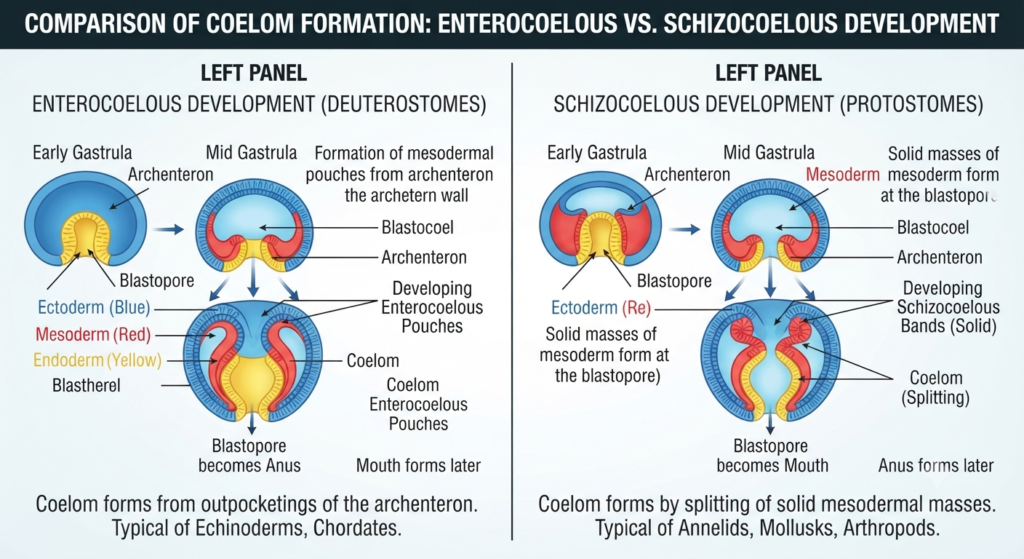
The main difference between Enterocoelous vs. Schizocoelous is that enterocoelous coelom formation occurs when the coelom develops from outpocketings of the embryonic archenteron (primitive gut), whereas schizocoelous coelom formation occurs when the mesoderm splits into two layers, creating a fluid-filled body cavity. Enterocoely is characteristic of deuterostomes, while schizocoely is typically found in protostomes.
Understanding Enterocoelous vs. Schizocoelous is important in embryology, zoology, and evolutionary biology because these two methods of coelom formation help classify animals into major evolutionary groups. They also explain differences in embryonic development, body organization, and the evolution of complex organ systems.
Enterocoelous vs. Schizocoelous Comparison Table
The table below highlights the major differences between Enterocoelous vs. Schizocoelous.
| Feature | Enterocoelous Development | Schizocoelous Development |
|---|---|---|
| Definition | Coelom forms from outgrowths of the archenteron. | Coelom forms by splitting of the mesoderm. |
| Method of Formation | Outpocketing of the embryonic gut. | Splitting of solid mesodermal masses. |
| Origin of Coelom | Archenteron (endoderm-lined pouches that become mesoderm). | Mesoderm. |
| Embryonic Pattern | Deuterostome development. | Protostome development. |
| VSEPR | Not applicable | Not applicable |
| Typical Animal Groups | Chordates, Echinoderms, Hemichordates. | Annelids, Arthropods, Mollusks. |
| Mesoderm Formation | Forms as pouches from the gut. | Forms as solid masses that split. |
| Body Cavity Formation | Pouches enlarge and separate. | Cavities appear within mesoderm. |
| Developmental Process | Usually slower and more organized. | Comparatively direct and rapid. |
| Examples | Amphioxus, Starfish, Sea Urchin. | Earthworm, Cockroach, Snail. |
| Evolutionary Group | Deuterostomes. | Protostomes. |
| Biological Significance | Supports complex organ development. | Enables efficient body cavity formation. |
What Is Enterocoelous?
Enterocoelous is a type of coelom formation in which the body cavity develops from paired outgrowths of the archenteron, also known as the primitive gut. These pouch-like extensions gradually enlarge, separate from the digestive tract, and develop into the coelomic cavity.
This mode of development is a characteristic feature of deuterostomes, including chordates, echinoderms, and hemichordates. Because the coelom develops directly from the embryonic gut, the process is highly organized and closely coordinated with early embryonic development.
Characteristics of Enterocoelous
- Coelom develops from the archenteron.
- Outpocketings gradually enlarge and separate.
- Characteristic of deuterostomes.
- Highly organized embryonic development.
- Mesoderm develops from enteric pouches.
- Supports complex body organization.
- Common in chordates and echinoderms.
- Associated with radial cleavage.
- Usually accompanied by indeterminate cleavage.
- Produces a true coelom.
Examples of Enterocoelous Animals
- Starfish
- Sea urchins
- Amphioxus
- Lancelets
- Humans (during embryonic development)
- Other vertebrates
What Is Schizocoelous?
Schizocoelous is a type of coelom formation in which the body cavity develops by the splitting of solid mesodermal masses. Initially, the mesoderm forms as compact bands of cells. As development progresses, these bands split internally, creating a fluid-filled cavity known as the coelom.
This developmental pattern is commonly observed in protostomes, including annelids, arthropods, and mollusks. Schizocoelous development is generally considered an efficient mechanism for forming the body cavity during embryogenesis.
Characteristics of Schizocoelous
- Coelom develops by splitting the mesoderm.
- Mesoderm initially forms solid masses.
- Characteristic of protostomes.
- Common in annelids, arthropods, and mollusks.
- Produces a true coelom.
- Usually associated with spiral cleavage.
- Often accompanied by determinate cleavage.
- Body cavity forms rapidly.
- Supports organ development and movement.
- Widely observed among invertebrates.
Examples of Schizocoelous Animals
- Earthworm
- Cockroach
- Snail
- Octopus
- Crab
- Butterfly
Enterocoelous vs. Schizocoelous: Key Differences
1. Method of Coelom Formation
The most significant difference between Enterocoelous vs. Schizocoelous lies in the way the coelom (body cavity) is formed during embryonic development.
In enterocoelous development, the coelom originates as paired pouch-like outgrowths from the archenteron, which is the primitive digestive tract of the embryo. These pouches gradually enlarge, separate from the archenteron, and develop into a fluid-filled body cavity lined by mesoderm. This method produces a well-organized and symmetrical coelom.
In schizocoelous development, the coelom forms through the splitting of solid masses of mesodermal tissue. Initially, the mesoderm appears as compact bands of cells on either side of the developing gut. As embryonic development progresses, cavities develop within these mesodermal bands, eventually forming the coelom.
Thus, enterocoely depends on outgrowth of the primitive gut, whereas schizocoely depends on splitting of mesodermal tissue.
2. Origin of the Coelom
Another major difference is the embryonic origin of the body cavity.
In enterocoelous development, the coelomic cavity is closely associated with the archenteron (primitive gut) because it develops directly from its outpocketings. Although the coelomic lining ultimately consists of mesodermal tissue, its formation begins as extensions of the embryonic gut, creating a close developmental relationship between the digestive system and the coelom.
In schizocoelous development, the coelom originates entirely within the mesoderm. The mesoderm forms independently of the gut and later splits internally to produce the body cavity. As a result, the coelom develops separately from the digestive tract during embryogenesis.
This distinction is one of the key criteria used to differentiate deuterostomes from protostomes.
3. Embryonic Development Pattern
The pattern of embryonic development also differs considerably between these two types of coelom formation.
Enterocoelous development is a characteristic feature of deuterostomes, a major animal group that includes echinoderms, hemichordates, and all chordates, including vertebrates. In these animals, embryonic development follows a highly regulated sequence that contributes to the formation of complex organ systems.
Schizocoelous development is characteristic of protostomes, including annelids, arthropods, mollusks, and many other invertebrates. In these animals, the body cavity develops through mesodermal splitting, which efficiently supports the formation of internal organs and body compartments.
Therefore, the type of coelom formation serves as an important embryological feature for classifying animals into major evolutionary groups.
4. Mesoderm Formation
The formation of the mesoderm follows different developmental pathways in enterocoelous and schizocoelous animals.
During enterocoelous development, the mesoderm develops as paired hollow pouches that bud outward from the wall of the archenteron. These pouches gradually expand, separate from the gut, and eventually give rise to the coelomic lining and various internal tissues.
In schizocoelous development, the mesoderm first appears as solid bands or blocks of cells located between the ectoderm and endoderm. These solid masses subsequently split internally, producing a cavity that becomes the coelom.
Although both methods ultimately generate mesoderm-lined body cavities, the mechanism of mesoderm formation is fundamentally different.
5. Developmental Process
The sequence of embryonic events varies significantly between the two developmental patterns.
Enterocoelous development is generally more gradual and highly coordinated. The archenteron first forms during gastrulation, after which paired pouches develop, enlarge, and detach before becoming the coelomic cavities. This multi-step process contributes to the organized body plan observed in deuterostomes.
In contrast, schizocoelous development follows a relatively direct pathway. Once the mesoderm is established, internal spaces form within the mesodermal masses through splitting, rapidly producing the coelomic cavity. This simpler developmental sequence is highly effective in many protostome animals.
Both mechanisms ultimately produce a true coelom but differ considerably in their developmental stages.
The cleavage pattern during early embryonic development is another distinguishing feature.
Animals exhibiting enterocoelous development usually undergo radial cleavage, where successive cell divisions occur either parallel or perpendicular to the embryo’s central axis. This cleavage pattern produces a symmetrical arrangement of blastomeres and is commonly associated with indeterminate cleavage.
Animals exhibiting schizocoelous development generally display spiral cleavage, in which the blastomeres divide at oblique angles relative to the embryo’s axis. This creates a spiral arrangement of cells and is typically associated with determinate cleavage.
These contrasting cleavage patterns are important developmental characteristics used in comparative embryology.
7. Fate of the Blastopore
The ultimate fate of the blastopore is one of the defining differences between deuterostomes and protostomes.
In enterocoelous development, which occurs in deuterostomes, the blastopore develops into the anus, while the mouth forms later from a separate opening. This developmental pattern gives rise to the term deuterostome, meaning “second mouth.”
In schizocoelous development, found in protostomes, the blastopore develops into the mouth, while the anus forms later during embryonic development. The name protostome means “first mouth,” reflecting this developmental sequence.
This difference is widely used in zoology to classify major groups of bilaterally symmetrical animals.
8. Evolutionary Significance
Both methods of coelom formation have played an important role in animal evolution.
Enterocoelous development is considered a defining characteristic of deuterostomes, whose members include highly complex vertebrates. This developmental strategy supports the formation of sophisticated organ systems, larger body sizes, and specialized body cavities such as the thoracic and abdominal cavities found in vertebrates.
Schizocoelous development has contributed to the remarkable evolutionary success of protostomes, which represent the largest and most diverse group of animals on Earth. The efficient formation of the coelom has enabled these organisms to evolve a wide variety of body forms, ecological adaptations, and survival strategies.
Together, these two developmental pathways illustrate the evolutionary diversity of multicellular animals.
9. Biological Importance
The biological significance of these developmental mechanisms extends beyond embryology.
Enterocoelous development provides the structural framework for complex internal organs, advanced circulatory systems, and highly organized body plans. It is essential for the development of vertebrates and other deuterostome animals with specialized organ systems.
Schizocoelous development provides a functional body cavity that allows internal organs to develop independently of the body wall. This arrangement improves flexibility, locomotion, circulation, digestion, and reproductive efficiency in numerous invertebrate groups.
Consequently, understanding Enterocoelous vs. Schizocoelous helps explain how different animal groups evolved distinct body plans and developmental strategies while maintaining the essential function of a true coelom.
Similarities Between Enterocoelous and Schizocoelous
Although Enterocoelous and Schizocoelous differ in the way the coelom develops during embryogenesis, they also share several important characteristics. Both are mechanisms of true coelom formation and play a vital role in the development of complex multicellular animals. In both cases, the resulting coelom provides space for internal organs, improves body organization, and allows organs to function independently of the body wall.
Some important similarities between enterocoelous and schizocoelous development include:
- Both produce a true coelom completely lined by mesoderm.
- Both occur during the embryonic development of triploblastic animals.
- Both involve the formation of the mesoderm, which gives rise to muscles, connective tissues, and many internal organs.
- Both create a fluid-filled body cavity that cushions and protects internal organs.
- Both allow organs such as the digestive, circulatory, and reproductive systems to develop efficiently.
- Both contribute to improved body organization and greater structural complexity.
- Both support independent movement of internal organs within the body cavity.
- Both are essential for the evolution of advanced bilaterally symmetrical animals.
- Both are explained by embryological and developmental biology principles.
- Both are important concepts in zoology, embryology, and evolutionary biology.
Advantages of Enterocoelous Development
Enterocoelous development offers several advantages because the coelom develops from the archenteron (primitive gut) in a highly organized manner. This developmental pattern is associated with deuterostomes, including vertebrates, which possess complex body structures and specialized organ systems.
Some major advantages of enterocoelous development are:
- Produces a well-organized and symmetrical coelomic cavity.
- Supports the development of highly complex organ systems.
- Provides better coordination between the digestive tract and body cavity during embryonic development.
- Facilitates the formation of specialized body cavities, such as the thoracic and abdominal cavities in vertebrates.
- Contributes to the evolution of large and structurally complex animals.
- Promotes accurate organ positioning during embryogenesis.
- Supports advanced circulatory, respiratory, and reproductive systems.
- Associated with indeterminate cleavage, allowing greater developmental flexibility.
- Reduces the chances of abnormal body cavity formation during development.
- Characteristic of highly evolved deuterostome animals, including humans.
Advantages of Schizocoelous Development
Schizocoelous development is an efficient method of coelom formation in which the body cavity develops by splitting the mesoderm. This process has enabled protostomes to evolve into one of the largest and most diverse groups of animals on Earth.
Some major advantages of schizocoelous development include:
- Forms the coelom rapidly during embryonic development.
- Efficiently produces a spacious body cavity for internal organs.
- Supports diverse body plans in protostome animals.
- Allows flexibility and independent movement of internal organs.
- Provides sufficient space for the development of digestive and reproductive organs.
- Enables efficient locomotion in segmented animals such as annelids.
- Supports the evolution of highly diverse invertebrate groups.
- Facilitates adaptation to a wide range of terrestrial and aquatic habitats.
- Well suited for animals with exoskeletons, such as arthropods.
- Contributes to the remarkable evolutionary success of protostomes.
Which Is Better—Enterocoelous or Schizocoelous?
Neither enterocoelous nor schizocoelous development is inherently better because each represents an evolutionary adaptation suited to different groups of animals. Their effectiveness depends on the organism’s evolutionary lineage, body organization, and developmental requirements.
Enterocoelous development is considered more suitable for animals with highly organized body plans and complex organ systems. Since the coelom develops from the archenteron in a controlled and coordinated manner, it supports the development of advanced structures found in deuterostomes, including vertebrates.
On the other hand, schizocoelous development is highly efficient for protostome animals. The direct splitting of the mesoderm allows rapid formation of the coelom, supporting the tremendous diversity of invertebrates such as insects, annelids, mollusks, and arthropods.
In summary:
- Choose enterocoelous development when studying deuterostomes, complex vertebrates, and organized embryonic development.
- Choose schizocoelous development when studying protostomes, invertebrate diversity, and mesodermal splitting during coelom formation.
Rather than one being superior, both developmental mechanisms are successful evolutionary strategies that have enabled different animal groups to thrive in diverse environments.
Conclusion
The comparison of Enterocoelous vs. Schizocoelous demonstrates two distinct methods of true coelom formation during embryonic development. In enterocoelous development, the coelom forms from pouch-like outgrowths of the embryonic archenteron, making it a characteristic feature of deuterostomes such as echinoderms and chordates. In schizocoelous development, the coelom forms through the splitting of solid mesodermal masses, which is typical of protostomes such as annelids, arthropods, and mollusks.
Although both developmental processes produce a functional, mesoderm-lined body cavity, they differ in their origin, embryonic sequence, cleavage pattern, blastopore fate, and evolutionary significance. Understanding Enterocoelous vs. Schizocoelous helps students and researchers explain animal classification, embryonic development, body cavity formation, and the evolutionary relationships among major animal groups.
Frequently Asked Questions (FAQs)
The primary difference between Enterocoelous vs. Schizocoelous is the method of coelom formation. In enterocoelous development, the coelom forms from outpocketings of the embryonic archenteron, whereas in schizocoelous development, it forms by the splitting of solid mesodermal tissue.
Enterocoelous development occurs mainly in deuterostomes, including:
Echinoderms (starfish, sea urchins)
Hemichordates
Chordates (fishes, amphibians, reptiles, birds, mammals, and humans during embryonic development)
Schizocoelous development is characteristic of protostomes, such as:
Earthworms
Leeches
Insects
Crabs
Spiders
Snails
Octopuses
Most annelids, arthropods, and mollusks
The coelom is a fluid-filled body cavity that provides space for the growth and movement of internal organs. It cushions organs against mechanical shock, supports efficient circulation, allows independent organ movement, and contributes to the development of complex body systems.
Yes. Both enterocoelous and schizocoelous development produce a true coelom because the body cavity is completely lined by mesodermal tissue. The difference lies only in how the coelom is formed during embryonic development, not in the nature of the final body cavity.
Read Next: