The main difference between Hydrogen Peroxide vs. Peroxide is that hydrogen peroxide (H₂O₂) is a specific chemical compound containing two hydrogen atoms and two oxygen atoms, whereas peroxide is a broader chemical term used for compounds that contain an oxygen–oxygen single bond or peroxide group. Hydrogen peroxide is therefore one specific member of the larger family of peroxide compounds. Other examples include sodium peroxide, calcium peroxide, and benzoyl peroxide, each with different chemical structures and properties.
Understanding Hydrogen Peroxide vs. Peroxide is important in chemistry, medicine, environmental science, cleaning, manufacturing, and industrial processing because the term peroxide can describe many chemically different substances. Although hydrogen peroxide is one of the best-known peroxides, other peroxide compounds can behave very differently depending on their chemical structure, concentration, and application.
Hydrogen Peroxide vs. Peroxide Comparison Table
The table below highlights the major differences between Hydrogen Peroxide vs. Peroxide.
| Feature | Hydrogen Peroxide | Peroxide |
|---|---|---|
| Definition | A specific chemical compound containing H₂O₂ | A general class of compounds containing an oxygen–oxygen peroxide group |
| Chemical Formula | H₂O₂ | Varies depending on the compound |
| Basic Structure | H–O–O–H | Contains an O–O peroxide linkage |
| Type | Specific peroxide compound | Broad chemical category |
| Physical State | Pure substance is a pale-blue liquid | May be solid, liquid, or another physical form depending on compound |
| Oxidizing Behavior | Can act as an oxidizing or reducing agent | Varies widely among different peroxide compounds |
| Common Examples | Hydrogen peroxide itself | Sodium peroxide, calcium peroxide, benzoyl peroxide, and others |
| Common Uses | Disinfection, bleaching, cleaning, water treatment, industrial processing | Oxidation, bleaching, polymerization, pharmaceuticals, cosmetics, and industrial processes |
| Stability | Relatively unstable and decomposes into water and oxygen | Varies considerably among different peroxide compounds |
| Chemical Scope | One specific substance | Includes inorganic and organic peroxide compounds |
| Environmental Behavior | Decomposes relatively readily under suitable conditions | Depends strongly on the individual peroxide compound |
| Safety Considerations | Concentration-dependent; concentrated solutions can be hazardous | Varies greatly; some peroxides can be highly reactive |
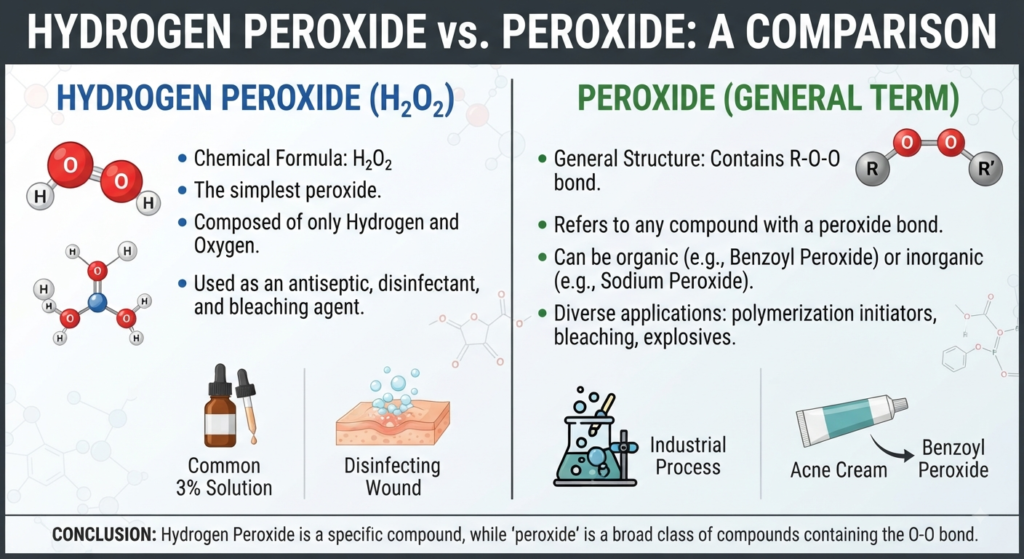
What Is Hydrogen Peroxide?
Hydrogen peroxide is a specific chemical compound with the molecular formula H₂O₂. Its molecule contains two hydrogen atoms and two oxygen atoms connected through an oxygen–oxygen bond. Pure hydrogen peroxide is a pale-blue liquid, although dilute aqueous solutions are generally colorless.
Hydrogen peroxide is widely known for its oxidizing properties. It can decompose into water and oxygen:
2H₂O₂ → 2H₂O + O₂
This decomposition is influenced by factors such as temperature, light, impurities, and catalysts.
Hydrogen peroxide is used in a variety of applications, including surface disinfection, bleaching, water and wastewater treatment, paper and textile processing, and chemical manufacturing. Its properties and applications depend strongly on its concentration and formulation.
Characteristics of Hydrogen Peroxide
- Chemical formula is H₂O₂.
- Contains two hydrogen atoms and two oxygen atoms.
- Contains an oxygen–oxygen bond.
- Pure hydrogen peroxide is a pale-blue liquid.
- Dilute aqueous solutions are generally colorless.
- Acts as an oxidizing agent in many reactions.
- Can also act as a reducing agent under suitable conditions.
- Decomposes into water and oxygen.
- Used in bleaching processes.
- Used in some disinfection applications.
- Important in water and wastewater treatment.
- Used in several industrial chemical processes.
Examples of Hydrogen Peroxide Applications
- Surface disinfection.
- Bleaching of paper and textiles.
- Hair-lightening products.
- Water treatment.
- Wastewater treatment.
- Chemical manufacturing.
- Cleaning applications.
- Laboratory chemistry.
- Certain sterilization processes.
- Oxidation reactions.
What Is Peroxide?
Peroxide is a general chemical term rather than the name of one particular compound. Peroxide compounds are characterized by an oxygen–oxygen single bond (–O–O–), commonly referred to as a peroxide linkage.
In ionic peroxides, the peroxide ion is represented as O₂²⁻, in which the two oxygen atoms are directly bonded. However, peroxide chemistry also includes covalent organic compounds containing an O–O bond, such as benzoyl peroxide.
Because peroxide is a broad category, its members can have very different physical and chemical properties. Some are used as oxidizing agents, while others are important in polymerization, pharmaceuticals, cosmetics, and specialized chemical processes.
Characteristics of Peroxides
- Contain an oxygen–oxygen bond.
- Can be inorganic or organic.
- Chemical formulas vary widely.
- May occur as solids or liquids.
- Properties depend on the specific peroxide.
- Some act as oxidizing agents.
- Some participate in radical reactions.
- Used in chemical manufacturing.
- Used in bleaching processes.
- Used in polymerization reactions.
- Some have pharmaceutical applications.
- Some peroxide compounds require specialized safety controls.
Examples of Peroxide Compounds
- Hydrogen peroxide (H₂O₂).
- Sodium peroxide (Na₂O₂).
- Calcium peroxide (CaO₂).
- Barium peroxide (BaO₂).
- Benzoyl peroxide.
- Organic peroxide compounds.
- Other metal peroxides.
Hydrogen Peroxide vs. Peroxide: Key Differences
1. Definition
The most fundamental difference between Hydrogen Peroxide vs. Peroxide is that hydrogen peroxide refers to one specific chemical compound, while peroxide refers to a broader class of compounds.
Hydrogen peroxide has the fixed chemical formula H₂O₂.
Peroxide, on the other hand, can refer to many compounds containing an oxygen–oxygen peroxide linkage. Their formulas, structures, physical properties, and applications can vary substantially.
Therefore, hydrogen peroxide is a peroxide, but not every peroxide is hydrogen peroxide.
2. Chemical Formula
Hydrogen peroxide has a definite molecular formula:
H₂O₂
This means each molecule contains two hydrogen atoms and two oxygen atoms.
The term peroxide does not have one universal molecular formula because it describes a class of compounds.
For example:
- Hydrogen peroxide: H₂O₂
- Sodium peroxide: Na₂O₂
- Calcium peroxide: CaO₂
- Benzoyl peroxide: C₁₄H₁₀O₄
Thus, the formula of a peroxide depends on the specific compound being discussed.
3. Chemical Structure
Hydrogen peroxide has the structure:
H–O–O–H
The O–O bond is the characteristic peroxide linkage.
Other peroxide compounds also contain an O–O single bond, but the groups attached to the oxygen atoms can be very different.
For example, metal peroxides contain peroxide units associated with metal cations, while organic peroxides contain the O–O group attached to carbon-containing structures.
Therefore, peroxide chemistry encompasses a much wider range of structures than hydrogen peroxide alone.
4. Oxidizing Properties
Hydrogen peroxide is well known for its oxidizing ability. It can participate in oxidation-reduction reactions and can transfer oxygen or promote oxidation under suitable conditions.
However, peroxide compounds do not all behave identically.
Some peroxides are strong oxidizing substances, while the reactivity of others depends on their molecular structure and reaction conditions. Certain organic peroxides can participate in reactions that generate reactive radicals.
Therefore, it is not correct to assume that every peroxide has exactly the same oxidizing strength as hydrogen peroxide.
5. Stability
Stability is another important difference in Hydrogen Peroxide vs. Peroxide.
Hydrogen peroxide is relatively unstable compared with water and can decompose into water and oxygen. The rate of decomposition depends on factors such as concentration, temperature, light exposure, impurities, and catalytic substances.
The stability of peroxide compounds varies considerably.
Some peroxide compounds are comparatively stable under normal conditions, while others can decompose readily or undergo reactions that require careful control.
Thus, the stability of a peroxide must be evaluated according to the specific compound, rather than applying one stability rule to the entire peroxide family.
6. Physical State
Hydrogen peroxide, in its pure form, is a liquid.
Peroxide compounds, however, can exist in different physical forms.
For example, sodium peroxide is a solid, calcium peroxide is a solid, and benzoyl peroxide is a solid under ordinary conditions.
Therefore, the physical state of a peroxide depends on its chemical composition and molecular structure.
7. Solubility
Hydrogen peroxide is commonly encountered as an aqueous solution and mixes readily with water.
Other peroxide compounds can have very different solubilities.
Some inorganic peroxides have limited water solubility or react with water, while organic peroxides may have solubilities determined by their organic structures.
Consequently, solubility cannot be generalized for all peroxide compounds.
8. Uses and Applications
Hydrogen peroxide has a broad range of practical applications.
It is used in disinfection, bleaching, water treatment, wastewater treatment, paper and textile processing, and chemical manufacturing.
Other peroxide compounds have different specialized applications.
For example, sodium peroxide can function as an oxidizing agent, calcium peroxide can be used in environmental and chemical applications, and benzoyl peroxide is widely used in polymerization chemistry and certain topical formulations.
Thus, the application depends on the particular peroxide compound and its chemical properties.
9. Decomposition
Hydrogen peroxide is well known for its decomposition reaction:
2H₂O₂ → 2H₂O + O₂
This reaction produces water and oxygen.
Other peroxides can undergo completely different decomposition reactions depending on their structures. Some may generate oxygen, while organic peroxides can produce reactive radical species.
Therefore, the decomposition behavior of peroxide compounds is highly dependent on their chemical structure.
10. Safety Considerations
Safety is an important consideration when comparing Hydrogen Peroxide vs. Peroxide.
Hydrogen peroxide solutions can cause irritation or tissue damage at sufficiently high concentrations, and concentrated material can present significant oxidizing hazards. Appropriate handling depends on its concentration and intended use.
The safety characteristics of other peroxides vary widely. Some peroxide compounds can be highly reactive and may present fire, decomposition, or explosion hazards under inappropriate conditions.
Therefore, peroxide compounds should not be treated as a single uniform group for safety purposes. The specific chemical, concentration, formulation, and applicable safety instructions must always be considered.
Similarities Between Hydrogen Peroxide and Peroxide
Although Hydrogen Peroxide and Peroxide are not equivalent terms, they share several important chemical characteristics because hydrogen peroxide belongs to the peroxide family.
Some important similarities include:
- Both involve an oxygen–oxygen bond.
- Hydrogen peroxide is itself a peroxide compound.
- Both can participate in oxidation-reduction reactions.
- Both are important in chemistry and industrial processes.
- Both can have oxidizing properties.
- Both can be involved in decomposition reactions.
- Both have applications in chemical processing.
- Both require appropriate handling based on their specific properties.
- Both can participate in reactions involving oxygen transfer.
- Both are important in understanding peroxide chemistry.
- Both can be found in industrial and laboratory applications.
- Both can have different behavior depending on reaction conditions.
Advantages and Uses of Hydrogen Peroxide
Hydrogen peroxide is widely used because it combines useful oxidizing properties with the ability to decompose into water and oxygen under appropriate conditions.
Some important advantages and applications of hydrogen peroxide include:
- Useful as an oxidizing agent.
- Effective for many disinfection applications.
- Useful in bleaching processes.
- Important in water treatment.
- Used in wastewater treatment.
- Useful in paper and textile processing.
- Can decompose into water and oxygen.
- Available in different concentrations for different applications.
- Useful in laboratory chemistry.
- Used in various industrial processes.
Applications of Other Peroxide Compounds
Peroxide compounds other than hydrogen peroxide also have important applications. Their uses depend on their individual chemical structures and properties.
Some examples include:
- Sodium peroxide: used as an oxidizing agent and in selected chemical processes.
- Calcium peroxide: used in certain environmental and chemical applications.
- Benzoyl peroxide: used in polymerization and certain topical formulations.
- Organic peroxides: used as initiators in polymer and plastics manufacturing.
- Metal peroxides: used in selected oxidation and chemical processes.
- Other peroxide compounds: used in research, manufacturing, and specialized chemical applications.
Therefore, the term peroxide covers a much broader range of uses than hydrogen peroxide alone.
Which Is Better—Hydrogen Peroxide or Peroxide?
Neither hydrogen peroxide nor peroxide is universally better because they are not actually two equivalent substances being selected for the same purpose.
Hydrogen peroxide is the appropriate term when referring specifically to H₂O₂, a well-defined compound used in disinfection, bleaching, oxidation, water treatment, and industrial applications.
Peroxide is the appropriate term when referring to the broader family of compounds containing an oxygen–oxygen peroxide linkage. The appropriate peroxide compound depends on the intended chemical or industrial application.
In summary:
- Choose hydrogen peroxide when you mean the specific compound H₂O₂.
- Use peroxide when referring to the broader family of peroxide compounds.
- Select a particular peroxide compound based on its chemical structure, reactivity, stability, and intended application.
Therefore, the key distinction is not which one is better, but whether you are referring to one specific compound or an entire class of compounds.
Conclusion
The comparison of Hydrogen Peroxide vs. Peroxide demonstrates an important distinction between a specific chemical substance and a broader chemical category. Hydrogen peroxide (H₂O₂) is one particular peroxide compound containing two hydrogen atoms and two oxygen atoms, while peroxide is a general term for compounds characterized by an oxygen–oxygen peroxide linkage.
Hydrogen peroxide is widely used for oxidation, bleaching, disinfection, water treatment, and industrial processing. Other peroxide compounds, such as sodium peroxide, calcium peroxide, and benzoyl peroxide, have different structures and applications.
Although hydrogen peroxide is a member of the peroxide family, the two terms should not be used interchangeably in precise chemical discussions. Understanding Hydrogen Peroxide vs. Peroxide helps distinguish the specific properties, formulas, applications, stability, and safety considerations of individual peroxide compounds.
Frequently Asked Questions (FAQs)
The primary difference between Hydrogen Peroxide vs. Peroxide is that hydrogen peroxide is a specific compound with the formula H₂O₂, whereas peroxide is a general term for compounds containing an oxygen–oxygen peroxide linkage.
Yes. Hydrogen peroxide is a peroxide compound. It is one of the best-known members of the peroxide family.
No. Peroxide is a broader chemical term, while hydrogen peroxide refers specifically to H₂O₂. Other peroxides include sodium peroxide, calcium peroxide, and benzoyl peroxide.
The chemical formula of hydrogen peroxide is H₂O₂. It contains two hydrogen atoms and two oxygen atoms connected through an oxygen–oxygen bond.
The peroxide ion is O₂²⁻. It contains two oxygen atoms connected by a single bond and has an overall charge of −2. Ionic peroxide compounds contain this peroxide unit.
Reference:
1. “Peroxide.” Encyclopædia Britannica, Encyclopædia Britannica, Inc,
Read Next:
- Chloride vs. Chlorite: What’s the Difference?
- 1-Butene vs. 2-Butene: What’s the Difference?
- Phosphodiester Bond vs. Phosphoester Bond:
- Difference Between Methyl and Methylene Group (CH3 vs CH2)
- Difference Between Molecular Equation and Ionic Equation
- Olefins vs. Paraffins: What’s the Difference?
- Cetyl Alcohol vs. Stearyl Alcohol: What’s the Difference?
- Buchner Funnel vs. Hirsch Funnel
- Cataphoresis vs. Anaphoresis