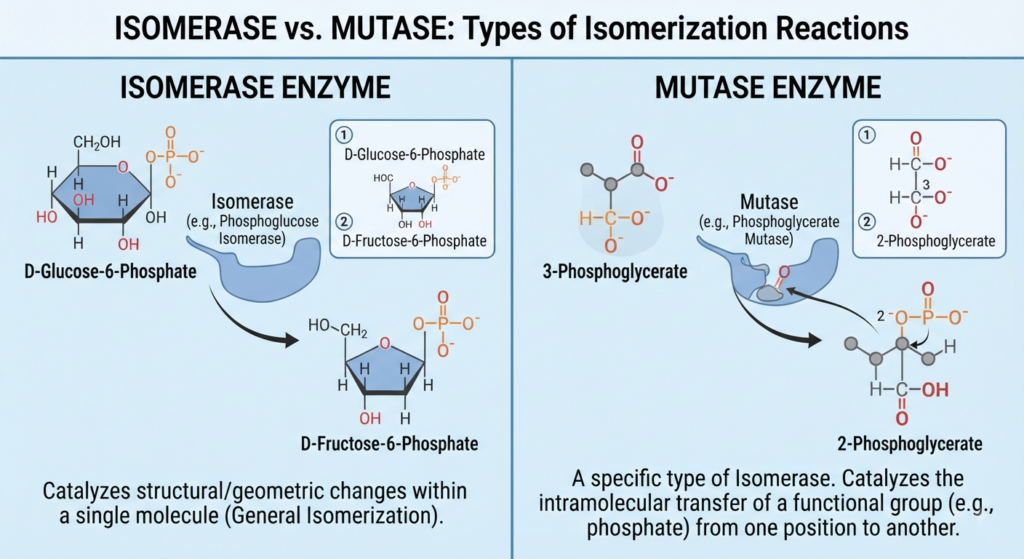
The main difference between Isomerase Enzyme vs. Mutase Enzyme is that an isomerase enzyme catalyzes the conversion of a molecule into another isomer by rearranging its atoms or bonds, whereas a mutase enzyme specifically catalyzes the intramolecular transfer of a functional group, such as a phosphate group, from one position to another within the same molecule. Mutases are therefore a specialized type of isomerase.
Understanding Isomerase Enzyme vs. Mutase Enzyme is important in biochemistry because both enzyme types participate in metabolic pathways by changing the internal arrangement of molecules without necessarily changing their overall molecular formula.
Isomerase Enzyme vs. Mutase Enzyme Comparison Table
The table below highlights the major differences between Isomerase Enzyme vs. Mutase Enzyme.
| Feature | Isomerase Enzyme | Mutase Enzyme |
|---|---|---|
| Basic Definition | Enzyme that catalyzes an isomerization reaction | Enzyme that transfers a functional group within the same molecule |
| Main Reaction | Rearrangement of atoms or bonds | Intramolecular transfer of a functional group |
| Enzyme Class | EC 5 | EC 5 |
| Substrate | Various molecules, including sugars and other metabolites | Molecules containing transferable functional groups |
| Product | An isomer of the starting substrate | A rearranged form of the same molecule |
| Functional Group Movement | May or may not involve movement of a functional group | Characteristically involves movement of a functional group |
| Specificity | Depends on the particular isomerase | Usually highly specific for a particular substrate and group |
| Biological Role | Important in metabolism and molecular rearrangement | Important in metabolic pathways requiring positional group transfer |
| Example | Triosephosphate isomerase | Phosphoglycerate mutase |
| Common Reaction | Glucose-6-phosphate ⇌ fructose-6-phosphate | 3-phosphoglycerate ⇌ 2-phosphoglycerate |
What Is an Isomerase Enzyme?
An isomerase enzyme is an enzyme that catalyzes the conversion of one isomer into another. Isomers have the same molecular formula but differ in the arrangement of their atoms or bonds.
Isomerases belong to EC class 5, which includes enzymes that catalyze intramolecular rearrangements. These enzymes are important because many metabolic pathways require a molecule to be converted into a different structural or stereochemical form before the next reaction can occur.
For example, triosephosphate isomerase catalyzes the reversible conversion between dihydroxyacetone phosphate and glyceraldehyde-3-phosphate during glycolysis.
Characteristics of Isomerase Enzymes
Some important characteristics of isomerase enzymes include:
- Catalyze intramolecular rearrangement reactions.
- Convert one isomer into another.
- Belong to EC enzyme class 5.
- Usually have high substrate specificity.
- Can act on sugars, amino acids, and other metabolites.
- Participate in important metabolic pathways.
- May involve changes in the position of atoms, bonds, or functional groups.
- Often catalyze reversible reactions.
- Help convert metabolites into forms suitable for subsequent reactions.
- Contribute to efficient cellular metabolism.
Examples of Isomerase Enzymes
Common examples include:
- Triosephosphate isomerase
- Glucose-6-phosphate isomerase
- Phosphoglucose isomerase
- Ribose-5-phosphate isomerase
- Xylose isomerase
- Alanine racemase
These enzymes perform different types of molecular rearrangements while remaining within the broad isomerase category.
What Is a Mutase Enzyme?
A mutase enzyme is an enzyme that catalyzes the transfer of a functional group from one position to another within the same molecule. Because the group is transferred internally rather than between two separate molecules, the reaction is an intramolecular rearrangement.
Mutases are considered a specialized group within the isomerases (EC 5). Their defining feature is the movement of a functional group from one location of a molecule to another.
A well-known example is phosphoglycerate mutase, which catalyzes the reversible conversion of 3-phosphoglycerate to 2-phosphoglycerate during glycolysis. In this reaction, the phosphate group changes position within the same molecule.
Characteristics of Mutase Enzymes
Important characteristics of mutase enzymes include:
- Catalyze intramolecular group-transfer reactions.
- Move a functional group from one position to another.
- Belong to EC class 5.
- Usually have high substrate specificity.
- Participate in metabolic pathways.
- May require cofactors or catalytic groups depending on the enzyme.
- Do not transfer the group to a separate substrate.
- Produce a rearranged form of the original molecule.
- Can catalyze reversible reactions.
- Are important in intermediary metabolism.
Examples of Mutase Enzymes
Examples of mutases include:
- Phosphoglycerate mutase
- Bisphosphoglycerate-dependent phosphoglycerate mutase
- Methylmalonyl-CoA mutase
- Phosphopentomutase
- Phosphoglucomutase
These enzymes differ in their substrates and the functional groups involved in their reactions.
Isomerase Enzyme vs. Mutase Enzyme: Key Differences
1. Definition
The primary difference between Isomerase Enzyme vs. Mutase Enzyme is their scope of activity.
An isomerase is a broad class of enzymes that catalyze intramolecular rearrangements that produce an isomer.
A mutase is a more specific type of isomerase that transfers a functional group from one position to another within the same molecule.
Therefore, mutases can be considered a specialized subgroup of isomerases.
2. Type of Reaction
Isomerases catalyze different types of isomerization reactions. These can include changes in structural arrangement, stereochemistry, or the position of groups within a molecule.
Mutases specifically catalyze the movement of a functional group within a molecule.
For example, phosphoglycerate mutase moves a phosphate group between two positions of a glycerate molecule.
3. Functional Group Transfer
Functional group movement is particularly characteristic of mutase enzymes.
Some isomerases rearrange atoms or stereochemical configurations without a simple positional transfer of a functional group.
Thus, mutase activity represents a more specific form of molecular rearrangement.
4. Enzyme Classification
Both isomerases and mutases belong to EC class 5.
However, “isomerase” describes the broader enzyme class, whereas “mutase” identifies enzymes that perform a particular type of intramolecular transfer.
This classification helps explain why mutases are closely related to isomerases.
5. Role in Metabolism
Isomerases are involved in many metabolic pathways where one molecular form needs to be converted into another.
For example, triosephosphate isomerase helps balance two three-carbon intermediates during glycolysis.
Mutases are especially important when a metabolic pathway requires a functional group to occupy a different position on the same molecule.
For example, phosphoglycerate mutase changes the position of a phosphate group during glycolysis.
6. Reaction Examples
A typical isomerase reaction is:
Dihydroxyacetone phosphate ⇌ Glyceraldehyde-3-phosphate
This reaction changes the arrangement of the atoms while retaining the same molecular formula.
A typical mutase reaction is:
3-Phosphoglycerate ⇌ 2-Phosphoglycerate
Here, the phosphate group changes from the third carbon to the second carbon of the molecule.
Therefore, the second reaction illustrates the characteristic intramolecular group transfer associated with mutases.
7. Biological Importance
Isomerases and mutases are essential because metabolic reactions often require compounds to exist in a particular structural form.
An isomerase can convert one form of a molecule into another form that is better suited for the next step of a pathway. This is particularly important in carbohydrate metabolism.
Mutases perform a more specific role by relocating functional groups. Phosphoglycerate mutase, for example, changes the position of a phosphate group during glycolysis, allowing the pathway to proceed toward the formation of phosphoenolpyruvate and ultimately ATP production.
Other mutases participate in amino acid and organic acid metabolism. Methylmalonyl-CoA mutase, for instance, is involved in the rearrangement of methylmalonyl-CoA to succinyl-CoA.
Thus, both groups contribute to the controlled transformation of metabolic intermediates.
Similarities Between Isomerase and Mutase Enzymes
Although Isomerase Enzyme vs. Mutase Enzyme describes an important distinction, the two enzyme groups also have several similarities.
Some major similarities include:
- Both catalyze intramolecular rearrangements.
- Both belong to EC class 5.
- Both generally act on specific substrates.
- Both are important in metabolism.
- Both change the arrangement of a molecule.
- Both can catalyze reversible reactions.
- Both lower the activation energy of their respective reactions.
- Both are important for efficient biochemical pathways.
- Both can produce an alternative molecular form of the substrate.
- Mutases are closely related to the broader isomerase category.
Which Is More Specific—Isomerase or Mutase?
A mutase is generally more specific in terms of reaction type because it refers to an enzyme that transfers a functional group from one position to another within the same molecule.
An isomerase is a broader category that includes several kinds of intramolecular rearrangements.
Therefore:
- Isomerase = broader enzyme category for intramolecular rearrangement.
- Mutase = specialized isomerase that transfers a functional group within a molecule.
This relationship is one of the easiest ways to remember the distinction between the two terms.
Conclusion
The comparison of Isomerase Enzyme vs. Mutase Enzyme shows that both enzymes catalyze important intramolecular rearrangements, but mutases represent a more specialized type of isomerase.
Isomerase enzymes catalyze the conversion of one isomer into another through changes in molecular arrangement. Mutase enzymes, which belong to the isomerase class, specifically transfer a functional group from one position to another within the same molecule.
Examples such as triosephosphate isomerase demonstrate general isomerization, whereas phosphoglycerate mutase demonstrates positional movement of a phosphate group.
Understanding Isomerase Enzyme vs. Mutase Enzyme therefore helps clarify enzyme classification and explains how different molecular rearrangements support essential metabolic pathways.
Frequently Asked Questions (FAQs)
The main difference between Isomerase Enzyme vs. Mutase Enzyme is that isomerases catalyze intramolecular rearrangements broadly, whereas mutases specifically transfer a functional group from one position to another within the same molecule.
Yes. Mutases are generally classified as specialized isomerases because they catalyze intramolecular rearrangements involving the transfer of a functional group within a molecule.
Triosephosphate isomerase is a well-known example. It catalyzes the reversible conversion of dihydroxyacetone phosphate into glyceraldehyde-3-phosphate.
Phosphoglycerate mutase is a common example. It catalyzes the reversible conversion of 3-phosphoglycerate to 2-phosphoglycerate by moving the phosphate group within the molecule.
Yes. Both are included in EC class 5, the isomerase class of enzymes.
Reference:
1. “Mutase.” An Overview | ScienceDirect Topics.
Read Next: