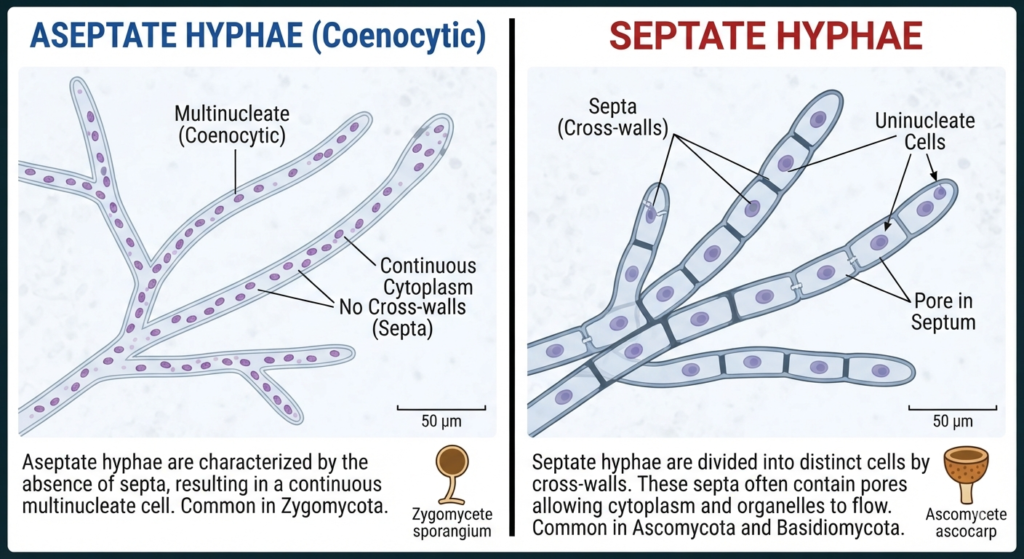
The main difference between Aseptate Hyphae vs. Septate Hyphae is that aseptate hyphae lack cross-walls called septa, resulting in a continuous cytoplasmic structure that may contain multiple nuclei, whereas septate hyphae contain septa that divide the hypha into separate cellular compartments. Aseptate hyphae allow relatively unrestricted movement of cytoplasm, nuclei, and nutrients throughout the hypha, while septate hyphae provide greater compartmentalization and structural control.
Understanding Aseptate Hyphae vs. Septate Hyphae is important in mycology, biology, plant pathology, and microbiology because the presence or absence of septa affects fungal structure, nutrient transport, growth, damage response, and reproduction. These two forms also help describe the structural diversity found among different groups of fungi.
Aseptate Hyphae vs. Septate Hyphae Comparison Table
The table below highlights the major differences between Aseptate Hyphae vs. Septate Hyphae.
| Feature | Aseptate Hyphae | Septate Hyphae |
|---|---|---|
| Definition | Hyphae that lack internal cross-walls or septa | Hyphae divided by internal cross-walls called septa |
| Internal Structure | Continuous cytoplasmic mass | Divided into cellular compartments |
| Septa | Absent | Present |
| Nuclei | Often numerous nuclei within continuous cytoplasm | Nuclei occur within compartments and may be one or several per compartment |
| Cytoplasmic Movement | Relatively unrestricted along the hypha | Controlled through openings in septa |
| Compartmentalization | Little or no compartmentalization | Stronger compartmentalization |
| Damage Response | Damage can affect a larger continuous region | Septa can help limit damage to neighboring compartments |
| Nutrient Transport | Cytoplasm permits rapid movement along the continuous hypha | Nutrients move between compartments through septal openings |
| Common Occurrence | Common in coenocytic fungi, including many mucoralean fungi | Common in many Ascomycota and Basidiomycota |
| Alternative Name | Coenocytic hyphae | Septate or cellular hyphae |
| Structural Advantage | Supports rapid internal cytoplasmic flow | Provides compartmentalization and structural control |
| Examples | Rhizopus, Mucor | Aspergillus, Penicillium, many mushroom-forming fungi |
What Are Aseptate Hyphae?
Aseptate hyphae are fungal hyphae that do not contain regular internal cross-walls called septa. Because septa are absent, the cytoplasm forms a continuous internal compartment containing multiple nuclei in many fungi. For this reason, aseptate hyphae are also commonly described as coenocytic hyphae.
The continuous structure allows cytoplasm, nutrients, organelles, and nuclei to move through a large portion of the hypha. Aseptate hyphae are particularly characteristic of many fungi in the group historically called Zygomycetes, although modern fungal classification places many of these organisms within the Mucorales and related groups.
Characteristics of Aseptate Hyphae
- Lack regular internal septa.
- Have a continuous cytoplasmic structure.
- Often contain multiple nuclei.
- Also called coenocytic hyphae.
- Allow relatively unrestricted cytoplasmic movement.
- Permit movement of nutrients and organelles along the hypha.
- Have limited compartmentalization.
- Common in many mucoralean fungi.
- Can form extensive fungal networks.
- Participate in nutrient absorption and fungal growth.
Examples of Aseptate Hyphae
- Rhizopus
- Mucor
- Lichtheimia
- Other members of the Mucorales
- Certain other coenocytic fungi
What Are Septate Hyphae?
Septate hyphae are fungal hyphae that contain internal cross-walls known as septa. These septa divide the long hyphal filament into separate compartments. In many fungi, septa contain pores that allow controlled movement of cytoplasm and other materials between adjacent compartments.
Septate hyphae are particularly common among Ascomycota and Basidiomycota. The compartments created by septa provide greater structural organization and can help limit the effects of local damage to a particular region of the hypha.
Characteristics of Septate Hyphae
- Contain internal cross-walls called septa.
- Divide the hypha into compartments.
- Septa usually contain pores or openings.
- Allow controlled movement of cytoplasm.
- Provide greater compartmentalization.
- Common in Ascomycota and Basidiomycota.
- May contain one or multiple nuclei per compartment.
- Help provide structural support.
- Can limit the spread of damage.
- Participate in nutrient absorption, growth, and reproduction.
Examples of Septate Hyphae
- Aspergillus
- Penicillium
- Neurospora
- Saccharomyces relatives with filamentous forms
- Many mushroom-forming fungi
- Many other Ascomycota and Basidiomycota
Aseptate Hyphae vs. Septate Hyphae: Key Differences
1. Presence of Septa
The most obvious difference between Aseptate Hyphae vs. Septate Hyphae is the presence or absence of septa.
Aseptate hyphae do not have regular cross-walls dividing the hypha. Their cytoplasm therefore remains continuous along the length of the hypha.
Septate hyphae, in contrast, contain cross-walls at intervals. These septa divide the hypha into separate compartments while usually allowing communication between neighboring compartments through pores.
Thus, the fundamental structural distinction is simple: aseptate hyphae lack septa, whereas septate hyphae possess septa.
2. Internal Organization
The internal organization of the two types of hyphae is also different.
In aseptate hyphae, the cytoplasm is continuous, and several nuclei may occur within the same continuous cytoplasmic region. There are no regular walls separating one region from another.
In septate hyphae, the septa create individual compartments along the fungal filament. Each compartment can contain one or more nuclei, depending on the fungal species and developmental stage.
Therefore, aseptate hyphae have a more continuous internal organization, while septate hyphae have a more compartmentalized structure.
3. Cytoplasmic Movement
Cytoplasmic movement is another important difference between the two types of hyphae.
In aseptate hyphae, cytoplasm can move relatively freely through the continuous hyphal structure. Organelles, nutrients, and other cellular materials can therefore be distributed along considerable distances without having to pass through septal openings.
In septate hyphae, movement between adjacent compartments occurs through openings in the septa. This provides greater control over the movement of materials within the fungal filament.
Consequently, aseptate hyphae provide a more continuous pathway for cytoplasmic movement, whereas septate hyphae provide greater regulation through compartmentalization.
4. Compartmentalization
The degree of compartmentalization differs significantly between aseptate and septate hyphae.
Aseptate hyphae have little internal compartmentalization because there are no regular septa dividing the cytoplasm. The entire hyphal region functions as a continuous cytoplasmic system.
Septate hyphae are divided into multiple compartments by septa. These compartments provide greater organization and allow different regions of the hypha to function with some degree of independence.
This compartmentalization is one of the major structural advantages of septate hyphae.
5. Response to Damage
The presence of septa can influence how fungi respond to physical damage.
In aseptate hyphae, damage to one region can potentially affect a much larger continuous area because the cytoplasm is not separated by regular cross-walls.
In septate hyphae, septa can help isolate damaged regions. Many fungi can regulate or block septal pores after injury, reducing the loss of cytoplasm and limiting the spread of damage.
Therefore, septation can provide an important protective mechanism in filamentous fungi.
6. Nutrient Transport
Both types of hyphae are highly effective at absorbing nutrients from their surroundings, but their internal transport systems differ.
In aseptate hyphae, nutrients can move through the continuous cytoplasm without encountering regular septal barriers. This allows materials to be distributed throughout the hypha.
In septate hyphae, nutrients and other materials move between compartments through septal openings. Although this creates additional control points, the interconnected compartments still permit efficient transport throughout the fungal network.
Thus, aseptate hyphae emphasize continuous internal movement, whereas septate hyphae emphasize controlled movement between compartments.
7. Structural Support
Septation also influences the structural organization of fungal hyphae.
Aseptate hyphae depend largely on the continuous hyphal wall and cytoplasmic organization for their structure. Because the hypha lacks regular internal cross-walls, there is less internal division.
Septate hyphae have additional cross-walls that divide the filament into sections. These structures contribute to the organization of the hypha and can provide additional control over its internal architecture.
Therefore, septate hyphae generally exhibit greater internal structural organization.
8. Occurrence in Fungi
Aseptate and septate hyphae occur in different groups of fungi.
Aseptate or coenocytic hyphae are common among many fungi in the Mucorales, including genera such as Rhizopus and Mucor.
Septate hyphae are widespread among Ascomycota and Basidiomycota, including fungi such as Aspergillus, Penicillium, and many mushroom-forming species.
However, fungal classification is more complex than simply dividing fungi into “aseptate” and “septate” groups, and exceptions occur.
9. Growth and Development
The structural arrangement of hyphae can influence fungal growth and development.
Aseptate hyphae have a continuous cytoplasmic system that can support rapid distribution of materials throughout growing regions.
Septate hyphae use compartmentalization while maintaining communication between adjacent regions. This arrangement allows different parts of the fungal filament to maintain coordinated growth while providing some degree of internal control.
Both types are therefore well adapted to filamentous growth, but they achieve internal organization in different ways.
Similarities Between Aseptate and Septate Hyphae
Although Aseptate Hyphae and Septate Hyphae differ in their internal structure, they share many important characteristics. Both are filamentous structures that contribute to fungal growth, nutrient absorption, environmental exploration, and reproduction.
Some important similarities between aseptate and septate hyphae include:
- Both are elongated filamentous structures found in fungi.
- Both contribute to fungal growth and development.
- Both absorb nutrients from the surrounding environment.
- Both increase the surface area available for nutrient uptake.
- Both can form extensive networks known as mycelia.
- Both contain fungal cytoplasm and nuclei.
- Both have cell walls primarily containing chitin and other structural components.
- Both can participate in fungal reproduction.
- Both can grow by extension at their tips.
- Both help fungi colonize substrates and explore their environments.
- Both can form specialized structures under suitable conditions.
- Both are important components of the fungal body.
When Are Aseptate Hyphae Useful?
Aseptate hyphae have a continuous cytoplasmic structure that can be advantageous for rapid internal movement of materials. Their lack of regular septa provides a continuous pathway through the fungal filament.
Some important characteristics that can make aseptate hyphae advantageous include:
- Provide continuous cytoplasmic space.
- Allow relatively unrestricted movement of cellular materials.
- Facilitate distribution of nutrients throughout the hypha.
- Support rapid hyphal growth.
- Reduce the need for materials to cross regular septal barriers.
- Allow nuclei to occur within a common cytoplasmic system.
- Support efficient exploration of substrates.
- Common in fungi adapted to rapid filamentous growth.
- Enable extensive coenocytic networks.
- Support nutrient acquisition and fungal development.
When Are Septate Hyphae Useful?
Septate hyphae provide a more compartmentalized organization. The presence of septa allows fungi to control movement between different parts of the hypha and can help limit the effects of local injury.
Some important characteristics that can make septate hyphae advantageous include:
- Provide compartmentalized internal organization.
- Help control cytoplasmic movement.
- Can limit the effects of local damage.
- Provide structural organization to long hyphae.
- Allow controlled movement through septal pores.
- Support efficient nutrient distribution.
- Help maintain separate cellular compartments.
- Common in many advanced filamentous fungi.
- Support specialized fungal structures.
- Facilitate complex fungal growth and development.
Aseptate Hyphae vs. Septate Hyphae: Which Is More Efficient?
Neither aseptate hyphae nor septate hyphae is universally more efficient because each structural arrangement provides different advantages.
Aseptate hyphae can be advantageous when continuous cytoplasmic movement is important. Since the hypha lacks regular cross-walls, nutrients, organelles, and other cellular materials can move through a continuous internal pathway.
Septate hyphae can be advantageous when compartmentalization and internal control are important. Septa divide the hypha into sections while pores allow communication between neighboring compartments. This arrangement can help limit damage and regulate the movement of cellular materials.
In summary:
- Aseptate hyphae are useful when continuous cytoplasmic movement and rapid internal transport are advantageous.
- Septate hyphae are useful when compartmentalization, structural organization, and controlled transport are advantageous.
Therefore, neither type is universally superior. Both represent successful structural adaptations that allow fungi to grow, obtain nutrients, reproduce, and survive in diverse environments.
Conclusion
The comparison of Aseptate Hyphae vs. Septate Hyphae demonstrates two major forms of fungal hyphal organization. Aseptate hyphae lack regular septa and contain a continuous cytoplasmic structure that often includes multiple nuclei. This arrangement allows relatively unrestricted movement of nutrients, organelles, and cytoplasm throughout the hypha.
In contrast, septate hyphae contain cross-walls called septa that divide the hypha into compartments. These septa usually contain pores that allow controlled communication between adjacent compartments. This organization provides greater compartmentalization and can help fungi respond to local damage.
Although the two types differ in septation, internal organization, cytoplasmic movement, and response to damage, both play essential roles in fungal growth, nutrient absorption, reproduction, and environmental adaptation. Understanding Aseptate Hyphae vs. Septate Hyphae is therefore important for studying fungal morphology, classification, mycology, microbiology, and plant pathology.
Frequently Asked Questions (FAQs)
The primary difference between Aseptate Hyphae vs. Septate Hyphae is the presence of septa. Aseptate hyphae lack regular cross-walls, creating a continuous cytoplasmic structure, whereas septate hyphae contain cross-walls called septa that divide the hypha into compartments.
Aseptate hyphae are fungal filaments that lack regular internal septa. They are often called coenocytic hyphae because the continuous cytoplasm may contain multiple nuclei.
Septate hyphae are fungal filaments divided into compartments by internal cross-walls called septa. These septa commonly contain pores that allow communication between neighboring compartments.
Aseptate or coenocytic hyphae are common in many fungi belonging to the Mucorales, including genera such as Rhizopus and Mucor.
Septate hyphae are common in many members of Ascomycota and Basidiomycota, including fungi such as Aspergillus, Penicillium, and many mushroom-forming fungi.
Reference:
1. “Hypha.” Wikipedia, Wikimedia Foundation, 30 Dec. 2018
2. “Septate vs Non-Septate Hyphae.” Biology Dictionary, 25 Apr. 2019
Read Next:
- Difference Between Etiology and Pathophysiology
- Difference Between DNA Fingerprinting and DNA Profiling
- Difference Between Detritivores and Saprotrophs
- Difference Between Glenoid Cavity and Acetabulum
- Difference Between Mycoplasma and Mycobacterium
- Pinnatifid vs. Pinnatisect: Key Differences Explained
- Phosphodiester Bond vs. Phosphoester Bond
- Cloning vs. Subcloning
- Chemoorganotrophs vs. Chemolithotrophs
- Acantholysis vs. Acanthosis
- Flatbread vs. Pita
- Isomerase Enzyme vs. Mutase Enzyme