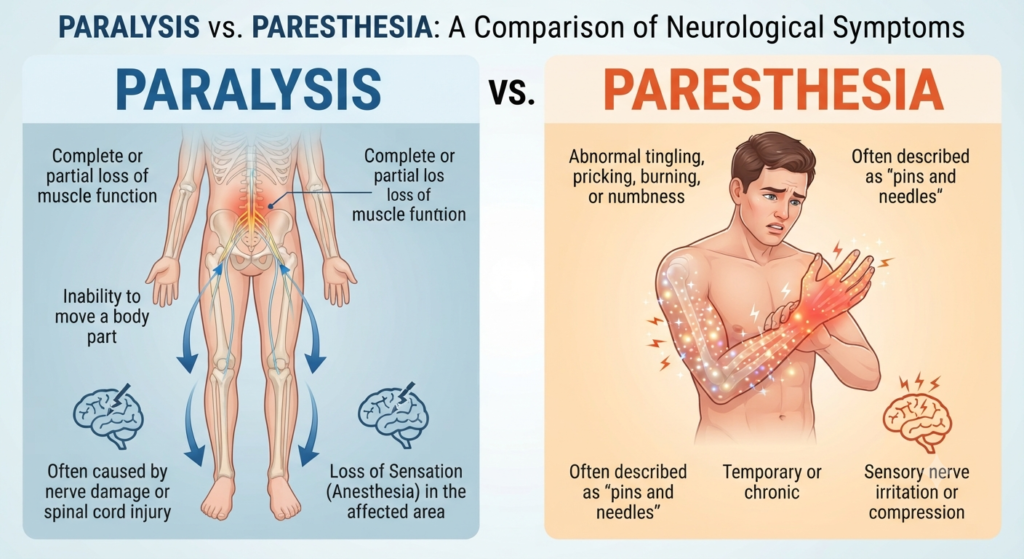
The main difference between Paralysis vs. Paresthesia is that paralysis causes partial or complete loss of voluntary muscle movement, whereas paresthesia causes abnormal sensations such as tingling, numbness, burning, or “pins and needles” without necessarily affecting muscle strength. Paralysis is usually caused by damage to the brain, spinal cord, or motor nerves, while paresthesia commonly results from irritation, compression, or injury to sensory nerves.
Although both conditions involve the nervous system, they affect different nerve functions. Paralysis primarily affects motor nerves, making movement difficult or impossible, whereas paresthesia affects sensory nerves, altering how the body perceives touch, temperature, or pain. Understanding these differences is important because some underlying causes, such as stroke or spinal cord injury, require immediate medical attention.
Paralysis vs. Paresthesia Comparison Table
The table below highlights the major differences between Paralysis vs. Paresthesia.
| Feature | Paralysis | Paresthesia |
|---|---|---|
| Definition | Loss of voluntary muscle movement | Abnormal sensations without loss of movement |
| Primary Nerves Affected | Motor nerves | Sensory nerves |
| Main Symptom | Inability to move muscles | Tingling, numbness, burning, or pins and needles |
| Muscle Strength | Reduced or absent | Usually normal |
| Sensation | May be reduced depending on the cause | Altered sensation is the main symptom |
| Movement | Difficult or impossible | Usually unaffected |
| Common Causes | Stroke, spinal cord injury, brain injury, nerve damage | Nerve compression, diabetes, vitamin deficiency, poor circulation |
| Severity | Can be life-threatening | Usually less severe but may indicate nerve disease |
| Duration | Temporary or permanent | Temporary or chronic |
| Treatment | Rehabilitation, medications, surgery, supportive care | Treat underlying cause, medications, lifestyle modifications |
| Emergency Condition | Often requires immediate treatment | Sometimes requires medical evaluation depending on the cause |
What Is Paralysis?
Paralysis is the inability to voluntarily move one or more muscles due to disruption of signals between the brain, spinal cord, and muscles. The condition occurs when the motor pathways responsible for controlling movement become damaged or interrupted.
The severity of paralysis varies significantly. Some individuals experience weakness in a single muscle group, while others lose movement in an entire limb or even the whole body. Paralysis may develop suddenly, as in a stroke, or gradually because of progressive neurological diseases.
Depending on the affected area, paralysis is classified into several types:
- Monoplegia – affects one limb.
- Hemiplegia – affects one side of the body.
- Paraplegia – affects both legs and the lower body.
- Quadriplegia (Tetraplegia) – affects both arms and legs.
- Facial paralysis – affects muscles of the face.
Some forms of paralysis improve with treatment, while others may become permanent if nerve damage is irreversible.
Characteristics of Paralysis
Paralysis has several distinguishing characteristics that help healthcare professionals diagnose the condition and determine its severity.
- Loss of voluntary muscle movement: The defining characteristic of paralysis is the inability to voluntarily move one or more muscles. Depending on the cause, the loss of movement may be partial (partial paralysis) or complete (complete paralysis).
- Muscle weakness: Paralysis is often preceded by progressive muscle weakness, making everyday activities such as walking, lifting objects, grasping items, or climbing stairs increasingly difficult.
- Abnormal muscle tone: The affected muscles may become stiff and rigid (spastic paralysis) or loose and floppy (flaccid paralysis), depending on whether the damage involves the brain, spinal cord, or peripheral nerves.
- Reduced or absent reflexes: Damage to the nervous system may weaken or eliminate normal reflex responses, affecting the body’s automatic reactions to stimuli.
- Muscle atrophy: When muscles remain inactive for extended periods, they gradually shrink in size and lose strength due to lack of use, a condition known as muscle atrophy.
- Possible loss of sensation: Although paralysis primarily affects motor function, some individuals may also experience numbness, reduced sensation, or complete loss of feeling if sensory nerves are damaged along with motor nerves.
Features of Paralysis
Paralysis affects more than just the ability to move. Depending on the location and severity of nerve damage, it can impair mobility, coordination, and other essential body functions.
- Complete or partial loss of movement: Paralysis may affect a single muscle, one limb, or multiple parts of the body. Some individuals lose all voluntary movement, while others retain limited muscle control.
- Difficulty performing daily activities: Simple tasks such as walking, standing, writing, eating, dressing, or driving can become difficult or impossible, often requiring assistance or mobility aids.
- Abnormal muscle tone: The affected muscles may become stiff and rigid (spastic paralysis) due to upper motor neuron damage or loose and floppy (flaccid paralysis) because of lower motor neuron injury.
- Poor balance and coordination: Loss of normal muscle control can reduce stability and coordination, increasing the risk of falls and making movements less precise.
- Reduced independence: Depending on the severity, paralysis can limit a person’s ability to work, participate in recreational activities, or perform self-care tasks without support.
- Secondary health complications: Long-term paralysis can lead to several complications, including pressure sores, muscle contractures, joint stiffness, blood clots, urinary tract infections, and respiratory problems in severe cases. Regular rehabilitation and proper medical care help reduce these risks.
Common Causes of Paralysis
Paralysis is caused by conditions that damage the nervous system, preventing the brain from sending movement signals to the muscles.
- Stroke: A stroke interrupts blood flow to the brain, damaging the areas responsible for controlling muscle movement and often causing paralysis on one side of the body.
- Spinal cord injury: Trauma to the spinal cord from accidents, falls, or sports injuries can block nerve signals between the brain and muscles, leading to partial or complete paralysis below the injury site.
- Brain injury: Severe head injuries caused by accidents, falls, or trauma can damage motor control centers in the brain, resulting in temporary or permanent paralysis.
- Multiple sclerosis (MS): This autoimmune disease damages the protective covering of nerve fibers, disrupting nerve communication and causing muscle weakness, coordination problems, and paralysis in advanced stages.
- Cerebral palsy: Brain damage occurring before, during, or shortly after birth can impair muscle control and movement, leading to varying degrees of paralysis and motor disability.
- Amyotrophic lateral sclerosis (ALS): Also known as Lou Gehrig’s disease, ALS progressively destroys motor neurons, causing increasing muscle weakness that eventually leads to paralysis.
- Brain tumors: Tumors that compress or damage areas of the brain responsible for movement can cause weakness or paralysis, depending on their size and location.
- Peripheral nerve injuries: Severe injuries, cuts, or compression of peripheral nerves may interrupt signals to specific muscles, resulting in localized paralysis.
- Guillain-Barré syndrome (GBS): This rare autoimmune disorder causes the immune system to attack peripheral nerves, leading to rapidly progressing muscle weakness that can develop into temporary paralysis.
- Severe nervous system infections: Infections such as polio, meningitis, encephalitis, or other neurological infections can damage the brain, spinal cord, or nerves, potentially causing paralysis.
The severity, symptoms, and likelihood of recovery depend on the location, extent, and underlying cause of the nervous system damage. Early diagnosis and timely treatment often improve outcomes and reduce the risk of long-term disability.
What Is Paresthesia?
Paresthesia refers to abnormal skin sensations that occur without an obvious external stimulus. People commonly describe it as tingling, numbness, prickling, burning, crawling, or a “pins and needles” feeling.
Unlike paralysis, paresthesia does not usually cause loss of muscle movement. Instead, it results from irritation, compression, or dysfunction of sensory nerves responsible for transmitting touch, pain, and temperature signals.
Temporary paresthesia is extremely common. For example, sitting with crossed legs for too long may compress a nerve and produce numbness that disappears after changing position.
However, chronic or recurrent paresthesia may indicate an underlying medical condition requiring evaluation.
Characteristics of Paresthesia
Paresthesia has several distinctive characteristics that help differentiate it from other neurological conditions. It primarily affects sensory nerves, causing unusual sensations without significantly impairing muscle movement.
- Tingling sensation: The most common characteristic is a tingling feeling, often described as tiny electric shocks or a mild “pins and needles” sensation beneath the skin.
- Numbness: The affected area may lose normal sensation, making it difficult to detect touch, pressure, pain, or temperature accurately.
- Burning or prickling sensations: Some individuals experience burning, stinging, prickling, or crawling sensations that range from mild discomfort to severe irritation.
- Pins and needles feeling: Temporary nerve compression commonly causes a “pins and needles” sensation, which usually disappears once pressure on the nerve is relieved and normal nerve function returns.
- Increased sensitivity: Damaged or irritated sensory nerves may become overly sensitive, causing even light touch or mild pressure to feel uncomfortable or painful.
- Intermittent or persistent symptoms: Paresthesia may occur briefly and resolve within minutes, or it may persist for weeks, months, or longer in chronic neurological disorders or ongoing nerve damage.
Features of Paresthesia
Paresthesia primarily affects sensation rather than muscle movement. Depending on the underlying cause, the symptoms may be temporary or persistent and can range from mild discomfort to significant sensory impairment.
- Altered sensation: The hallmark feature of paresthesia is abnormal sensory perception, including tingling, numbness, burning, or a “pins and needles” feeling, usually without significant muscle weakness.
- Localized symptoms: Paresthesia commonly affects specific areas of the body, particularly the hands, fingers, feet, toes, arms, legs, or face, although it can occur anywhere sensory nerves are present.
- Temporary or chronic condition: Short-term paresthesia, often caused by temporary nerve compression, usually resolves on its own. Persistent or recurrent paresthesia may indicate nerve damage or an underlying neurological disorder.
- Occurs during rest or activity: Symptoms may develop while sitting, standing, sleeping, or performing repetitive movements. In some individuals, paresthesia is more noticeable at night or after prolonged inactivity.
- Usually reversible: When caused by temporary pressure on a nerve or reduced blood flow, paresthesia typically disappears after normal nerve function is restored. Chronic cases may require treatment of the underlying condition.
- May interfere with daily activities: Persistent numbness or tingling can reduce grip strength, impair fine motor skills, and make tasks such as writing, typing, buttoning clothes, or walking more difficult, especially when the hands or feet are affected.
Common Causes of Paresthesia
Paresthesia develops when sensory nerves are irritated or compressed, causing abnormal sensations such as tingling, numbness, or burning.
- Nerve compression: Prolonged pressure on a nerve—such as sitting with crossed legs, leaning on an elbow, or sleeping in an awkward position—can temporarily reduce nerve function and cause numbness or tingling.
- Carpal tunnel syndrome: Compression of the median nerve at the wrist commonly causes tingling, numbness, and discomfort in the thumb, index finger, middle finger, and part of the ring finger.
- Diabetes-related peripheral neuropathy: High blood sugar levels can gradually damage peripheral nerves, leading to chronic tingling, numbness, burning pain, and sensory loss, especially in the feet and legs.
- Vitamin B12 deficiency: A lack of vitamin B12 can impair nerve health and cause numbness, tingling, weakness, and balance problems.
- Cervical or lumbar disc herniation: A herniated disc in the neck or lower back may compress nearby nerve roots, producing tingling, numbness, or radiating pain in the arms or legs.
- Multiple sclerosis (MS): This autoimmune disorder damages the protective covering of nerve fibers, often causing intermittent or persistent paresthesia along with other neurological symptoms.
- Stroke: Reduced blood flow to the brain can cause sudden numbness or tingling, usually affecting one side of the body and often accompanied by weakness or speech difficulty.
- Poor blood circulation: Conditions that reduce blood flow to the limbs can cause temporary numbness and tingling because nerves receive insufficient oxygen and nutrients.
- Hypothyroidism: An underactive thyroid can contribute to fluid retention and nerve compression, leading to tingling and numbness in the hands and feet.
- Alcohol-related nerve damage: Chronic excessive alcohol consumption can damage peripheral nerves and cause persistent paresthesia, pain, and weakness.
- Medication side effects: Certain medications, including some chemotherapy drugs, antiviral agents, and antibiotics, may cause peripheral neuropathy and abnormal sensory symptoms.
- Anxiety and panic attacks: Hyperventilation and heightened nervous system activity during anxiety or panic episodes can temporarily produce tingling sensations, especially around the face, hands, and feet.
Paralysis vs. Paresthesia: Detailed Comparison
Although paralysis and paresthesia both involve the nervous system, they affect different nerve functions and produce very different symptoms.
1. Definition
The most significant difference between Paralysis vs. Paresthesia lies in what each condition affects.
- Paralysis is the loss of voluntary muscle movement.
- Paresthesia is an abnormal sensation, such as tingling or numbness, while muscle movement usually remains normal.
2. Type of Nerves Involved
Paralysis mainly affects the motor nervous system, which controls muscle movement.
Paresthesia primarily affects the sensory nervous system, which carries signals related to touch, temperature, pain, and vibration.
This distinction explains why paralysis limits movement, whereas paresthesia changes sensation.
3. Primary Symptoms
The symptoms are distinctly different.
Paralysis:
- Inability to move muscles
- Muscle weakness
- Loss of coordination
- Difficulty walking
- Reduced muscle control
Paresthesia:
- Tingling
- Numbness
- Burning sensation
- Pins and needles
- Crawling sensation on the skin
4. Effect on Muscle Strength
Muscle strength is one of the easiest ways to distinguish the two conditions.
In paralysis, muscle strength is greatly reduced or completely absent because muscles cannot receive normal nerve signals.
In paresthesia, muscle strength usually remains normal, although prolonged nerve damage may eventually cause weakness if motor nerves also become affected.
5. Sensory Changes
Sensory involvement differs considerably.
People with paralysis may or may not lose sensation depending on the underlying cause.
People with paresthesia almost always experience altered sensation because sensory nerves are directly affected.
6. Common Causes
Paralysis is generally associated with serious neurological injuries or diseases, including:
- Stroke
- Spinal cord injury
- Brain injury
- Multiple sclerosis
- ALS
- Brain tumors
Paresthesia is commonly associated with:
- Diabetes
- Vitamin deficiencies
- Nerve compression
- Carpal tunnel syndrome
- Herniated discs
- Peripheral neuropathy
7. Duration
Both conditions may be temporary or permanent.
Paraylysis recovery depends on the extent of nerve damage. Some patients recover completely, while others experience lifelong disability.
Temporary paresthesia often resolves within minutes, whereas chronic paresthesia may persist for months or years if the underlying nerve disorder is not treated.
8. Severity
Paralysis is generally considered more serious because it directly affects mobility and independence.
Paresthesia is often less severe, but persistent symptoms should never be ignored since they may be an early sign of nerve disease or stroke.
9. Impact on Daily Life
Paralysis may interfere with nearly every aspect of daily living, including:
- Walking
- Eating
- Dressing
- Writing
- Driving
- Working
Paresthesia mainly causes discomfort, reduced sensation, and difficulty performing tasks requiring fine touch, such as typing or buttoning clothes.
10. Treatment Approach
Treatment depends entirely on the underlying cause.
Paralysis Treatment
Treatment may include:
- Physical therapy
- Occupational therapy
- Medications
- Surgery
- Mobility aids
- Electrical stimulation
- Rehabilitation programs
Paresthesia Treatment
Treatment may involve:
- Correcting vitamin deficiencies
- Controlling diabetes
- Anti-inflammatory medications
- Pain-relieving medicines
- Physical therapy
- Lifestyle modifications
- Relieving nerve compression
11. Recovery
Recovery differs significantly between the two conditions.
Some patients with paralysis regain movement through rehabilitation if nerve pathways recover.
Most temporary cases of paresthesia disappear once the pressure on the nerve is relieved or the underlying medical condition is treated.
12. Medical Emergency
Sudden paralysis is a medical emergency because it may indicate a stroke or spinal cord injury.
Sudden paresthesia accompanied by weakness, facial drooping, speech difficulty, or confusion should also be treated as an emergency since it may signal a stroke.
Similarities Between Paralysis and Paresthesia
Despite their differences, paralysis and paresthesia share several characteristics.
- Both involve the nervous system.
- Both can result from nerve damage.
- Both may occur suddenly or develop gradually.
- Both may affect the arms, legs, face, or other body parts.
- Both may be temporary or permanent.
- Both require proper medical evaluation when symptoms persist.
- Both may occur after spinal cord or brain injuries.
- Both can significantly affect quality of life.
- Both may improve with early diagnosis and treatment.
How to Differentiate Paralysis from Paresthesia
Recognizing the differences helps determine when urgent medical attention is needed.
| Feature | Paralysis | Paresthesia |
|---|---|---|
| Can you move the affected area? | No or only partially | Yes, in most cases |
| Is muscle strength affected? | Yes | Usually no |
| Is tingling present? | Sometimes | Almost always |
| Is numbness common? | May occur | Very common |
| Is movement impaired? | Yes | Usually no |
| Is it a medical emergency? | Often | Depends on the cause |
If you experience loss of movement, think of paralysis.
If you experience tingling without weakness, paresthesia is more likely.
However, both conditions should be evaluated by a healthcare professional if symptoms are severe, persistent, or occur suddenly.
Diagnosis
Doctors use several methods to determine whether symptoms are caused by paralysis, paresthesia, or another neurological disorder.
Common diagnostic tests include:
- Medical history
- Physical examination
- Neurological examination
- Muscle strength testing
- Sensory testing
- MRI scan
- CT scan
- Nerve conduction studies
- Electromyography (EMG)
- Blood tests for diabetes, vitamin deficiencies, infections, and autoimmune diseases
The combination of these tests helps identify the location and cause of nerve dysfunction.
Treatment Options
Treatment depends on the underlying condition rather than the symptoms alone.
Paralysis Management may include:
- Physical rehabilitation
- Occupational therapy
- Speech therapy (when necessary)
- Medications to reduce muscle stiffness
- Surgical repair of injured nerves
- Assistive devices such as braces or wheelchairs
- Functional electrical stimulation
Paresthesia Treatment commonly includes:
- Managing diabetes
- Vitamin B12 supplementation
- Anti-inflammatory medications
- Pain medications for neuropathy
- Wrist splints for carpal tunnel syndrome
- Regular exercise
- Improved posture and ergonomics
- Avoiding prolonged pressure on nerves
Early diagnosis often improves treatment outcomes for both conditions.
Can Paresthesia Lead to Paralysis?
In most cases, paresthesia does not lead to paralysis. Temporary tingling or numbness caused by sitting in one position, mild nerve compression, or reduced blood flow usually resolves within a few minutes without causing permanent damage.
However, persistent or worsening paresthesia can sometimes be an early warning sign of conditions that may eventually affect muscle function. Diseases such as multiple sclerosis, severe peripheral neuropathy, spinal cord compression, brain tumors, or stroke may initially produce numbness or tingling before progressing to weakness or paralysis.
Seek immediate medical attention if paresthesia is accompanied by:
- Sudden weakness in the arms or legs
- Difficulty speaking
- Facial drooping
- Loss of balance or coordination
- Vision changes
- Severe headache
- Loss of bladder or bowel control
These symptoms may indicate a medical emergency, such as a stroke or spinal cord injury.
When Should You See a Doctor?
Occasional tingling that disappears quickly is generally harmless. However, medical evaluation is recommended if symptoms become frequent, severe, or persistent.
You should consult a healthcare provider if you experience:
- Numbness lasting longer than a few minutes without an obvious cause
- Recurrent tingling in the hands, feet, arms, or legs
- Progressive muscle weakness
- Difficulty walking or maintaining balance
- Loss of coordination
- Persistent burning pain
- Symptoms that interfere with daily activities
- Loss of bladder or bowel control
- Sudden paralysis or facial weakness
Prompt diagnosis can prevent complications and improve treatment outcomes.
Common Misconceptions About Paralysis and Paresthesia
Although paralysis and paresthesia both affect the nervous system, they are often confused because some symptoms may occur together. Here are some common myths and the correct facts.
Myth: Paralysis and paresthesia are the same condition.
Fact: They are two different neurological conditions. Paralysis causes partial or complete loss of voluntary muscle movement, whereas paresthesia causes abnormal sensations such as tingling, numbness, or a pins-and-needles feeling without usually affecting muscle movement.
Myth: Tingling always means paralysis is developing.
Fact: Most episodes of tingling are temporary and result from short-term nerve compression or reduced blood flow. Persistent or worsening paresthesia accompanied by muscle weakness should be evaluated by a healthcare professional.
Myth: Paralysis always affects the entire body.
Fact: Paralysis may involve a single muscle, one limb, one side of the body (hemiplegia), both legs (paraplegia), or all four limbs (quadriplegia), depending on the location and severity of nerve damage.
Myth: Paresthesia is always harmless.
Fact: Temporary paresthesia is common, but persistent or recurrent numbness and tingling may indicate underlying conditions such as diabetes, vitamin B12 deficiency, multiple sclerosis, stroke, or peripheral neuropathy.
Myth: Paralysis is always permanent.
Fact: Some types of paralysis are temporary or partially reversible. Recovery depends on the cause, severity of nerve damage, and timely treatment, including rehabilitation, medication, or surgery.
Myth: Only older adults develop paresthesia.
Fact: Paresthesia can affect people of any age. It may result from nerve compression, repetitive movements, injuries, nutritional deficiencies, anxiety, or various neurological and metabolic disorders.
Paralysis vs. Paresthesia: Which Is More Serious?
Neither condition should be ignored, but paralysis is generally more serious because it directly affects voluntary movement and may indicate life-threatening disorders such as stroke, spinal cord injury, or severe brain damage.
Paresthesia is often temporary and less severe, but chronic or sudden paresthesia—especially when accompanied by weakness, difficulty speaking, or loss of coordination—may signal a serious neurological condition requiring immediate medical attention.
The severity depends on the underlying cause rather than the symptom itself.
Conclusion
Understanding the difference between Paralysis vs. Paresthesia is important because these conditions affect different parts of the nervous system and require different approaches to diagnosis and treatment. Paralysis results in partial or complete loss of voluntary muscle movement due to damage to motor pathways, whereas paresthesia causes abnormal sensations such as tingling, numbness, burning, or pins and needles because of sensory nerve dysfunction.
Although temporary paresthesia is common and often harmless, persistent numbness or tingling should never be ignored, as it may indicate an underlying neurological disorder. Likewise, sudden paralysis or rapidly developing muscle weakness is a medical emergency that requires immediate attention.
Recognizing the symptoms early, identifying the underlying cause, and seeking timely medical care can improve recovery and reduce the risk of long-term complications. If you experience unexplained weakness, persistent numbness, or any sudden neurological symptoms, consult a qualified healthcare professional without delay.
Frequently Asked Questions (FAQs)
The main difference is that paralysis causes loss of voluntary muscle movement, while paresthesia causes abnormal sensations such as tingling, numbness, or pins and needles without usually affecting muscle strength.
Temporary paresthesia does not usually cause paralysis. However, certain neurological disorders, such as spinal cord compression, stroke, or multiple sclerosis, may initially present with paresthesia before progressing to muscle weakness or paralysis.
No. Numbness is a sensory symptom associated with paresthesia, whereas paralysis refers to the inability to move muscles voluntarily.
Yes. Anxiety and panic attacks can temporarily cause tingling or numbness due to changes in breathing patterns and increased nerve sensitivity. Persistent symptoms should still be evaluated by a healthcare provider.
Diagnosis may include a neurological examination, muscle strength assessment, sensory testing, MRI or CT scans, electromyography (EMG), nerve conduction studies, and blood tests to identify the underlying cause.
Read Next:
- What is the Difference Between Dextrose, Dextrin, and Dextran?
- Difference Between Hemolysis and Crenation
- Difference Between Junctional and Idioventricular Rhythm
- Difference Between Male and Female Sternum
- Difference Between Calamine and Caladryl
- Terramycin vs. Tobramycin: Differences, Uses & Side Effects
- Lanolin vs. Linalool
- Aquaphor vs. Hydrophore