The main difference between Olefin vs. Polypropylene is that olefin refers to a broad family of unsaturated hydrocarbons (alkenes) containing at least one carbon-carbon double bond, whereas polypropylene (PP) is a specific thermoplastic polymer produced by polymerizing the olefin propylene (propylene gas). In simple terms, olefins are the raw chemical building blocks, while polypropylene is a finished plastic material manufactured from one of those olefins.
Understanding the difference between Olefin vs. Polypropylene is important for chemistry students, polymer engineers, plastics manufacturers, textile professionals, and consumers because these terms are often used interchangeably, even though they describe different materials. Olefins are chemical compounds used as feedstocks in the petrochemical industry, whereas polypropylene is one of the world’s most widely used plastics, found in packaging, automotive components, textiles, medical devices, and household products.
Olefin vs. Polypropylene Comparison Table
The table below highlights the major differences between Olefin vs. Polypropylene.
| Feature | Olefin | Polypropylene |
| Definition | Family of unsaturated hydrocarbons (alkenes) | Thermoplastic polymer made from propylene |
| Chemical Type | Hydrocarbon | Polymer |
| Basic Unit | Ethylene, Propylene, Butene, etc. | Repeating propylene units |
| Chemical Formula | General formula: CₙH₂ₙ | (C₃H₆)ₙ |
| Double Bond | Present | Absent after polymerization |
| Molecular Structure | Small hydrocarbon molecules | Long-chain polymer |
| Physical Form | Gas or liquid | Solid plastic |
| Reactivity | Highly reactive | Chemically stable |
| Polymerization | Easily polymerized | Already polymerized |
| Density | Lower | Approximately 0.90–0.91 g/cm³ |
| Melting Point | Depends on compound | About 160–170°C |
| Chemical Resistance | Moderate to high | Excellent |
| Common Uses | Petrochemical feedstock | Packaging, fibers, automotive parts |
| Recycling Code | Not applicable | #5 (PP) |
| Industrial Importance | Raw material | Finished engineering plastic |
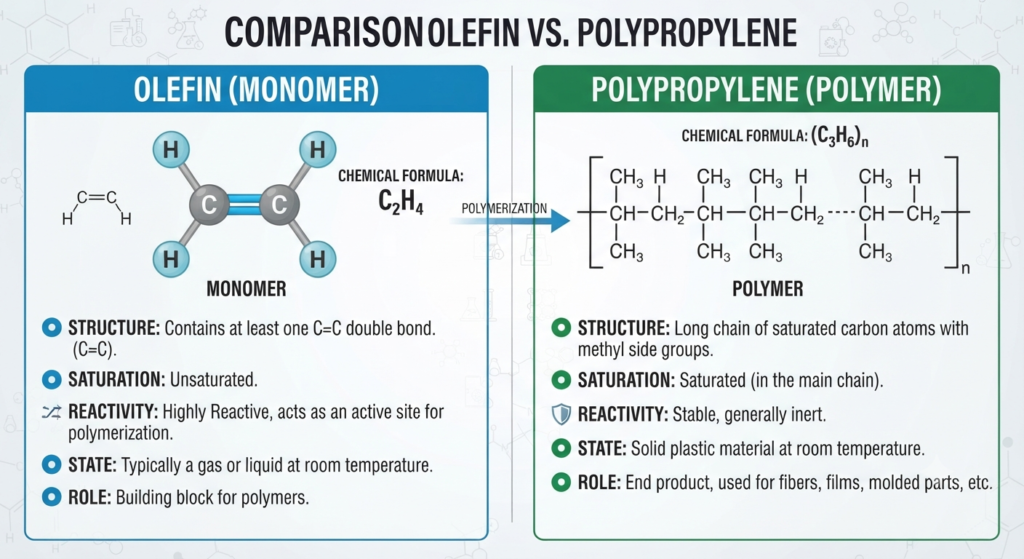
What Is Olefin?
Olefins, also called alkenes, are hydrocarbons that contain one or more carbon-carbon double bonds (C=C). Because of this double bond, olefins are highly reactive and serve as the foundation for manufacturing numerous petrochemical products.
The most commercially important olefins include:
- Ethylene
- Propylene
- Butene
- Pentene
Olefins are produced primarily through steam cracking and catalytic cracking in petroleum refineries.
Key Characteristics of Olefin
- Unsaturated hydrocarbons
- Contain carbon-carbon double bonds
- General formula: CₙH₂ₙ
- Highly reactive
- Easily polymerized
- Important petrochemical feedstocks
- Used to manufacture plastics and synthetic chemicals
- Usually exist as gases or volatile liquids
- Essential in polymer production
What Is Polypropylene?
Polypropylene (PP) is a thermoplastic polymer produced by polymerizing propylene, which is one of the most important olefins.
During polymerization, thousands of propylene molecules join together to form long molecular chains, creating a lightweight, durable, and chemically resistant plastic.
Today, polypropylene is one of the most widely used plastics worldwide because it combines low cost with excellent mechanical and chemical properties.
It is commonly used in:
- Food containers
- Plastic packaging
- Automotive components
- Medical equipment
- Textiles
- Household products
- Pipes and fittings
- Industrial containers
Key Characteristics of Polypropylene
- Thermoplastic polymer
- Produced from propylene monomer
- Lightweight material
- Excellent chemical resistance
- High impact strength
- Good fatigue resistance
- Moisture resistant
- Easily recyclable
- Widely used engineering plastic
- Recycling code #5
Olefin vs. Polypropylene: Key Differences
1. Definition
Although the terms are often confused, Olefin vs. Polypropylene represent two completely different concepts.
Olefin refers to an entire family of unsaturated hydrocarbons containing carbon-carbon double bonds. These compounds act as raw materials for producing many petrochemical products.
Polypropylene, however, is a finished polymer created by joining thousands of propylene molecules through polymerization. It is one specific product derived from the olefin family.
2. Chemical Structure
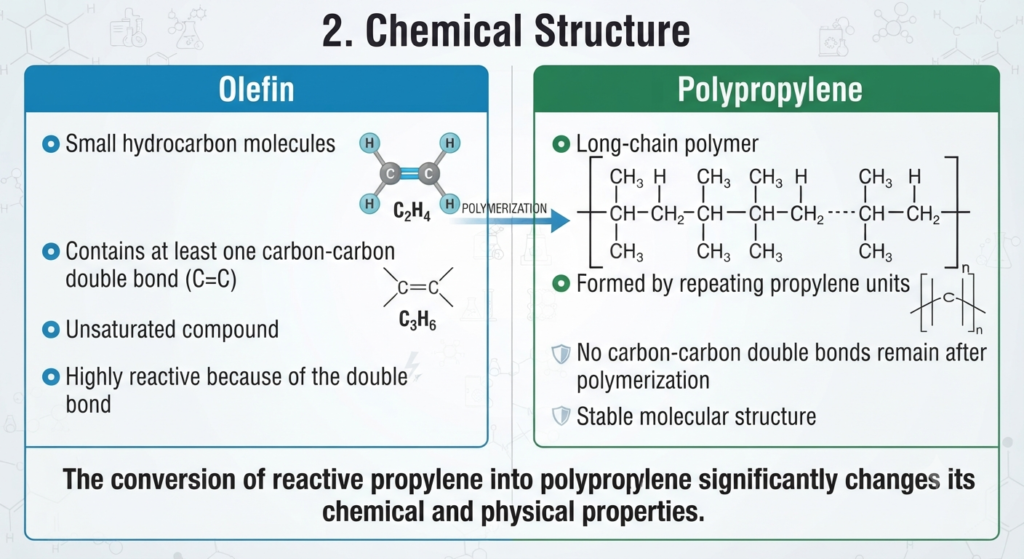
The chemical structure is the most significant difference between Olefin vs. Polypropylene.
Olefin
- Small hydrocarbon molecules
- Contains at least one carbon-carbon double bond (C=C)
- Unsaturated compound
- Highly reactive because of the double bond
Polypropylene
- Long-chain polymer
- Formed by repeating propylene units
- No carbon-carbon double bonds remain after polymerization
- Stable molecular structure
The conversion of reactive propylene into polypropylene significantly changes its chemical and physical properties.
3. Chemical Formula
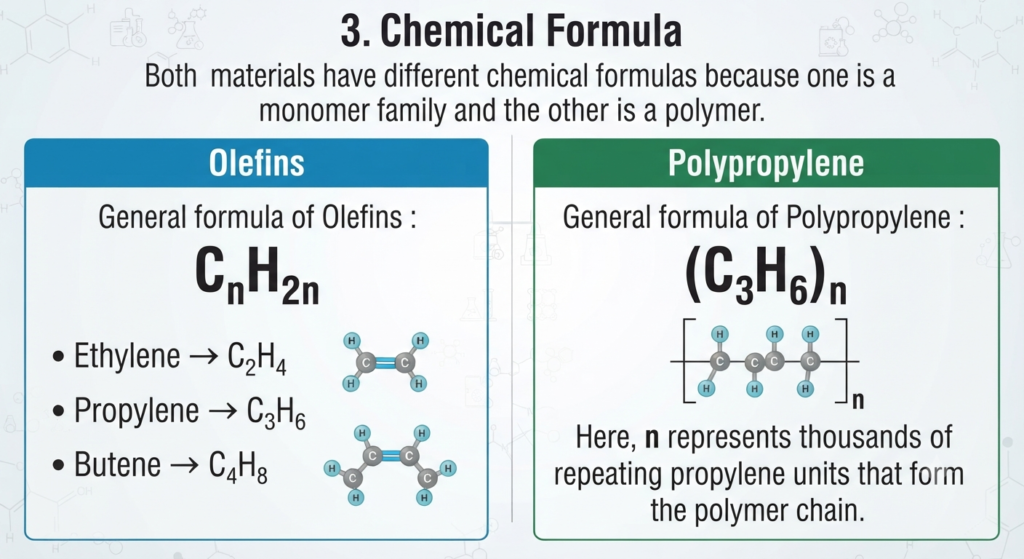
Both materials have different chemical formulas because one is a monomer family and the other is a polymer.
General formula of Olefins :
CₙH₂ₙ
Examples:
- Ethylene → C₂H₄
- Propylene → C₃H₆
- Butene → C₄H₈
General formula of Polypropylene :
(C₃H₆)ₙ
Here, n represents thousands of repeating propylene units that form the polymer chain.
4. Physical State
Their physical forms are entirely different.
Olefins
- Mostly gases at room temperature (lower molecular weight)
- Higher olefins may exist as liquids
- Volatile compounds
Polypropylene
- Solid plastic
- Lightweight
- Semi-crystalline material
- Manufactured as pellets before molding into finished products
This difference makes polypropylene suitable for structural and consumer applications.
5. Manufacturing Process
The manufacturing process is another major distinction in Olefin vs. Polypropylene.
Olefin Production
Olefins are primarily produced from petroleum and natural gas through refinery processes such as:
- Steam cracking
- Catalytic cracking
- Fluid catalytic cracking (FCC)
- Dehydrogenation
These processes convert larger hydrocarbon molecules into valuable olefins like ethylene and propylene.
Polypropylene Production
Polypropylene is manufactured by polymerizing propylene using specialized catalysts such as:
- Ziegler–Natta catalysts
- Metallocene catalysts
- Chromium-based catalysts
The polymer is then processed into pellets, which are molded or extruded into finished products.
6. Chemical Reactivity
Chemical reactivity differs significantly between olefins and polypropylene.
Olefin
- Highly reactive
- Undergoes addition reactions
- Easily polymerized
- Reacts with halogens, hydrogen, and oxygen
- Used as a chemical intermediate
Polypropylene
- Chemically stable
- Resistant to acids and alkalis
- Does not readily participate in chemical reactions
- Excellent corrosion resistance
- Suitable for long-term industrial applications
The polymerization process converts reactive olefins into a much more stable material.
7. Mechanical Properties
Mechanical performance is one of polypropylene’s greatest advantages.
Olefin
Since olefins are small molecules, they are not used directly as structural materials.
Their mechanical strength is generally not considered for engineering applications because they primarily serve as chemical feedstocks.
Polypropylene
Polypropylene offers excellent mechanical properties, including:
- High tensile strength
- Good impact resistance
- Excellent fatigue resistance
- Lightweight construction
- Good stiffness
- Long service life
These characteristics make polypropylene suitable for both consumer and industrial products.
8. Chemical Resistance
Chemical resistance is another important difference in Olefin vs. Polypropylene.
Olefin
- Reactive toward many chemicals
- Can oxidize readily
- Susceptible to addition reactions
- Used intentionally in chemical synthesis
Polypropylene
- Excellent resistance to acids
- Resistant to alkalis
- Resistant to many solvents
- Excellent moisture resistance
- Good corrosion resistance
This makes polypropylene an excellent material for chemical storage tanks, laboratory equipment, and industrial piping.
9. Heat Resistance
Heat performance also differs because of their molecular structure.
Olefin
- Lower boiling points
- Lower thermal stability
- Suitable mainly as chemical feedstocks
Polypropylene
- Melting point around 160–170°C
- Can withstand relatively high service temperatures
- Maintains mechanical strength under moderate heat
- Commonly used for microwave-safe containers and hot-fill packaging
Although polypropylene has good heat resistance, prolonged exposure to very high temperatures can still cause deformation.
10. Moisture Resistance
Both materials exhibit excellent moisture resistance, but for different reasons.
Olefin
- Does not readily absorb water
- Hydrophobic in nature
- Useful in chemical processing
Polypropylene
- Extremely low water absorption
- Resistant to mold and mildew
- Suitable for outdoor products
- Maintains dimensional stability in humid environments
This property makes polypropylene ideal for ropes, outdoor furniture, carpets, geotextiles, and packaging.
11. Applications
One of the biggest differences between Olefin vs. Polypropylene lies in how they are used in industry.
Applications of Olefins
Olefins serve as raw materials for manufacturing countless chemicals and polymers.
Common applications include:
- Polyethylene production
- Polypropylene production
- Synthetic rubber
- Ethylene glycol
- Alcohol production
- Detergents
- Solvents
- Plasticizers
- Petrochemical intermediates
- Pharmaceutical chemicals
Applications of Polypropylene
Polypropylene is used directly as a finished engineering plastic in numerous industries.
Major applications include:
- Food packaging
- Plastic containers
- Automotive bumpers
- Interior vehicle parts
- Medical syringes
- Laboratory equipment
- Reusable storage boxes
- Household furniture
- Pipes and fittings
- Textile fibers
- Nonwoven fabrics
- Carpets and rugs
- Battery cases
- Appliance components
Its versatility makes polypropylene one of the most widely consumed plastics in the world.
12. Recycling and Sustainability
Recycling is an important consideration when comparing Olefin vs. Polypropylene.
Olefin
- Used mainly as a chemical feedstock rather than a consumer material
- Can be converted into recyclable polymers
- Supports chemical recycling processes
Polypropylene
- Identified by Recycling Code #5
- Can be mechanically recycled into new products
- Increasingly used in circular economy initiatives
- Lightweight nature reduces transportation energy consumption
Although polypropylene is recyclable, recycling rates vary depending on local collection and processing infrastructure.
13. Environmental Impact
Both olefins and polypropylene are petroleum-based materials, but their environmental impacts differ because one is a chemical feedstock and the other is a finished plastic.
Olefin
- Produced from crude oil or natural gas
- Serves as the building block for many plastics and chemicals
- Production requires significant energy
- Can contribute to greenhouse gas emissions during manufacturing
- Supports the production of recyclable polymers
Polypropylene
- Lightweight, reducing transportation fuel consumption
- Fully recyclable under Recycling Code #5
- Durable with a long service life
- Resistant to biodegradation in the natural environment
- Can be reused in many applications before recycling
- Increasingly incorporated into mechanical and chemical recycling programs
The environmental impact of polypropylene depends largely on proper collection, reuse, and recycling after its useful life.
Similarities Between Olefin and Polypropylene
Although Olefin vs. Polypropylene are different materials, they share several important characteristics because polypropylene is manufactured from the olefin propylene.
Some key similarities include:
- Both are derived from petroleum or natural gas.
- Both are composed primarily of carbon and hydrogen atoms.
- Both play a vital role in the petrochemical industry.
- Both are lightweight compared to many engineering materials.
- Both exhibit good moisture resistance.
- Both have good resistance to many chemicals.
- Both are highly flammable under suitable conditions.
- Both are widely used in industrial manufacturing.
- Both contribute to the production of everyday consumer products.
- Both are valuable materials in modern chemical and plastics industries.
Despite these similarities, olefins are primarily chemical feedstocks, whereas polypropylene is a finished polymer used in countless products.
Advantages and Uses of Olefin
Olefins are among the most important raw materials in the petrochemical industry because of their high reactivity and versatility.
Major advantages and uses include:
- Primary feedstock for plastic manufacturing
- Easily undergo polymerization reactions
- Used to produce polyethylene and polypropylene
- Essential for synthetic rubber production
- Raw material for detergents and surfactants
- Used in manufacturing solvents and alcohols
- Important intermediate in pharmaceutical production
- Used to manufacture synthetic fibers
- Supports production of adhesives and coatings
- Widely used in chemical synthesis
Their ability to participate in numerous chemical reactions makes olefins indispensable in modern industrial chemistry.
Advantages and Uses of Polypropylene
Polypropylene is one of the most widely used thermoplastics because it combines low cost, durability, and excellent chemical resistance.
Major advantages and uses include:
- Lightweight with a high strength-to-weight ratio
- Excellent resistance to acids, alkalis, and many chemicals
- Good impact and fatigue resistance
- Low moisture absorption
- Food-safe grades available for packaging and containers
- Suitable for microwave-safe and reusable products
- Easily molded into complex shapes
- Used in automotive parts to reduce vehicle weight
- Common material for medical devices and laboratory equipment
- Widely used in ropes, carpets, woven bags, and nonwoven fabrics
- Recyclable under Recycling Code #5
- Cost-effective for high-volume manufacturing
These advantages make polypropylene one of the most versatile and economical plastics available today.
Safety and Handling
Both olefins and polypropylene require proper handling to ensure safe use in industrial and commercial environments.
Safety Guidelines for Olefins
- Store away from heat, sparks, and open flames.
- Use in well-ventilated areas.
- Wear appropriate personal protective equipment (PPE).
- Prevent leaks, especially with gaseous olefins.
- Keep away from strong oxidizing agents.
- Follow industry-specific storage and transportation regulations.
Safety Guidelines for Polypropylene
- Store away from direct flames and excessive heat.
- Avoid overheating during processing to prevent thermal degradation.
- Wear protective gloves and eye protection when handling molten polypropylene.
- Dispose of waste according to local recycling and environmental regulations.
- Recycle whenever possible to reduce environmental impact.
Following recommended safety practices helps minimize risks during manufacturing, processing, and disposal.
Which Is Better- Olefin or Polypropylene?
Neither olefin nor polypropylene is inherently better because they serve different purposes.
Olefins are ideal when a reactive chemical feedstock is required for producing plastics, synthetic rubber, detergents, solvents, and other petrochemicals. Their chemical versatility makes them indispensable in industrial manufacturing.
Polypropylene is the better choice when a lightweight, durable, chemically resistant, and cost-effective plastic is needed. Its excellent mechanical properties make it suitable for packaging, automotive components, medical devices, textiles, and countless consumer products.
In simple terms, olefins are the raw materials, while polypropylene is one of the valuable finished products made from those raw materials.
Conclusion
The comparison of Olefin vs. Polypropylene highlights the fundamental difference between a chemical family and a finished polymer. Olefins are unsaturated hydrocarbons containing carbon-carbon double bonds that serve as essential building blocks in the petrochemical industry. Polypropylene, on the other hand, is a thermoplastic polymer produced by polymerizing the olefin propylene into long molecular chains.
While olefins are highly reactive and primarily used as chemical feedstocks, polypropylene is valued for its lightweight nature, excellent chemical resistance, durability, and versatility. Understanding the differences between Olefin vs. Polypropylene helps students, engineers, manufacturers, and consumers choose the appropriate material for chemical processing, industrial production, and everyday applications.
Frequently Asked Questions (FAQs)
The main difference is that olefin is a family of unsaturated hydrocarbons containing carbon-carbon double bonds, whereas polypropylene is a thermoplastic polymer produced from the olefin propylene.
No. Polypropylene is not an olefin. It is a polymer made from the olefin propylene through a polymerization process.
Olefins are essential feedstocks used to manufacture plastics, synthetic rubber, detergents, solvents, alcohols, and numerous industrial chemicals.
Polypropylene is widely used in food packaging, automotive parts, medical devices, household products, textile fibers, ropes, carpets, reusable containers, pipes, and industrial equipment.
Yes. Polypropylene is recyclable and is identified by Recycling Code #5. It can be mechanically recycled into new products where suitable recycling facilities are available.
References:
- “Olefin” – Global Britannica
- “Olefin Fibers” – Textile Fibers
Read Next:
- Chloride vs. Chlorite: What’s the Difference?
- 1-Butene vs. 2-Butene: What’s the Difference?
- Phosphodiester Bond vs. Phosphoester Bond:
- Difference Between Methyl and Methylene Group (CH3 vs CH2)
- Difference Between Molecular Equation and Ionic Equation
- Olefins vs. Paraffins: What’s the Difference?
- Cetyl Alcohol vs. Stearyl Alcohol: What’s the Difference?
- Buchner Funnel vs. Hirsch Funnel
- Teal vs. Turquoise