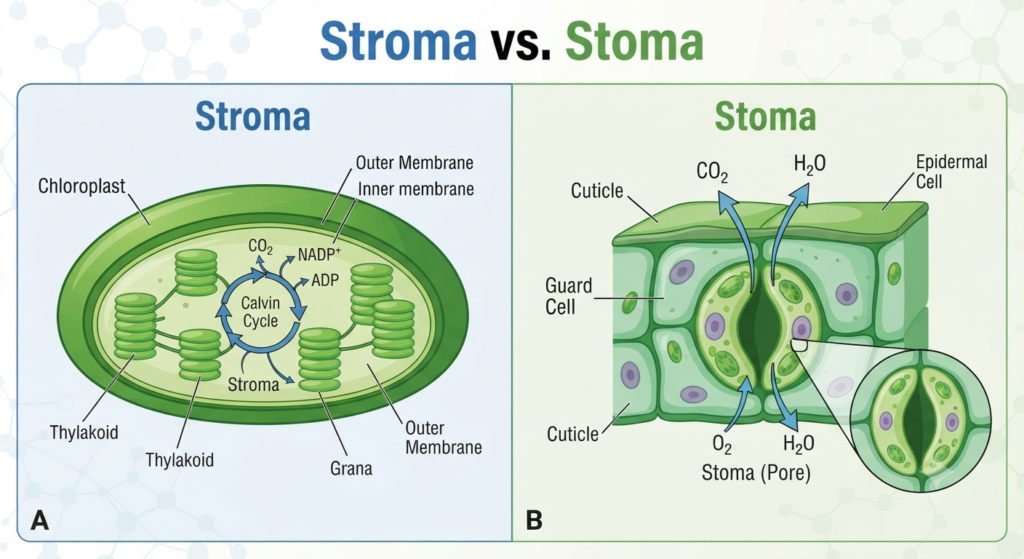
The main difference between Stoma vs. Stroma is that stoma is a tiny pore found on the surface of plant leaves and stems that regulates gas exchange and transpiration, whereas stroma is the gel-like fluid inside chloroplasts where the Calvin cycle (light-independent reactions of photosynthesis) takes place. Although the names sound similar, they refer to completely different plant structures with distinct locations, functions, and roles in photosynthesis.
Understanding Stroma and Stoma is essential for students, biology enthusiasts, and competitive exam aspirants because both are closely related to photosynthesis but perform entirely different tasks.
Stoma vs. Stroma: Comparison Table
The table below highlights the major differences between Stroma and Stoma.
| Feature | Stoma | Stroma |
| Definition | Tiny pore on leaves and stems | Gel-like matrix inside chloroplasts |
| Location | Leaf and stem epidermis | Interior of chloroplast |
| Found In | Plant epidermis | Chloroplasts of plant cells |
| Main Function | Gas exchange and transpiration | Site of the Calvin cycle |
| Structure | Opening surrounded by guard cells | Semi-fluid matrix containing enzymes |
| Contains | Guard cells and pore | Enzymes, DNA, ribosomes, and starch grains |
| Role in Photosynthesis | Allows CO₂ entry and O₂ exit | Converts CO₂ into glucose |
| Visible Under | Light microscope | Electron microscope |
| Controls | Water loss and gas exchange | Sugar synthesis |
| Present In | Leaves and young stems | Every chloroplast |
What Is Stoma?
A stoma (plural: stomata) is a microscopic opening found mainly on the lower surface of plant leaves and sometimes on stems. Each stoma is surrounded by two specialized guard cells that regulate its opening and closing.
The primary purpose of a stoma is to facilitate the movement of gases between the plant and the surrounding atmosphere. Carbon dioxide enters through stomata for photosynthesis, while oxygen and water vapor exit during photosynthesis and transpiration.
Functions of Stoma
- Allows carbon dioxide to enter leaves
- Releases oxygen into the atmosphere
- Controls transpiration
- Helps regulate plant temperature
- Maintains water balance
- Supports nutrient transport by creating transpiration pull
What Is Stroma?
The stroma is the thick, gel-like fluid that fills the inside of a chloroplast outside the thylakoid membranes. It contains enzymes, DNA, ribosomes, minerals, and starch granules required for photosynthesis.
The most important process occurring in the stroma is the Calvin cycle, also called the light-independent reaction. During this process, carbon dioxide is converted into glucose using ATP and NADPH produced during the light-dependent reactions.
Components of Stroma
- Calvin cycle enzymes
- Chloroplast DNA
- Ribosomes
- RNA
- Starch granules
- Minerals and proteins
Stoma vs. Stroma: Key Differences
1. Definition
A stoma is a microscopic pore present on the epidermis of leaves and stems that regulates gas exchange and water loss.
A stroma is the semi-fluid matrix inside chloroplasts where carbon fixation and sugar production occur.
2. Location
One of the easiest ways to understand the difference in Stoma vs. Stroma is by looking at where each structure is found in a plant.
Stomata are tiny pores located on the outer surface of leaves and young stems, primarily on the lower epidermis of most plants. Their position on the leaf surface allows them to efficiently regulate gas exchange with the atmosphere while minimizing excessive water loss through transpiration.
Stroma, in contrast, is found inside the chloroplasts of plant cells. It is the gel-like matrix that surrounds the thylakoid membranes and serves as the site of the Calvin cycle, where carbon dioxide is converted into glucose during the light-independent stage of photosynthesis.
3. Function
One of the most significant differences in Stoma vs. Stroma is their function in plant physiology and photosynthesis. Although both structures are essential for plant survival, they perform completely different roles.
Stomata regulate the exchange of gases between the plant and the surrounding atmosphere. By opening and closing through the action of guard cells, they help maintain the plant’s water balance while ensuring an adequate supply of carbon dioxide for photosynthesis. Their main functions include:
- Allowing carbon dioxide (CO₂) to enter the leaf
- Releasing oxygen (O₂) produced during photosynthesis
- Regulating the loss of water vapor through transpiration
- Controlling the plant’s water balance and temperature
Stroma, on the other hand, is the metabolic center of the chloroplast where the light-independent reactions of photosynthesis occur. It contains the enzymes and other components required to convert carbon dioxide into carbohydrates. Its primary functions include:
- Carrying out carbon fixation during the Calvin cycle
- Synthesizing glucose and other carbohydrates
- Hosting the light-independent (Calvin cycle) reactions of photosynthesis
- Containing enzymes, chloroplast DNA, ribosomes, and starch granules essential for chloroplast function
4. Role in Photosynthesis
The role of Stoma and Stroma in photosynthesis is closely connected, but each structure contributes in a different way. While the stoma helps supply the raw materials needed for photosynthesis, the stroma is where a major stage of the process actually takes place.
Stomata support photosynthesis indirectly by allowing carbon dioxide (CO₂) from the atmosphere to enter the leaf. The guard cells regulate the opening and closing of stomata to balance carbon dioxide uptake with water conservation. Without functioning stomata, plants would not receive enough carbon dioxide for efficient photosynthesis.
Stroma, in contrast, plays a direct role in photosynthesis. It is the site of the Calvin cycle (light-independent reactions), where carbon dioxide is fixed and converted into glucose using ATP and NADPH produced during the light-dependent reactions. This process enables plants to manufacture carbohydrates that serve as their primary source of energy and growth.
In simple terms, stomata provide the carbon dioxide required for photosynthesis, while the stroma uses that carbon dioxide to produce sugars, making both structures essential for the overall photosynthetic process.
5. Structure
The structural difference between Stoma vs. Stroma is quite distinct. A stoma is a specialized opening on the surface of a leaf, whereas the stroma is a gel-like internal matrix found within the chloroplast. Their unique structures enable them to perform entirely different biological functions.
A stoma consists of several specialized components that work together to regulate gas exchange:
- A microscopic opening or stomatal pore
- Two guard cells that control the opening and closing of the pore
- Subsidiary (accessory) cells in many plant species, which provide support to the guard cells
- Surrounding epidermal cells that protect and support the stomatal complex
In contrast, the stroma is a dense, semi-fluid matrix enclosed by the inner membrane of the chloroplast. It contains numerous molecules required for photosynthesis, including:
- Enzymes involved in the Calvin cycle
- Chloroplast DNA
- Ribosomes for protein synthesis
- Proteins and various ions
- Starch granules for temporary carbohydrate storage
- RNA and other metabolic compounds necessary for chloroplast function
This structural difference explains why stomata regulate the movement of gases at the leaf surface, whereas the stroma serves as the biochemical center for sugar synthesis inside the chloroplast.
6. Gas Exchange
Gas exchange is one of the most important differences in Stoma and Stroma. While stomata are directly responsible for exchanging gases between the plant and the atmosphere, the stroma does not participate in gas exchange itself.
Stomata serve as microscopic gateways that regulate the movement of gases into and out of the leaf. When the guard cells open the stomatal pore, carbon dioxide (CO₂) enters the leaf for photosynthesis, while oxygen (O₂) and water vapor are released into the atmosphere. By adjusting the opening and closing of the stomata, plants maintain an optimal balance between carbon dioxide uptake and water conservation.
The stroma, on the other hand, is located inside the chloroplast and does not exchange gases with the external environment. Instead, it uses the carbon dioxide that has already entered the leaf through the stomata and diffused into the chloroplast. Within the stroma, this carbon dioxide is fixed during the Calvin cycle and converted into glucose and other carbohydrates, which provide energy and support plant growth.
7. Water Regulation
Water regulation highlights another important difference between Stoma vs. Stroma. While stomata actively control water loss from the plant, the stroma has no direct role in regulating transpiration or maintaining the plant’s water balance.
Stomata regulate the loss of water vapor through the process of transpiration. Their guard cells respond to environmental conditions such as light intensity, temperature, humidity, soil moisture, and carbon dioxide concentration by opening or closing the stomatal pore. When sufficient water is available, the pores open to allow carbon dioxide to enter for photosynthesis. During hot, dry, or water-deficient conditions, they close partially or completely to reduce excessive water loss and prevent dehydration.
The stroma, in contrast, is the gel-like matrix inside the chloroplast where the Calvin cycle takes place. Its primary function is to support the synthesis of glucose and other carbohydrates during photosynthesis. Although the reactions occurring in the stroma rely on products generated from water during the light-dependent stage, the stroma itself does not regulate transpiration or control the movement of water within the plant.
8. Components
Another important difference between Stoma and Stroma lies in their components. A stoma is made up of specialized cells that regulate gas exchange, whereas the stroma contains the enzymes and molecular machinery required for the light-independent reactions of photosynthesis.
A stoma consists of several structural components that work together to control the movement of gases and water vapor:
- Guard cells that open and close the stomatal pore
- A stomatal pore through which carbon dioxide, oxygen, and water vapor pass
- Epidermal cells surrounding the stoma that provide protection and support
- In many plants, subsidiary (accessory) cells that assist the guard cells in regulating stomatal movement
The stroma, in contrast, is a complex, enzyme-rich matrix inside the chloroplast that contains numerous molecules essential for photosynthesis, including:
- Rubisco, the key enzyme responsible for carbon fixation
- Chloroplast DNA, which carries genetic information for chloroplast function
- Ribosomes that synthesize proteins within the chloroplast
- ATP-utilizing enzymes involved in energy-dependent reactions of the Calvin cycle
- Calvin cycle intermediates that participate in the production of glucose
- Starch granules, ions, RNA, and other proteins required for chloroplast metabolism
These distinct components reflect the specialized roles of each structure. Stomata are designed for efficient gas exchange and water regulation, whereas the stroma provides the biochemical environment needed to convert carbon dioxide into energy-rich carbohydrates during photosynthesis.
9. Importance
Both stomata and stroma are indispensable for the survival and healthy growth of plants. Although they perform different functions, they work together to ensure that photosynthesis occurs efficiently. If either structure fails to function properly, the plant’s ability to produce food and maintain normal physiological processes is severely affected.
Without properly functioning stomata:
- Plants cannot absorb sufficient carbon dioxide (CO₂) for photosynthesis.
- Oxygen and water vapor cannot be exchanged efficiently with the atmosphere.
- Water regulation through transpiration becomes disrupted.
- Nutrient transport and temperature regulation are adversely affected.
- Plant growth and productivity decline due to reduced photosynthetic activity.
Without a functional stroma:
- Carbon fixation during the Calvin cycle cannot occur.
- Glucose and other carbohydrates cannot be synthesized.
- Photosynthesis remains incomplete because the light-independent reactions cannot proceed.
- The plant is unable to produce enough energy-rich compounds for growth, repair, and reproduction.
In simple terms, stomata supply the carbon dioxide needed for photosynthesis, while the stroma converts that carbon dioxide into glucose. Together, these structures are essential for food production, energy storage, and the overall survival of plants.
10. Occurrence
The occurrence of stomata and stroma also differs significantly because they are found in different parts of a plant. One is located on the plant’s outer surface, while the other is present inside the chloroplasts of photosynthetic cells.
Stomata are found on the epidermis of leaves and young stems, where they act as microscopic pores for gas exchange. In most terrestrial plants, they are more numerous on the lower surface of leaves, which helps reduce water loss caused by direct sunlight. However, their distribution can vary depending on the plant species and environmental adaptations. For example, floating aquatic plants often have stomata only on the upper leaf surface, while submerged aquatic plants may have very few or no stomata.
Stroma, in contrast, is found inside the chloroplasts of all photosynthetic plant cells. It occupies the space surrounding the thylakoid membranes and is present in the chloroplasts of leaf mesophyll cells, green stems, and other photosynthetic tissues. Since the stroma houses the enzymes required for the Calvin cycle, it is an essential component of every functional chloroplast involved in photosynthesis.
Similarities Between Stroma and Stoma
Despite their differences, Stroma and Stoma share several similarities.
- Both are essential parts of photosynthesis.
- Both are present in plants.
- Both contribute to plant growth and survival.
- Both are involved in carbon dioxide utilization.
- Both support food production in plants.
- Both are found in photosynthetic tissues.
Advantages and Importance of Stoma
Stomata are essential structures that help plants survive by regulating gas exchange, water balance, and photosynthesis. Their ability to open and close in response to environmental conditions allows plants to conserve water while maintaining the carbon dioxide supply needed for food production.
The major advantages and importance of stomata include:
- Enables efficient gas exchange by allowing carbon dioxide to enter and oxygen to leave the leaf.
- Controls transpiration through the regulated opening and closing of the stomatal pore.
- Prevents excessive water loss, helping plants survive during hot or dry conditions.
- Helps cool the plant by releasing water vapor through transpiration, reducing leaf temperature.
- Supports nutrient transport by creating the transpiration pull that moves water and dissolved minerals from the roots to the leaves.
- Maintains internal water balance, ensuring proper cell turgidity and healthy plant growth.
- Improves photosynthetic efficiency by providing a continuous supply of carbon dioxide for photosynthesis.
- Responds to environmental changes such as light, humidity, temperature, and carbon dioxide levels to optimize plant function.
- Enhances plant adaptation by helping plants adjust to changing environmental conditions while minimizing water stress.
- Promotes healthy growth and development by balancing gas exchange, water conservation, and energy production.
Advantages and Importance of Stroma
The stroma is the metabolic center of the chloroplast, where essential biochemical reactions of photosynthesis occur. It provides the enzymes, genetic material, and molecular environment needed to convert carbon dioxide into energy-rich carbohydrates. Without a functional stroma, plants would be unable to produce the food required for growth and survival.
The major advantages and importance of the stroma include:
- Serves as the site of the Calvin cycle, where the light-independent reactions of photosynthesis take place.
- Converts carbon dioxide into glucose, enabling plants to synthesize carbohydrates for energy and growth.
- Contains essential enzymes, including Rubisco, that catalyze carbon fixation and other photosynthetic reactions.
- Stores chloroplast DNA, which carries genetic information necessary for chloroplast development and function.
- Supports protein synthesis by housing ribosomes and the molecular machinery required to produce chloroplast proteins.
- Stores temporary starch reserves, allowing plants to accumulate excess glucose for later use.
- Facilitates the conversion of light energy into chemical energy by using ATP and NADPH from the light-dependent reactions to produce carbohydrates.
- Provides a medium for metabolic reactions, ensuring efficient interaction between enzymes and photosynthetic intermediates.
- Contributes to plant growth and development by supplying the sugars required for respiration, cell division, and tissue formation.
- Maintains chloroplast function by supporting the biochemical processes essential for continuous and efficient photosynthesis.
Stoma vs. Stroma: Which Is More Important?
It is impossible to consider one structure more important than the other because they perform complementary functions.
The stoma ensures that carbon dioxide enters the plant while minimizing water loss. The stroma then uses that carbon dioxide to manufacture glucose through the Calvin cycle. If either structure is absent or fails to function properly, photosynthesis becomes inefficient, reducing plant growth and productivity.
Conclusion
The comparison of Stoma vs. Stroma shows that although the two terms are often confused because of their similar spelling, they represent entirely different structures in plants. A stoma is a microscopic pore on the leaf surface responsible for gas exchange and transpiration, while the stroma is the enzyme-rich fluid inside chloroplasts where the Calvin cycle converts carbon dioxide into glucose. Together, these structures ensure that photosynthesis proceeds efficiently—stomata supply the necessary carbon dioxide, and the stroma transforms it into energy-rich carbohydrates. Understanding the distinction between Stroma and Stoma is fundamental for studying plant biology and the mechanisms that sustain plant growth.
Frequently Asked Questions (FAQs)
No. A stoma is a microscopic pore on leaves, whereas the stroma is the gel-like matrix inside chloroplasts
The stroma is located inside chloroplasts, surrounding the thylakoid membranes.
The Calvin cycle occurs inside the stroma, converting carbon dioxide into glucose using ATP and NADPH.
The Calvin cycle occurs inside the stroma, converting carbon dioxide into glucose using ATP and NADPH.
Most plants have more stomata on the lower surface to reduce water loss caused by direct sunlight and wind.
Read Next: