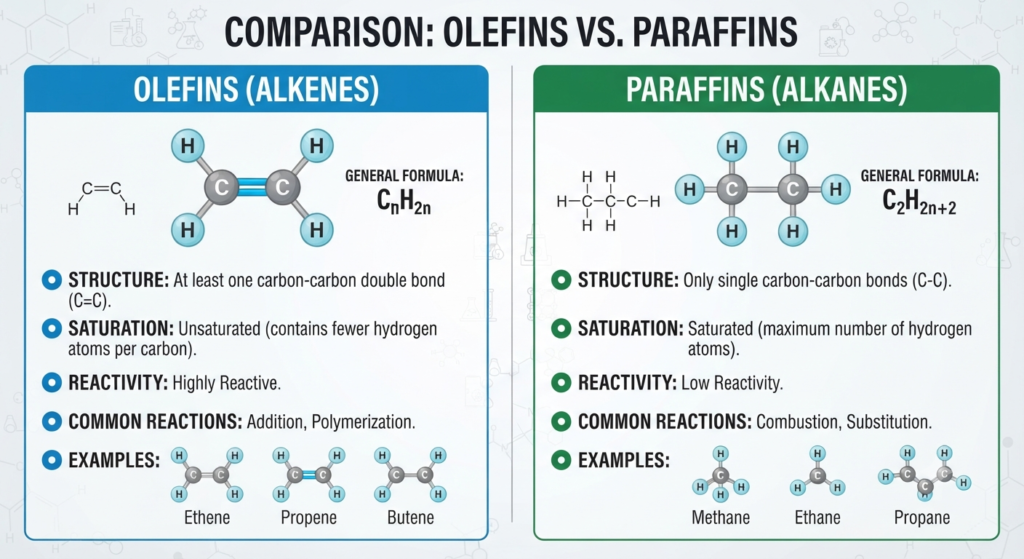
The main difference between Olefins vs. Paraffins is that olefins (alkenes) are unsaturated hydrocarbons containing at least one carbon-carbon double bond (C=C), whereas paraffins (alkanes) are saturated hydrocarbons containing only single carbon-carbon bonds (C–C). Because of their double bonds, olefins are more chemically reactive and are widely used in the production of plastics, synthetic rubber, and petrochemicals. In contrast, paraffins are more stable, less reactive, and are primarily used as fuels, lubricants, and waxes.
Understanding the difference between Olefins vs. Paraffins is important for chemistry students, chemical engineers, petroleum professionals, refinery operators, and researchers because these two classes of hydrocarbons have different molecular structures, chemical properties, industrial applications, and refining processes.
Olefins vs. Paraffins Comparison Table
The table below highlights the major differences between Olefins vs. Paraffins.
| Feature | Olefins | Paraffins |
| Chemical Family | Alkenes | Alkanes |
| Saturation | Unsaturated | Saturated |
| Carbon Bonds | At least one C=C double bond | Only C–C single bonds |
| General Formula | CₙH₂ₙ | CₙH₂ₙ₊₂ |
| Chemical Reactivity | High | Low |
| Stability | Less stable | More stable |
| Hydrogen Content | Lower | Higher |
| Polymerization | Easily polymerized | Does not readily polymerize |
| Combustion | Burns readily | Burns readily |
| Bromine Test | Decolorizes bromine solution | No reaction |
| Industrial Importance | Petrochemical feedstock | Fuels and lubricants |
| Common Examples | Ethylene, Propylene, Butene | Methane, Ethane, Propane, Butane |
| Primary Uses | Plastics, synthetic fibers, detergents | Fuels, waxes, lubricants |
| Refinery Production | Cracking processes | Naturally present in crude oil |
| Flammability | Highly flammable | Highly flammable |
What Are Olefins?
Olefins, also known as alkenes, are unsaturated hydrocarbons that contain one or more carbon-carbon double bonds. The presence of the double bond makes them chemically active and capable of undergoing numerous chemical reactions.
Olefins are among the most important raw materials in the petrochemical industry. They serve as building blocks for plastics, synthetic fibers, detergents, solvents, alcohols, and numerous industrial chemicals.
Some of the most common olefins include:
- Ethylene (C₂H₄)
- Propylene (C₃H₆)
- Butene (C₄H₈)
- Pentene (C₅H₁₀)
Key Characteristics of Olefins
- Unsaturated hydrocarbons
- Contain one or more carbon-carbon double bonds
- General formula: CₙH₂ₙ
- Highly reactive
- Easily undergo addition reactions
- Can be polymerized
- Important petrochemical feedstocks
- Widely used in plastics manufacturing
- Produced mainly by steam cracking
- Lower hydrogen-to-carbon ratio than paraffins
What Are Paraffins?
Paraffins, commonly called alkanes, are saturated hydrocarbons that contain only single carbon-carbon bonds. Since every carbon atom is fully bonded with hydrogen atoms, paraffins are chemically more stable than olefins.
Paraffins are the primary constituents of natural gas, crude oil, LPG, gasoline, diesel fuel, kerosene, and many lubricating oils.
Common examples include:
- Methane (CH₄)
- Ethane (C₂H₆)
- Propane (C₃H₈)
- Butane (C₄H₁₀)
- Pentane (C₅H₁₂)
Key Characteristics of Paraffins
- Saturated hydrocarbons
- Only single carbon-carbon bonds
- General formula: CₙH₂ₙ₊₂
- Chemically stable
- Low reactivity
- Excellent fuel properties
- High hydrogen content
- Occur naturally in petroleum and natural gas
- Produce clean combustion under proper conditions
- Important components of transportation fuels
Olefins vs. Paraffins: Key Differences
1. Definition
Although both olefins and paraffins are hydrocarbons composed of carbon and hydrogen atoms, they differ fundamentally in their chemical bonding.
Olefins are unsaturated hydrocarbons containing one or more carbon-carbon double bonds.
Paraffins are saturated hydrocarbons in which all carbon atoms are connected by single covalent bonds.
The presence or absence of the double bond determines nearly all of their physical and chemical properties.
2. Chemical Structure
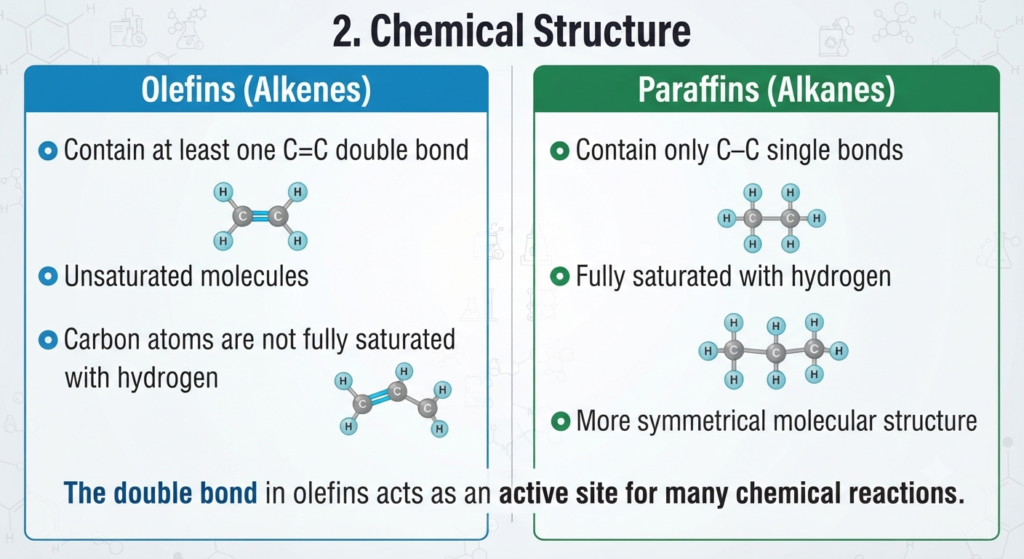
The most important distinction in Olefins vs. Paraffins is their molecular structure.
Olefins contain:
- Contain at least one C=C double bond
- Unsaturated molecules
- Carbon atoms are not fully saturated with hydrogen
Paraffins contain:
- Contain only C–C single bonds
- Fully saturated with hydrogen
- More symmetrical molecular structure
The double bond in olefins acts as an active site for many chemical reactions.
3. General Formula
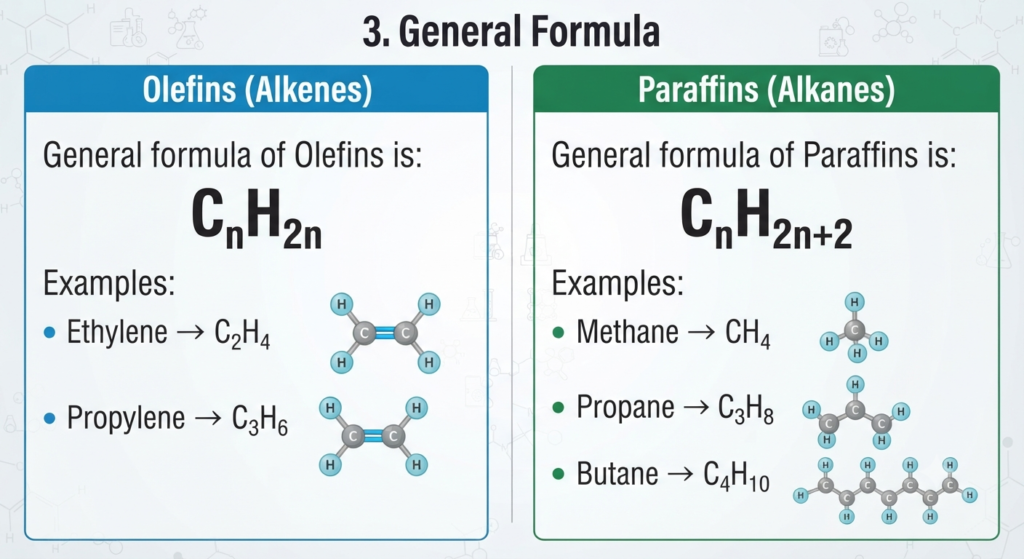
Each hydrocarbon family follows a characteristic molecular formula.
General formula of Olefins is:
CₙH₂ₙ
Examples:
- Ethylene → C₂H₄
- Propylene → C₃H₆
General formula of Paraffins is:
CₙH₂ₙ₊₂
Examples:
- Methane → CH₄
- Propane → C₃H₈
- Butane → C₄H₁₀
The additional hydrogen atoms make paraffins fully saturated.
4. Saturation
Another major difference is the degree of saturation.
Olefins
- Unsaturated hydrocarbons
- Can add hydrogen across the double bond
- Undergo hydrogenation reactions
Paraffins
- Saturated hydrocarbons
- Already contain the maximum possible hydrogen atoms
- Cannot undergo hydrogenation under normal conditions
5. Chemical Reactivity
Olefins are considerably more reactive than paraffins.
Olefins readily undergo:
- Addition reactions
- Polymerization
- Oxidation
- Halogenation
- Hydration
Paraffins mainly undergo:
- Combustion
- Free radical substitution
- Thermal cracking under high temperatures
Because paraffins lack double bonds, they remain relatively inert under ordinary conditions.
6. Stability
Chemical stability differs greatly between these hydrocarbons.
Olefins
- Less stable
- Double bonds are chemically active
- More susceptible to oxidation
Paraffins
- Highly stable
- Resistant to many chemical reactions
- Longer storage life
This stability makes paraffins suitable for fuels and lubricants.
7. Hydrogen Content
Hydrogen content influences fuel quality and combustion.
Olefins
- Lower hydrogen-to-carbon ratio
- More carbon-rich
Paraffins
- Higher hydrogen-to-carbon ratio
- Produce cleaner combustion with less soot under ideal conditions
This is one reason paraffinic fuels are generally preferred for combustion applications.
8. Polymerization
One of the biggest industrial differences involves polymerization.
Olefins readily polymerize to produce valuable plastics such as:
- Polyethylene (PE)
- Polypropylene (PP)
Paraffins generally do not polymerize because they lack reactive double bonds.
This makes olefins indispensable in the plastics industry.
9. Industrial Production
Both hydrocarbons are obtained during petroleum refining, but their production methods differ.
Olefins are mainly produced by:
- Steam cracking
- Catalytic cracking
- Fluid catalytic cracking (FCC)
Paraffins are obtained from:
- Crude oil distillation
- Natural gas processing
- Petroleum refining
Paraffins occur naturally in much larger quantities than olefins.
10. Physical Properties
The physical properties of olefins and paraffins differ because of the presence or absence of carbon-carbon double bonds.
Physical Properties of Olefins
- May exist as gases or liquids at room temperature, depending on molecular weight
- Generally colorless
- Lower boiling points than comparable paraffins
- Lower melting points
- Slightly higher density than corresponding paraffins
- Insoluble in water
- Soluble in organic solvents
- Highly flammable
Physical Properties of Paraffins
- Exist as gases, liquids, or solids depending on chain length
- Colorless and nearly odorless
- Slightly higher boiling points than comparable olefins
- Higher melting points for similar molecular weights
- Insoluble in water
- Soluble in organic solvents
- Highly flammable
- Chemically more stable during storage
The difference in molecular bonding significantly influences their physical behavior in refining, transportation, and industrial processing.
11. Combustion Characteristics
Both olefins and paraffins are combustible hydrocarbons, but their combustion behavior differs slightly.
Olefins
- Burn with a brighter, more luminous flame
- Can produce more soot because of their lower hydrogen-to-carbon ratio
- Release high amounts of heat during combustion
- Used as components in gasoline blending
Paraffins
- Burn with a cleaner flame under proper combustion conditions
- Produce less soot
- Higher hydrogen content promotes cleaner combustion
- Widely used as fuels for engines, heating, and power generation
Because of these properties, paraffins are generally preferred for fuel applications.
12. Industrial Applications
Although both hydrocarbon families are important in the petroleum industry, their applications differ considerably.
Applications of Olefins
Olefins are the primary raw materials for manufacturing numerous petrochemical products.
Major applications include:
- Polyethylene production
- Polypropylene production
- Synthetic rubber manufacturing
- Detergent production
- Alcohol synthesis
- Solvent manufacturing
- Plastic packaging
- Pipes and fittings
- Automotive components
- Medical plastics
- Textile fibers
- Adhesives
Ethylene and propylene are among the world’s highest-volume petrochemical products.
Applications of Paraffins
Paraffins are widely used because of their stability and excellent fuel properties.
Major applications include:
- Natural gas
- LPG
- Gasoline
- Diesel fuel
- Aviation fuel
- Kerosene
- Lubricating oils
- Paraffin wax
- Candles
- Cosmetics
- Pharmaceuticals
- Electrical insulation
- Waterproof coatings
Their stability makes them ideal wherever long-term storage and safe handling are required.
13. Production in Petroleum Refineries
Petroleum refineries produce both olefins and paraffins through different refining operations.
Major refinery processes in Olefin Production include:
- Steam cracking
- Fluid catalytic cracking (FCC)
- Catalytic cracking
- Thermal cracking
These processes break larger hydrocarbon molecules into smaller, more valuable olefins.
Paraffins are mainly obtained through:
- Atmospheric distillation
- Vacuum distillation
- Natural gas separation
- Hydroprocessing
- Fractional distillation of crude oil
Many refinery streams naturally contain paraffinic hydrocarbons.
14. Environmental Impact
Both olefins and paraffins have environmental implications depending on their production, use, and disposal.
Olefins
- Used to manufacture plastics that may contribute to plastic waste if not recycled.
- Production requires significant energy and generates greenhouse gas emissions.
- Can participate in atmospheric photochemical reactions that contribute to ground-level ozone formation.
Paraffins
- Burning paraffinic fuels releases carbon dioxide and water vapor.
- Incomplete combustion can produce carbon monoxide and particulate matter.
- Paraffin waxes are generally stable and biodegradable more slowly than many natural substances.
Improving refinery efficiency, adopting cleaner fuels, and increasing recycling can help reduce the environmental impact of both hydrocarbon families.
Similarities Between Olefins and Paraffins
Although Olefins vs. Paraffins have important structural differences, they also share several common characteristics because both belong to the hydrocarbon family.
Some major similarities include:
- Both are hydrocarbons composed only of carbon and hydrogen.
- Both originate from crude oil and natural gas.
- Both are important products of petroleum refining.
- Both are highly flammable.
- Both release energy during combustion.
- Both are insoluble in water.
- Both dissolve readily in many organic solvents.
- Both serve as important industrial feedstocks.
- Both are widely used in petrochemical manufacturing.
- Both can be converted into valuable chemicals through refinery processes.
Despite these similarities, olefins are mainly valued for their chemical reactivity, while paraffins are prized for their stability and fuel properties.
Advantages and Uses of Olefins
Olefins are among the most valuable raw materials in the petrochemical industry because of their high reactivity and versatility.
Major advantages and uses include:
- Excellent feedstock for plastic manufacturing
- Easily undergo polymerization reactions
- Used to produce polyethylene and polypropylene
- Essential for synthetic rubber production
- Used in manufacturing detergents
- Raw material for alcohols and glycols
- Important in pharmaceutical synthesis
- Used in packaging materials
- Supports production of synthetic fibers
- Widely used in automotive and construction industries
Their ability to form countless chemical products makes olefins indispensable to modern manufacturing.
Advantages and Uses of Paraffins
Paraffins are widely used because of their chemical stability, high energy content, and low reactivity. They play an essential role in the petroleum, transportation, chemical, and manufacturing industries.
Major advantages and uses of paraffins include:
- Excellent fuels for vehicles and power generation
- Major components of natural gas, LPG, gasoline, diesel, and kerosene
- High chemical stability for long-term storage
- Used in lubricating oils and greases
- Important raw material for paraffin wax production
- Used in candle manufacturing
- Applied in cosmetics and personal care products
- Used in pharmaceutical ointments and coatings
- Suitable for waterproof coatings and packaging
- Used as insulating materials in electrical applications
- Important feedstock in petrochemical industries
- Low chemical reactivity makes them safe for many industrial applications
Their stability and excellent combustion characteristics make paraffins one of the most important classes of hydrocarbons worldwide.
Safety and Handling
Although both olefins and paraffins are valuable industrial chemicals, they should be handled carefully because they are highly flammable and may present health and safety hazards under certain conditions.
When handling these hydrocarbons, follow these general safety guidelines:
- Store in tightly sealed, approved containers.
- Keep away from heat, sparks, and open flames.
- Ensure adequate ventilation in storage and processing areas.
- Wear appropriate personal protective equipment (PPE), including gloves and safety glasses.
- Avoid inhaling concentrated vapors.
- Prevent spills and leaks to minimize fire hazards.
- Follow local environmental and industrial safety regulations.
- Dispose of waste materials according to applicable guidelines.
Additional Precautions for Olefins
- Protect from strong oxidizing agents.
- Polymerization may occur under certain conditions; use inhibitors where required.
- Handle pressurized gases carefully to prevent leaks.
Additional Precautions for Paraffins
- Liquid paraffins can create slip hazards if spilled.
- Heated paraffin wax may cause burns.
- Avoid prolonged exposure to hot vapors during industrial processing.
Proper storage, transportation, and handling help ensure safe operation in laboratories, refineries, and petrochemical plants.
Which Is Better- Olefins or Paraffins?
Neither olefins nor paraffins are universally better because each serves a different purpose.
Olefins are the preferred choice when high chemical reactivity is needed. Their ability to undergo addition reactions and polymerization makes them indispensable for manufacturing plastics, synthetic rubber, fibers, detergents, and many other petrochemical products.
Paraffins, on the other hand, are valued for their excellent stability, higher hydrogen content, and outstanding fuel properties. They are widely used as transportation fuels, heating fuels, lubricants, waxes, and industrial solvents.
In practice, both hydrocarbon families complement each other. Olefins are essential building blocks for chemical manufacturing, while paraffins provide reliable energy sources and stable industrial materials.
Conclusion
The comparison of Olefins vs. Paraffins shows that although both are hydrocarbons composed of carbon and hydrogen, they differ significantly in their molecular structure, chemical reactivity, stability, and industrial applications. Olefins are unsaturated hydrocarbons containing one or more carbon-carbon double bonds, making them highly reactive and ideal for producing plastics, synthetic fibers, rubber, and numerous petrochemicals.
Paraffins, in contrast, are saturated hydrocarbons containing only single carbon-carbon bonds. Their excellent stability, high hydrogen content, and low reactivity make them the preferred choice for fuels, lubricants, waxes, and many everyday industrial applications.
Understanding the differences between Olefins vs. Paraffins helps students, refinery engineers, chemical manufacturers, and researchers select the appropriate hydrocarbon for refining, petrochemical production, fuel applications, and industrial processes.
Frequently Asked Questions (FAQs)
The main difference between Olefins vs. Paraffins is that olefins contain at least one carbon-carbon double bond and are unsaturated hydrocarbons, whereas paraffins contain only single carbon-carbon bonds and are saturated hydrocarbons.
Yes. Olefins are much more reactive because the carbon-carbon double bond readily participates in addition reactions, polymerization, oxidation, and hydrogenation. Paraffins are comparatively stable and less reactive.
Common olefins include ethylene, propylene, butene, and pentene. Common paraffins include methane, ethane, propane, butane, and pentane.
Olefins are the primary feedstocks for producing polyethylene, polypropylene, synthetic rubber, detergents, alcohols, solvents, and many other industrial chemicals, making them among the most valuable petrochemical building blocks.
Paraffins have a high hydrogen-to-carbon ratio, good combustion characteristics, chemical stability, and high energy content, making them ideal for use in natural gas, LPG, gasoline, diesel fuel, kerosene, aviation fuel, and heating applications.
Reference:
1. “Paraffin Hydrocarbon.” Encyclopædia Britannica, Encyclopædia Britannica, Inc.,
Read Next:
- Chloride vs. Chlorite: What’s the Difference?
- 1-Butene vs. 2-Butene: What’s the Difference?
- Phosphodiester Bond vs. Phosphoester Bond:
- Difference Between Methyl and Methylene Group (CH3 vs CH2)
- Difference Between Molecular Equation and Ionic Equation
- Olefin vs. Polypropylene: What’s the Difference?
- Cetyl Alcohol vs. Stearyl Alcohol: What’s the Difference?
- Teal vs. Turquoise