The main difference between Polycarbonate vs. Polyurethane is that polycarbonate is a relatively rigid, tough thermoplastic known for its high impact resistance, transparency, dimensional stability, and heat resistance, whereas polyurethane is a versatile polymer that can be formulated as a flexible elastomer, rigid material, foam, coating, adhesive, or sealant. Polycarbonate is commonly selected when strength, clarity, and rigidity are important, while polyurethane is preferred when flexibility, elasticity, abrasion resistance, cushioning, or sealing properties are required.
Understanding Polycarbonate vs. Polyurethane is important in engineering, manufacturing, construction, automotive applications, consumer products, and industrial design because these materials have different structures, mechanical properties, processing characteristics, and typical uses. Choosing the appropriate material depends on factors such as impact resistance, flexibility, temperature exposure, chemical environment, transparency, durability, and cost.
Polycarbonate vs. Polyurethane Comparison Table
The table below highlights the major differences between Polycarbonate vs. Polyurethane.
| Feature | Polycarbonate | Polyurethane |
|---|---|---|
| Material Type | Thermoplastic polymer | Polymer that can be formulated as thermoplastic, elastomer, thermoset, or foam |
| General Structure | Contains carbonate linkages | Contains urethane linkages |
| Appearance | Often transparent and optically clear | Usually translucent or opaque, depending on formulation |
| Hardness | Relatively rigid | Ranges from soft and flexible to hard and rigid |
| Flexibility | Limited compared with polyurethane | Generally highly flexible and elastic |
| Impact Resistance | Very high | Good to excellent, depending on formulation |
| Abrasion Resistance | Good | Excellent in many grades |
| Heat Resistance | Generally good | Varies significantly with formulation |
| Chemical Resistance | Resistant to many chemicals but vulnerable to some solvents | Varies with formulation and chemical type |
| Elasticity | Relatively low | Generally high |
| Transparency | Excellent in suitable grades | Usually lower, although transparent grades exist |
| Typical Applications | Safety glazing, lenses, machine guards, electronic housings, automotive components | Foams, seals, wheels, rollers, coatings, adhesives, insulation, synthetic leather |
| Processing | Injection molding, extrusion, thermoforming | Casting, reaction molding, extrusion, injection molding, coating, foaming |
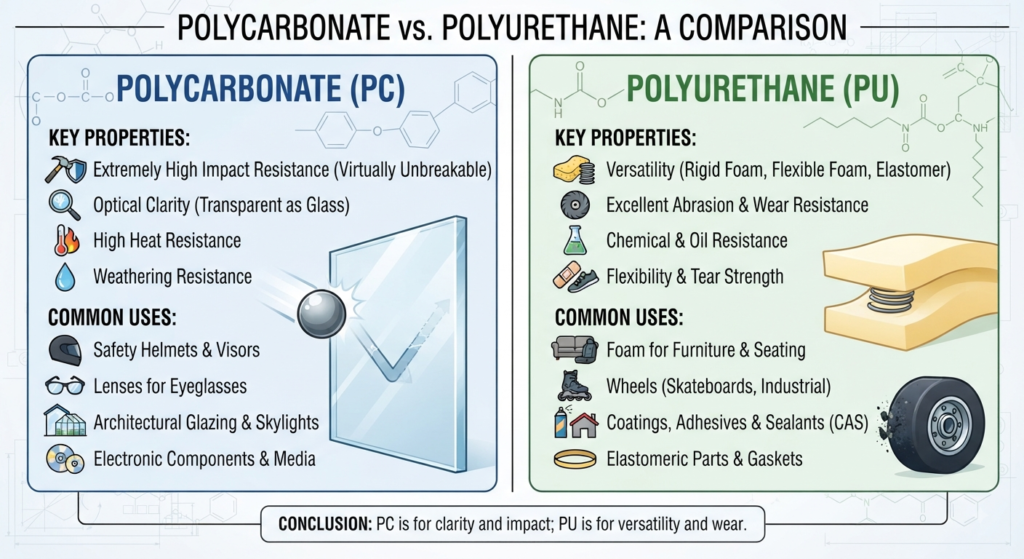
What Is Polycarbonate?
Polycarbonate is a strong and versatile thermoplastic polymer containing carbonate groups in its molecular structure. It is particularly well known for its combination of high impact resistance, transparency, dimensional stability, and relatively good heat resistance.
Polycarbonate can be processed using methods such as injection molding, extrusion, and thermoforming. Its ability to combine strength with optical clarity makes it useful in applications where ordinary glass or less impact-resistant plastics may not provide sufficient performance.
Common polycarbonate products include protective glazing, safety shields, machine guards, optical components, electronic housings, automotive components, and various consumer products.
Characteristics of Polycarbonate
- High impact resistance.
- Generally rigid and strong.
- Excellent optical clarity in suitable grades.
- Good dimensional stability.
- Good heat resistance.
- Relatively low flexibility compared with polyurethane.
- Can be processed by injection molding.
- Can be extruded into sheets and profiles.
- Can be thermoformed.
- Suitable for protective and structural applications.
- Available in transparent and opaque grades.
- Used widely in engineering and consumer products.
Examples of Polycarbonate Applications
- Safety glasses and protective eyewear.
- Machine guards.
- Protective shields.
- Transparent roofing and glazing.
- Automotive components.
- Electronic housings.
- Lighting components.
- Optical components.
- Safety barriers.
- Engineering components.
What Is Polyurethane?
Polyurethane is a highly versatile class of polymers containing urethane linkages. Unlike polycarbonate, polyurethane can be manufactured in a wide range of forms and hardness levels. Depending on its chemical formulation, it can be soft and flexible, rubber-like, rigid, or foam-like.
Polyurethane is particularly valued for its elasticity, abrasion resistance, resilience, cushioning ability, and versatility. It is used in products ranging from flexible foams in furniture and mattresses to durable coatings, adhesives, seals, rollers, wheels, and industrial components.
The properties of polyurethane can vary considerably depending on the raw materials, formulation, density, and manufacturing process.
Characteristics of Polyurethane
- Highly versatile polymer.
- Can be flexible or rigid.
- Excellent elasticity in many grades.
- Good abrasion resistance.
- Good tear resistance in suitable formulations.
- Can provide excellent cushioning.
- Available as foam, elastomer, coating, adhesive, and solid material.
- Good resistance to wear in many applications.
- Can be formulated for different hardness levels.
- Used in automotive and industrial components.
- Useful for sealing and protective applications.
- Available in transparent, translucent, and opaque formulations.
Examples of Polyurethane Applications
- Flexible foam mattresses.
- Furniture cushions.
- Insulation foam.
- Industrial rollers.
- Wheels and casters.
- Seals and gaskets.
- Coatings.
- Adhesives.
- Sealants.
- Synthetic leather.
- Automotive components.
- Protective coatings.
Polycarbonate vs. Polyurethane: Key Differences
1. Material Structure
The fundamental difference between Polycarbonate vs. Polyurethane lies in their chemical structures.
Polycarbonate contains carbonate functional groups within its polymer chains. Engineering polycarbonates commonly have aromatic structures that contribute to their strength, rigidity, and impact resistance.
Polyurethane, in contrast, contains urethane linkages formed through reactions involving isocyanates and compounds containing hydroxyl groups. Its chemistry can be modified extensively to produce materials ranging from flexible elastomers to rigid foams.
Thus, their different molecular structures are responsible for many of the differences in their mechanical and physical properties.
2. Hardness and Flexibility
Hardness and flexibility are major differences between Polycarbonate vs. Polyurethane.
Polycarbonate is generally a rigid engineering thermoplastic. Although it can deform under load and has some flexibility, it does not normally exhibit the rubber-like elasticity associated with polyurethane.
Polyurethane can be produced in a wide range of hardness levels. Some polyurethane grades are soft and highly elastic, while others are hard and rigid.
Therefore, polyurethane generally provides greater flexibility and elasticity, whereas polycarbonate is better suited to rigid structural applications.
3. Impact Resistance
Both materials can provide good impact resistance, but they behave differently when subjected to mechanical forces.
Polycarbonate is particularly well known for its high impact strength. It can withstand considerable impact without easily cracking or shattering, which makes it useful for protective glazing, safety equipment, guards, and housings.
Polyurethane can also have excellent impact resistance, particularly in elastomeric grades. Its flexibility allows it to absorb mechanical energy and resist repeated impacts.
Thus, polycarbonate is often preferred when a rigid, impact-resistant material is needed, while polyurethane can be advantageous when impact absorption and flexibility are important.
4. Transparency and Optical Clarity
Transparency is another important distinction.
Polycarbonate can be manufactured with excellent optical clarity. Transparent polycarbonate sheets and molded components are widely used where visibility and impact resistance are required at the same time.
Polyurethane is generally less transparent and is frequently produced as a translucent or opaque material. However, specialized polyurethane formulations can provide transparency when required.
Therefore, polycarbonate is generally the better choice for applications requiring high optical clarity.
5. Elasticity
Elasticity strongly favors polyurethane.
Polycarbonate is a relatively rigid polymer and does not normally return to its original shape after large deformation in the same way as an elastomer.
Polyurethane, particularly elastomeric polyurethane, can undergo substantial deformation and recover its original shape. This property makes it useful for seals, wheels, rollers, flexible components, and shock-absorbing applications.
Consequently, polyurethane is generally more suitable when elastic recovery and repeated deformation are required.
6. Abrasion and Wear Resistance
Abrasion resistance is another area where polyurethane can provide a significant advantage.
Polycarbonate has good durability but may not be the first choice for applications involving continuous rubbing, sliding, or severe abrasion.
Many polyurethane elastomers have excellent abrasion and wear resistance. They are therefore widely used for industrial rollers, wheels, conveyor components, seals, and other parts exposed to repeated mechanical contact.
Thus, polyurethane is often preferred for high-wear applications, while polycarbonate is more commonly selected for rigid protective and structural components.
7. Temperature Resistance
The temperature performance of these materials depends on the specific grade and operating conditions.
Polycarbonate generally offers good heat resistance for a thermoplastic and can retain useful mechanical properties over a relatively broad temperature range.
Polyurethane has more variable temperature performance because different polyurethane formulations can have very different thermal characteristics. Some grades are designed for low-temperature flexibility, while others are formulated for elevated-temperature service.
Therefore, the specific material grade should always be considered when selecting either polymer for a temperature-sensitive application.
8. Chemical Resistance
The chemical resistance of Polycarbonate vs. Polyurethane also differs.
Polycarbonate has good resistance to many chemicals but can be affected by certain organic solvents, strong chemicals, and environmental conditions. Chemical compatibility should therefore be checked before using it in aggressive environments.
Polyurethane can provide good resistance to oils, fuels, abrasion, and various chemicals depending on its formulation. However, not every polyurethane grade has the same chemical resistance.
Therefore, neither material should be considered universally chemically resistant. The exact polymer grade and chemical exposure must be evaluated before use.
9. Processing and Manufacturing
Polycarbonate is a thermoplastic, meaning it can be softened by heating and processed using manufacturing techniques such as injection molding, extrusion, and thermoforming.
Polyurethane has much broader processing possibilities. Depending on its formulation, it can be produced by casting, reaction injection molding, extrusion, injection molding, coating, or foaming.
This versatility allows polyurethane to be manufactured into products with widely different shapes, densities, hardness levels, and mechanical properties.
10. Applications
The applications of polycarbonate and polyurethane reflect their different characteristics.
Polycarbonate is commonly used where a combination of rigidity, impact resistance, transparency, and dimensional stability is needed. Examples include protective glazing, safety equipment, machine guards, electronic housings, and automotive components.
Polyurethane is commonly used where flexibility, elasticity, abrasion resistance, cushioning, sealing, or protective coatings are required. Examples include mattresses, cushions, industrial wheels, rollers, seals, adhesives, coatings, and insulation materials.
Thus, the intended function of the component is an important factor when choosing between the two materials.
11. Cost and Material Selection
Cost can vary significantly depending on the grade, formulation, manufacturing process, and application.
Polycarbonate can be relatively expensive compared with many commodity plastics because it provides a valuable combination of impact strength, transparency, and engineering performance.
Polyurethane also has a broad price range because it can be formulated into many different products. Simple polyurethane foams may be economical, while specialized high-performance polyurethane elastomers can be relatively expensive.
Therefore, material selection should not be based on purchase price alone. Service life, processing requirements, maintenance, durability, and performance should also be considered.
Similarities Between Polycarbonate and Polyurethane
Although Polycarbonate and Polyurethane have different chemical structures and physical properties, they share several important characteristics. Both are versatile polymers that can be engineered for specific applications and are widely used in industrial and consumer products.
Some important similarities between polycarbonate and polyurethane include:
- Both are synthetic polymers.
- Both can be manufactured into a wide range of products.
- Both can provide good mechanical durability.
- Both are used in automotive applications.
- Both can be used in protective applications.
- Both can be processed into molded components.
- Both are available in different grades.
- Both can be modified to improve specific properties.
- Both have applications in industrial manufacturing.
- Both can provide good resistance to mechanical stresses when properly formulated.
- Both are used in engineering and consumer products.
- Both can be selected according to application-specific performance requirements.
Advantages of Polycarbonate
Polycarbonate offers a combination of strength, transparency, and impact resistance that makes it useful for many engineering applications.
Some major advantages of polycarbonate include:
- Excellent impact resistance.
- High optical clarity.
- Good dimensional stability.
- Good heat resistance.
- Relatively lightweight compared with glass.
- Suitable for protective glazing.
- Useful for transparent safety barriers.
- Can be injection molded.
- Can be extruded and thermoformed.
- Suitable for engineering applications.
- Available in different grades and finishes.
- Useful where rigidity and transparency are required together.
Advantages of Polyurethane
Polyurethane is particularly valuable because its properties can be tailored for different applications. It can be produced as a flexible foam, rigid foam, elastomer, coating, adhesive, or sealant.
Some major advantages of polyurethane include:
- Excellent flexibility in many grades.
- High elasticity.
- Excellent abrasion resistance in many formulations.
- Good wear resistance.
- Available in a wide range of hardness levels.
- Excellent cushioning properties.
- Useful for seals and gaskets.
- Suitable for industrial wheels and rollers.
- Can be used as a protective coating.
- Useful for adhesives and sealants.
- Can be manufactured as flexible or rigid foam.
- Highly adaptable to specialized applications.
Which Is Better—Polycarbonate or Polyurethane?
Neither polycarbonate nor polyurethane is universally better because the appropriate material depends on the requirements of the application.
Polycarbonate is generally the better choice when the application requires high impact resistance, rigidity, transparency, dimensional stability, and good heat resistance. It is particularly useful for protective glazing, machine guards, safety equipment, and transparent engineering components.
Polyurethane is generally more suitable when the application requires flexibility, elasticity, abrasion resistance, cushioning, sealing, or wear resistance. It is widely used for foams, industrial rollers, wheels, seals, coatings, adhesives, and flexible components.
In summary:
- Choose polycarbonate when you need rigidity, transparency, high impact resistance, and good heat resistance.
- Choose polyurethane when you need flexibility, elasticity, abrasion resistance, cushioning, or sealing properties.
Rather than one material being universally superior, Polycarbonate vs. Polyurethane should be evaluated according to the mechanical, thermal, chemical, optical, and manufacturing requirements of the specific application.
Conclusion
The comparison of Polycarbonate vs. Polyurethane demonstrates the differences between two highly versatile polymer materials. Polycarbonate is a relatively rigid thermoplastic recognized for its excellent impact resistance, transparency, dimensional stability, and good heat resistance. Polyurethane, in contrast, can be formulated into flexible, elastic, rigid, or foam materials and is particularly valued for its abrasion resistance, resilience, cushioning ability, and versatility.
Although both materials are durable and widely used in engineering and consumer products, their strengths are different. Polycarbonate is generally preferred for rigid, transparent, and impact-resistant components, whereas polyurethane is often selected for flexible, elastic, wear-resistant, cushioning, and sealing applications.
Understanding Polycarbonate vs. Polyurethane makes it easier to select the appropriate material for a particular application. The final choice should consider factors such as impact resistance, flexibility, transparency, temperature, chemical exposure, abrasion, manufacturing method, and overall service requirements.
Frequently Asked Questions (FAQs)
The main difference between Polycarbonate vs. Polyurethane is their structure and typical properties. Polycarbonate is generally a rigid, transparent thermoplastic with high impact resistance, while polyurethane can range from flexible and elastic to rigid and is known for versatility, abrasion resistance, and cushioning properties.
Polyurethane is generally more flexible than polycarbonate. Many polyurethane grades are highly elastic and can undergo repeated deformation, whereas polycarbonate is comparatively rigid.
Both can have excellent impact resistance, but polycarbonate is particularly well known for high impact strength in rigid applications. Polyurethane can absorb impacts effectively, especially when an elastomeric or flexible grade is used.
Polycarbonate is generally more transparent and offers better optical clarity. Polyurethane is commonly translucent or opaque, although transparent polyurethane formulations are available.
Polyurethane is generally better suited to severe abrasion and wear applications, particularly in elastomeric grades. It is commonly used for industrial rollers, wheels, seals, and other components exposed to repeated mechanical contact.
Reference:
1. Lazonby, John. “Polyurethanes.” The Essential Chemical Industry Online
2. “Polycarbonate.” Wikipedia, Wikimedia Foundation, 2 May 2019
Read Next:
- Chloride vs. Chlorite: What’s the Difference?
- 1-Butene vs. 2-Butene: What’s the Difference?
- Phosphodiester Bond vs. Phosphoester Bond:
- Difference Between Methyl and Methylene Group (CH3 vs CH2)
- Difference Between Molecular Equation and Ionic Equation
- Olefins vs. Paraffins: What’s the Difference?
- Cetyl Alcohol vs. Stearyl Alcohol: What’s the Difference?
- Buchner Funnel vs. Hirsch Funnel
- Teal vs. Turquoise
- Cataphoresis vs. Anaphoresis