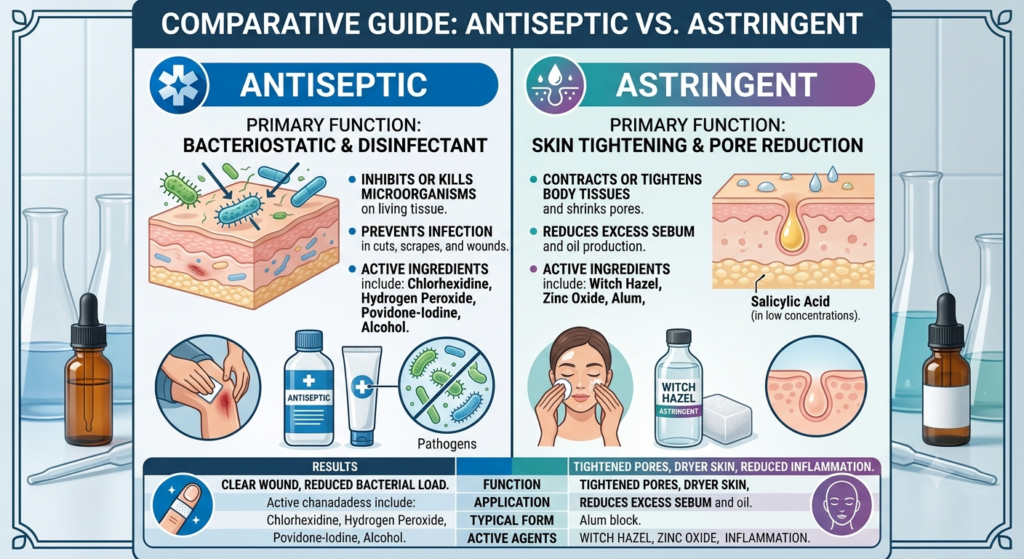
The main difference between Antiseptic vs. Astringent is their primary purpose and how they act on the skin. An antiseptic is a substance used to reduce or inhibit the growth of microorganisms on living tissues, while an astringent is a substance that causes tissues to contract and is commonly used to reduce surface oil, moisture, or minor secretions. Although some products may have overlapping properties, antiseptics are primarily associated with infection control, whereas astringents are mainly associated with tissue tightening and skin care.
Understanding Antiseptic vs. Astringent is important because the two terms are sometimes used interchangeably even though they describe different actions. Choosing the appropriate product depends on whether the goal is reducing microorganisms on the skin or producing an astringent effect such as temporary tissue contraction.
Antiseptic vs. Astringent Comparison Table
The table below highlights the major differences between Antiseptic vs. Astringent.
| Feature | Antiseptic | Astringent |
| Definition | Substance used to reduce or inhibit microorganisms on living tissue | Substance that causes contraction of tissues |
| Primary Purpose | Helps reduce the risk of infection | Produces a tightening or drying effect |
| Main Action | Acts against microorganisms | Causes proteins or tissues to contract |
| Common Target | Bacteria and other microorganisms on skin or tissue | Surface tissues, particularly skin |
| Typical Uses | Wound cleansing and infection prevention | Skin care and control of excessive surface oil or moisture |
| Effect on Skin | Reduces microbial contamination | Produces a temporary tightening or drying effect |
| Common Ingredients | Chlorhexidine, povidone-iodine, and certain alcohol-based preparations | Witch hazel and aluminum salts are examples of astringent ingredients |
| Medical Importance | Important for infection-control applications | More commonly associated with topical skin care and minor local applications |
| Use on Wounds | Some formulations are specifically intended for wound or skin antisepsis | Not generally a substitute for an antiseptic wound-care product |
| Main Benefit | Microbial reduction | Tissue contraction and reduction of surface secretions |
| Overuse Concern | Can cause irritation or tissue damage depending on the product | Can cause dryness or irritation, particularly with frequent use |
What Is an Antiseptic?
An antiseptic is a chemical substance formulated to reduce or inhibit the growth of microorganisms on living tissues, particularly the skin. Antiseptics are commonly used when reducing microbial contamination is important.
Antiseptics are different from disinfectants. A disinfectant is generally intended for inanimate surfaces, whereas an antiseptic is formulated for use on living tissue. The exact permitted use depends on the specific active ingredient and product formulation.
Common antiseptic agents include chlorhexidine, povidone-iodine, and certain alcohol-based preparations. Different antiseptics work in different ways and have different activity against bacteria, fungi, viruses, and other microorganisms.
Antiseptic products are widely used in healthcare, first aid, and skin preparation before certain medical procedures.
Characteristics of Antiseptics
Important characteristics of antiseptics include:
- They are designed for use on living tissues.
- They help reduce microorganisms on the skin.
- They can reduce the risk of infection in appropriate applications.
- Different antiseptics have different antimicrobial activity.
- They are available in liquids, solutions, gels, creams, and other formulations.
- Their effectiveness depends on concentration and contact time.
- They should be used according to product instructions.
- Some formulations are intended specifically for surgical or pre-procedure skin preparation.
- Some may cause skin irritation or allergic reactions.
- They should not automatically be used on every type of wound.
Examples of Antiseptics
Examples of substances used in antiseptic products include:
- Chlorhexidine.
- Povidone-iodine.
- Ethanol in appropriate formulations.
- Isopropyl alcohol in appropriate formulations.
- Certain other antimicrobial compounds formulated for topical use.
The appropriate antiseptic depends on the intended application, formulation, concentration, and instructions provided by the manufacturer or healthcare professional.
What Is an Astringent?
An astringent is a substance that causes contraction of tissues. In skin care, astringent products are commonly used to produce a temporary tightening or drying effect on the skin.
Astringent substances can interact with proteins in superficial tissues and may reduce surface secretions. Some are therefore used in formulations intended for oily skin or for specific minor topical applications.
Examples of substances with astringent properties include witch hazel and certain aluminum salts. However, the effects and suitability of a product depend on its complete formulation.
Astringents should not automatically be considered antiseptics. Although some astringent products may contain antimicrobial ingredients or have some antimicrobial activity, their defining characteristic is their tissue-contracting effect, not microbial killing.
Characteristics of Astringents
Important characteristics of astringents include:
- They cause contraction of superficial tissues.
- They can produce a tightening sensation on the skin.
- They may reduce surface oil or moisture.
- They are commonly used in topical skin-care formulations.
- Some have mild antimicrobial properties.
- Their effects depend on the active ingredient and concentration.
- Strong formulations can cause dryness.
- Frequent use may irritate sensitive skin.
- They are available in lotions, toners, solutions, and other topical preparations.
- They should be selected according to the intended application and skin type.
Examples of Astringents
Common examples include:
- Witch hazel preparations.
- Aluminum acetate preparations.
- Certain aluminum salt formulations.
- Other compounds with tissue-contracting properties.
Not every product containing these ingredients is necessarily suitable for every skin condition, so the product label and intended use should be considered.
Antiseptic vs. Astringent: Key Differences
1. Primary Purpose
The most important difference in Antiseptic vs. Astringent is their primary purpose.
Antiseptics are designed to reduce or inhibit microorganisms on living tissues.
Astringents are designed to produce tissue contraction and may reduce surface secretions.
Therefore, an antiseptic is primarily concerned with microbial control, while an astringent is primarily concerned with tissue contraction.
2. Mode of Action
Antiseptics work through chemical mechanisms that damage, inhibit, or otherwise reduce microorganisms.
The mechanism varies considerably among antiseptic agents. Some disrupt microbial membranes, while others interfere with proteins or other cellular components.
Astringents act mainly by causing contraction of tissues, often through interactions with proteins in superficial tissues.
Thus, their biological actions are fundamentally different.
3. Effect on Microorganisms
Antiseptics have a direct antimicrobial purpose. Their formulations are designed to reduce microorganisms on the skin or other appropriate living tissues.
Astringents do not necessarily have a primary antimicrobial function. Some may possess antimicrobial properties, but this does not make every astringent an antiseptic.
This distinction is particularly important when selecting a product for infection prevention.
4. Effect on the Skin
An antiseptic primarily affects the microbial population on the skin.
An astringent primarily produces a tightening or drying effect. Depending on the formulation, it may also reduce excess surface oil or moisture.
Some antiseptic products can cause dryness or irritation as a side effect, but skin tightening is not their defining purpose.
5. Common Applications
Antiseptics are frequently associated with:
- Skin preparation.
- First aid.
- Certain wound-care applications.
- Healthcare procedures.
- Reducing microbial contamination.
Astringents are more commonly associated with:
- Skin-care products.
- Oily skin.
- Temporary reduction of surface oil.
- Tissue-tightening effects.
- Certain minor topical applications.
The exact use depends on the specific product.
6. Role in Wound Care
Antiseptics may be formulated specifically for use on certain wounds or intact skin, depending on the product.
Astringents are generally not a replacement for appropriate wound-care products. Applying an unsuitable astringent to damaged tissue can cause irritation and may interfere with healing.
For wound care, it is important to follow the instructions for the specific product and seek medical advice for deep, contaminated, infected, or serious wounds.
7. Role in Skin Care
Astringents have a stronger association with cosmetic and skin-care applications.
They may temporarily make skin feel tighter and can help reduce surface oil depending on the formulation.
Antiseptics, by contrast, are used primarily when reducing microorganisms is the intended objective rather than simply improving the feel or appearance of the skin.
8. Drying Effect
Astringents can have a noticeable drying effect on the skin because they can reduce surface secretions and cause tissue contraction.
Some antiseptics can also cause dryness, particularly certain alcohol-containing formulations, but this is generally an effect associated with the product rather than the defining function of an antiseptic.
People with sensitive or dry skin should take particular care when using products that may cause irritation.
9. Product Formulations
Antiseptics can be formulated as:
- Solutions.
- Sprays.
- Creams.
- Gels.
- Wipes.
- Preparations for surgical skin cleansing.
Astringents may be found in:
- Toners.
- Lotions.
- Solutions.
- Gels.
- Other topical skin-care formulations.
The concentration and combination of ingredients can significantly affect the product’s performance and tolerability.
10. Safety Considerations
Both antiseptics and astringents should be used according to their intended purpose.
Using an antiseptic excessively can irritate or damage skin, depending on the active ingredient and concentration.
Likewise, excessive use of astringents can remove too much surface oil and cause dryness, redness, burning, or irritation.
A product intended for intact skin should not automatically be applied to open wounds, mucous membranes, eyes, or other sensitive areas unless the label specifically indicates that use.
Similarities Between Antiseptic and Astringent
Although Antiseptic vs. Astringent describes different types of substances, they share several characteristics.
Some important similarities include:
- Both can be used in topical products.
- Both can be applied to the skin in appropriate formulations.
- Both are available in liquid and other topical forms.
- Both can be found in personal-care or healthcare products.
- Both may produce noticeable effects on the skin.
- Both can cause irritation if used improperly.
- Both should be used according to product directions.
- Some substances may have both astringent and antimicrobial properties.
- Both have applications related to skin hygiene or care.
- Their effects depend on the specific chemical and formulation.
Antiseptic vs. Astringent for Skin
The choice between an antiseptic and an astringent depends on the intended purpose.
If the primary objective is to reduce microorganisms on the skin, an appropriately formulated antiseptic is generally the relevant type of product.
If the objective is to produce a temporary tightening or drying effect and manage surface oil, an astringent formulation may be more appropriate.
However, modern skin-care products can contain multiple active ingredients, so a product should be evaluated based on its label and intended use rather than its marketing category alone.
Antiseptic vs. Astringent for Wounds
Antiseptics and astringents should not be treated as interchangeable wound-care products.
Certain antiseptics are specifically formulated for use on skin or wounds and may help reduce microbial contamination when used appropriately.
Astringents primarily produce tissue contraction and are not generally intended to replace appropriate wound cleansing or infection-control measures.
For a minor wound, following appropriate first-aid guidance is more important than simply choosing a product because it is labeled an antiseptic or astringent. For serious wounds, persistent bleeding, signs of infection, animal or human bites, or deeply contaminated injuries, medical evaluation may be necessary.
Is an Astringent the Same as an Antiseptic?
No. An astringent and an antiseptic are not the same thing.
An antiseptic is defined primarily by its ability to reduce or inhibit microorganisms on living tissue.
An astringent is defined primarily by its ability to cause tissue contraction.
There can be some overlap because certain ingredients may have both astringent and antimicrobial effects. However, the two terms describe different primary actions.
Which Is Better—Antiseptic or Astringent?
Neither is universally better because they are intended for different purposes.
An antiseptic is more appropriate when microbial reduction on living tissue is the primary objective and the particular product is labeled for that use.
An astringent is more appropriate when the desired effect is tissue contraction, temporary tightening, or reduction of surface secretions.
Selecting the right product should therefore depend on the intended application, active ingredients, concentration, and manufacturer’s directions.
Conclusion
The comparison of Antiseptic vs. Astringent shows that these substances have different primary functions despite sometimes appearing in similar topical products. Antiseptics are primarily used to reduce or inhibit microorganisms on living tissues, making them important in appropriate skin-preparation, hygiene, and infection-control applications.
Astringents, on the other hand, primarily cause contraction of superficial tissues and may produce a tightening or drying effect. They are commonly associated with skin-care products and management of surface oil or moisture.
The simplest distinction is that antiseptics focus on microbial control, while astringents focus on tissue contraction and surface effects. Some products may have overlapping properties, but an astringent should not automatically be considered an antiseptic.
Understanding Antiseptic vs. Astringent can help in selecting topical products more appropriately and avoiding the misuse of products for purposes for which they were not designed.
Frequently Asked Questions (FAQs)
The main difference in Antiseptic vs. Astringent is their primary action. Antiseptics are used to reduce or inhibit microorganisms on living tissues, whereas astringents cause contraction of tissues and can produce a tightening or drying effect.
Not necessarily. Some astringent ingredients may have antimicrobial properties, but an astringent should not automatically be treated as an antiseptic. The product’s formulation and labeled purpose determine whether it is suitable for antimicrobial use.
Some antiseptic products are specifically formulated for certain wound-care or skin-preparation applications. They should be used only according to their product directions because not every antiseptic is appropriate for every type of wound.
Yes, many astringents can produce a drying effect by reducing surface secretions and causing tissue contraction. Excessive use may lead to dryness, irritation, or redness, particularly in sensitive skin.
It depends on the purpose. An antiseptic is intended primarily for microbial reduction, while an astringent is generally used for a tightening or drying effect. The appropriate choice depends on the specific skin-care need and the formulation of the product.
Reference:
1. Gotter, Ana. “What Is Antiseptic: Antiseptic vs. Disinfectant, Uses, and Safety.” Healthline, Healthline Media.
Read Next:
- Chloride vs. Chlorite: What’s the Difference?
- 1-Butene vs. 2-Butene: What’s the Difference?
- Phosphodiester Bond vs. Phosphoester Bond:
- Difference Between Methyl and Methylene Group (CH3 vs CH2)
- Difference Between Molecular Equation and Ionic Equation
- Olefins vs. Paraffins: What’s the Difference?
- Cetyl Alcohol vs. Stearyl Alcohol: What’s the Difference?
- Equipment vs. Materials
- Levigation vs. Trituration