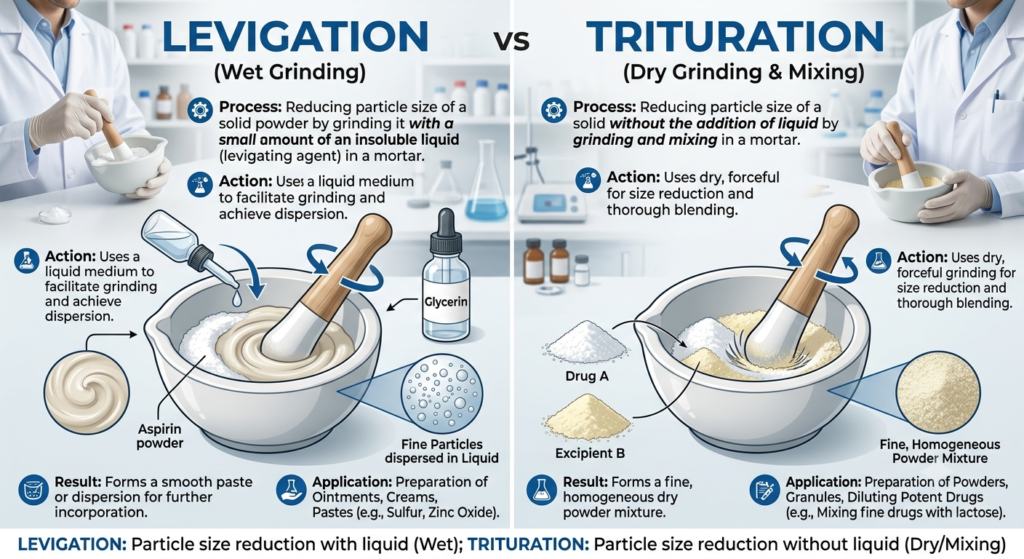
The main difference between Levigation vs. Trituration is the medium used during the grinding process. Levigation involves reducing the particle size of a solid by rubbing or grinding it with a small amount of a suitable liquid to produce a smooth paste or dispersion. Trituration, in contrast, involves grinding or pulverizing a substance, usually with a mortar and pestle, without adding a liquid. Both techniques are used to reduce particle size and improve the mixing of pharmaceutical ingredients, but their applications and methods are different.
Understanding Levigation vs. Trituration is important in pharmaceutics and pharmaceutical compounding because particle size can affect the uniformity, stability, texture, and performance of a formulation. Choosing the appropriate technique depends on the physical properties of the material and the type of preparation being made.
Levigation vs. Trituration Comparison Table
The table below highlights the major differences between Levigation vs. Trituration.
| Feature | Levigation | Trituration |
| Definition | Reduction of particle size by rubbing a solid with a small amount of liquid | Reduction of particle size by grinding or pulverizing a solid |
| Liquid Used | Requires a suitable liquid or levigating agent | Normally performed without a liquid |
| Main Purpose | Produces a smooth dispersion or paste | Produces a fine powder or uniform powder mixture |
| Material | Usually used for insoluble powders | Commonly used for solid powders and crystalline materials |
| Equipment | Mortar and pestle, slab, or other suitable surface | Mortar and pestle or mechanical grinder |
| Product Form | Smooth paste, dispersion, or wet mixture | Dry, finely divided powder |
| Common Application | Ointments, creams, suspensions, and other semisolid preparations | Powders, capsules, tablets, and pharmaceutical mixtures |
| Role of Liquid | Reduces friction and helps distribute particles | Not normally involved |
| Particle Reduction | Helps produce smooth, finely dispersed particles | Breaks larger particles into smaller particles |
| Example | Levigating an insoluble powder before incorporating it into an ointment base | Grinding a solid drug with a mortar and pestle before mixing |
| Key Advantage | Helps produce a smooth and uniform dispersion | Simple and effective for dry powder processing |
| Major Limitation | Not suitable for materials affected by the selected liquid | May generate dust and may be unsuitable for some very hard materials |
What Is Levigation?
Levigation is a pharmaceutical technique used to reduce the particle size of a solid by rubbing it with a small amount of a suitable liquid. The process produces a smooth paste or finely dispersed material that can be incorporated into a formulation.
The liquid used for levigation is called a levigating agent. Its selection depends on the formulation and the properties of the substance being processed. Examples of suitable liquids may include water, glycerin, mineral oil, or another compatible liquid vehicle.
During levigation, the powder is gradually mixed with the levigating agent and rubbed against a mortar, pestle, or ointment slab. The liquid helps reduce friction between particles and promotes a smoother dispersion.
This technique is especially useful when an insoluble powder needs to be incorporated into an ointment, cream, suspension, or another preparation where a gritty texture would be undesirable.
Characteristics of Levigation
Important characteristics of levigation include:
- It involves a liquid medium.
- It is commonly used for insoluble powders.
- It reduces the apparent particle size and improves dispersion.
- It produces a smooth paste or dispersion.
- A suitable levigating agent is selected according to the formulation.
- It can improve the texture of semisolid preparations.
- It helps prevent the formation of coarse particles.
- It is widely associated with pharmaceutical compounding.
- It can facilitate the incorporation of powders into ointment bases.
- The liquid used should be compatible with the drug and formulation.
Examples of Levigation
Levigation may be used when:
- An insoluble drug needs to be incorporated into an ointment.
- A powder must be dispersed smoothly in a liquid vehicle.
- A coarse powder needs to be incorporated into a semisolid preparation.
- A pharmaceutical formulation requires a smooth and uniform texture.
- An insoluble ingredient needs to be distributed evenly throughout a base.
What Is Trituration?
Trituration is the process of reducing the particle size of a solid by grinding, crushing, or rubbing it. In traditional pharmacy practice, this is commonly performed using a mortar and pestle.
Unlike levigation, conventional trituration is generally performed without adding a liquid. The solid material is placed in the mortar and ground until the required degree of fineness is obtained.
Trituration is also used to mix powders. When two or more ingredients are present, controlled grinding and mixing can help distribute the ingredients more uniformly.
The technique is particularly useful in pharmaceutical compounding when preparing dry powder mixtures. However, the method must be selected carefully because some substances may be sensitive to mechanical stress, heat, or other processing conditions.
Characteristics of Trituration
Important characteristics of trituration include:
- It is primarily a dry grinding technique.
- It commonly uses a mortar and pestle.
- It reduces the particle size of solid materials.
- It can be used to mix powdered ingredients.
- It increases the surface area of finely divided materials.
- It can improve the uniformity of powder mixtures.
- It does not normally require a liquid.
- It is useful in traditional pharmaceutical compounding.
- It can be performed manually or with mechanical equipment.
- The required grinding time depends on the material and desired particle size.
Examples of Trituration
Trituration may be used for:
- Grinding a solid pharmaceutical ingredient into a fine powder.
- Mixing two or more dry powders.
- Preparing a powdered drug for further formulation.
- Reducing the size of crystalline materials when appropriate.
- Incorporating a small quantity of an active ingredient into a larger powder mixture.
Levigation vs. Trituration: Key Differences
1. Presence of Liquid
The most important difference in Levigation vs. Trituration is whether a liquid is used.
Levigation uses a small quantity of a suitable liquid during the grinding process. The liquid helps create a smooth paste or dispersion.
Trituration is generally performed without a liquid and produces a dry powder.
This is the easiest distinction to remember when comparing the two techniques.
2. Main Purpose
Levigation is mainly used to obtain a smooth dispersion of an insoluble substance and to facilitate its incorporation into a formulation.
Trituration is primarily used to reduce the particle size of solids or to mix dry powders.
Although both processes involve mechanical action, their practical purposes can differ depending on the formulation.
3. Final Product
The physical form produced by each method is different.
Levigation usually produces a smooth paste or dispersion because a liquid is incorporated during processing.
Trituration normally produces a fine, dry powder.
The desired final form therefore influences which technique is appropriate.
4. Use in Ointments
Levigation is particularly useful in the preparation of ointments and creams containing insoluble powders.
The powder is first reduced and dispersed with an appropriate liquid before being incorporated into the base. This helps reduce grittiness and improves the uniformity of the finished preparation.
Trituration may be used before this stage to reduce the size of a dry ingredient, but it does not itself create the same smooth liquid-assisted dispersion.
5. Use in Powder Formulations
Trituration is commonly associated with powder preparation.
A solid ingredient can be ground to reduce its particle size and then mixed with other ingredients. This can help achieve a more uniform distribution of the components.
Levigation is less suitable when the final product must remain completely dry because it introduces a liquid into the process.
6. Role of the Liquid
In levigation, the liquid has an important role in the process. It acts as a medium that assists rubbing and helps distribute the particles.
In trituration, the absence of a liquid allows the material to remain in a dry state during grinding.
Therefore, the moisture sensitivity of a material should be considered before choosing the method.
7. Texture of the Preparation
Levigation is useful when a smooth texture is required.
For example, coarse particles in an ointment can produce an unpleasant gritty feeling. Levigation can help disperse such particles more smoothly before incorporation into the base.
Trituration can reduce particle size, but because it is normally a dry process, it does not provide the same liquid-assisted smoothing effect.
8. Equipment Used
Both techniques can involve a mortar and pestle, but their working conditions are different.
During trituration, the dry material is placed in the mortar and ground directly.
During levigation, the material is rubbed with a small quantity of a suitable liquid, either in a mortar or on an appropriate compounding surface.
9. Suitability of Materials
Trituration is useful for many dry solid substances that can tolerate mechanical grinding.
Levigation is more appropriate when an insoluble material needs to be dispersed in a compatible liquid or incorporated into a semisolid base.
Materials that react with, dissolve in, or are otherwise incompatible with the selected levigating agent may require another method.
10. Pharmaceutical Application
Both methods have an important place in pharmaceutical preparation.
Trituration is useful for particle-size reduction and powder mixing, while levigation is useful for smooth dispersion and incorporation of insoluble powders into semisolid or liquid formulations.
The choice should always depend on the properties of the material and the intended dosage form.
Similarities Between Levigation and Trituration
Although Levigation vs. Trituration involves different processing methods, they share several similarities.
Some important similarities include:
- Both involve mechanical reduction of particle size.
- Both can be performed using a mortar and pestle.
- Both are used in pharmaceutical preparation.
- Both can improve the uniformity of a formulation.
- Both involve rubbing or grinding of solid materials.
- Both can help prepare ingredients for further processing.
- Both are useful in pharmaceutical compounding.
- Both can improve the distribution of active ingredients.
- Both require appropriate technique to obtain consistent results.
- Both are selected according to the properties of the material being processed.
Functions of Levigation and Trituration
The main functions of levigation include:
- Reducing the size of coarse particles.
- Producing a smooth dispersion.
- Helping incorporate insoluble powders into semisolid bases.
- Improving the texture of ointments and creams.
- Promoting uniform distribution of particles.
- Reducing grittiness in pharmaceutical preparations.
- Preparing powders for incorporation into suitable formulations.
The main functions of trituration include:
- Crushing solid materials.
- Reducing particle size.
- Producing fine powders.
- Mixing dry pharmaceutical ingredients.
- Increasing the surface area of solids.
- Improving powder uniformity.
- Preparing ingredients for subsequent formulation steps.
Levigation vs. Trituration in Pharmacy
Pharmacy provides a clear example of why the difference between these techniques matters.
Suppose an insoluble powder must be incorporated into an ointment. Simply adding the dry powder to the ointment base may produce a coarse or gritty preparation. Levigation can be used to first disperse the powder with a compatible liquid and produce a smoother material before incorporation.
In another situation, a solid ingredient may need to be reduced to a fine powder or mixed with other dry ingredients. Trituration can be used for this purpose.
The choice therefore depends on the dosage form and the characteristics of the substance being prepared.
Levigating Agents
A levigating agent is a liquid used during levigation to facilitate the formation of a smooth dispersion. The agent should be compatible with both the substance being levigated and the final formulation.
Common examples may include:
- Glycerin – often useful with certain powders in aqueous or semisolid preparations.
- Mineral oil – suitable for some preparations involving oleaginous bases.
- Water – useful when the formulation and ingredient are compatible with water.
- Other compatible liquids – selected according to the formulation requirements.
The choice of levigating agent is important because an unsuitable liquid can affect the stability, solubility, texture, or therapeutic performance of the final preparation.
Particle Size and Pharmaceutical Formulation
Particle size is an important consideration in pharmaceutical preparations. Smaller and more uniformly distributed particles can influence properties such as dissolution, dispersion, sedimentation, texture, and content uniformity.
Trituration can reduce the size of dry particles, while levigation can help create a smooth dispersion of an insoluble material.
However, neither technique should automatically be considered a substitute for specialized particle-size reduction processes. Hard or difficult materials may require equipment such as mills or micronizers when very fine particle sizes are necessary.
Which Technique Should Be Used?
The choice between levigation and trituration depends mainly on the material and the desired preparation.
Levigation is appropriate when a smooth dispersion or paste is required and the substance can be safely processed with a compatible liquid.
Trituration is appropriate when a dry solid needs to be pulverized or when dry powders need to be mixed.
Factors such as moisture sensitivity, solubility, hardness, compatibility, dosage form, and desired particle size should all be considered before selecting a technique.
Conclusion
The comparison of Levigation vs. Trituration shows that both are useful techniques for processing solid pharmaceutical ingredients, but they are performed differently.
Levigation uses a small amount of a suitable liquid to help reduce particle size and produce a smooth paste or dispersion. It is particularly useful for incorporating insoluble powders into ointments, creams, suspensions, and similar formulations.
Trituration, on the other hand, is primarily a dry grinding process used to reduce the particle size of solids and mix powdered ingredients. It is commonly associated with the preparation of dry pharmaceutical mixtures.
The simplest distinction is that levigation involves grinding with a suitable liquid, whereas trituration generally involves grinding a solid without a liquid. Selecting the correct method helps achieve the desired particle size, texture, uniformity, and formulation performance.
Frequently Asked Questions (FAQs)
The main difference in Levigation vs. Trituration is the use of liquid. Levigation involves rubbing or grinding a substance with a suitable liquid to produce a smooth dispersion, while trituration generally involves grinding a solid without a liquid.
Levigation is commonly used to reduce the apparent particle size of insoluble powders and produce a smooth dispersion. It is particularly useful when preparing ointments, creams, suspensions, and other pharmaceutical formulations.
Trituration is used to grind solid substances into finer powders and to mix dry pharmaceutical ingredients. It is commonly performed with a mortar and pestle in traditional compounding.
A levigating agent is a compatible liquid used during levigation to help produce a smooth dispersion of a solid powder. Examples can include glycerin, mineral oil, or water, depending on the formulation.
Yes. Both techniques can reduce particle size through mechanical action. However, levigation uses a liquid during the process, while trituration is generally performed as a dry grinding technique.
Reference:
1. “Water Treatment Solutions.” Lenntech Water Treatment & Purification.
Read Next:
- Chloride vs. Chlorite: What’s the Difference?
- 1-Butene vs. 2-Butene: What’s the Difference?
- Phosphodiester Bond vs. Phosphoester Bond:
- Difference Between Methyl and Methylene Group (CH3 vs CH2)
- Difference Between Molecular Equation and Ionic Equation
- Olefins vs. Paraffins: What’s the Difference?
- Cetyl Alcohol vs. Stearyl Alcohol: What’s the Difference?
- Equipment vs. Materials