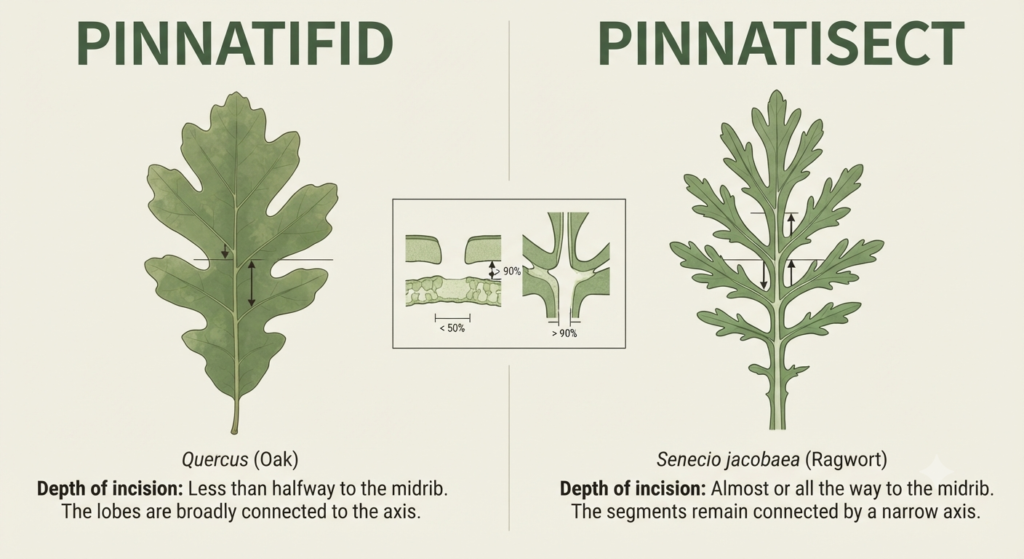
The main difference between Pinnatifid vs. Pinnatisect is that pinnatifid leaves have deep lobes that do not reach the midrib, while pinnatisect leaves are cut almost completely to the midrib, forming nearly separate leaf segments. Understanding this distinction helps in identifying plant species and recognizing their adaptations.
Leaves come in many shapes and forms, and botanists use specific terms to describe their structure accurately. Two commonly confused leaf types are pinnatifid and pinnatisect. Although both have deep lobes arranged along a central midrib, they differ in how far those lobes extend toward the leaf’s center.
Whether you are studying botany, gardening, agriculture, or simply curious about leaf morphology, this guide explains everything you need to know about pinnatifid and pinnatisect leaves.
Comparison Table: Pinnatifid vs. Pinnatisect
The table below highlights the major differences between pinnatifid and pinnatisect leaves.
| Feature | Pinnatifid | Pinnatisect |
|---|---|---|
| Definition | Leaf deeply lobed but not cut to the midrib | Leaf deeply divided almost to the midrib |
| Depth of Lobes | Extend more than halfway toward the midrib | Extend nearly or completely to the midrib |
| Midrib Connection | Leaf tissue remains connected | Lobes are almost completely separated |
| Overall Appearance | Broad, lobed leaf | Feather-like or finely divided leaf |
| Degree of Division | Moderate to deep | Very deep |
| Leaf Integrity | Appears as a single leaf | Appears divided into narrow segments |
| Surface Area | Relatively broad | More segmented with narrow divisions |
| Wind Resistance | Moderate | Better airflow through leaf segments |
| Common Examples | Dandelion, Oak, Mustard | Parsley, Carrot, Ragwort |
| Botanical Complexity | Less dissected | More dissected |
What Is a Pinnatifid Leaf?
A pinnatifid leaf is a leaf with deep indentations or lobes that extend significantly toward the central vein but stop before reaching it. The leaf blade remains continuous, meaning all lobes stay connected by a strip of leaf tissue along the midrib.
The word pinnatifid originates from the Latin words pinna (feather) and fidere (to split). As the name suggests, the leaf resembles a feather while maintaining a single, connected blade.
These leaves are common in many flowering plants and help increase the leaf edge without completely separating the leaf into individual leaflets.
Characteristics of Pinnatifid Leaves
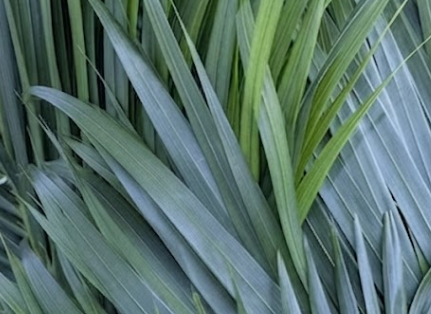
- Lobes extend more than halfway toward the midrib.
- Midrib remains surrounded by leaf tissue.
- Leaf blade stays intact.
- Lobes may be rounded or pointed.
- Classified as a simple leaf despite deep cuts.
- Usually broader than pinnatisect leaves.
Features of Pinnatifid Leaves
- Deeply lobed but connected: The lobes extend more than halfway toward the midrib but do not reach it, so the leaf blade remains connected.
- Simple leaf structure: Despite the deep cuts, pinnatifid leaves are classified as simple leaves because they consist of a single, continuous blade.
- Broad photosynthetic area: The connected leaf tissue provides a larger surface area for efficient sunlight absorption and photosynthesis.
- Greater structural strength: The continuous blade offers better mechanical support than more deeply divided leaf types.
- Efficient water and nutrient transport: The intact vascular network allows water and nutrients to move smoothly throughout the leaf.
- Distinctive lobed appearance: The deep indentations give the leaf a decorative, jagged look without separating it into individual segments.
Examples of Pinnatifid Leaves
Many flowering plants have pinnatifid leaves. Some common examples include:
- Dandelion (Taraxacum officinale): Features deep, backward-pointing lobes that stop before reaching the midrib, making it a classic pinnatifid leaf.
- Mustard (Brassica species): Produces broad leaves with irregular, deeply cut lobes that remain connected along the central vein.
- Oak (Some species): Young leaves of several oak species exhibit pinnatifid lobes before developing their mature shape.
- Chrysanthemum (Chrysanthemum species): Ornamental varieties often have attractive, deeply lobed leaves with a continuous blade.
- Wild Radish (Raphanus raphanistrum): Develops pinnatifid leaves with uneven lobes that are connected by the leaf blade.
- Sow Thistle (Sonchus species): Has soft, deeply lobed leaves with indentations that do not reach the midrib.
- Common Ragwort (Jacobaea vulgaris): Young basal leaves are often pinnatifid before becoming more deeply divided with maturity.
What Is a Pinnatisect Leaf?
A pinnatisect leaf is a leaf in which the lobes extend almost all the way to the central midrib, leaving only a narrow strip of tissue connecting them.
Unlike compound leaves, the divisions are still part of the same leaf because they remain attached to the midrib. However, the leaf appears almost completely separated into narrow segments.
The term pinnatisect comes from the Latin word sectus, meaning “cut.”
These leaves resemble feathers or ferns due to their highly divided structure.
Characteristics of Pinnatisect Leaves
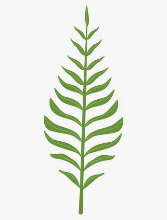
- Lobes extend nearly to the midrib.
- Very narrow connections remain.
- Leaf appears finely divided.
- Segments resemble individual leaflets.
- Greater degree of dissection than pinnatifid leaves.
- Common in herbs and plants growing in windy environments.
Features of Pinnatisect Leaves
Pinnatisect leaves are more deeply divided than pinnatifid leaves, giving them a finely dissected or feather-like appearance. Although the lobes extend almost to the midrib, they remain attached, so the leaf is still classified as a simple leaf.
- Deeply divided lobes: The lobes extend almost to the central midrib, leaving only a narrow strip of tissue connecting them.
- Feather-like appearance: The long, narrow segments give the leaf a delicate, fern-like or feathery look.
- Improved air circulation: The deeply divided structure allows better airflow around the leaf, helping reduce moisture buildup and the risk of fungal diseases.
- Reduced wind resistance: The narrow segments allow wind to pass through more easily, minimizing mechanical damage in exposed environments.
- Better heat regulation: Increased spacing between the lobes promotes heat dissipation and transpiration, helping the plant stay cooler in warm climates.
- Ornamental value: The finely dissected foliage adds texture and visual appeal, making many pinnatisect plants popular in gardens and landscapes.
Examples of Pinnatisect Leaves
Many plants have pinnatisect leaves with deep divisions that extend almost to the midrib. Some common examples include:
- Parsley (Petroselinum crispum): A classic example with finely divided, feather-like leaves that are deeply cut almost to the midrib.
- Carrot (Daucus carota): Produces delicate, highly dissected leaves that improve airflow while remaining flexible.
- California Poppy (Eschscholzia californica): Features blue-green leaves with narrow, deeply divided lobes, giving the plant a soft, feathery appearance.
- Common Ragwort (Jacobaea vulgaris): Develops pinnatisect leaves with slender lobes that extend nearly to the midrib.
- Artemisia (Artemisia species): Many species have finely divided pinnatisect leaves that help reduce water loss in dry and windy environments.
- Yarrow (Achillea millefolium): Bears finely dissected pinnatisect leaves that create a fern-like texture and increase ornamental appeal.
- Fennel (Foeniculum vulgare): Has thread-like, deeply divided pinnatisect leaves that contribute to its airy, feathery foliage.
Pinnatifid vs. Pinnatisect: Detailed Comparison
1. Degree of Leaf Division
This is the primary difference between the two leaf types.
- Pinnatifid leaves have lobes that extend well into the blade but stop before reaching the midrib.
- Pinnatisect leaves have much deeper cuts that extend almost completely to the midrib.
As a result, pinnatisect leaves appear significantly more dissected.
2. Overall Appearance
Pinnatifid leaves maintain a relatively broad outline because the leaf blade remains largely intact.
Pinnatisect leaves appear much finer, with narrow segments arranged along the midrib like the barbs of a feather.
3. Structural Strength
Because more leaf tissue connects the lobes, pinnatifid leaves generally possess greater mechanical strength.
Pinnatisect leaves sacrifice some structural rigidity for improved flexibility and airflow.
4. Adaptation to Wind
Plants growing in windy environments benefit from pinnatisect leaves because the divided structure allows wind to pass through more easily.
Pinnatifid leaves, while still resistant, present a larger surface area to moving air.
5. Air Circulation
The deeper divisions of pinnatisect leaves improve ventilation around the leaf surface. Better airflow reduces humidity, helping minimize fungal infections and excessive moisture retention.
Pinnatifid leaves provide less airflow because the lobes remain more closely connected.
6. Water Loss
The increased spacing between pinnatisect segments can enhance transpiration under certain conditions. Many plants compensate for this by developing waxy coatings, hairs, or smaller leaf segments.
Pinnatifid leaves generally retain moisture more effectively because of their broader blade.
7. Photosynthetic Surface
Pinnatifid leaves retain a larger uninterrupted photosynthetic area, making them efficient at capturing sunlight.
Pinnatisect leaves have less continuous leaf tissue, but their divided structure helps optimize light penetration to lower leaves within dense plant canopies.
8. Plant Identification
Botanists frequently use leaf dissection as an important characteristic when identifying species.
A quick observation of whether the lobes stop before or nearly reach the midrib often distinguishes pinnatifid from pinnatisect leaves.
Similarities Between Pinnatifid and Pinnatisect Leaves
Despite their differences, these two leaf types share several important characteristics.
- Both are simple leaves, not compound leaves.
- Both have lobes arranged along a central midrib.
- Both increase the complexity of leaf shape compared to entire leaves.
- Both are common in flowering plants and many herbaceous species.
- Both aid in species identification in plant taxonomy.
- Both improve light penetration within dense vegetation.
- Both may help reduce heat stress compared to completely undivided leaves.
- Both contribute to the ornamental value of many garden plants.
How to Identify Pinnatifid and Pinnatisect Leaves
You can easily distinguish between pinnatifid and pinnatisect leaves by examining the depth of the lobes and how they connect to the midrib.
- Locate the midrib: Identify the main central vein running from the base to the tip of the leaf.
- Check the depth of the lobes: If the lobes stop well before reaching the midrib, the leaf is pinnatifid. If they extend almost to the midrib, the leaf is pinnatisect.
- Observe the connections: Broad leaf tissue connecting the lobes indicates a pinnatifid leaf, while very narrow connections suggest a pinnatisect leaf.
- Examine the overall shape: Pinnatifid leaves appear broad and deeply lobed, whereas pinnatisect leaves have a finely divided, feather-like appearance.
- Remember the key distinction: In pinnatifid leaves, the blade remains broadly connected. In pinnatisect leaves, the lobes are nearly separated but still attached to the central midrib, making both types simple leaves.
Which Leaf Type Is Better Adapted?
Neither pinnatifid nor pinnatisect leaves are universally better. Each leaf type has evolved to help plants thrive under specific environmental conditions.
Plants with pinnatifid leaves are generally better suited to environments where maintaining a larger photosynthetic surface is beneficial. The broader leaf blade captures more sunlight while still improving airflow compared to an entire leaf.
These leaves are commonly found in:
- Temperate grasslands
- Meadows
- Agricultural fields
- Woodland edges
- Moderate climates
Pinnatisect leaves are often an adaptation to environments where reducing wind resistance and improving air circulation are essential. Their finely divided structure minimizes mechanical stress and helps the plant tolerate challenging weather conditions.
They are frequently found in:
- Open grasslands
- Coastal regions
- Dry or semi-arid climates
- Mountain slopes
- Wind-exposed habitats
Ultimately, the effectiveness of either leaf type depends on the plant’s habitat, climate, and evolutionary adaptations rather than the leaf shape itself.
Botanical Importance of Pinnatifid and Pinnatisect Leaves
The distinction between pinnatifid and pinnatisect leaves plays an important role in botany, helping scientists identify plants, classify species, and understand their adaptations to different environments.
- Plant identification: The depth and arrangement of leaf lobes are key features used to distinguish closely related plant species.
- Taxonomic classification: Botanists use leaf dissection patterns in identification keys to accurately classify genera, species, and plant families.
- Understanding ecological adaptations: The degree of leaf division often reflects how a plant has adapted to factors such as sunlight, temperature, humidity, and wind.
- Evolutionary research: Comparing pinnatifid and pinnatisect leaves helps researchers study the evolution of plant morphology and environmental adaptation over time.
- Horticulture and landscaping: Plants with these distinctive leaf shapes are widely valued for their attractive foliage, adding texture, contrast, and ornamental appeal to gardens and landscapes.
- Botanical education: Learning to recognize pinnatifid and pinnatisect leaves helps students and plant enthusiasts better understand leaf morphology and botanical terminology.
Common Misconceptions About Pinnatifid and Pinnatisect Leaves
Although pinnatifid and pinnatisect leaves look similar, they are often misunderstood. Here are some common myths and the correct facts.
- Myth: Pinnatisect leaves are compound leaves.
Fact: Pinnatisect leaves are simple leaves. Their lobes extend almost to the midrib but remain connected to a single leaf blade. - Myth: Pinnatifid and pinnatisect have the same meaning.
Fact: They describe different degrees of leaf division. Pinnatifid leaves have lobes that do not reach the midrib, whereas pinnatisect leaves are cut almost to the midrib. - Myth: More deeply divided leaves are always better.
Fact: Neither leaf type is superior. Each is adapted to specific environmental conditions and offers advantages depending on the plant’s habitat. - Myth: All feather-like or fern-like leaves are pinnatisect.
Fact: Many fern fronds and feather-like leaves are compound leaves, not pinnatisect simple leaves. Similar appearance does not necessarily indicate the same leaf type. - Myth: Pinnatisect leaves consist of separate leaflets.
Fact: Unlike compound leaves, the segments of a pinnatisect leaf remain attached to the central midrib and together form a single leaf.
Tips for Remembering the Difference
A simple memory trick can help distinguish these two botanical terms.
- Pinnatifid = Partially Cut
- The lobes are deeply cut but do not reach the midrib.
- Pinnatisect = Severely Cut
- The lobes extend almost to the midrib, making the leaf appear nearly separated.
Another easy way to remember:
- “Fid” = Split
- “Sect” = Sectioned
Since “sect” implies cutting into sections, pinnatisect leaves are more deeply divided.
Conclusion
Understanding Pinnatifid vs. Pinnatisect is essential for anyone interested in botany, horticulture, agriculture, or plant identification. While both leaf types have lobes arranged along a central midrib, the depth of those lobes is the defining characteristic. Pinnatifid leaves remain broadly connected because their lobes do not reach the midrib, whereas pinnatisect leaves are cut almost completely to the midrib, creating a finely divided, feather-like appearance.
These differences are more than just botanical terminology—they reflect important adaptations that influence airflow, light interception, water management, and resistance to environmental stresses. Recognizing these leaf forms not only improves plant identification skills but also provides insight into how plants have evolved to survive in diverse habitats.
Whether you’re a student, gardener, researcher, or plant enthusiast, learning to distinguish pinnatifid from pinnatisect leaves will deepen your understanding of plant morphology and make identifying species in the field much easier.
Frequently Asked Questions (FAQs)
The primary difference is the depth of the cuts. Pinnatifid leaves have deep lobes that stop before reaching the midrib, while pinnatisect leaves are divided almost completely to the midrib.
No. Pinnatifid leaves are simple leaves because the blade remains connected throughout.
Pinnatisect leaves generally provide better airflow because their deeper divisions allow air to circulate more freely between the leaf segments.
Their highly divided structure reduces wind resistance, lowering the chances of tearing or mechanical damage during strong winds.
Leaf shape is a key characteristic used for plant identification, taxonomy, ecological studies, and understanding evolutionary relationships among plant species.
Reference:
1. “Pinnation”. En.Wikipedia.Org, 2020,
2. “Plantnet – Floraonline – Glossary”. Plantnet.Rbgsyd.Nsw.Gov.Au, 2020
Read Next:
- Difference Between Ingroup and Outgroup in Biology
- Difference Between Wormwood and Sweet Wormwood
- Difference Between Cyst and Oocyst
- Difference Between Chemotaxis and Diapedesis
- Difference Between Mycoplasma and Mycobacterium
- Phosphodiester Bond vs. Phosphoester Bond
- Stoma vs. Stroma: What’s the Difference?
- Chemoorganotrophs vs. Chemolithotrophs
- Amylase vs. Amylose